That sudden, harsh “seal-like” cough at night can make any parent sit up straight. Croup is a common reason: swelling in the upper airway that often comes with a noisy, whistling sound while breathing in. It looks dramatic. It sounds worse than a typical cold. Yet most croup episodes settle well with simple support and, when needed, one-time medical treatment.
You may be thinking: Is this dangerous? Should I step out into the cool night air? Does my child need a nebulisation? And how do I decide whether to wait, call the doctor, or rush to the emergency room? Let’s break it down – cleanly, calmly, and with the medical “why” explained in simple terms.
Understanding croup: what’s happening in the airway
Croup is usually a viral infection of the upper airway. Doctors also call it viral laryngotracheitis – because it inflames the larynx (voice box) and the trachea (windpipe). The key zone is just below the vocal cords, the subglottic region, which is already the narrowest part in small children.
When a virus irritates the lining, the body sends immune cells and fluid to the area. That causes inflammation and oedema (swelling). In a toddler’s tiny airway, even mild swelling can reduce the space for air to pass. Less space + faster airflow = turbulence. Turbulence makes noise.

So you hear:
- a barking cough (often “seal-like”)
- a high-pitched sound on breathing in, called inspiratory stridor
- a hoarse or raspy voice
Why it can look so dramatic in babies and toddlers
Young children have smaller airways, and they also get upset quickly when they can’t breathe comfortably. Crying increases airflow speed and worsens turbulence – so stridor can get louder within seconds.
Reassuring signs (even if the cough is loud) include a child who remains pink, alert, responsive, and is still drinking – maybe in smaller, more frequent sips.
More worrying is a child who is tiring out, becoming unusually sleepy, struggling to drink, or breathing hard even when calm.
Usual course and duration
Most croup begins like an ordinary cold – blocked nose, runny nose, mild fever – then shifts to barking cough and stridor, often at night. Symptoms commonly peak over 24-48 hours and then gradually improve. Many children recover in 3-7 days.
If nights keep getting worse without a clear improving trend, it is sensible to speak to a clinician.
Causes of croup and why it happens
Most croup is viral, with parainfluenza (types 1 and 2) being a frequent trigger. Other viruses can also cause croup, including:
- Influenza A/B
- RSV
- Adenovirus
- Rhinovirus
- Human metapneumovirus
- SARS-CoV-2
Rare bacterial causes (why doctors take them seriously)
Bacterial causes are uncommon, but they can worsen quickly.
- Bacterial tracheitis may follow a viral illness and can involve bacteria like Staphylococcus aureus or Haemophilus influenzae.
- Epiglottitis is now rare in vaccinated children, but still an emergency when suspected, drooling and difficulty swallowing are classic warning signs.
Factors that can worsen irritation
Some children have more sensitive airways. These can aggravate croup symptoms:
- tobacco smoke exposure (including smoke on clothing)
- strong household irritants (agarbatti/incense smoke, room fresheners, cleaning fumes)
- very dry air (AC running all night can contribute)
- air pollution/particulate matter
- an atopic tendency (eczema, allergic rhinitis)
In some children, reflux (acid coming up from the stomach) can irritate the upper airway and contribute to nighttime symptoms or repeated episodes.
Who gets croup most often?
Croup is most common between 6 months and 3 years, and usually under 5-6 years. The smaller the airway, the bigger the impact of swelling.
Seasonal pattern is typical: more cases in autumn and early winter, though viruses circulate year-round.
Most croup is mild. Hospitalisation is uncommon, and intubation is very rare with timely care.
How croup spreads at home and in daycare
Viruses that cause croup spread through:
- droplets (coughing, sneezing)
- hands (wiping nose, touching the face)
- surfaces (toys, door handles, mobile phones)
Children are often most contagious early on. A practical thumb rule: higher contagiousness for about 3 days after symptoms start, and until fever has settled.
Simple steps help:
- handwash with soap and water for 20 seconds
- clean high-touch surfaces and shared toys
- avoid sharing cups, spoons, towels, pacifiers
- improve ventilation when possible
- follow daycare/school illness policy
Croup symptoms you can recognise
The typical triad of croup:
- barking cough
- inspiratory stridor (noisy breathing in)
- hoarse voice
In babies, hoarseness may show up most in the cry: rough, muffled, or strained.
Other common symptoms
Many children also have:
- runny/blocked nose
- mild fever (or no fever)
- tiredness, irritability
Why it gets worse at night
Night flare-ups are common. Lying flat, mucus pooling, fatigue, drier air, and crying can all make stridor louder. Also, the body’s natural overnight drop in cortisol can make swelling feel more obvious.
Croup severity: mild, moderate, severe
Clinicians assess stridor, breathing effort, oxygen saturation, hydration, and the child’s overall appearance. Some teams use the Westley score.
A key difference: stridor only when upset vs stridor at rest
- Stridor only when crying/coughing often indicates milder croup.
- Stridor at rest (while calm) needs urgent medical assessment.
Signs suggesting moderate-to-severe croup
Look for:
- chest/neck retractions (skin pulling in between ribs, under ribs, or above the collarbones)
- nasal flaring
- very fast breathing
- visible distress or panic
- reduced drinking and fewer wet nappies/diapers
What severe croup can look like
Severe croup may show marked retractions, poor air movement, and respiratory fatigue (child becoming unusually quiet, drowsy, or hard to rouse). This is uncommon, especially after early steroids.
Types of croup, including recurrent episodes
Classic cold-to-barky-cough pattern, often with fever, improving over days.
Spasmodic croup
Sudden nighttime onset, often little/no fever and minimal cold symptoms. Can settle quickly when the child calms down.
Recurrent or atypical croup
Repeated episodes can happen. Clinicians may consider:
- subglottic narrowing
- laryngomalacia or tracheomalacia
- reflux-related irritation
- allergy and environmental irritants
If episodes are frequent, unusually severe, or hoarseness persists between illnesses, a clinician may suggest an ENT review.
Diagnosis: what doctors check
Croup is usually diagnosed clinically: history + the sound of the cough/stridor.
The first job is excluding look-alikes that need different care – epiglottitis, foreign body aspiration, deep neck infections, bacterial tracheitis.
In clinic or ER, the team may check respiratory rate, retractions, temperature, hydration status, lung sounds, and oxygen saturation (pulse oximeter).
Tests like blood work or X-ray are usually not needed for typical croup. If a neck X-ray is done in unclear cases, it may show a “steeple sign” of subglottic narrowing.
Conditions that can mimic croup
- Epiglottitis: high fever, drooling, trouble swallowing, muffled voice, sitting forward to breathe.
- Foreign body aspiration: sudden onset during eating/play, choking episode, persistent cough.
- Bronchiolitis/reactive airways: tends to cause wheeze (often on breathing out), not stridor.
- Anaphylaxis: lip/tongue swelling, hives, fast breathing difficulty – emergency.
Home care for mild croup
Calm changes the airway noise.
- Hold your child close, speak softly.
- Keep them upright on your lap.
- Keep lights low, reduce stimulation.
- Avoid checking the throat at home – it upsets children and adds no benefit.
Fluids, feeding, and dehydration watch
Offer small, frequent sips. For babies, shorter, more frequent feeds can be easier.
Reassuring signs:
- drinking continues (even if less)
- wet diapers continue
Seek medical advice sooner if:
- refusal to drink
- significantly fewer wet diapers
- repeated vomiting
- unusual sleepiness or hard to wake
Nasal care when congested
Saline drops/spray and gentle suction (age-appropriate) can make breathing and feeding easier – especially before sleep.
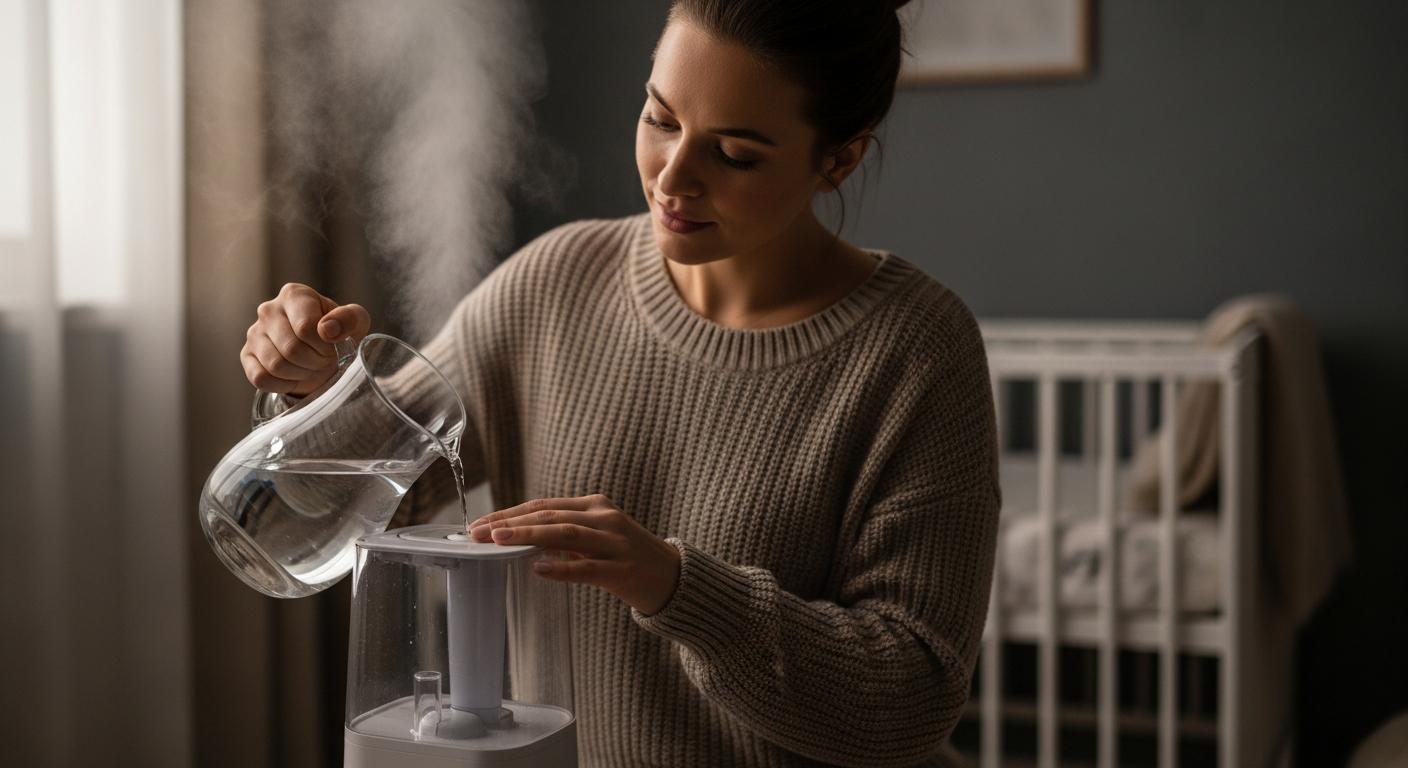
Cool air or humidified air
Evidence is mixed, but some children feel better with cool, fresh air or a clean cool-mist humidifier.
- Avoid hot steam (burn risk).
- Clean humidifiers well to prevent mould and bacteria.
- Follow safe sleep: baby on back, no pillows used for propping.
Medicines: what can help, what to avoid
- Paracetamol can help fever/discomfort.
- Ibuprofen is usually used from 6 months onward.
- Avoid aspirin.
- Cough suppressants are rarely useful for croup in young children.
- Essential oils are not advised for infants.
Medical treatment options
Steroids reduce subglottic swelling and are standard for croup of many severities. A common regimen is single-dose dexamethasone (often 0.6 mg/kg, with a maximum dose depending on protocol), given orally or by injection if needed. Many children show improvement within about 2 hours.
Some settings use nebulised budesonide based on local practice and the child’s situation.
Nebulised epinephrine (for moderate-to-severe cases)
Nebulised epinephrine may be used when there is stridor at rest or significant work of breathing. It acts fast but temporarily (often 2-4 hours), so observation is needed to watch for rebound symptoms.
Hospital care (when required)
Hospital support can include oxygen if saturation is low, monitoring, repeat treatments, and hydration support. Intubation is very uncommon.
Antibiotics
Antibiotics do not treat viral croup. They are reserved for suspected bacterial infection (for example, bacterial tracheitis).
When to seek urgent or emergency care
Go for urgent evaluation if your child has:
- stridor at rest
- increasing retractions or breathing effort
- very fast breathing or visible distress
- signs of tiring out
Go to emergency care now
Get emergency help if you see:
- blue or very pale lips/face (cyanosis)
- breathing pauses, severe exhaustion
- unusual drowsiness or difficulty waking
- inability to drink with dehydration signs
- drooling with difficulty swallowing (especially with fever)
- sudden onset after choking
- lip/tongue swelling with hives (possible anaphylaxis)
Extra caution for higher-risk children
Be extra cautious with:
- infants under 6 months
- premature babies
- children with known airway issues or chronic lung disease
If unsure, seeking assessment earlier is a sensible decision.
Prevention and reducing future episodes
- hand hygiene and surface cleaning
- better ventilation
- keep home and car smoke-free
- reduce irritants (incense smoke, strong sprays)
- avoid overly dry air
If croup keeps recurring – especially outside colds or with ongoing hoarseness – speak to your clinician. Sometimes reflux or airway anatomy plays a role.
Daycare and school considerations
Return is usually reasonable when your child is:
- fever-free for 24 hours without fever reducers
- breathing comfortably at rest (no stridor at rest, no significant retractions)
- drinking well enough
Tell caregivers what symptoms remain, what helped at home (calm, fluids), and what should prompt a call (noisy breathing at rest, poor drinking, fever returning).
Key takeaways
- Croup is usually viral and improves over a few days.
- Barking cough and inspiratory stridor often worsen at night.
- Stridor at rest needs urgent medical assessment.
- Steroids (often dexamethasone) reduce airway swelling, nebulised epinephrine may be used for more severe breathing difficulty with observation.
- Emergency help is needed for cyanosis, exhaustion, unusual drowsiness, drooling with swallowing difficulty, choking-related sudden onset, or inability to drink with dehydration signs.
- Healthcare professionals can guide you, and you can download the Heloa app for personalised tips and free child health questionnaires.

Further reading: