That harsh, seal-like cough in the middle of the night can stop a parent in their tracks. Croup is often the reason: a very common, usually viral swelling of the upper airway that can sound dramatic—especially in babies and toddlers whose airways are naturally narrow. You may be weighing a dozen questions at once: Is the noisy breathing dangerous? Should you try cool air? Does your child need steroids? And at what point is it time to leave the house and get urgent care? Let’s make the signs easier to read and the next steps clearer.
What croup is (and why it sounds so scary)
Croup is most often a viral infection of the upper airway. Clinicians often use the term viral laryngotracheitis (larynx + trachea), because the infection irritates the voice box and windpipe. The key event is inflammation plus edema (swelling with fluid) in the subglottic area—the tight “bottleneck” just below the vocal cords.
Why does that matter? Because airflow through a narrower tube becomes turbulent. Turbulence makes noise.
- The barking cough comes from swollen tissues vibrating.
- The high-pitched, squeaky noise when breathing in is inspiratory stridor.
- The voice often turns rough or whispery because the vocal cords are irritated.
In young children, a few millimeters of swelling can change everything. A child who seemed to have “just a cold” at bedtime can suddenly sound alarming at 2 a.m.


Typical timeline: how long does croup last?
Most croup episodes follow a recognizable arc:
- Cold-like start: runny nose, congestion, mild fever, sore throat.
- Nighttime shift: barking cough, hoarseness, stridor.
- Peak at 24–48 hours, then gradual settling.
Many children improve over 3–7 days. The cough or hoarse voice can linger a little longer while the airway lining calms down.
You might wonder: “Why does it keep flaring at night?” Lying flat, drier air, fatigue, mucus pooling, and crying (which increases turbulent airflow) can all amplify symptoms.
What causes croup?
Most croup is viral. Frequent culprits include:
- Parainfluenza virus (especially types 1 and 2)
- Influenza A/B
- RSV (respiratory syncytial virus)
- Adenovirus
- Rhinovirus
- Human metapneumovirus
- SARS‑CoV‑2 (in some children)
These viruses inflame the upper airway lining, the swelling is what produces the classic sound.
Rare bacterial causes (important because they can worsen fast)
Bacterial infections are uncommon in typical croup, yet they matter because they can progress quickly and require hospital care.
- Bacterial tracheitis: often after a viral illness, sometimes involving Staphylococcus aureus or Haemophilus influenzae.
- Epiglottitis: now rare in vaccinated children, but still an emergency if suspected (drooling, trouble swallowing, high fever, child sitting forward to breathe).
If the picture looks “off” for usual croup, clinicians think first about safety: what must be ruled out urgently?
Irritants and factors that can worsen symptoms
Some children have more reactive upper airways. Triggers that can make croup sound louder or last longer include:
- Tobacco smoke exposure (including third-hand residue on clothes and furniture)
- Strong indoor irritants (fragrances, incense, cleaning solvents)
- Very dry air
- Air pollution/particulates
- An atopic tendency (eczema, allergic rhinitis)
- Gastroesophageal reflux (stomach acid irritating the upper airway, often worse at night)
Who gets croup most often?
Croup peaks between 6 months and 3 years, and is most often seen under 5–6 years. Smaller airway diameter is the main reason younger children are more affected.
Season matters too: many cases cluster in fall and early winter, though viruses circulate all year.
Severe croup is uncommon. Hospitalization is the exception, not the rule, and needing a breathing tube is rarer still—especially when steroids are given early.
How croup spreads at home and in childcare
The viruses that cause croup spread through:
- Respiratory droplets (coughing, sneezing)
- Hands (wiping noses, touching faces)
- Contaminated surfaces (toys, door handles, tables)
Children are often most contagious in the first few days. A practical approach: assume higher contagiousness for about 3 days after symptoms begin, and until fever has resolved.
Helpful habits:
- Handwashing with soap and water for 20 seconds
- Cleaning high-touch surfaces and shared toys
- No sharing cups, utensils, towels, pacifiers
- Better ventilation when feasible
- Following childcare illness policies
Croup symptoms parents can spot
The classic trio of croup is:
- Barking cough (“seal-like”)
- Inspiratory stridor (noisy breathing in)
- Hoarse voice
Other common features:
- Runny nose and congestion
- Mild-to-moderate fever (or no fever)
- Tiredness, irritability
In babies, hoarseness may show up most clearly in the cry—rough, muffled, or strained.
Mild vs moderate vs severe: reading the signs
Clinicians judge croup severity by listening and watching, not by one symptom alone. They consider stridor, retractions, oxygen saturation, hydration, and the child’s overall appearance. Some teams use the Westley score.
The “stridor test”: only when upset vs at rest
This distinction is a big deal:
- Stridor only when crying/coughing often points to milder croup (still worth close observation).
- Stridor at rest (while calm) suggests more significant narrowing and needs urgent medical assessment.
Signs that suggest moderate-to-severe illness
Watch for:
- Retractions (skin pulling in between ribs, under ribs, or at the base of the neck)
- Nasal flaring
- Fast breathing, visible distress
- Reduced drinking, fewer wet diapers
- A child who looks anxious, then later unusually quiet (fatigue)
Severe croup may look paradoxically “quieter” as air movement drops. A very sleepy or unusually still child with breathing difficulty needs immediate evaluation.
Types of croup (including recurrent episodes)
The typical pattern: cold symptoms first, then barking cough and stridor, often with fever. Improvement usually comes over days.
Spasmodic croup
Often sudden nighttime onset, little or no fever, and fewer cold symptoms beforehand. It can look dramatic, then settle quickly once the child is calm.
Recurrent or atypical croup
When episodes repeat or look unusual, clinicians may consider:
- Subglottic narrowing
- Laryngomalacia or tracheomalacia (floppier airway structures)
- Reflux irritation
- Environmental irritants
- Allergy/atopy
Recurring croup is a reason for a thoughtful conversation with a clinician, sometimes an ENT (ear, nose, throat) evaluation is useful.
How doctors diagnose croup
Most croup is a clinical diagnosis: the history plus that characteristic sound.
The priority is ruling out more dangerous causes of upper-airway symptoms, such as:
- Epiglottitis
- Foreign body aspiration
- Deep neck infections
- Bacterial tracheitis
In urgent care or the emergency department, the team may check respiratory rate, retractions, temperature, hydration status, lung sounds, and oxygen saturation (pulse oximeter).
Blood tests, cultures, and X-rays are usually unnecessary for typical croup. If imaging is used because the presentation is unclear, a neck X-ray may show subglottic narrowing (“steeple sign”), though it is not always present.
Conditions that can mimic croup
Some illnesses sound similar at first, yet require different action.
- Epiglottitis: high fever, drooling, trouble swallowing, muffled voice, child leaning forward. Emergency.
- Foreign body aspiration: sudden onset during eating/play, choking episode, persistent cough, sometimes one-sided wheeze. Urgent.
- Bronchiolitis or reactive airways: usually wheeze (often on breathing out), not stridor.
- Anaphylaxis: lip/tongue swelling, hives, rapid breathing difficulty. Emergency.
Home care for mild croup
If symptoms are mild and your child is otherwise well, home care focuses on comfort, hydration, and watching for changes.
Calm first (it really changes the sound)
Crying increases airflow turbulence and can make stridor louder.
- Hold your child upright on your lap.
- Keep the room quiet and lights low.
- Offer reassurance with a steady voice.
- Avoid trying to look at the throat at home, it upsets children and does not help.
Fluids and feeding: what matters most
Aim for small, frequent sips. For babies, shorter, more frequent feeds can be easier.
Reassuring signs:
- Drinking, even if less than usual
- Continuing wet diapers
Seek medical advice sooner if you see:
- Refusal to drink
- Much fewer wet diapers
- Repeated vomiting
- Unusual sleepiness or difficulty waking
Nasal care when congestion is present
Saline drops or spray plus age-appropriate suctioning can improve comfort and make feeding easier—especially before sleep.
Cool air or humidified air: what families can try safely
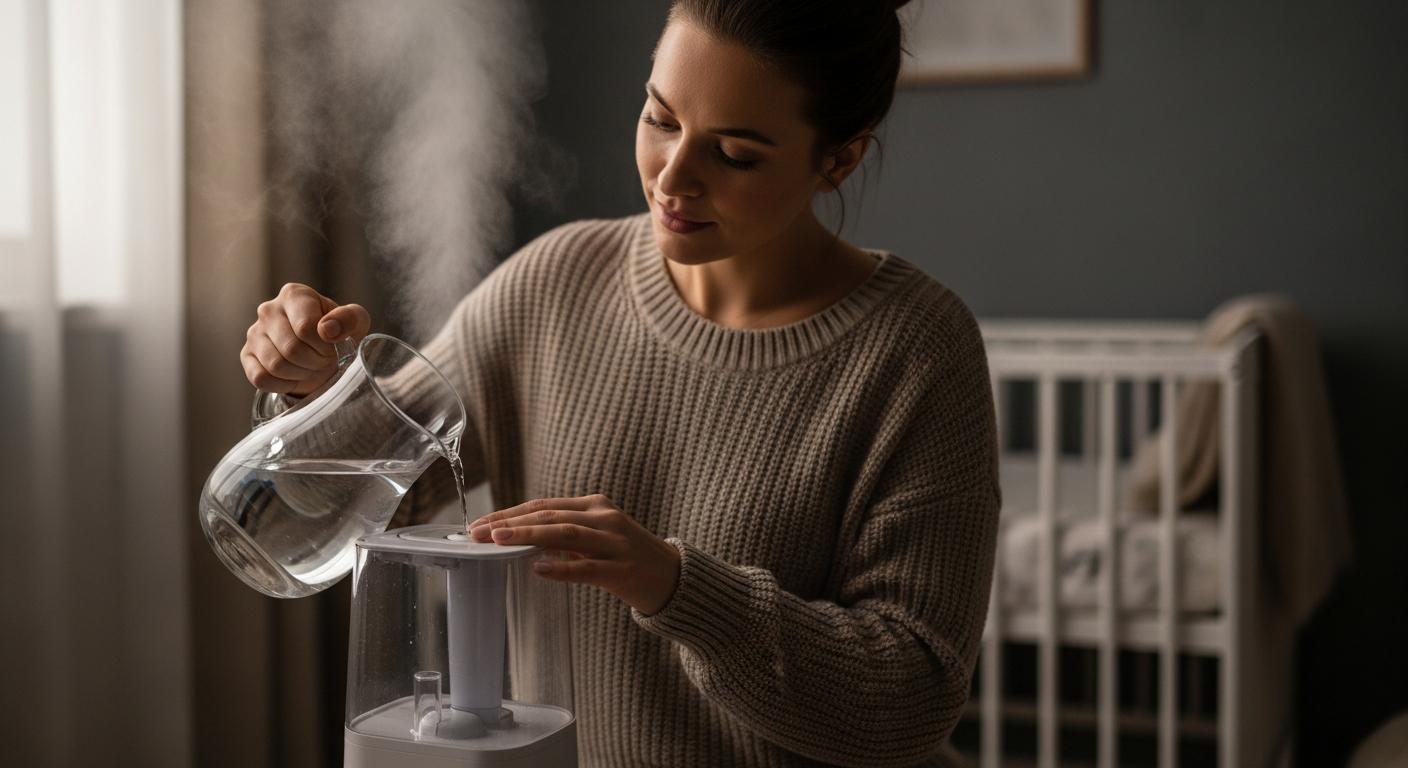
Evidence that humidity changes the course of croup is limited, yet some children seem to breathe more comfortably with cool, fresh air or a clean cool-mist humidifier.
Safety notes:
- Avoid hot steam (burn risk).
- Clean humidifiers to limit mold and bacteria.
- Follow safe sleep practices (back to sleep, no pillows used for propping).
Medicines: what helps and what to skip
- Acetaminophen/paracetamol for fever or discomfort.
- Ibuprofen is generally used from 6 months of age.
- Avoid aspirin.
- Cough suppressants are rarely helpful for croup in young children.
- Essential oils are not advised for infants.
Medical treatment for croup
Steroids reduce airway swelling and are used across severities.
A common option is dexamethasone (often a single dose, frequently 0.6 mg/kg by mouth, sometimes given by injection if needed). Many families notice improvement within about 2 hours.
Some settings use nebulized budesonide depending on the child and local protocols.
Nebulized epinephrine (for more significant breathing difficulty)
For moderate-to-severe croup—especially stridor at rest or marked work of breathing—clinicians may use nebulized epinephrine. It works quickly, yet the effect is temporary (often 2–4 hours), so an observation period is needed.
Hospital care (when needed)
Hospital care may include oxygen if saturation is low, monitoring, repeat treatments, and hydration support. Intubation is rare and reserved for life-threatening obstruction not responding to treatment.
Antibiotics
Antibiotics do not treat viral croup. They are used only if a bacterial infection is suspected (for example, bacterial tracheitis).
When to seek urgent or emergency care
Arrange urgent medical evaluation if your child has:
- Stridor at rest
- Increasing retractions or breathing effort
- Very fast breathing or visible distress
- Signs of fatigue (becoming unusually quiet, floppy, or hard to engage)
Go to emergency care now
Get emergency help if you notice:
- Pale or blue lips/face (cyanosis)
- Breathing pauses or severe exhaustion
- Unusual drowsiness, difficulty waking, or extreme agitation
- Inability to drink with signs of dehydration
- Drooling with trouble swallowing (especially with fever)
- Sudden onset after choking
- Lip/tongue swelling with hives (possible anaphylaxis)
Extra caution for higher-risk children
Be more cautious with:
- Infants under 6 months
- Premature babies
- Children with known airway anomalies or chronic lung disease
If you are unsure, seeking assessment earlier is a reasonable choice.
Complications and outlook
Complications are uncommon, yet possible: bacterial tracheitis, pneumonia, rarely pulmonary edema, and dehydration when drinking drops.
Most children recover from croup within 3–7 days. After steroids, many parents notice less stridor and easier breathing within a couple of hours.
Prevention and reducing future episodes
- Handwashing, surface cleaning, ventilation
- Smoke-free home and car
- Fewer strong indoor fragrances and irritants
- Reasonable humidity (not overly dry)
If croup keeps recurring, if stridor appears outside viral colds, or if hoarseness persists, discuss it with your clinician, reflux or airway anatomy can sometimes contribute.
Daycare and school: when return is reasonable
Return is usually reasonable when your child is:
- Fever-free for 24 hours without fever reducers
- Breathing comfortably at rest (no significant stridor or retractions)
- Drinking well enough to stay hydrated
Tell caregivers what remains (lingering cough), what helped (calm, fluids), and what should prompt a call (noisy breathing at rest, poor drinking, fever returning).
Key takeaways
- Croup is usually viral and tends to improve over a few days.
- Barking cough, hoarseness, and inspiratory stridor are typical and often worse at night.
- Stridor at rest needs urgent medical assessment.
- Steroids (often dexamethasone) reduce airway swelling, nebulized epinephrine may be used for more significant breathing difficulty with observation afterward.
- Seek emergency help for cyanosis, exhaustion, unusual drowsiness, drooling with swallowing difficulty, sudden onset after choking, or inability to drink with dehydration signs.
- Calm, frequent small drinks, nasal saline for congestion, and a smoke-free environment can make a meaningful difference.
- Support exists: healthcare professionals can guide you, and you can download the Heloa app for personalized tips and free child health questionnaires.
Questions Parents Ask
Can my child get croup more than once—and does recurrent croup mean something serious?
Yes, some children have repeated episodes, especially between 6 months and 3 years. Often, it’s simply that their upper airway is more sensitive and reacts strongly to common viruses. Recurrent croup can also be linked with irritation triggers (like reflux or smoke exposure) or, more rarely, a narrower-than-average area below the vocal cords. If episodes are frequent, unusually severe, happen outside colds, or your child stays hoarse between illnesses, it can be reassuring to discuss it with a clinician—sometimes an ENT opinion is helpful.
Is croup contagious, and how long should we keep our child home?
Croup itself describes the airway swelling, but the viruses that cause it do spread easily. Many families choose to keep children home while they have fever, feel unwell, or can’t manage normal drinking and rest. Returning is usually reasonable once your child is fever-free for 24 hours (without fever reducers), breathing comfortably at rest, and has enough energy to participate. If there’s ongoing noisy breathing at rest, extra rest at home can be the kinder (and safer) option.
Why does croup seem worse at night?
You’re not imagining it—nighttime flare-ups are common. When children lie down, mucus can pool and the airway may feel more “tight.” Bedrooms can also be cooler and drier, which may irritate an already inflamed voice box. Fatigue and crying can amplify the sound too. Keeping your child calm and upright often makes a noticeable difference.

Further reading: