
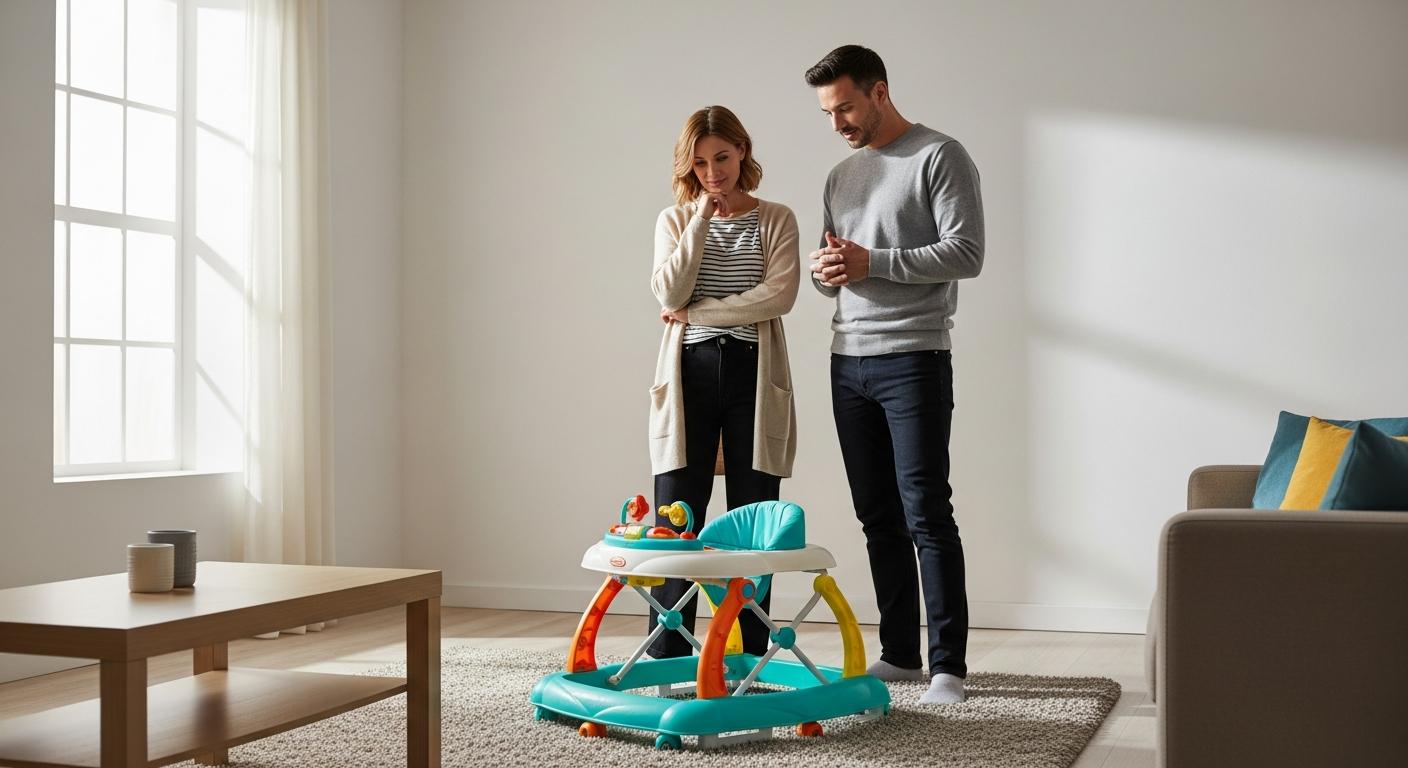
Parents in India often type baby walker what age the minute their baby begins bouncing on the lap, pushing against the floor, and looking around like the whole house is a new adventure. Exciting? Yes. A little worrying? Also yes—because a faster baby can reach stairs, kitchens, and table edges in the blink of an eye.
Here’s the straightforward medical reality: many paediatric safety bodies discourage sit-in wheeled baby walkers at any age due to injury risk. So when families ask baby walker what age, the more useful question becomes: Is my baby’s body ready—and is my home set up for safety? Readiness signs, fit, and strict supervision matter than a number on the calendar.
Baby walker what age: why readiness beats the calendar
You may have seen a neighbour’s baby in a walker at 7 months, while your own baby at 8 months still prefers rolling and tummy time. Totally possible. Babies don’t follow identical timelines, and motor development (how babies learn to move) is influenced by temperament, floor time, muscle tone, and space to practise.
When you search baby walker what age, keep this in mind: a walker changes both biomechanics (how the body moves) and risk exposure (what your baby can access). Wheels add speed. The seat raises reach. That combination is why age is not a reliable safety marker.

Why age alone is not a dependable safety marker
Two babies of the same age can show very different:
- head control and neck stability,
- trunk strength (core strength),
- balance reactions (automatic catch-yourself responses),
- risk-taking behaviour.
A walker can let a baby move faster than their balance skills can handle. Even a baby who looks strong can topple over a threshold or collide with furniture within seconds.
The age window people mention (and why it varies)
Many families hear 6–9 months (sometimes 6–12 months) when discussing baby walker what age because head control is often steadier and sitting may be more reliable by then.
Still, readiness shifts with:
- time spent on the floor (rolling, pivoting, early crawling),
- prematurity (being born early),
- asymmetry (preferring one side, or uneven posture),
- health factors affecting tone and joints.
What a baby walker is—and why parents consider it
A traditional sit-in walker is a wheeled frame with a suspended seat. The baby sits inside and propels forward by pushing off the floor.
For busy households—especially in flats where the kitchen and living area blend together—it may feel convenient: baby stays occupied, parents get a few minutes, and the child looks delighted.
But expectations need to stay realistic. A wheeled walker is not a learning tool for walking. It is, at best, brief entertainment—while floor play remains the real engine for mobility.
How walkers change baby’s access to danger zones at home
In Indian homes, a few everyday items become suddenly reachable:
- hot chai/coffee mugs on centre tables,
- pressure cooker handles near the counter edge,
- dangling charging cables,
- balcony door tracks and small thresholds,
- pooja lamp areas, incense stands, or diya plates,
- staircases in duplex homes.
The seat height increases reach, and the wheels compress reaction time.
Baby walker what age by month: what is typical (not a recommendation)
These ranges describe common development patterns. They are not a suggestion to use a wheeled walker.
4–6 months: usually too early
Most babies are still building neck and trunk control and cannot keep a stable upright posture for long. Many cannot sit without slumping. Early upright device use can also reduce tummy time and rolling—skills that later support crawling and walking.
6–8 months: interest may start, but many babies are not ready
Some babies begin to enjoy standing with support. Yet trunk stability may still be inconsistent. If your baby folds forward, leans sideways, or needs constant prop sitting, a walker is not a good match.
8–10 months: often discussed, but floor skills matter most
This is when many babies crawl, pull to stand, and begin cruising along furniture. The developmental work here is balance, transitions (sit-to-stand), and learning to fall safely. A walker may steal practice time from these floor-based skills, while injury risk remains.
10–12 months: often less useful as walking emerges
Some babies take a few independent steps, others perfect cruising first. A walker often adds little and may encourage toe pushing rather than stable heel-to-toe stepping.
After 12 months: often time to stop
Once independent walking begins, the wheeled walker usually becomes less useful and can become more hazardous as speed and curiosity rise.
Readiness signs that matter more than age
If you still choose a wheeled walker despite cautions, treat readiness as a minimum checklist. This device demands coordinated posture: head, trunk, pelvis, and feet must work together.
Head and neck control: steady upright positioning
Your baby should hold the head steady without bobbing when upright and looking around. If the chin drops towards the chest or the head wobbles, wait.
Independent sitting and trunk strength
Look for sitting unassisted with a tall posture (not rounded), plus the ability to reach for a toy and regain balance. A collapsing posture suggests insufficient core control.
Comfortable weight-bearing
When supported in standing, your baby should accept weight on the legs without buckling at the knees or crying. Pulling to stand and cruising are stronger signs of functional readiness than being placed in a device.
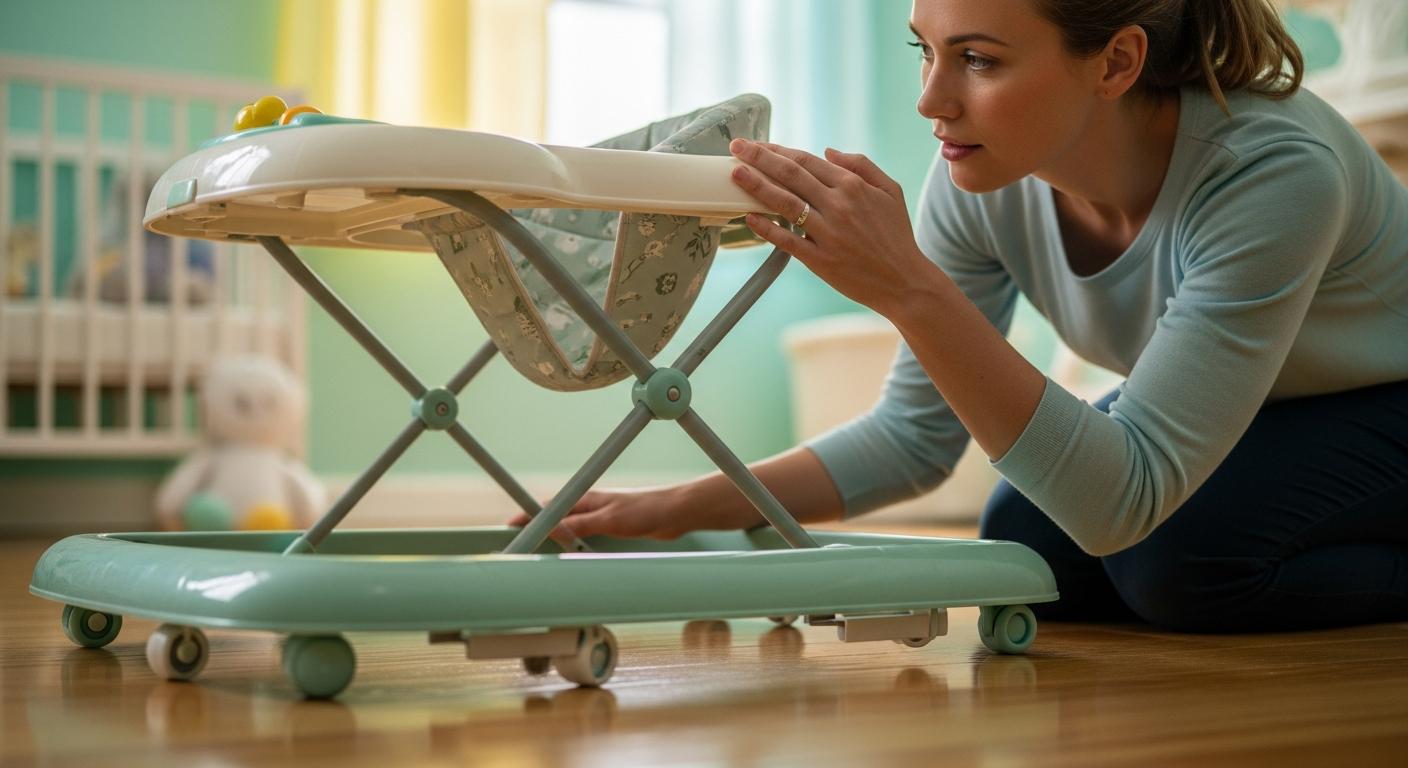
Fit check: height, posture, and full-foot contact
Fit is non-negotiable:
- baby should not hang in the seat,
- feet should touch the floor with full-foot contact (not only toes),
- knees should be slightly bent,
- pelvis should stay aligned (not twisted).
Not yet signals to respect
Pause if your baby:
- slumps or melts into the seat,
- arches stiffly,
- gets upset quickly,
- stays on tiptoes despite correct adjustment.
This is not stubbornness. It is a sign the neuromuscular system is not ready.
When a baby walker may not suit your baby
Some situations deserve extra caution or a clear no.
Premature babies: use corrected age
For babies born early, milestones are judged using corrected age (chronological age minus weeks early). If sitting and trunk stability are still developing for corrected age, skip the walker and prioritise floor play.
Hip dysplasia, low tone, high tone, or neuromotor concerns
With hip dysplasia, joint instability, hypotonia (low muscle tone), hypertonia (increased tone), or worries about motor development, upright devices can add stress to developing joints or reinforce poor alignment. A paediatrician or paediatric physiotherapist can guide safer positioning.
If baby cannot sit (even with support) or lacks head stability
Without stable head and trunk control, a seated mobility device increases slumping and poor alignment. That can mean discomfort and unsafe posture.
Home layouts that are hard to secure
Homes with stairs, split levels, balconies, or sloped surfaces make safety management much harder. If you cannot guarantee a flat, enclosed area with no stair access, skipping the wheeled walker is safer.
Safety reality check: are wheeled baby walkers safe at any age?
Even with careful adults, the main risks come from what the device allows: speed, reach, and sudden access.
Falls, stairs, tip-overs, and collisions
Stair falls are a well-known injury mechanism because walkers roll quickly towards edges. Collisions with furniture, door frames, and walls can happen abruptly, and tip-overs remain possible on thresholds or uneven flooring.
Large injury data sets have described substantial emergency visits linked to baby walkers over decades (for example, more than 230,000 U.S. emergency department visits in children under 15 months between 1990 and 2014).
Reaching hazards: hot surfaces and heavy objects
Walkers can speed up access to kitchens and hot items (stove tops, ovens, hot vessels), table edges, and pull-down hazards like tablecloths or dangling cords.
The just for a second moment
Most mishaps happen during tiny interruptions—doorbell, phone call, a quick turn to the sink. A walker reduces the time you have to react.
Do baby walkers help babies walk sooner?
No. If your main reason for searching baby walker what age is to help your baby walk earlier, the evidence does not support that.
Biomechanically, the baby is partly supported by the seat, pelvic movement is restricted, and many babies practise forward toe pushing rather than stable balance.
What babies actually need to learn to walk
Walking develops through child-led practice:
- tummy time and rolling,
- pivoting and crawling,
- moving into kneeling and standing,
- pulling to stand and cruising,
- practising balance reactions, falls, and recovery.
These steps build coordination, body awareness, and postural adjustments—skills a walker does not train.
Possible downsides: less floor practice and toe-walking patterns
Long or frequent walker use can reduce floor practice. Some babies also develop a habit of pushing on the toes, which may reinforce toe-walking.
Walker types: options that change the safety equation
Not all walking products carry the same risks.
Traditional sit-in wheeled walker (highest risk)
Highest risk because it rolls and increases reach. If used at all, it should be brief, on flat floors, far from hazards, and never near stairs.
Stationary activity centre (no rolling): generally safer
An activity centre offers upright play without rolling into danger zones. Supervision and time limits still matter, but stair-fall risk is reduced.
Push walker (behind-the-baby) and ride-on toys: often a better fit later
A stable push toy with a wide base and speed control supports active standing—when your baby is already pulling to stand and beginning supported steps. Ride-on toys can also support coordination.
If you choose a wheeled baby walker: practical safety rules
These steps can reduce risk, but they cannot remove it.
Duration: think short activity
Keep it brief:
- often 15–20 minutes per session,
- avoid back-to-back sessions,
- limit total daily time.
If your baby slumps, stiffens, gets upset, or speeds around without control, stop.
Set-up basics: height, feet, harness, stability
- Adjust height so your baby is not suspended and can place feet down (aim for full-foot contact).
- Use the harness snugly.
- Confirm the frame is stable and the seat does not twist posture.
- Test brakes/locks if present, every time.
Create a safer space
- Flat, uncluttered floor only.
- Stair gates at the top and bottom of stairs.
- Keep kitchen access blocked.
- Remove cords, small objects, loose rugs, and pull-down hazards.
- Pad sharp edges if you cannot clear the space.
Supervision: within arm’s reach
Supervision means close enough to stop the walker immediately.
Maintenance and second-hand walkers
Check wheels, screws, seat fabric, and harness clips regularly. If buying second-hand, inspect carefully and look for recalls.
When to stop using a baby walker
Stop once independent walking is established
Once your child walks independently for several metres, a wheeled walker becomes low-benefit and remains risky. Your child needs practice: turning, stopping, stepping back, and recovering from imbalance.
Signs your child no longer needs it
- your child stands and moves without seeking the walker seat,
- cruising becomes confident and letting go happens more often,
- your child prefers crawling, walking, or pushing an object.
If toe pushing, stiff posture, frequent collisions, or frustration appear, reduce use sharply or stop.
Safer alternatives that support natural mobility
If your aim is confident movement, simpler options often work better.
0–6 months: tummy time and reach-and-grasp play
Short, frequent tummy time builds neck, shoulder, and core strength. Use a firm mat, place toys slightly out of reach, and vary positions.
6–9 months: floor play and a gated safe zone
Create a protected space where your baby can roll, pivot, sit, and start crawling. Offer brief supported standing at a stable surface, letting your baby take weight gradually.
9–12 months: cruising set-ups and stable push toys
Offer stable furniture for cruising and place toys to encourage side stepping. Add a sturdy push toy with speed control once pulling to stand is consistent.
12+ months: balance play and simple obstacle courses
Low cushion courses, stepping over small barriers, and ride-on toys build balance and coordination in a safer way than a sit-in wheeled walker.
To remember
- baby walker what age is rarely answered by a single month, look for steady head control, strong independent sitting, comfortable weight-bearing, and good alignment.
- Many paediatric safety bodies discourage wheeled walkers because they increase risks: falls (especially near stairs), collisions, and access to hot surfaces.
- Walkers do not reliably make babies walk sooner, walking develops through floor time, transitions, cruising, and balance practice.
- If you still use one: keep sessions short, block hazards, and supervise within arm’s reach.
- Stop once independent walking is established, or earlier if toe pushing and frustration show up.
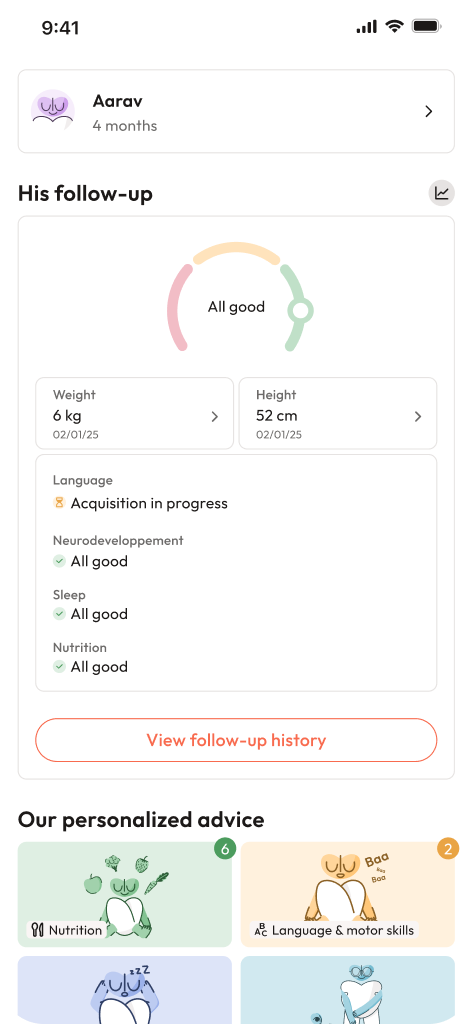
If you have concerns about milestones, prematurity, hip issues, or muscle tone, a paediatrician or paediatric physiotherapist can guide you. You can also download the Heloa app for personalised tips and free child health questionnaires.
Further reading :