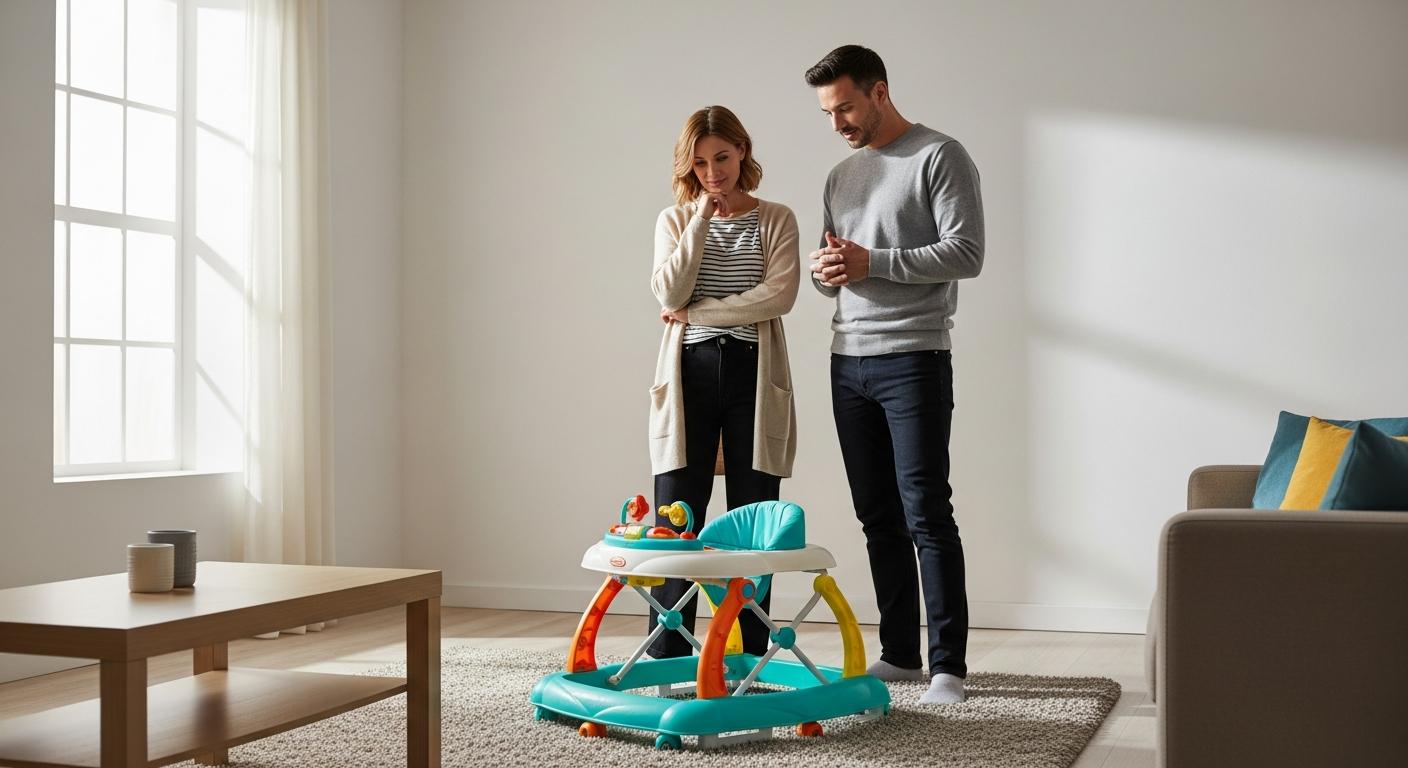
Parents often type baby walker what age the moment their baby starts bouncing, straightening the legs, and scanning the room like there is somewhere important to be. And then the worry follows: stairs, hot drinks, sharp corners, conflicting advice.
Here is the calm, evidence-based bottom line: for many pediatric safety bodies, sit-in wheeled baby walkers are discouraged at any age because the device increases speed, reach, and access to hazards. If you still consider using one, the calendar matters less than developmental readiness, strict home safety, and very short, closely supervised sessions.
Baby walker what age: why the number matters less than readiness
Some babies sit like little statues at 6 months. Others still topple at 8 months. That spread is normal.
Age is a rough proxy for what truly protects your child: head control, trunk stability, and the ability to weight-bear with good alignment. A wheeled walker, by design, changes biomechanics (how the body moves) and changes the environment (what your baby can reach).


Why age alone is not a reliable safety marker
Two babies of the same age can have very different muscle tone, balance reactions (the automatic “catch yourself” responses), and appetite for risk. Add wheels, and your baby can cross a room in seconds. Even a baby who looks strong can:
- tip on a threshold,
- collide with furniture,
- reach a table edge and pull objects down.
The age window people mention (and why it varies)
You will often hear “around 6-9 months” or “6-12 months” when families discuss baby walker what age. That range shows up because many babies can sit more steadily and have better head control then.
But readiness shifts with:
- floor time (rolling, pivoting, crawling),
- body proportions,
- medical history such as prematurity,
- asymmetry (one-sided preference) or torticollis.
What a baby walker is, and why it raises so many questions
A traditional sit-in walker is a wheeled frame with a suspended seat. Your baby sits inside and moves by pushing against the floor.
It can look practical: baby is upright, occupied, and “moving”. But it is not a motor-development shortcut. Think of it as a brief entertainment tool, not a replacement for floor play, transitions, and child-led movement.
How walkers change access to risks at home
Wheels add speed. The seat height adds reach. Together, they can bring your baby to:
- stairs and door thresholds,
- kitchens and oven fronts,
- dangling cords and tablecloths,
- hot drinks and heavy objects,
- cleaning products stored “up high” (suddenly not so high).
Baby walker what age by month: what is typical (not a recommendation)
These ranges describe common development patterns. They are not an endorsement of wheeled walkers.
4-6 months: usually too early
Most babies are still building postural control (the ability to hold the head, trunk, and pelvis aligned against gravity). Many cannot sit without slumping. Upright devices can also steal time from tummy time and rolling, which feed later crawling and walking.
6-8 months: interest may start, but many babies are not ready
Standing interest often appears. Some babies sit well, others still fold sideways when reaching. If your baby collapses forward or to the side when sitting, a walker is a poor match.
8-10 months: often discussed, but floor skills matter most
Crawling, pulling to stand, and cruising (side-stepping along furniture) may be in full swing. This stage is all about balance, transitions (sit-to-stand), and learning to fall safely. A walker can take practice time away from these tasks, while injury risk remains.
10-12 months: often less useful as real walking emerges
Some babies begin taking independent steps, others keep cruising. If walking is emerging, a wheeled walker often adds little and may encourage toe pushing rather than heel-to-toe control.
After 12 months: when it often makes sense to stop
Curiosity rises, speed rises, and the device becomes less useful and more hazardous.
Readiness signs that matter more than age
If you still ask baby walker what age, flip the question: “Is my baby ready for this posture and this speed?” Consider these as minimums.
Head and neck control: steady upright positioning
Your baby should hold the head steady when upright and looking around. If the head bobs or the chin drops toward the chest, wait.
Independent sitting and trunk strength
Look for unassisted sitting with a tall posture (not rounded), and the ability to reach for a toy and regain balance. A collapsing posture suggests insufficient trunk control.
Comfortable weight-bearing
When you hold your baby in standing, the legs should accept weight without buckling, distress, or a rigid “locked” posture. Pulling to stand and cruising usually indicate more functional readiness than being placed in a device.
Fit check: height, posture, and flat-foot contact
Fit is not optional.
- Your baby should not hang in the seat.
- Feet should contact the floor with the whole foot, not only toes.
- Knees should be slightly bent.
- The pelvis should stay aligned, not twisted.
“Not yet” signals to respect
Pause if your baby:
- slumps or melts into the seat,
- arches stiffly,
- becomes upset quickly,
- stays on tiptoes despite correct adjustment.
That is not stubbornness. It is neuromuscular immaturity.
When a baby walker may be a poor fit
Premature babies: use corrected age
For babies born early, milestones are judged by corrected age (chronological age minus weeks early). If sitting and trunk stability are still developing for corrected age, prioritize floor play.
Hip dysplasia, low tone, high tone, or neuromotor concerns
With hip dysplasia, orthopedic issues, hypotonia (low muscle tone), hypertonia (increased tone), or concerns about motor development, upright devices can stress joints or reinforce poor alignment. A pediatrician or pediatric physiotherapist can help choose safer positioning.
If baby cannot sit (even with support) or lacks head stability
Without stable head and trunk control, a seated mobility device increases slumping, friction, and unsafe alignment.
Home layouts that are hard to secure
Split levels, steps, thresholds, and any access to stairs make risk management much harder. If you cannot guarantee a flat, enclosed area with no stair access, skipping the wheeled walker is the safer choice.
Safety reality check: are wheeled baby walkers safe at any age?
Even with good supervision, the device creates risk: fast movement plus higher reach.
Falls, stairs, tip-overs, and collisions
Stair falls are a classic mechanism because the walker rolls quickly toward edges. Collisions happen abruptly. Tip-overs are possible on uneven surfaces.
Injury surveillance data have repeatedly shown large numbers of emergency visits associated with baby walkers (for example, more than 230,000 U.S. emergency department visits in children under 15 months between 1990 and 2014).
Reaching hazards: hot surfaces and heavy objects
A walker can bring a baby to oven doors, pot handles, mugs on tables, and pull-down hazards (tablecloths, cords) within seconds.
The hardest part: the “just for a second” moment
Accidents often occur during tiny interruptions: the doorbell, the bathroom, a quick text. A wheeled walker compresses reaction time.
Do baby walkers help babies walk sooner?
No. If you are asking baby walker what age because you hope it will speed up walking, the evidence does not support that.
Biomechanically, a baby in a walker is partly supported by the seat, the pelvis is less free to rotate, and many babies push forward with the forefoot rather than practicing controlled balance.
What babies actually need to learn to walk
Walking emerges from repeated, child-led practice:
- tummy time, rolling,
- pivoting and crawling,
- moving into kneeling,
- pulling to stand,
- cruising,
- balance reactions, falling, and recovery.
Possible downsides: less floor practice and toe-walking patterns
Frequent or long use can reduce time spent on transitions and crawling. Some babies also rehearse toe pushing in the walker, which may reinforce a toe-walking pattern.
Walker types: options that change the safety conversation
If baby walker what age is really a search for “What can I offer my baby safely?”, product type matters.
Traditional sit-in wheeled walker (highest risk)
This is the highest-risk type because it rolls and increases reach. Many pediatric groups discourage it.
Stationary activity center (no rolling): generally safer
A stationary activity center offers upright play without rolling into danger zones. It still needs supervision and time limits, but it removes the stair-fall mechanism.
Push walker (behind-the-baby) and ride-on toys: often a better fit later
A stable push toy with a wide base and speed control fits better when your baby is already pulling to stand and starting supported steps. Ride-on toys (seated astride and pushing along) can also support coordination later.
If you choose a wheeled baby walker: practical safety rules
These steps reduce risk, but they cannot erase it.
Duration: think “short activity”, not babysitting
Many families use:
- about 15-20 minutes per session,
- no back-to-back sessions,
- limited daily total time.
If your baby slumps, stiffens, gets upset, or speeds around without control, stop.
Set-up basics: height, feet, harness, stability
- Adjust height so your baby is not suspended and can place feet down (aim for whole-foot contact).
- Use the harness snugly.
- Check that the seat does not twist posture.
- Test brakes or locks every time, if present.
Create a truly safer space
- Flat, uncluttered floor only.
- Sturdy stair gates at top and bottom.
- Kitchens closed off.
- Remove cords, small objects, loose rugs, and pull-down hazards.
- Pad sharp furniture edges if you cannot clear the space.
Supervision: within arm’s reach
Constant supervision means close enough to intervene immediately.
Maintenance and second-hand walkers
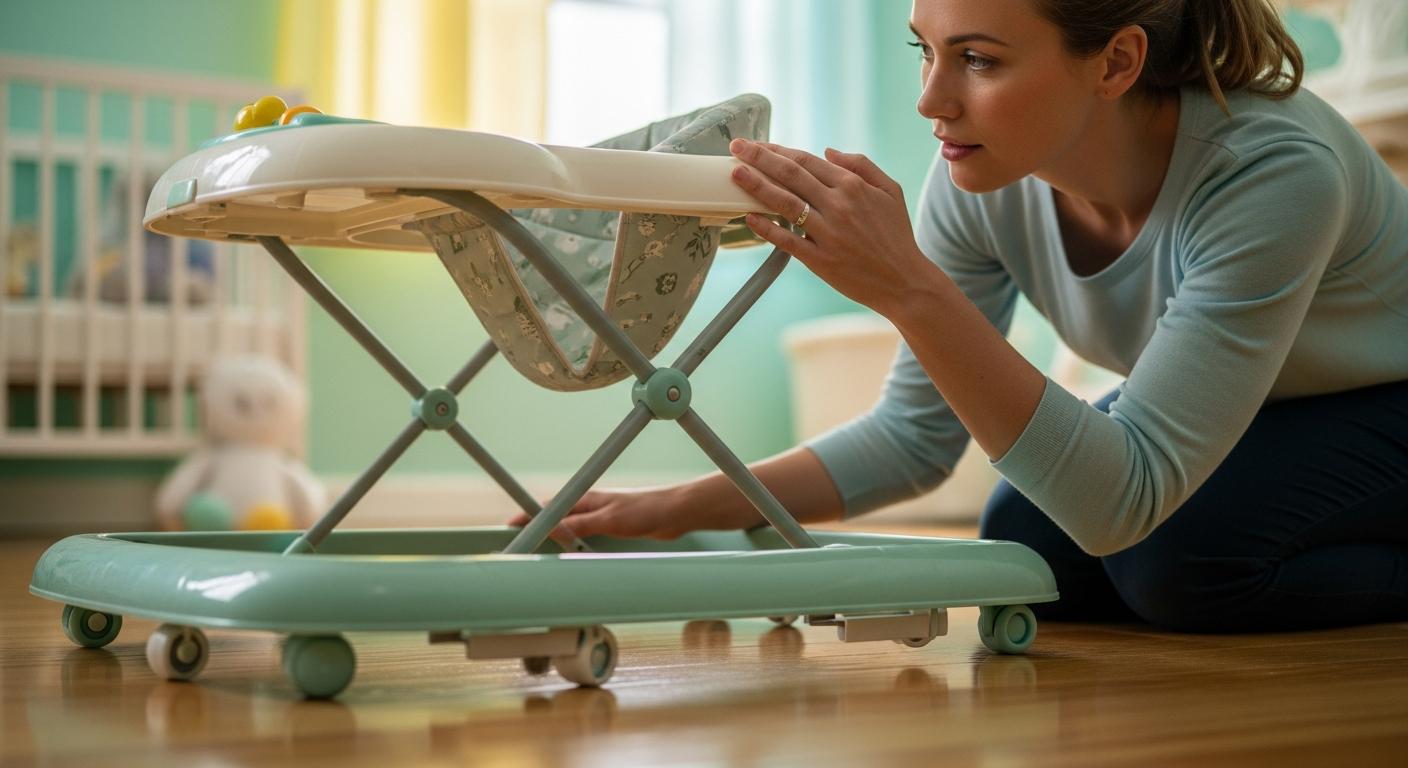
Check wheels, screws, and the seat/harness for wear. With second-hand walkers, also check for recalls in your country.
When to stop using a baby walker
If baby walker what age is now turning into “How long is too long?”, focus on skill and safety.
Stop once independent walking is established
Once your child walks independently for several meters, the walker becomes low-benefit and remains high-risk. Your child needs real practice: turning, stopping, stepping backward, and recovering from imbalance.
Signs your child no longer needs it
- cruising is confident and letting go happens often,
- your child prefers crawling, walking, or pushing an object,
- collisions, frustration, or toe pushing are frequent.
Safer alternatives that support natural mobility
Often, the safest tools are simple and low-tech.
0-6 months: tummy time and reach-and-grasp play
Short, frequent tummy time builds neck, shoulder, and core strength. A firm mat, toys slightly out of reach, and position changes go a long way.
6-9 months: floor play and a gated safe zone
A protected play area supports rolling, sitting, pivoting, and early crawling. Offer brief supported standing at a stable surface, letting your baby load the legs gradually.
9-12 months: cruising set-ups and stable push toys
Arrange stable furniture for cruising and place toys to encourage side-stepping. Add a sturdy push toy with speed control once pulling to stand is solid.
12+ months: balance play and simple obstacle courses
Cushion “courses”, stepping over low barriers, and ride-on toys support balance and coordination with far less risk than a sit-in wheeled walker.
Key takeaways
- baby walker what age is rarely answered by a single month, readiness (head control, independent sitting, weight-bearing, alignment) is the real filter.
- Many pediatric safety bodies discourage wheeled walkers because they raise risks for stair falls, collisions, and access to hot surfaces.
- A walker does not reliably help babies walk sooner, walking grows from floor time, transitions, cruising, and balance reactions.
- If you still use one: keep sessions short, childproof aggressively, and supervise within arm’s reach.
- Stop when independent walking is established or if toe pushing and frustration appear.
- If you want safer, confidence-building options: floor play, child-led movement, stationary activity centers, and stable push toys often fit better.
Parents deserve support when making safety choices. If questions remain about baby walker what age for your child (prematurity, hip concerns, tone issues, uneven milestones), a pediatrician or pediatric physiotherapist can help. You can also download the Heloa app for personalized guidance and free child health questionnaires.
Questions Parents Ask
Can I use a baby walker if my baby is 4–5 months old?
It’s completely normal to wonder, especially when your baby looks eager to “stand.” At 4–5 months, most babies are still building core strength and steady sitting skills. Even if they can push on their legs, their trunk control and balance reactions are usually not mature yet. If you’re looking for upright play, a few minutes of supported standing on your lap or at a stable surface (with you close) often feels more appropriate—and keeps your baby in a more natural position.
Are baby walkers banned anywhere?
Yes—rules vary by country. For example, Canada has banned the sale, import, and advertising of wheeled baby walkers because of injury risk. In other places, they may still be sold, but many pediatric safety organizations strongly discourage their use. If you’re unsure, you can check your local child-safety agency or product-recall website for the most up-to-date recommendations.
What can I use instead if my baby wants to be upright?
You’ve got options, and you’re not “behind” if you skip a wheeled walker. Many parents like:
- a stationary activity center (no rolling) for short play periods,
- a safe gated floor space for crawling and pulling up,
- a sturdy push walker later on, once pulling to stand is consistent.
These choices support confidence while keeping the focus on child-led movement.
Further reading :