Parents often notice it quickly: your newborn stares at your face from feeding distance, but the toy across the room gets no response. Normal? In many cases, yes. baby vision develops in layers: eye structures are still maturing, and the brain is learning to decode what the eyes send.
Some days the gaze is steady. Other days it wanders, especially if your baby is sleepy, hungry, or overstimulated. So what should you expect by month? How do you support healthy development without overdoing it? And which signs mean you should show your baby to a doctor the same day?
Baby vision basics: how babies see and why it matters
What baby vision means compared with adult vision
In the first weeks, baby vision is designed for closeness, not for reading details at a distance. Most newborns see best at about 8-12 inches (20-30 cm), roughly the distance between your arms and your face during feeding.
Compared with adult vision, early baby vision is:


- Less sharp (low visual acuity), so edges and details look blurry.
- More responsive to large shapes and movement than to fine lines.
- Better with bold differences than subtle shades (limited contrast sensitivity).
Vision improves rapidly in the first year and keeps refining through toddler and preschool years. Many children reach 20/20 around 3-5 years, with normal variation.
How the eyes and brain build vision together
Vision is not only eyes. It is eyes + brain teamwork.
During infancy, several systems mature at once:
- The retina and the fovea (the centre for detail) continue developing after birth.
- The optic nerve and visual pathways in the brain get better insulated (myelination) and form new connections.
- The systems controlling eye movements and focusing (accommodation) gain precision.
That is why progress can look uneven. A baby may fixate intensely one day and appear less focused the next.
Why faces and high-contrast patterns help early visual attention
Babies are drawn to faces from birth. Even if the image is blurry, the brain is remarkably good at recognising the eyes-nose-mouth layout.
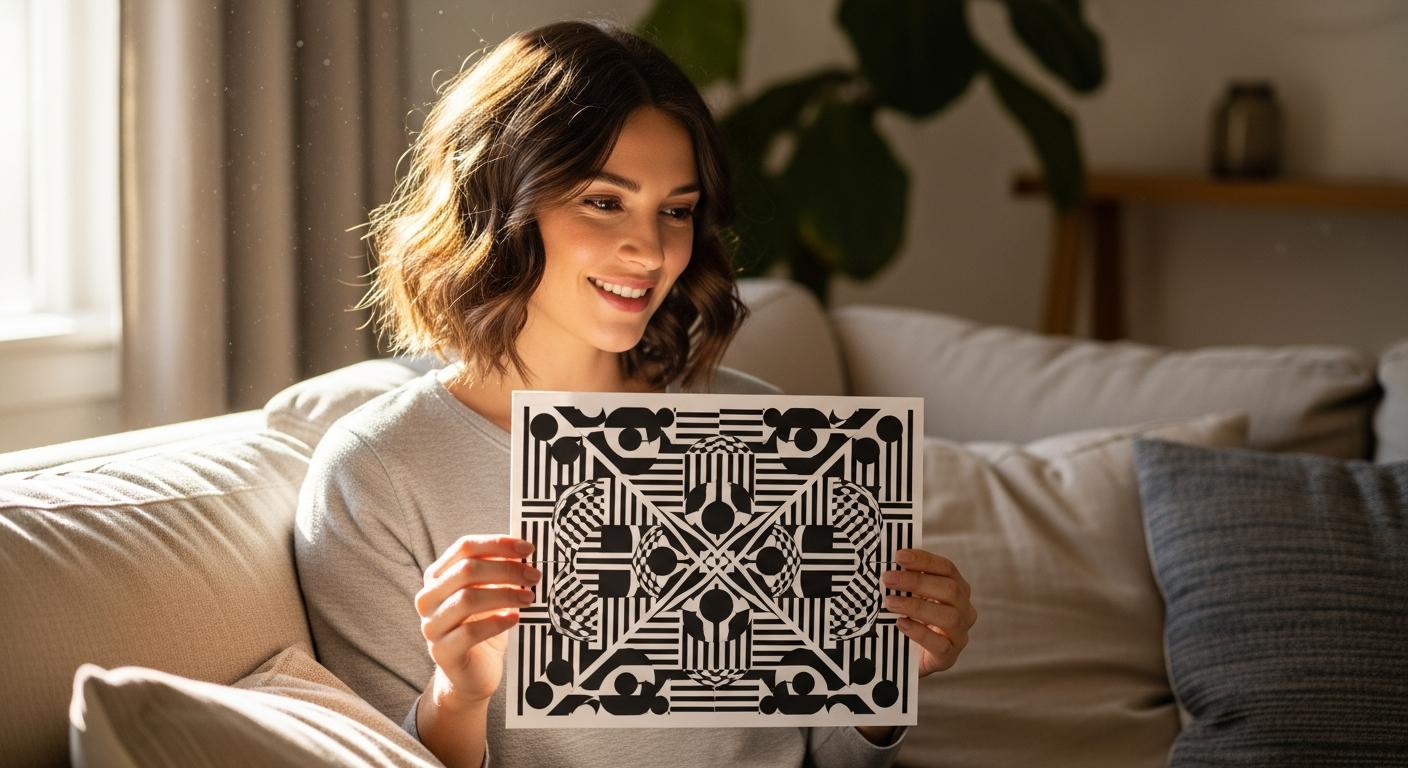
Early baby vision also prefers contrast. Black-and-white patterns, bold outlines, and simple shapes are easiest to see. No fancy gadgets needed: your face, a striped scarf/dupatta, or a simple board book is often enough.
How baby eyes develop before birth
Key prenatal stages: optic cup and early retina development
Eye development begins early in pregnancy. Around weeks 4-5, optic vesicles form as outgrowths from the developing brain. By weeks 5-6, they fold inward to create the optic cup, which later becomes the retina (inner layer) and the retinal pigment epithelium (outer layer). The lens starts forming through close signalling between these tissues.
As pregnancy progresses, retinal cells differentiate and organise into layers, while the optic nerve and early visual pathways develop.
Eyelid fusion and reopening during pregnancy
Eyelids start forming around weeks 7-9, fuse around weeks 8-9, and typically reopen around weeks 26-28.
Light sensitivity in the womb: what babies can (and can’t) perceive
After the eyelids reopen, the fetus can detect changes in light intensity. A bright torch shone on the belly may trigger movement or heart-rate changes.
Still, the womb is dim. Fetal vision is not seeing pictures. There is no sharp focus, meaningful colour discrimination, or recognition of faces before birth: those depend on postnatal brain maturation and real-world visual experience.
Newborn eyesight development from birth to 4 months
What newborns can see at birth: focus range, contrast, and light
At birth, a baby can usually:
- Focus best at 20-30 cm.
- Notice light/dark differences and large shapes.
- Prefer high-contrast patterns and faces.
- Blink or turn away from bright light (basic pupil and blink reflexes).
Many newborns are sensitive to harsh light. If your baby squints or turns away, softer, indirect lighting is more comfortable.
Early tracking: what jerky vs smoother movements can look like
In the early weeks, tracking is brief and imperfect. You may see quick eye jumps called saccades.
Between 2 and 4 months, many babies begin following slow movement more smoothly (early smooth pursuit). You might notice your baby follows your face as you shift side to side.
Early colour vision: when babies start noticing colour
Colour discrimination is limited at first. Around 2 months, many babies respond more to brighter colours, often red and green. Colour vision continues improving through 3-6 months.
Crossed eyes in newborns: what can be typical early on
In the first weeks, occasional crossing or wandering can happen, especially when tired. By about 3-4 months, the eyes should usually align most of the time. Persistent turning (in, out, up, or down) needs assessment, because long-term misalignment can affect visual development.
Baby vision milestones by age (0 to 12 months)
0-1 month: brief fixation, very limited tracking
- Best vision remains up close, distance is blurry.
- Fixation is brief, often on faces at 20-30 cm.
- Tracking exists, but is short and not smooth.
Around 2 months: steadier looking, widening field, early colour interest
- Fixation becomes more stable.
- Visual field expands (often cited around 60 degrees).
- Clearer interest in red/green is common.
Around 3 months: better coordination and smoother pursuit
- The eyes work together more consistently.
- Tracking is more continuous.
- Colour discrimination sharpens.
Around 4 months: binocular vision strengthens and early depth skills appear
- Developing binocular vision (two-eye teamwork).
- Early depth foundations appear.
- Hand-eye coordination ramps up: look, reach, miss, try again.
5-6 months: stronger 3D vision and more precise reaching
- Depth perception becomes more effective.
- Details become more accessible.
- Tracking moving objects is quicker.
7-12 months: vision supports exploration and recognition at a distance
- baby vision becomes an action tool: spotting toys, recognising faces from farther away.
- Mobility increases visual learning.
- By 10-12 months, colour vision for daily life becomes closer to adult-like.
After 12 months: vision continues maturing for years
After the first birthday, visual precision, attention endurance, eye-movement control, and depth efficiency continue to improve. The brain remains highly adaptable for years, one reason early detection matters.
Depth perception and binocular vision
Early depth cues vs mature depth perception
Depth perception starts with one-eye cues: motion, object size, and occlusion (one object blocking another). Babies can use some of these before two-eye teamwork is perfect.
More mature depth perception (stereopsis) depends on both eyes aligning well.
Why alignment matters: convergence, fusion, and amblyopia risk
To see well in 3D, a baby needs:
- Convergence (both eyes pointing to the same target), and
- Binocular fusion (the brain combining the two images).
The 4-6 month period is often important for strengthening this system. If one eye is consistently misaligned, or always blurrier (for example, because of different refractive error between eyes), the brain may suppress input from that eye. This is amblyopia: not lazy, but uneven visual learning.
Colour vision in babies
How colour vision develops over the first year
A practical timeline:
- 0-1 month: contrast matters more than colour.
- Around 2 months: clearer interest in bright colours.
- 3-6 months: the colour palette expands.
- 7-12 months: colour vision becomes closer to adult-like for day-to-day use.
Colour vision depends on cone maturation in the retina and the brain’s processing.
Choosing books and toys that match colour development
- Early months: black-and-white patterns, bold outlines.
- 2-6 months: bright blocks of colour with high contrast.
- 7-12 months: richer scenes, still with clear shapes.
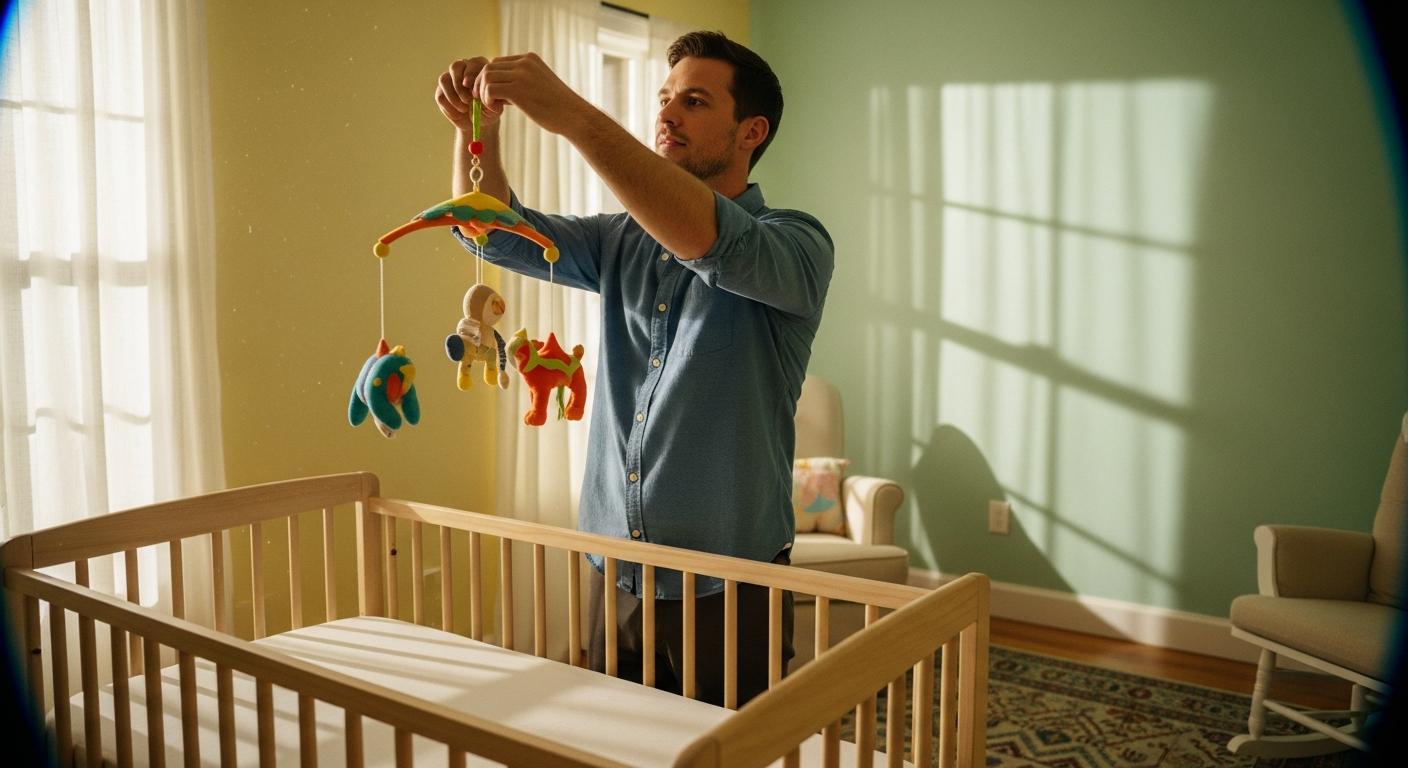
Keep objects within comfortable distance early on, then gradually place interesting toys a bit farther as focusing improves.
What baby vision does in everyday life: bonding, movement, and learning
Recognition and communication: shared looking
Vision supports connection. Babies watch expressions and gradually link faces to emotion. Toward the end of the first year, many babies look at an object and then look back at you, like they are checking you are seeing the same thing.
Coordinating the body: hand-eye skills, balance, and movement planning
Reaching, dropping, turning, pulling to stand: vision helps the brain judge distance and obstacles. As head-eye coordination improves, movement becomes more confident.
Supporting baby vision development (without overstimulation)
A simple rule: stimulate, then pause
If your baby turns away, fusses, yawns, arches the back, or seems done, that is often a request for a break.
0-2 months: face-to-face time and slow movement at close range
- Prioritise face-to-face interaction at 20-30 cm.
- Use high-contrast images briefly.
- Move objects slowly, keep sessions short.
- Do supervised tummy time.
3-5 months: gentle tracking games and early reaching practice
- Move a simple colourful object slowly.
- Offer toys just within reach.
- Switch sides to encourage tracking.
6-12 months: search games, rolling balls, and safe exploration
- Roll a ball slowly.
- Play hide-and-find with a cloth.
- Create a safe floor space for crawling and cruising.
The home environment: light, sleep, and screens
Lighting that supports comfort
Soft, indirect light is easier than glare.
- Use curtains to diffuse harsh sunlight.
- Avoid shining bright lights directly into baby’s face.
Sleep and visual development
Sleep supports brain development, including visual pathways. When babies are overtired, tracking and attention often look worse.
Screen time in the first year
Passive screens offer little compared with real interaction. If screens are used (like a short video call with grandparents), keep it brief and stay close.
Nutrition and eye health in the first year
Key nutrients for eye development
Nutrition supports eye structures and brain pathways that interpret baby vision:
- DHA/ARA for retinal and brain development.
- Vitamin A for retinal function.
- Iron and zinc for growth and neurodevelopment.
- Lutein/zeaxanthin (macular pigments).
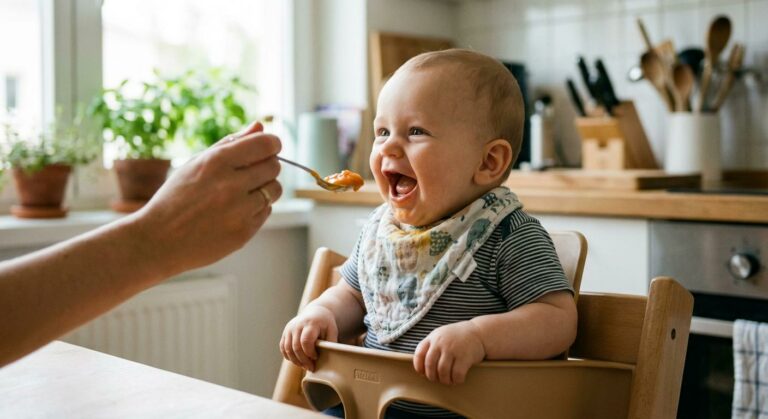
Solids from 6 months: simple, Indian household-friendly ideas
When developmentally ready (often around 6 months):
- Iron-fortified cereal
- Mashed dal or soft khichdi textures (as appropriate)
- Orange vegetables like carrot or sweet potato
- Curd (plain yoghurt)
Avoid honey before 12 months. Keep choking prevention in mind and supervise meals.
Signs of baby vision problems parents can notice
Red flags: urgent vs non-urgent
Same-day evaluation is needed if you notice:
- A white pupil (white reflex) in photos or in person
- Sudden change in tracking, focusing, or eye teamwork
- Severe redness with swelling, fever, marked light sensitivity, or thick yellow-green discharge
- Eye injury or chemical exposure
Non-urgent (but discuss promptly if persistent):
- Not fixing or not tracking by 3-4 months
- Ongoing eye turning after early infancy
- Persistent tearing, recurrent redness, repeated eye rubbing
Eye alignment concerns: pseudostrabismus vs strabismus
Some babies look cross-eyed due to facial features: pseudostrabismus.
True strabismus means the eye actually turns. If it seems persistent, ask for assessment rather than waiting.
Baby eye exams and vision screening
Eye appearance and basic function are checked at birth and during well-baby visits. If needed, an infant eye exam can assess refractive errors, eye movements, alignment, and overall eye health.
Premature babies have higher risk of vision issues and may need screening for retinopathy of prematurity (ROP).
Baby vision safety at home and outdoors
- Keep coins, magnets, and button batteries away.
- Store cleaning products locked, avoid sprays near baby.
- Check toys for loose parts.
- Outdoors: shade first, hat with brim, UV-protective sunglasses if tolerated.
When baby vision becomes 20/20
20/20 is an adult measurement using letter charts. Babies cannot do that yet.
A typical pattern:
- Around 6 months: sharper for daily tasks
- By 12 months: strong improvements in focus and tracking
- 3-5 years: many children reach 20/20
Key takeaways
- baby vision develops step by step as eyes and brain learn to work together.
- In the first months, babies see best at 20-30 cm, tracking, colour and depth skills strengthen quickly.
- Support development with short, calm activities and pauses.
- Seek prompt advice for persistent misalignment, delayed tracking after 3-4 months, or ongoing redness/tearing.
- Health professionals can support you, and you can download the Heloa app for personalised tips and free child health questionnaires.
Further reading: