Those first soft “ooohs”, the tiny gurgles, and then, some morning when you are least prepared, a “ba-ba” that sounds almost purposeful. Naturally, the mind runs ahead: is baby cooing normal, is it a need, a game, or the first spark of language? These sounds (sweet, puzzling, sometimes surprisingly loud) usually point to one big learning task: your baby is coordinating breathing, voice (phonation), mouth movements, and social connection.
Between crying, shrieks, reflux noises, hiccups, baby cooing, and later babbling, it is easy to second-guess yourself. You want to respond well without turning every sound into a test. You also want to know when to relax, and when a doctor or a developmental professional can add clarity.
Baby cooing: what it is and why it matters
Baby cooing definition (early vowel-like sounds such as “oo”, “ah”)
Baby cooing is an early form of preverbal communication. It often sounds like soft, vowel-heavy noises (“oo”, “ah”, “oh”, sometimes “agoo”), produced when a baby is calm, comfortable, and alert. Unlike crying, cooing is usually smooth and sustained, with gentle voicing and more controlled breathing.
Cooing is not “talking” yet, but it is serious practice. Your baby is learning to align airflow from the lungs, vibration of the vocal cords, and shaping by the tongue, lips, and jaw.

Many families use the word cooing for all early baby vocalisations. In the first weeks, some sounds are involuntary (normal breathing variation, reflux, secretions). Quite soon, intention enters: your baby experiments with the larynx and mouth, and discovers a powerful cause-and-effect loop, make a sound, get a response.
Baby cooing and early proto-conversations
Do these sounds already “count” as communication? Often, yes.
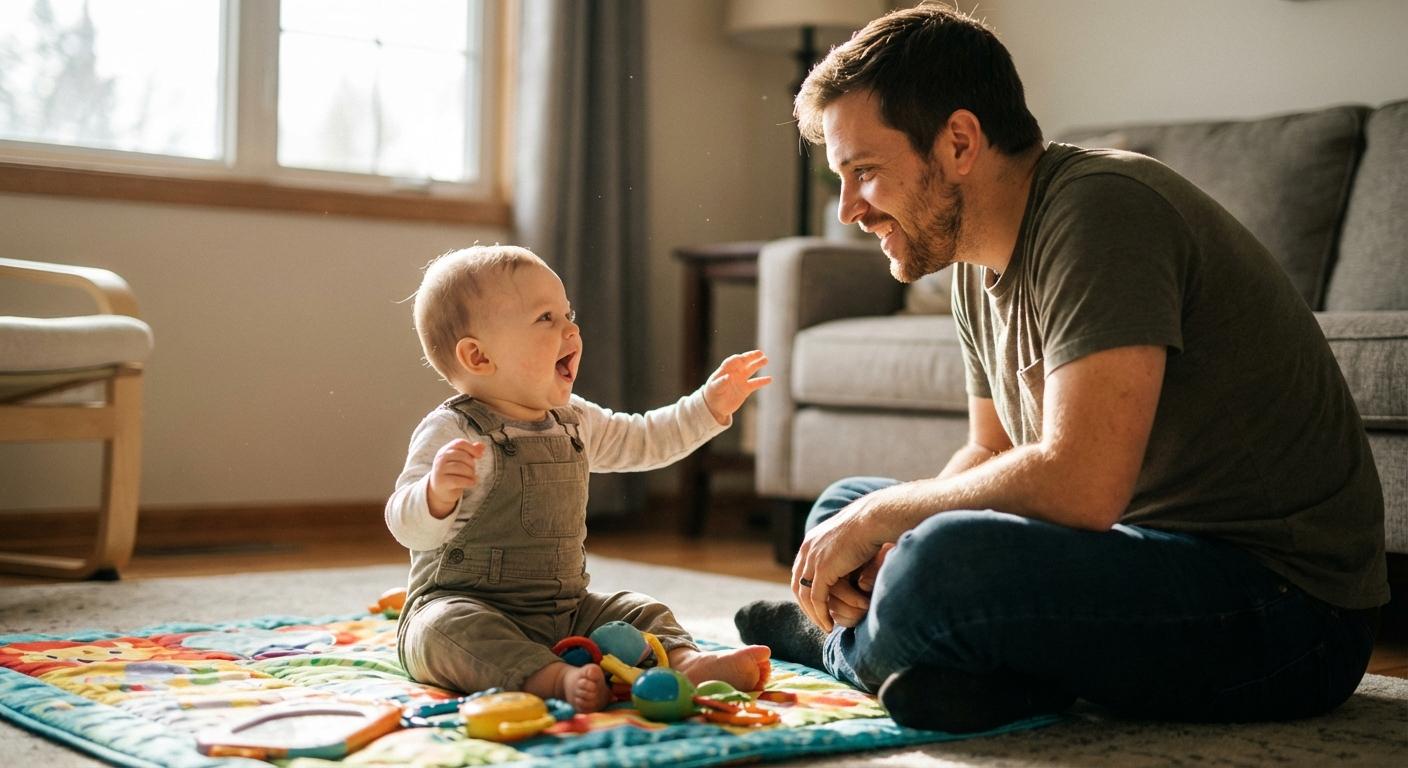
With baby cooing, you may notice turn-taking: your baby vocalises, you respond, you pause, and your baby answers again. No words, still a conversation. This back-and-forth supports attention, emotional security, and early social learning.
Baby cooing vs crying and reflexive newborn noises (grunts, hiccups, sneezes)
In the early weeks, babies make many noises that are not meant for social interaction. In daily life, context matters as much as the sound.
- Crying: longer, rhythmic, repetitive. Often linked to hunger, fatigue, wet diaper, discomfort. Body signs help: rooting/sucking motions, grimacing, increasing agitation.
- Shrieks/yells: higher-pitched, sudden, may reflect excitement, protest, or overstimulation. A pain cry is often abrupt, with a tense body, and can be harder to settle.
- Reflexive (“vegetative”) sounds: grunts, sighs, throat clearing, feeding-related sounds, sneezes, hiccups, and digestive-effort noises.
Baby cooing stands out because it is voiced, more speech-like, and often shows up when your baby is alert and enjoying you, frequently with eye contact or a relaxed smile.
Where baby cooing fits in early communication
A common sequence (with normal variation) looks like:
- Birth to ~2 months: crying, fussing, reflexive sounds.
- ~6 to 8 weeks to ~3 to 4 months: baby cooing and early laughter.
- ~3 to 6 months: sound play, pitch changes, squeals, chuckles.
- ~4 to 6 months onwards: early babbling begins.
- ~6 to 10 months: canonical babbling (clear syllables like “ba-ba”, “da-da”).
Why baby cooing supports early language development
Baby cooing builds the physical foundations of speech: steadier exhalation, better timing between breathing and voicing, and early control of pitch and rhythm.
It also links to prosody, the melody and intonation patterns in speech. Babies usually absorb prosody before they manage consonants. In multilingual Indian homes (Hindi, Marathi, Tamil, Telugu, Bengali, Kannada, Malayalam, Punjabi, English, or more), babies learn multiple sound patterns. That is fine, what matters is steady progress and interaction.
Social bonding through serve-and-return moments
Cooing often happens in warm exchanges. When your baby coos and you respond, then pause so your baby can “reply”, you are practising contingent responding (serve-and-return). This strengthens social engagement and early communication skills.
When baby cooing starts and what timing can look like
Typical age range for baby cooing (about 6 weeks to 3 months)
Many babies begin baby cooing between about 6 weeks and 3 months. Some start earlier, some later. The most useful marker is gradual change over time, plus social engagement (watching your face, relaxing in your arms, reacting to your voice).
Early signs baby cooing is starting
Often baby cooing appears alongside steadier eye contact, a social smile (commonly increasing around 6 to 8 weeks), longer alert windows, and calming or brightening when you speak.
Why some babies start earlier or later
Timing varies for many normal reasons: temperament, opportunities for face-to-face interaction, and comfort and health (nasal congestion, reflux discomfort, sleep disruption, ear pain).
Premature babies and corrected age
If your baby was born early, use corrected age for milestones:
- Corrected age = chronological age minus weeks of prematurity.
Baby cooing milestones from 0 to 12 months (and what comes next)
0 to 3 months: first coos and early social vocalisation
Typical patterns:
- reflexive sounds alongside crying,
- baby cooing and gurgling become noticeable,
- mostly open vowels,
- early exchange: your baby may settle to your voice and sometimes answer with a small sound.
A helpful thing to observe is responsiveness: does your baby’s expression change when you speak? Do they pause, listen, or look towards you?
3 to 6 months: richer cooing, vocal play, squeals and early laughter
Many babies begin to experiment with a wider pitch range, squeals, giggles, clearer vocalisations, and more consistent mini-dialogues.
6 to 9 months: transition towards babbling
This phase often brings consonant-vowel combinations, canonical babbling (“ba-ba”, “da-da”, “ma-ma”) for many babies, more imitation, and better understanding, including responding to their name in context later in the period.
9 to 12 months: complex babble, gestures, first-word readiness
Babbling becomes more varied, voice pairs with gestures (requesting, protesting, sharing interest), and comprehension increases fast. First words may come around 12 months, with wide variation.
12 to 24 months: from vocal play to intentional communication
After one year, many children move into first words, more purposeful communication, and possible vocabulary acceleration around 18 to 24 months.
What baby cooing means in everyday life
Common messages behind baby cooing
Most often, baby cooing signals comfort, pleasure, curiosity, and connection.
Using context clues (engagement vs overstimulation)
Look at the whole baby.
- Happy engagement: relaxed body, steady breathing, eye contact, smiles.
- Need a break: turning away, yawning, rubbing eyes, stiffening, fussing.
If your baby looks away, it is often self-regulation. Reduce stimulation and try later.
Real-life scenarios parents recognise
- Baby cooing and hunger: hunger more often leads to crying, but some babies vocalise while getting impatient. Look for rooting and increasing agitation.
- Baby cooing before sleep: small sounds can be self-soothing.
- Baby cooing for attention: learning cause-and-effect.
- Baby cooing during play: experimenting with breath and mouth movements.
- Baby cooing with overstimulation: louder sounds may precede fussing, lower noise, dim lights, slow the pace.
What baby cooing sounds like
Parents commonly describe “oooh”, “aaah”, “eee”, “agoo”, and gentle gurgles during calm alert time. You may hear longer vowels, a musical tone, pitch slides, and little pauses that feel like waiting for your reply.
When sounds are not just communication: breathing warning signs
Noisy breathing is different from baby cooing. Seek prompt medical advice if sounds come with visible breathing effort (ribs pulling in, nostrils flaring), feeding difficulty or choking, or colour change (pale skin or bluish lips). Wheezing (whistling out) or stridor (harsh sound in) should be discussed quickly.
How to encourage baby cooing in a natural, low-pressure way
Set the stage for connection
Choose calm awake moments, after a feed, during nappy change, after bath, or in a quiet cuddle. Get to eye level. Keep the pace gentle.
Responsive turn-taking
Look and listen, reply briefly, then pause. That pause is powerful.
Imitation and one-step expansion
If your baby says “oo”, echo “oo”, then add a tiny variation, then wait.
Parentese and routines
Use a warm tone, slower pace, and clear pauses. Talk during routines, name what you are doing, repeat simple phrases. In many Indian households where multiple caregivers speak to the baby (parents, grandparents), consistency in warmth matters more than the exact language.
Songs, books, and simple games
Sing rhymes, read short books, and play peekaboo or mirror play for a few minutes.
Reduce background noise
Keep TV and constant phone audio low, so your baby can focus on real voices.
Baby cooing vs babbling
Baby cooing is mainly vowels and melody, often seen in early months. Babbling adds consonant-vowel patterns (“ba”, “da”, “ma”), becomes more rhythmic, and usually strengthens from about 6 months onwards.
Baby cooing concerns: when extra support helps
Consider a paediatric check if:
- there is no clear baby cooing or sustained vowel-like sound by about 4 to 6 months (corrected age if premature),
- low vocalising comes with limited social response (few smiles, rare eye contact),
- there is limited progression towards babbling and communicative gestures by about 9 to 12 months,
- you notice regression (fewer sounds than before, less social connection, loss of gestures).
Baby cooing and hearing: what parents can watch for
Hearing supports vocal learning. Bring it up with your paediatrician if your baby rarely startles to loud sounds, does not seem to notice voices, does not turn towards sound as they get older, or shows limited vocal progress. Middle-ear fluid or recurrent ear infections can temporarily reduce hearing clarity, and persistent nasal congestion can also interfere.
To remember
- Baby cooing is an early, vowel-like sound play that often appears between about 6 weeks and 3 months.
- It supports breath control, voicing, prosody, and early turn-taking.
- Cooing gradually shifts towards babbling over the next months.
- Encourage with calm, responsive interaction: imitate, pause, talk in routines, sing, read, and reduce background noise.
- If you are unsure about progress or hearing, professionals can help.
- You can also download the Heloa app for personalised tips and free child health questionnaires.