Parents often notice it fast: your newborn locks onto your face up close, then seems to ignore the toy held farther away. Normal? Most of the time, yes. baby vision is built in layers—an eye that is still maturing, and a brain that is learning to interpret signals. Some days the gaze is steady, other days it drifts, especially with fatigue or overstimulation. What matters is the trend over weeks, and knowing the signs that deserve a prompt check.
Baby vision basics: what babies actually see
What baby vision looks like compared with adult vision
Early baby vision is made for closeness, not for crisp details across the room. Newborns usually see best at 8–12 inches (20–30 cm), the distance between your baby and your face during feeding.
Compared with adults, early vision is often:
- Low visual acuity (details look blurry).
- More attracted by movement and big shapes.
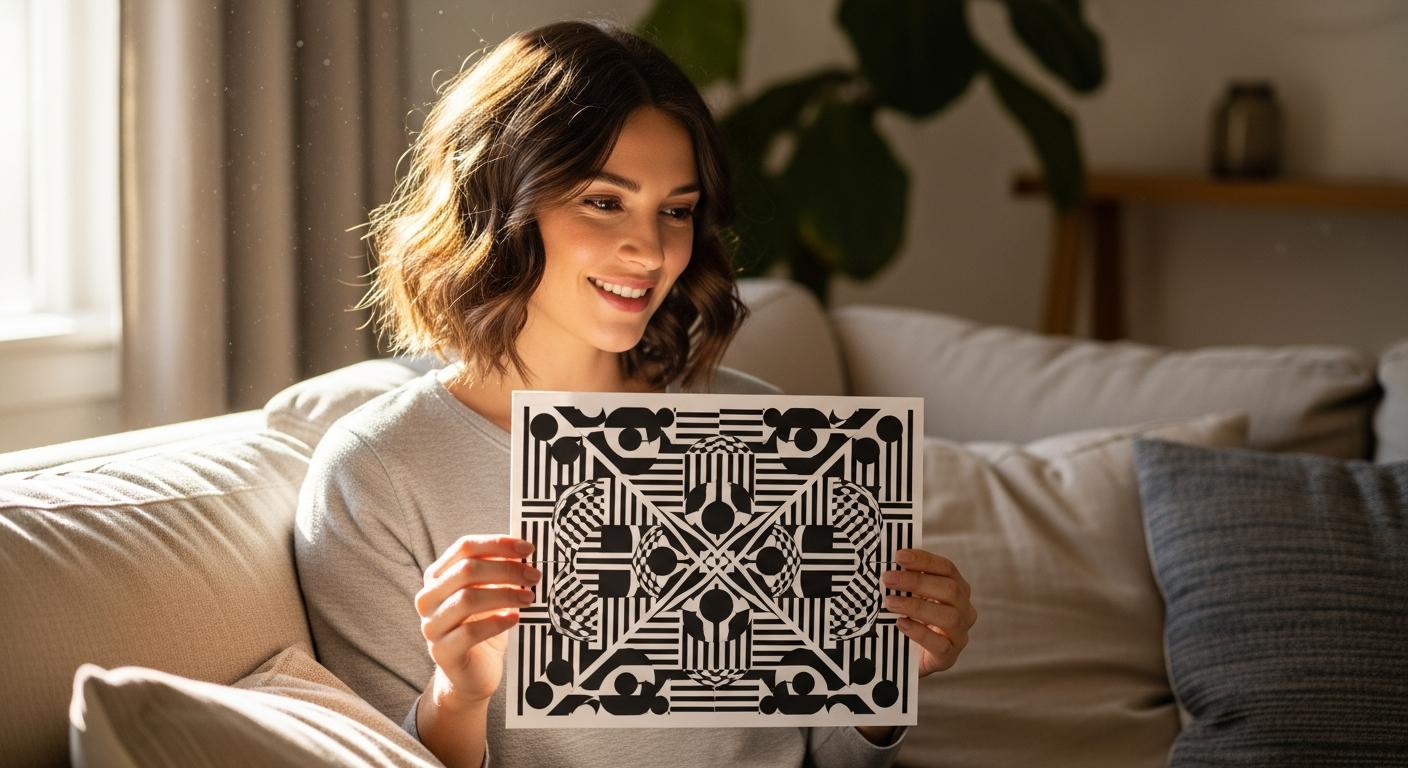
- Limited contrast sensitivity (bold black/white is easier than subtle pastels).
Many children reach 20/20 between 3 and 5 years, with normal variation.


Eyes and brain: the real engine of baby vision
baby vision is not just the eyeballs. It is an eye–brain partnership.
Several systems mature together:
- The retina keeps developing after birth, especially the fovea (the central zone for detail).
- The optic nerve and visual pathways get better insulated in the brain (myelination), improving signal speed.
- Focusing (accommodation) and eye-movement control become more precise.
So progress can look uneven. A baby may stare intensely one day and seem less focused the next.
Why faces and high-contrast patterns grab attention
Even with blurry vision, newborns prefer faces. The brain recognizes a face-like layout quickly.
Early baby vision also loves contrast:
- black-and-white patterns,
- bold outlines,
- simple shapes.
No special products required—your face and a simple board book already do a lot.
How baby eyes develop before birth
Key prenatal stages (optic cup, early retina)
Eye development starts early. Around weeks 4–5, optic vesicles form as outgrowths of the developing brain. By weeks 5–6, they fold into the optic cup, the foundation of the retina and retinal pigment epithelium. The lens forms through tight tissue signaling.
Eyelids: closed, then open
Eyelids typically fuse around weeks 8–9 and reopen around weeks 26–28.
Light sensitivity in the womb
After reopening, the fetus can detect changes in light intensity. Still, this is not seeing pictures: the womb is dim, focus is absent, and meaningful color and object recognition depend on life after birth.
Newborn eyesight: birth to 4 months
What newborns can see at birth
Most newborns can:
- Focus best at 20–30 cm.
- Notice light/dark differences and large shapes.
- Prefer faces and high contrast.
- Blink or turn away from bright light.
Harsh lamps can feel uncomfortable. Softer, indirect lighting is often easier.
Tracking: jerky, then smoother
In the first weeks, tracking is brief and jumpy (quick gaze shifts called saccades). Between about 2 and 4 months, smoother following (early smooth pursuit) becomes more common.
Color vision: when it starts
Color discrimination is limited at first. Around 2 months, many babies show clearer interest in brighter colors (often red/green). Processing continues to mature through 3–6 months.
Crossed eyes: typical early on, then watchful
Occasional drifting or brief crossing can happen in the early weeks, especially when tired. By 3–4 months, the eyes should usually align most of the time. Persistent turning (in, out, up, or down) needs assessment.
Baby vision milestones (0–12 months)
0–1 month
- baby vision works best up close.
- Fixation is brief, often on faces.
- Tracking is short and not smooth.
Around 2 months
- More stable fixation.
- Wider visual field.
- Clearer interest in bright colors.
Around 3–4 months
- Better coordination between both eyes.
- Smoother tracking.
- Early foundations of binocular vision and depth skills.
5–6 months
- Depth perception improves.
- Reaching becomes more accurate.
- Moving objects are tracked more efficiently.
7–12 months
- baby vision supports exploration: spotting a toy across the room, recognizing familiar faces at a distance.
- Mobility (crawling, cruising) multiplies visual learning.
- By 10–12 months, everyday color vision becomes closer to adult-like.
Depth perception and binocular vision
One-eye depth cues vs stereopsis
Babies use early depth clues such as motion, size, and occlusion. True 3D vision (stereopsis) depends on both eyes aligning so the brain can merge two slightly different images.
Alignment matters: convergence, fusion, amblyopia
To build stable 3D vision, babies need:
- Convergence (both eyes pointing at the same target),
- Binocular fusion (the brain combining the two images).
If one eye is consistently misaligned or consistently blurrier, the brain may suppress that eye’s input. This is amblyopia—a problem of visual development, not motivation.
Supporting baby vision (without overstimulation)
A simple rhythm: stimulate, then pause
If your baby turns away, yawns, fusses, arches the back, or seems done, that is often a need for a break.
0–2 months
- Face-to-face time at 20–30 cm.
- High-contrast images briefly.
- Slow movement, short sessions.
- Supervised tummy time to support head control.
3–5 months
- Gentle tracking games with a simple colorful toy.
- Offer a toy just within reach (look, then reach).
- Switch sides to encourage following in both directions.
6–12 months
- Roll a ball slowly.
- Play simple hide-and-find (partly cover a toy).
- Provide safe floor space for crawling and cruising.
Home environment: light, sleep, and screens
Lighting
Soft, indirect light reduces glare and helps comfort.
Sleep
Sleep supports brain maturation, including the visual system. When overtired, tracking and attention often look worse.
Screens
Passive screens offer little compared with real interaction. If screens happen (like short video calls), stay close, talk, and keep it brief.
Nutrition and eye health
Nutrition supports the eye and the brain pathways behind baby vision:
- DHA/ARA for retinal and brain development.
- Vitamin A for retinal function.
- Iron and zinc for growth and neurodevelopment.
- Lutein/zeaxanthin (macular pigments) from egg yolk and colorful vegetables.
From around 6 months (when ready), iron-rich foods help: fortified cereals, meats, lentils/beans, plus orange vegetables for vitamin A.
Signs of baby vision problems
Seek same-day care for
- A white pupil/white reflex in photos or in person.
- Sudden change in tracking or eye coordination.
- Severe redness with swelling, fever, strong light sensitivity, or thick yellow-green discharge.
- Eye injury or chemical exposure.
Discuss promptly if persistent
- No clear fixation or tracking by 3–4 months.
- Frequent eye turning after early infancy.
- Constant tearing, recurrent redness, repeated eye rubbing.
Pseudostrabismus vs strabismus
Some babies look cross-eyed because of facial features (broad nasal bridge or epicanthal folds): pseudostrabismus. True strabismus means the eye really turns. If it seems persistent, ask for an assessment.
Watery eyes and discharge
A blocked tear duct can cause constant watering with crusting and often improves by 6–12 months. Conjunctivitis tends to cause redness with thicker discharge and may need treatment.
Baby eye checks and screening
Routine newborn exams and well visits include eye checks. If there is concern, a more complete infant assessment may evaluate refractive errors (farsightedness, nearsightedness, astigmatism), focusing, alignment, and overall eye health.
Premature babies may need extra screening for retinopathy of prematurity (ROP) and follow-up, milestones may fit corrected age.
Baby vision safety
- Keep coins, magnets, and button batteries out of reach.
- Store cleaning products locked, avoid sprays near baby.
- Choose age-appropriate toys, inspect for loose parts.
- Prioritize shade outdoors, consider UV400 sunglasses if tolerated and age-appropriate.
When baby vision becomes 20/20
20/20 is an adult measurement using letter charts, so it does not apply directly to infants. baby vision keeps sharpening for years: big gains in the first 12 months, then refinement through toddler and preschool years, with many children reaching 20/20 around 3–5 years.
Key takeaways
- baby vision starts blurry and close-range, then sharpens as the retina, focusing, and brain pathways mature.
- Faces and high contrast are easiest early on, tracking and binocular teamwork strengthen rapidly from about 2–6 months.
- Short, calm play with pauses supports visual development, overstimulation often shows up as turning away or fussing.
- Seek prompt advice for persistent misalignment, delayed tracking after 3–4 months, or ongoing redness/tearing/discharge. Seek same-day care for a white pupil in photos, sudden vision change, severe infection signs, or eye injury.
- Professionals can help at any stage, and you can download the Heloa app for personalized tips and free child health questionnaires.
Questions Parents Ask
Can a baby be nearsighted or farsighted?
Yes—many babies are naturally a little farsighted at birth, and it often improves as the eye grows. Nearsightedness (myopia) can happen too, especially with family history. If your baby consistently holds objects very close, seems frustrated when looking at faces, or one eye looks “less engaged,” it’s worth mentioning at a routine check-up. Reassuringly, when a focusing issue is confirmed, simple solutions (like glasses) can support comfortable visual development.
How can I check my baby’s vision at home?
No pressure to “test” perfectly—small everyday observations are enough. You can notice whether your baby:
- looks toward your face or a light source,
- briefly follows a high-contrast object moved slowly side to side,
- reacts to a sudden change (your smile, a new sound + your face together).
If tracking feels inconsistent, it can still be normal with tiredness. What matters most is progress over time. If you feel something is off, you can absolutely ask for an eye-focused check.
When is an eye exam needed beyond routine pediatric visits?
You can ask for a pediatric eye assessment if there’s persistent eye turning after 4 months, strong family history of eye conditions, or ongoing concerns about focusing. And if you ever see a white glow in the pupil in photos, it’s important to seek same-day medical advice—early evaluation really helps.
Further reading: