By Heloa | 28 May 2025

At what age do babies start crawling?

6 minutes
de lecture
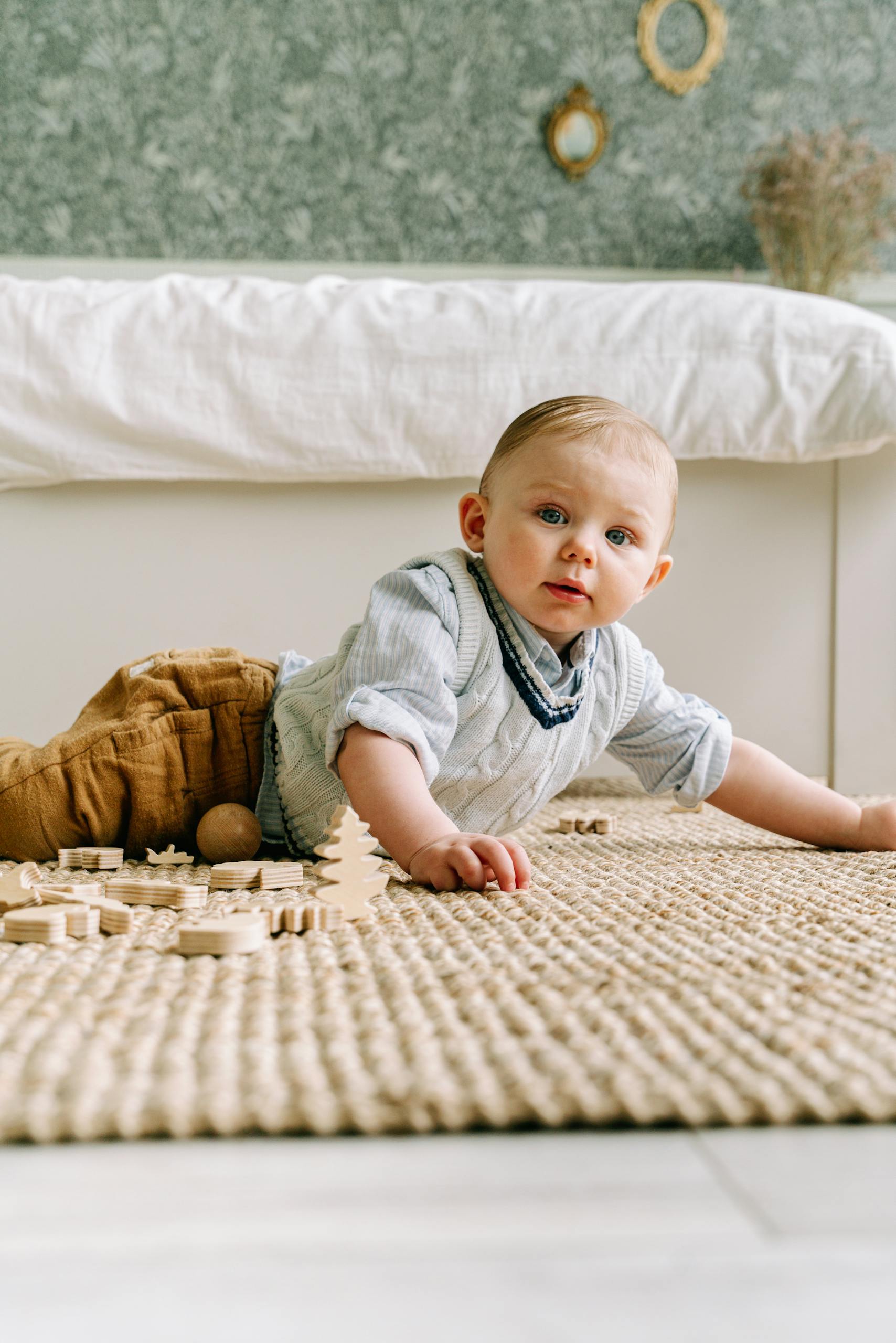
Charmant bébé en train de ramper sur un tapis de sol beige

By Heloa | 28 May 2025

At what age do babies start crawling?

6 minutes
Charmant bébé en train de ramper sur un tapis de sol beige

Par Heloa, le 28 May 2025

At what age do babies start crawling?

6 minutes
de lecture
Charmant bébé en train de ramper sur un tapis de sol beige

Welcoming a baby’s first movements can be a moment of wonder and anxiety all at once—how soon is too soon, and when should the concern start if your little one prefers observation over exploration? If the question “At what age do babies start crawling?” lingers in your thoughts, rest assured, you are in the company of countless parents puzzling over this childhood milestone. Slightly impatient to see those little hands and knees in action, you might scrutinise every wriggle or shuffle, seeking meaning in each twist and turn. Yet, the timeline of crawling is anything but fixed, and an individual journey awaits every child, full of surprises and unique detours. What signals readiness? Does skipping crawling hint at anything? How do the daily environment, early activities, or medical nuances shape this skill? The answers, blending medical insight and practical advice, help to decode the cues and nurture your child’s next leap in mobility.

At what age do babies start crawling: understanding the window

You may find yourself asking, sometimes repeatedly, at what age do babies start crawling? While most will land between 7 and 10 months, developmental rhythm swings both earlier and later—6 months for the especially enthusiastic, and up to 12 months for those on their own path. Medical research reflects this astonishing variety: infants might begin with a rocking motion, move into a commando-style shuffle, or even devise their own method, such as “bear crawl” or “bottom scoot”—each approach satisfying their urge to explore. For some, especially those born premature, adjustments based on expected due date are essential, gently recalibrating the timeline so milestones align with individual growth.

This window is not rigid. Numerous babies bypass crawling altogether, opting instead to sit, swivel and—seemingly overnight—pull up and walk. Such detours are well within the realm of typical development. Pediatricians and physiotherapists emphasise: variation in timing is expected and seldom a red flag unless paired with symptoms concerning for overall motor delay. Does the worry persist? Paediatric check-ups are the best ally—routine assessments can help clarify whether your child’s journey simply follows a less-travelled road.

Milestones: pre-crawling signs and notable styles

The journey to crawling rarely begins on a random afternoon. Instead, a sequence unfolds: the earliest signs are small yet significant. Around 6 to 9 months, you may observe a crescendo of “pre-crawling” moves:

  • Lifting head and chest confidently while on tummy
  • Pushing up on arms, then starting to gather knees underneath
  • Rocking back and forth, as if building momentum for that first launch
  • Skillful rolling—front to back and reverse
  • Reaching or grabbing toys placed tantalizingly out of immediate range

Does your baby spend extra time on the tummy, scanning toys crowding the playmat, or trying to pivot playfully? These, too, are quiet signals of readiness.

When momentum builds, the appearance of crawling may surprise you: not all babies adopt the classic hands-and-knees crawl. Some display the commando crawl, dragging the body forward with strength in their arms, while others invent the crab crawl, sideways and utterly original. The bear crawl (on hands and feet, with legs straightened), bum shuffle, rolling crawl, and occasional backward crawl speak to the creative, flexible nature of human motor development. Each style uses a blend of muscular strength, balance, and coordination—blood, bones, and brains working in a symphony unique for every child. As a parent, celebrating these irregular milestones is just as important as noting the textbook ones.

The physiological canvas: how crawling supports baby’s development

To ask at what age do babies start crawling is also to wonder, perhaps unconsciously, about its significance. Crawling is far more than travel across a playmat. Medical studies demonstrate that this early movement triggers muscular and brain development in tandem. Muscle tone and coordination, especially of the shoulders, hips, core, and back, are built robustly as your child propels themselves forward. Rhythmic alternation between left and right sides of the body facilitates cross-lateral movement—essential for spatial awareness and body balance.

There’s another layer. Spatial awareness, or proprioception, sharpens as a baby navigates around furniture and over small obstacles. Such experiences foster problem-solving, hand-eye coordination, and even the early groundwork for literacy skills—since cross-body movements are linked to future reading and writing ability. As for independence, nothing quite matches that first triumphant reach for a favourite toy, self-initiated and hard-earned.

Factors that influence when crawling starts

Why do some infants launch into movement with wild enthusiasm while others prefer steady observation? The question circles back to your earlier concern: at what age do babies start crawling? The answer lies in a complex braid of influences:

  • Muscular development and tone: Regular tummy time from birth is not just a “parenting tip”—it has direct impact, stimulating shoulder, arm, trunk and leg muscles required for crawling.
  • Motivation and curiosity: Babies who are enticed by colourful, reachable toys or an older sibling tumbling nearby may summon the motivation sooner.
  • Environment and safety: Soft, non-slippery surfaces such as carpets or padded mats support safe exploration. Crowded, cluttered spaces or slippery tiles can hinder even determined crawlers.
  • Clothing: Tight, stiff or restrictive clothing can hamper free movement, while soft, breathable fabrics, especially those that allow feet to grip the floor, make a notable difference.
  • Genetic and individual variation: Family history and individual temperament play important roles—there may be patterns unique to your family.
  • Prematurity or underlying medical conditions: Babies born before term, or those with conditions affecting tone or coordination, may have a different timeline, ideally guided by paediatric advice and regular assessment.

Creating an environment that fosters crawling

Enthusiastic though some babies may be, not all developmental leaps occur unassisted. To encourage and enhance crawling, several strategies have proven beneficial—each backed by observations from early childhood specialists:

  • Prioritise daily tummy time starting at birth, gradually extending the duration as your baby becomes more comfortable.
  • Place toys or interesting objects just out of reach—the gentle frustration leads to determination, a key step in motor milestones.
  • Offer a firm, padded surface, such as a playmat, so the baby can push off and grip safely.
  • Remove hazards diligently—keep the floor free of small objects, cords, sharp-edged furniture, and use baby-proofing solutions to block stairs and any risky zones.
  • Dress for movement: leave feet bare on safe surfaces, or use soft, fitted onesies that do not impede mobility.
  • Offer emotional encouragement—join the play on the floor, mirror crawling behaviour, clap and smile whenever your child attempts movement.

What if, despite every encouragement, mobility doesn’t follow the predicted script? Often, patience is the missing ingredient. Developmental timelines are guides, not laws, and the path from stillness to motion is rarely a straight line.

When is it time to seek advice?

Your paediatrician is the most reliable partner for tracking progress. Yet, there are clear signals that prompt a check-up:

  • By 9–12 months, an absence of any self-initiated movement (no rolling, crawling, pulling to stand) calls for professional evaluation.
  • Noticeable preference for one side of the body or difficulty in weight-bearing should be mentioned during well-baby visits.
  • Lack of response to toys or the environment—a disinterest that persists beyond the usual variations in temperament.
  • Difficulty supporting weight on arms or legs, or floppiness, also merit discussion.

Routine well-child visits are designed to notice these patterns and support you with tailored interventions if needed. Most often, reassurance follows—development is non-linear, and occasional delays resolve naturally with time and opportunity for practice.

What comes after crawling? Next steps in the mobility adventure

Once crawling emerges, the cascade of changes can seem dizzying—standing, cruising, those tentative first steps. Typically, babies:

  • Pull up to stand on sturdy furniture, testing their balance (often between 9 and 12 months)
  • “Cruise” along surfaces, building lateral coordination and experimenting with weight transfer
  • Achieve the courage to briefly stand alone before the big leap—independent steps
  • Many begin walking between 9 and 15 months, with frequent falls and triumphant smiles

Each milestone serves not just the obvious goal—getting from X to Y—but builds cognitive complexity, environmental learning, and a thrilling sense of self-directed exploration.

Key Takeaways

  • The milestone “At what age do babies start crawling” reveals a broad spectrum—most between 7 and 10 months, but vibrant normality reaches from 6 to 12 months and accommodates those who prefer other styles of mobility.
  • Crawling bolsters muscular growth, cross-lateral brain connections, balance and a sense of autonomy.
  • Individual timing is influenced by muscle tone, environment, clothing, and personal drive, with a distinct pace for each baby.
  • Encourage progress with safe, supportive, clutter-free play areas, daily tummy time, and motivating toys.
  • If motor skills are not emerging by 9–12 months, or signs such as one-sided movement or inability to bear weight appear, consult a healthcare provider for guidance.
  • For extra support, tips, and health screening tailored to children, parents can download the application Heloa for personalised guidance and free health questionnaires.

Questions Parents Ask

What can I do if my baby doesn’t seem interested in crawling?

Are you watching your child, hoping for a new attempt at crawling, yet observing only contented sitting or rolling? Rest easy—many babies follow their own timeline. Try creating a comfortable, open space with a soft mat or blanket, adding colourful toys just out of reach to spark that little sense of adventure. Daily tummy time helps build the muscles needed for crawling. Celebrate small attempts, even if progress seems gradual. Should the lack of interest persist alongside minimal engagement with toys or surroundings, discussing your concerns with a health professional is always a good step.

Is it normal for babies to skip crawling and go straight to walking?

Yes, it’s possible for some babies to miss the crawling phase, showing instead a tendency to pull up, stand, and embark on early walking. This variation doesn’t mean there’s a problem. What matters more is visible progress in other ways of moving or exploring. Respect your child’s individual rhythm—sometimes, the path to walking simply takes a shortcut.

Can the environment or clothing affect when my baby starts crawling?

Certainly—surfaces that are firm yet gentle on delicate skin, such as play mats or carpets, make a difference. Spacious, hazard-free areas encourage curiosity. Soft, well-fitted clothing and bare feet (or non-slip socks in cooler conditions) enable babies to push and grip better. Avoid tight or slippery outfits as even these small things can make those first crawling moments easier and safer.

Similar Posts

Curiosity about movement takes hold early. Parents often find themselves asking, with both eagerness and a touch of anxiety: at what age do babies start crawling? Every milestone is scrutinized, every shuffle observed. Will crawling signal a new stage of independence, or should you worry if it seems delayed? The world of motor skill development is a patchwork of timelines, techniques, and temptations. It can feel daunting—staring down the path to crawling, punctuated by both enthusiasm and uncertainty. From muscle coordination to the architecture of the living room, many factors influence when and how babies decide to make their first move. Let’s break down the landscape and offer practical pathways for every parent, whether your baby dashes into crawling or takes the scenic route.

The spectrum of crawling ages: Measuring the unpredictable

At what age do babies start crawling?” The typical answer lands between 7 and 10 months, but reality refuses to conform to averages. You might spot subtle pre-crawling gestures—rocking, shuffling, or peculiar belly slides—as early as 5 or 6 months. Still, some little explorers stretch this timeline farther, waiting until 11 or even 12 months to give crawling a try. Surprisingly, a small group bypasses crawling entirely, scooting or progressing directly to standing and walking.

How should parents interpret these differences? Medical research confirms vast normality within these variations. Developmental milestones—such as crawling—are benchmarks, not rigid deadlines. Especially for babies born preterm, the timeline may shift when compared to full-term peers; pediatricians calculate progress based on adjusted age (due date rather than birth date). The key? Watch for progression and curiosity rather than precise timing.

Decoding crawling: Types and milestones

What does “crawling” actually look like? The term covers a spectrum of approaches:

  • The classic hands-and-knees crawl involves an alternating, rhythmic pattern, resembling a synchronous four-limbed march.
  • The commando crawl (sometimes called an “army crawl”) uses the arms to drag the body forward, belly pressed to the ground—a resourceful tactic for early movement.
  • The crab crawl veers sideways, often with asymmetric leg positions.
  • The bear crawl brings straightened legs and feet into play, a posture both quirky and effective for speedy babies.
  • Others shuffle on their bottoms or roll across the room with singular intent.

Each method builds essential gross motor skills—the fundamental coordination between large muscle groups. This isn’t merely about mobility; it’s a symphony of muscle strength, balance, and cognitive curiosity at work.

Signs your baby is preparing to crawl: Watchful waiting with purpose

Noticing subtle signals before overt crawling becomes apparent sets the stage for early support. Watch for:

  • Lengthy, purposeful tummy time with head and chest up, gazing at everything in their field of vision.
  • Experimentation with bearing weight on arms and working knees beneath the body.
  • Rocking movements, shifting back and forth while in an all-fours position—a classic pre-crawling milestone.
  • Fluid rolling, both ways, indicating growing core stability.
  • Energetic attempts to reach for toys just out of range, paired with increasing focus and concentration.

Medically, these acts reveal rapid maturation of the neuromuscular system—the network that coordinates signal transmission from the brain to the limbs, driving the urge to explore.

The bigger picture: Why crawling matters

Yes, movement is delightful, but the benefits run much deeper. Crawling hones major muscle groups—shoulders, arms, core, and legs all engaged in coordinated harmony. The alternating, cross-lateral pattern (right arm/left leg) cross-wires the corpus callosum in the brain, strengthening communication between the brain’s hemispheres; this lays the groundwork for more complex skills like reading and problem-solving later in life.

Add improved balance, refined spatial awareness, continuous sensorimotor learning, and a growing sense of autonomy. Navigating over or around obstacles sharpens object recognition and depth perception, crucial for future activities like climbing stairs or running.

What factors influence when babies start crawling?

Why such variability in timing? Genetics play a central role—each child’s blueprint for development is singular. Muscle strength and joint flexibility incrementally build from day one, amplified by regular floor play and freedom of movement. Motivation—often sparked by the glitter of an out-of-reach rattle—fuels repeated attempts. The home environment matters, too. Babies fare best on firm but padded surfaces—play mats, carpets—offering friction without impeding progress.

Clothing deserves special mention: loose outfits and bare feet usually outperform slippery socks or ill-fitting pants. Environmental safety also tips the scales. A cluttered or hazardous space represses instinctive movement, while a carefully arranged living area invites exploration.

How to encourage crawling (with patience, not pressure)

Is there a secret formula? Not at all, but encouragement counts. Some strategies:

  • Prioritize daily tummy time—from birth onward—gradually increasing as comfort allows, to fortify upper body strength.

  • Position toys or objects just beyond reach, inviting effort but preventing frustration.

  • Arrange soft, supportive surfaces; remove potential hazards like small choking items.

  • Let your baby encounter gentle, safe obstacles (cushions, soft boxes), nudging creative problem-solving.

  • Celebrate persistence with smiles, soft claps, and positive words; avoid criticism or unnecessary comparison.

    Pause and reflect for a moment: What motivates your child? Are they transfixed by a jingling set of keys or intrigued by a favorite book? Use these cues as starting points for encouragement.

When to reach out for professional advice

Unease is natural, especially if crawling seems delayed. Pediatric guidelines reassure: most healthy infants establish some form of independent movement by 9–12 months. However, specific warning signs warrant closer observation and a professional opinion. These include:

  • Persistent preference for one side of the body, asymmetrical movement, or difficulty with coordination.

  • Apparent disinterest in surroundings, lack of engagement even with enticing toys.

  • Inability to bear weight through arms or legs after the 9-month mark.

    Do frequent check-ins with your child’s pediatrician; assessments during well-baby visits help track developmental patterns and address concerns proactively.

Beyond crawling: What comes next?

The path doesn’t stop at crawling. Mastery of this skill soon gives way to pulling up to stand, then cruising—moving laterally while holding onto furniture—followed by freestanding and, ultimately, those exhilarating first independent steps. The typical window for walking falls between 9 and 15 months. This is a continuum: every milestone builds a stronger foundation for climbing, running, and more adventurous exploration.

Each phase projects new challenges and highlights the marvels of child development. Just as there’s diversity in crawling, so too is there variability in what comes next. What matters: ongoing, responsive support and lots of positive reinforcement.

Key takeaways

  • At what age do babies start crawling? Most begin between 7 and 10 months, but it’s healthy for movement to start as early as 6 months or as late as 12 months. Range is part of what makes each child’s development unique.

  • There are many valid ways to crawl—each style boosts gross motor skills and confidence. Some babies skip crawling entirely; this is typically not a sign of developmental trouble.

  • Crawling encourages not only physical strength and coordination, but also key cognitive wiring and spatial skills.

  • Create spaces that invite safe exploration, prioritize floor time, and motivate with small, reachable challenges to foster independence.

  • Consult a healthcare professional if your baby shows significant asymmetry, cannot support weight on limbs, or lacks interest in interacting with their environment by 9–12 months.

  • Remember: every developmental journey is singular, shaped by genetics, environment, opportunity, and personality.

If you’re ever filled with questions or facing uncertainties, numerous resources are available to guide you—your pediatrician remains a trusted ally. For tailored advice and free health questionnaires, consider downloading the Heloa app, designed to support your family’s well-being every step of the way.

Questions Parents Ask

What can I do if my baby doesn’t seem interested in crawling?

It’s understandable to wonder why your little one isn’t showing signs of crawling yet. Every child develops at their own rhythm, so a lack of interest in crawling isn’t uncommon. You can gently encourage their curiosity by creating safe, spacious play areas with interesting toys or objects just out of reach. Offer plenty of floor time and celebrate any new movement, big or small. If you ever feel uncertain or if your child seems disengaged from their surroundings over time, don’t hesitate to reach out to your health care provider for reassurance and guidance tailored to your situation.

Is it normal for babies to skip crawling and go straight to walking?

Some babies take alternate routes in their development—it’s possible for little ones to bypass crawling and head straight to pulling up, cruising, or walking. This variation is generally no cause for concern and simply reflects the diversity of children’s milestones. What’s most important is that your child shows ongoing progress in other forms of movement and interaction with their environment. Trust your child’s unique journey and remember, different paths can all lead to confident movement.

Can the environment or clothing affect when my baby starts crawling?

Absolutely, a baby’s surroundings and even their choice of outfit can make a difference. Babies are often more motivated to explore when given ample space and a safe, uncluttered surface—think of a firm play mat on the floor. Clothes that fit comfortably and let your baby move freely (such as soft pants and bare feet) can help ensure nothing holds them back. Sometimes, simply adjusting the play area or ensuring your baby isn’t stuck in restrictive clothing can encourage those first attempts at crawling.

Similar Posts