When the lights go out, some children suddenly bargain, cry, or call you back, again and again, until bedtime feels endless. If your child afraid of the dark panics the moment the room dims, it is rarely “just a phase” you can ignore or a habit you can punish away. In low light, the brain loses visual reassurance, the imagination starts projecting, and the stress system can switch on fast (especially with fatigue). Parents usually want two things at once: comfort now, and more independence later. Both are possible.
Child afraid of the dark: what it means clinically
A child afraid of the dark is typically showing a developmental nighttime fear: a surge of anxiety at lights-out, often paired with requests for a night light, repeated calling out, or needing you to “check.” The feeling is intense, even when there is no objective danger.
What it is not: a child trying to manipulate you in a calculated way. At night, the amygdala (the brain’s alarm center) reacts quickly, while the thinking brain (prefrontal cortex) is tired and less efficient. So long explanations rarely land.
Nighttime fear vs real safety issues
Before working on emotions, do a quick safety scan:


- Safe bed and furniture (no unstable bookshelf, cords, or heavy objects above the bed)
- Clear pathway to the bathroom (nighttime falls are common)
- Secure windows and doors if that worry fuels anxiety
If everything is safe, you can confidently frame it: “Your room is safe, and your body is having a fear response.” That distinction matters for a child afraid of the dark.
Fear of the dark vs nyctophobia
Most nighttime fears peak between 2 and 6 years and fluctuate with illness, family changes, or starting school. It looks more like nyctophobia (specific phobia) when fear is persistent for months, extreme at every bedtime, and spills into daytime (fatigue, irritability, avoidance of dark rooms, school impact). If that sounds familiar, a pediatrician or child psychologist can help.
Darkness + sleeping alone: why the combo is so powerful
Bedtime is separation. For some children, separation anxiety amplifies the “danger” signal: no parent in sight plus darkness equals threat. The goal is a gentle bridge: predictable routine, a small dose of parent presence, then gradual distance.
Why a child afraid of the dark feels unsafe at night
The brain hates uncertainty (shadows, noises, missing cues)
In darkness, the brain receives fewer visual cues. A chair becomes “something,” a coat looks like a figure. Small sounds (radiator clicks, wind, pipes) become louder in the mind. Turning on a light works so fast because it restores certainty.
A helpful exercise: sit on your child’s bed and look around. What creates moving shadows? What looks odd from that angle? Fixing one shadow can change the whole night for a child afraid of the dark.
Fatigue turns down coping skills
When children are overtired, they have less emotional regulation available. The stress response (heart rate up, tense muscles, fight or flight) is easier to trigger and harder to calm. Earlier bedtime for a few days can be more effective than any speech.
Imagination fills gaps (monsters are often “feelings with a costume”)
Between 2 and 6 years, imagination grows faster than reality-testing. “Monster” can translate to: tension, overload, a scary image seen earlier, or a need for control.
You do not need to debate monsters. Try: “That’s a scary thought. Thoughts are not facts. Let’s use a tool.”
Common triggers to look for
Night fears often spike after:
- Scary or suspenseful content (even “kid-friendly”)
- Fever or illness, disrupted sleep
- Big transitions (new sibling, moving, travel)
- Late screens (light and stimulation can delay melatonin)
Ask yourself: What changed this week? That question often clarifies why your child afraid of the dark suddenly escalated.
By age: what is typical, what deserves extra attention
- 18 months-2 years: fear is usually separation plus settling difficulty. Predictable steps and a comforting presence help most.
- 3-4 years: imagination-driven fears peak, children benefit from simple coping scripts and playful daytime practice.
- 5-6 years: independence grows, but setbacks happen with stress and vacations.
- After 7-8 years: persistent intense fear becomes less common. Consider support if it lasts months, regularly blocks sleep, or affects daytime functioning.
How to tell fear from “stalling”
You may wonder: “Is my child scared, or just delaying?” Sometimes it is both.
Signs the child afraid of the dark is truly anxious:
- Distress rises sharply at lights-out
- Themes: shadows, noises, unsafe feelings
- Calms with dim light, escalates with darkness
Signs it is mostly limit-testing:
- Stalling is constant all evening
- No consistent fear theme
- Settles quickly once boundaries are clear
Either way, the same recipe usually works: warmth plus short routine plus consistent limits.
What to say to a child afraid of the dark (fast, effective phrases)
Validate without inflating
Try:
- “I see you’re scared. I’m listening.”
- “Your room is safe.”
- “Let’s slow your breathing together.”
Why it helps: validation reduces alarm, it tells the nervous system it has been heard.
Reassure without endless checking
Checking under the bed ten times can accidentally teach: “Maybe danger is real.” If a check helps, make it:
- One time
- Very brief
- The same every night
Then move on: “Check done. Next step is cuddle, then lights dim.” Predictability steadies a child afraid of the dark.
Micro-scripts that build coping
Short and repeatable wins:
- “Scary thought, real body. We breathe, then we rest.”
- “Brave is being scared and staying in bed.”
- “I’ll come back in two minutes to check.”
Avoid shame (“Big kids don’t…”) and avoid long nighttime debates (the tired brain cannot process them well).
Bedtime structure: safety now, autonomy later
A routine that stays small (5-10 minutes)
A simple sequence:
- Toilet/teeth, pajamas
- One calm story
- One cuddle
- One phrase (“You are safe. I am nearby.”)
- Lights dim
If the routine keeps growing, a child may learn that extra requests equal extra parent time. Keep it warm, but contained.
Boundaries that reduce “curtain calls”
Consider three steady rules:
- One drink request before bed
- One bathroom trip after lights-out
- One quick room check, then no more
Then respond with the same calm line. Consistency is soothing for a child afraid of the dark.
Environment: light, sound, and “room readability”
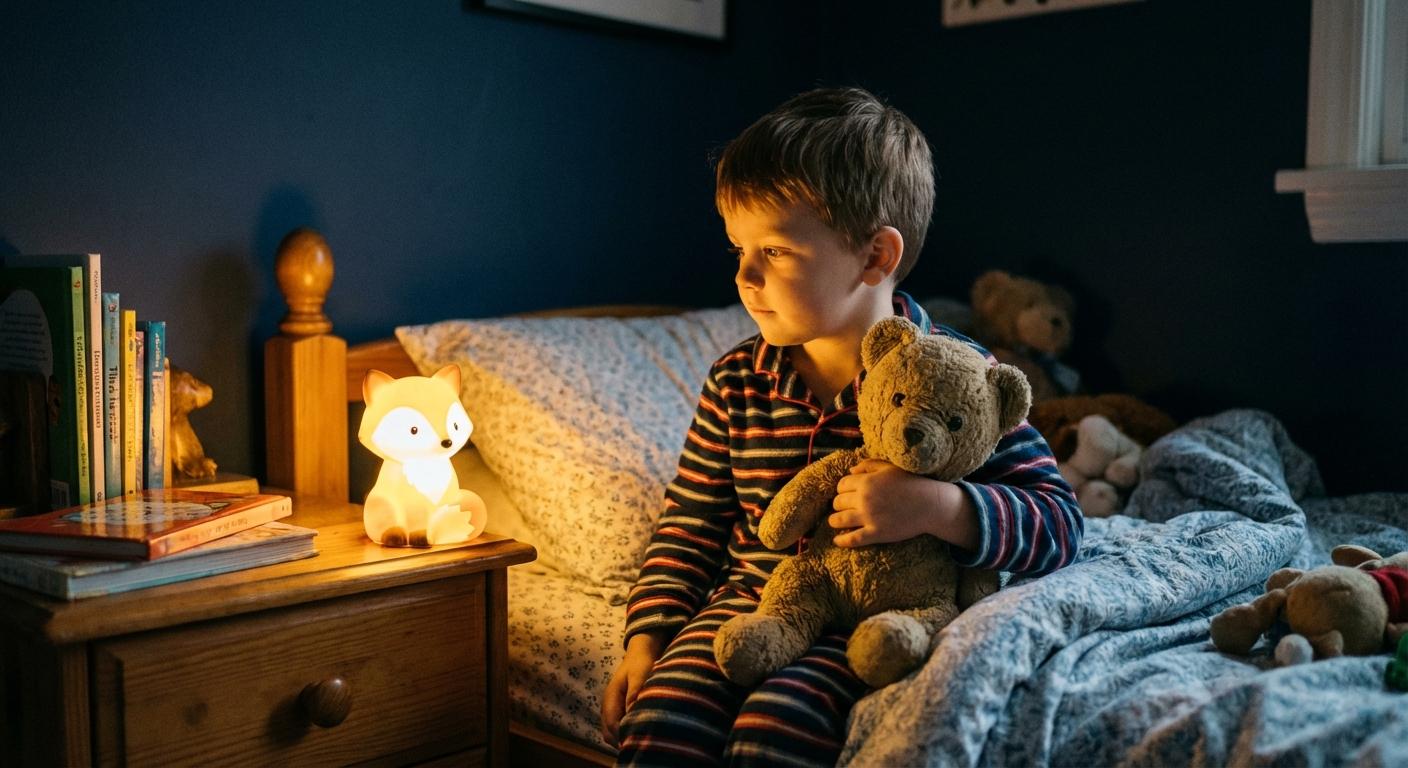
Night light: how to choose one that supports sleep
A night light can be a bridge, not a failure.
Prefer:
- Warm color (amber/red)
- Low intensity (dim)
- No flicker, no projections
- Positioned toward a wall, not the eyes
Bright blue-white light can reduce sleepiness by suppressing melatonin, so “brighter” is not always better.
Make the room easy to read
In daylight:
- Put clothes in a basket (piles become “creatures” at night)
- Close the closet or use a simple cover
- Show where shadows come from (curtain plus car headlights)
A tidy visual field reduces false alarms in a child afraid of the dark.
Name the noises
“That click is the heater.” “That whoosh is the wind.” Naming turns “unknown” into “known.” If sounds are unpredictable, low-volume white noise can mask spikes.
Practical add-ons that often help within a week
Some families do everything “right” and the fear still spikes. Then what? You add tiny supports that calm the nervous system without turning bedtime into an event.
- Transitional object: a soft toy or blanket that stays in bed all night. The goal is not magic, it is a stable cue that signals safety.
- Scent cue (if your child tolerates smells): a drop of a familiar lotion on the pajama sleeve can become an anchor. Avoid essential oils in young children unless your clinician approves.
- Bedtime “worry parking”: earlier in the evening, let your child tell you one worry. Write it on paper and place it in a box until morning. Many children accept this ritual because it acknowledges the worry and also sets a boundary.
A detail parents notice: a child afraid of the dark often does better when the fear is addressed before the bedroom, not after the lights are off.
Strategies you can try tonight
Stay, then fade (support without dependence)
Offer closeness, then reduce it gradually:
- Sit beside the bed for 2 minutes
- Then move to the doorway
- Then to the hallway
Tell your child the plan before you move. Surprises increase anxiety.
Timed check-ins (predictable returns)
Try check-ins at 2 minutes, then 5, then 8. Each check is 10-20 seconds: calm voice, one phrase, leave again. This is gradual exposure paired with security, a strong combination for a child afraid of the dark.
Help your child label the fear
Ask:
- “Is it the dark, a shadow, or a noise?”
- “Where do you feel it in your body: tummy, chest, throat?”
- “What tool helps most: dim light, one check, or breathing?”
Labeling converts a big vague fear into a solvable problem.
Daytime practice: skills are built in daylight
Pick one playful exercise:
- Shadow detective with a flashlight
- Noise hunt (listen, locate, name)
- Practice slow breathing (4 seconds in, 6 out)
Nighttime is for sleep, daytime is for learning.
Nightmares, night terrors, and night waking: key differences
Night waking in tears
If your child afraid of the dark wakes crying, keep the intervention boring: low voice, minimal light, short reassurance, back to bed. A long cuddle in a bright hallway can fully wake the brain and restart the cycle. Of course, if there is pain, fever, vomiting, or breathing difficulty, you shift priorities and assess health first.
Nightmares (REM sleep)
Often in the second half of the night. Your child wakes fully, can describe the dream, seeks comfort.
What helps:
- Dim light, low voice
- “That was scary. You’re safe now.”
- Back to bed with brief soothing
- The next day: redraw the story with a safe ending
Night terrors and other parasomnias
Night terrors happen in the first 1-3 hours after sleep onset (deep non-REM sleep). A child may scream, sweat, look terrified, and be hard to wake, memory is usually absent.
What helps:
- Keep them safe (clear space, prevent falls)
- Don’t force waking
- Wait calmly, it passes
- Reduce triggers: overtiredness, irregular schedule
If episodes are frequent, risky (sleepwalking), or you hear loud snoring or pauses in breathing, talk with your pediatrician.
When to seek help
Consider medical or psychological support if your child afraid of the dark:
- Cannot fall asleep most nights for weeks
- Has panic-like symptoms (hyperventilation, trembling)
- Wakes frequently and sleep is fragmented
- Seems tired, anxious, or irritable in the daytime
- Avoids dark spaces beyond bedtime
Therapies such as CBT (cognitive behavioral therapy) use child-friendly exposure and coping skills to reduce fear without forcing.
Key takeaways
- A child afraid of the dark is often experiencing a normal developmental nighttime fear, intensified by uncertainty, imagination, and fatigue.
- Start with safety and predictability: a short routine, calm phrases, and consistent limits.
- A warm, dim night light and a readable room can lower the brain’s alarm.
- Build independence in steps: stay briefly, then fade, use timed check-ins for gentle gradual exposure.
- Seek support if fear persists for months, blocks sleep, or affects daytime life, professionals can help, and you can download the Heloa app for personalized advice and free child health questionnaires.
Questions Parents Ask
Should I let my child sleep with me if they’re afraid of the dark?
It’s understandable to want everyone to get some sleep—no guilt. If co-sleeping helps your family, it can be a short-term bridge rather than a “bad habit.” Many parents choose a middle option: stay in the room briefly, then gradually move farther away over a few nights. If you prefer to avoid co-sleeping, a predictable plan (“I’ll check on you in 2 minutes”) can feel just as safe, without turning bedtime into a long negotiation.
What if my child is afraid of the dark after a scary movie or story?
That reaction is very common, even with “kid-friendly” content. You can acknowledge it simply: “That image stuck in your brain—your body is reacting.” The next day, try a quick “story repair”: invite your child to redraw the scary part and add a protector, a funny twist, or a safe ending. At night, keep it low-key: dim light, one short reassurance, then back to the same routine.
My child is still afraid of the dark at 7–10 years old—should I worry?
Rassurez-vous: it can still happen, especially after stress, changes, or poor sleep. It becomes more important to seek support if the fear lasts for months, regularly blocks sleep, or spills into daytime (avoidance, exhaustion, school impact). A pediatrician or child therapist can offer gentle, effective tools like gradual exposure and coping skills—without forcing or shaming.

Further reading :