Watching a child face an obstacle course can stir up two feelings at once: excitement and a quick flash of worry when little feet head toward something higher than expected. Should you help? Step back? And what about safety—falls, tired legs, muddy water, grip that suddenly gives up? A good obstacle course is playful, yes, but it also trains balance, coordination, and decision-making in a way that transfers to daily life.
What an obstacle course is (indoor vs outdoor)
An obstacle course is a route made of physical challenges in sequence: stepping over/under barriers, crawling, carrying, climbing, balancing, and moving between stations. Under the fun, your child is practicing motor planning (how the brain organizes movement) and proprioception (knowing where the body is in space).
Indoor setups (gyms, parks) offer predictable floors, stable temperature, and easier supervision—often ideal for beginners. Outdoor setups add natural terrain (grass, dirt, slopes, water, mud): excellent variety, but weather changes traction and increases slip risk.
Obstacle course vs Ninja Warrior, parkour, mud run, adventure race
These cousins can look similar.


- Ninja-style emphasizes overhead work (rings, bars) and demands grip and shoulder stability.
- Parkour focuses on efficient movement and landing mechanics rather than “stations”.
- Mud runs feature slippery terrain, obstacles may be simple.
- Adventure races are longer and may include navigation, cycling, or paddling.
A family obstacle course can borrow ideas, then scale height, load, and speed.
Obstacle course racing (OCR): what it means for families
OCR is running between obstacles and attempting them in order. Competitive waves are timed, family waves usually aim for participation.
Rules vary, but commonly:
- You attempt each obstacle.
- If you cannot complete it, there is a penalty loop/time or a simple exercise.
The parent-friendly rule: technique first, speed second, especially above the ground.
Why obstacle courses are great for kids (and parents)
A “brain gym”: balance, body awareness, coordination
Every obstacle triggers a loop: plan → try → feel → adjust. That loop strengthens postural control and coordination.
Benefits often include:
- Better balance during position changes
- Stronger proprioception
- Improved hand–eye and foot–eye coordination
Physical benefits: strength, endurance, mobility
A well-designed obstacle course uses whole-body patterns: squatting, stepping, crawling, pulling, short runs. For kids, it supports gross motor skills and joint control, for parents, it can be a workout that still feels like shared play.
Mental and social benefits
Small challenges with clear goals build confidence and problem-solving. Turn-taking, cheering, and cooperating happen naturally—without lectures.
Obstacle courses by age: how to scale safely
When can a baby start?
A baby can try a very simple obstacle course once they move independently (rolling/crawling) and begin pulling to stand with support—often around 10–12 months, but mobility matters more than age.
Babies (around 10–12 months and up)
Aim for 2–4 steps, close to the floor, 5–15 minutes.
Ideas:
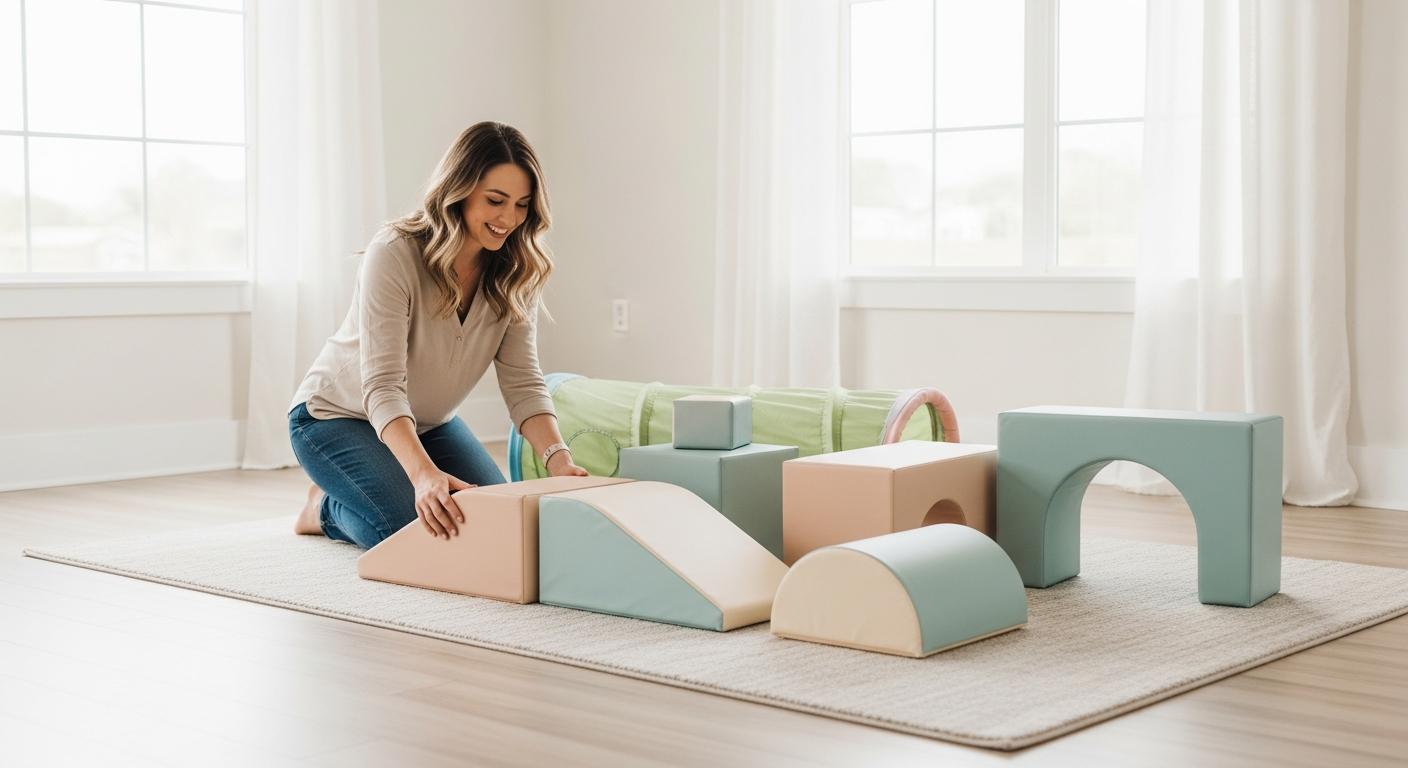
- Crawl under a low table (pad corners)
- Up/down a firm cushion
- Soft pop-up tunnel
- Small foam step
Stay close with hands ready. Avoid pulling a baby “to succeed”, let them figure it out.
Toddlers (1–3 years)
Toddlers love repetition. Keep the route predictable, then change one small thing.
Add gradually:
- Gentle crawl sections
- 2–3 foam steps
- Very low beam with a mat beside it
- Hoops to step into
Preschool and early school age (3–7 years)
Prioritize precision over height.
Try:
- Slalom around cones
- Hoops: one foot per hoop
- Taped line + 3-second “freeze”
- Two-foot jumps over a line
Types of obstacle courses families can choose
Indoor obstacle course parks and ninja gyms
Look for age-separated zones, visible rules, staff supervision, and padding under higher-risk stations. Predictable surfaces reduce fatigue-related falls.
Outdoor OCR formats (sprint, standard, endurance)
- Sprint: shorter, often a good first try with kids.
- Standard: mid-length, better for older children who can pace.
- Endurance: longer, choose only with clear family modifications, rest points, and easy opt-outs.
Backyard or school setups (temporary vs permanent)
Temporary courses (cones, tape, cushions, pool noodles) are easy to adjust when a child gets tired or hesitant. Permanent structures can work well, but require routine checks (wobble, rust, splinters, loose bolts) and safe landing surfaces.
Common obstacles and child-safe cues
Over/under/through and low walls
Teach a sequence: hands secure, feet step, then down first, forward second. Avoid “jumping blind”.
Monkey bars, rigs, rings
Overhead traverses load shoulders and forearms. The common risk is a fatigue-driven fall.
Protective habits:
- Short attempts + frequent rest
- Mats under the entire path
- No slippery socks
Rope climbs and net climbs
Good technique uses legs to clamp and assist. Nets need three points of contact and slow foot placement. Check ropes for fraying and insist on controlled descents.
Crawls and tunnels
Crawling builds shoulder stability and core strength. Choose non-abrasive surfaces and ensure a quick exit if a child feels stuck.
Carries
For kids: light loads, short distances.
Cue: bend hips and knees, keep the load close, avoid twisting.
Balance beams and narrow bridges
Keep them low.
Cue: soft knees, eyes forward, pausing to reset counts as success.
Water and mud
Mud increases slipping and can chill smaller children faster. Check depth/cleanliness, rinse promptly, and plan dry clothes after—especially if eczema or cuts are present.
How to set up a kid-friendly obstacle course anywhere
At home: short and clear
3–5 elements is often enough. Keep routes open, move hard furniture away, and protect corners.
Outdoors: scan first
Look for holes, rocks, wet patches, sharp sticks. Natural terrain is great for motor learning, but it demands more vigilance.
In groups: prevent collisions
Use one-way flow, empty transition zones, and an adult near the trickiest station. Simple cues (“one at a time”) beat long speeches.
Safety: practical, calm, effective
Simple rules
One person at a time on higher obstacles. No pushing. A child can skip an obstacle without pressure.
Warm-up and pacing
Warm up 5–10 minutes (easy jog, arm circles, squats, ankle mobility). Fatigue changes coordination, build rest in early.
Footwear
Barefoot at home can improve grip and sensory feedback, in group settings, grippy shoes may be easier. Avoid slippery socks.
When to simplify immediately
Repeated falls, rushing, disorganized movement, irritability, or clear fatigue: lower the difficulty, shorten the course, or stop.
Red flags that need medical advice
Seek prompt care for chest pain, fainting, severe breathlessness at rest, a swollen joint, limping, or persistent bone pain.
Training for an obstacle course as a parent (and with kids)
Three short sessions per week can fit family life:
- Strength + technique (rows, step-ups, planks)
- Grip + carries (brief hangs, light farmer carries)
- Balance/mobility + a playful mini-course
Keep grip work gentle, stop if finger, wrist, or elbow pain appears.
Key takeaways
- An obstacle course develops balance, proprioception, coordination, strength, and problem-solving—when scaled to your child.
- Indoor settings offer predictability, outdoor settings offer variety but need weather and surface planning.
- Babies can try a simple obstacle course once they move independently, keep it low, short, and enjoyable.
- Safety comes from soft surfaces, clear fall zones, one-at-a-time rules, warm-ups, and the option to skip.
- Professionals can support adaptations for specific needs, and you can download the Heloa app for personalized tips and free child health questionnaires.
Questions Parents Ask
How long should a kids’ obstacle course session be?
It often works best when it stays short and upbeat. For many children, 10–20 minutes is plenty, especially for toddlers and preschoolers. If your child is still smiling and focused, you can extend a little, if you notice more tripping, rushing, or frustration, that’s a good sign to pause. Rassurez-vous: stopping “early” is still a successful session—fatigue is when most minor bumps happen.
Are obstacle courses helpful for kids with ADHD or sensory needs?
They can be a great fit, because moving through clear, repeatable stations gives the body “heavy work” (pushing, crawling, carrying) and helps many kids regulate attention and energy. You can keep it supportive by offering simple choices (two versions of the same obstacle), using predictable order, and adding calm pauses like a 3‑second “freeze” station. If your child becomes overwhelmed, it’s totally normal—shorten the route and reduce noise, speed, or waiting time.
What should my child wear for an obstacle course?
Comfort and grip matter most. Aim for clothes that allow full movement (leggings/shorts, a fitted top) and shoes with good traction for outdoor courses. Indoors, barefoot can work for grip and body awareness if the surface is clean and safe, socks alone can be slippery. If there’s water/mud, quick‑dry layers and a full change afterward can keep everyone comfortable.