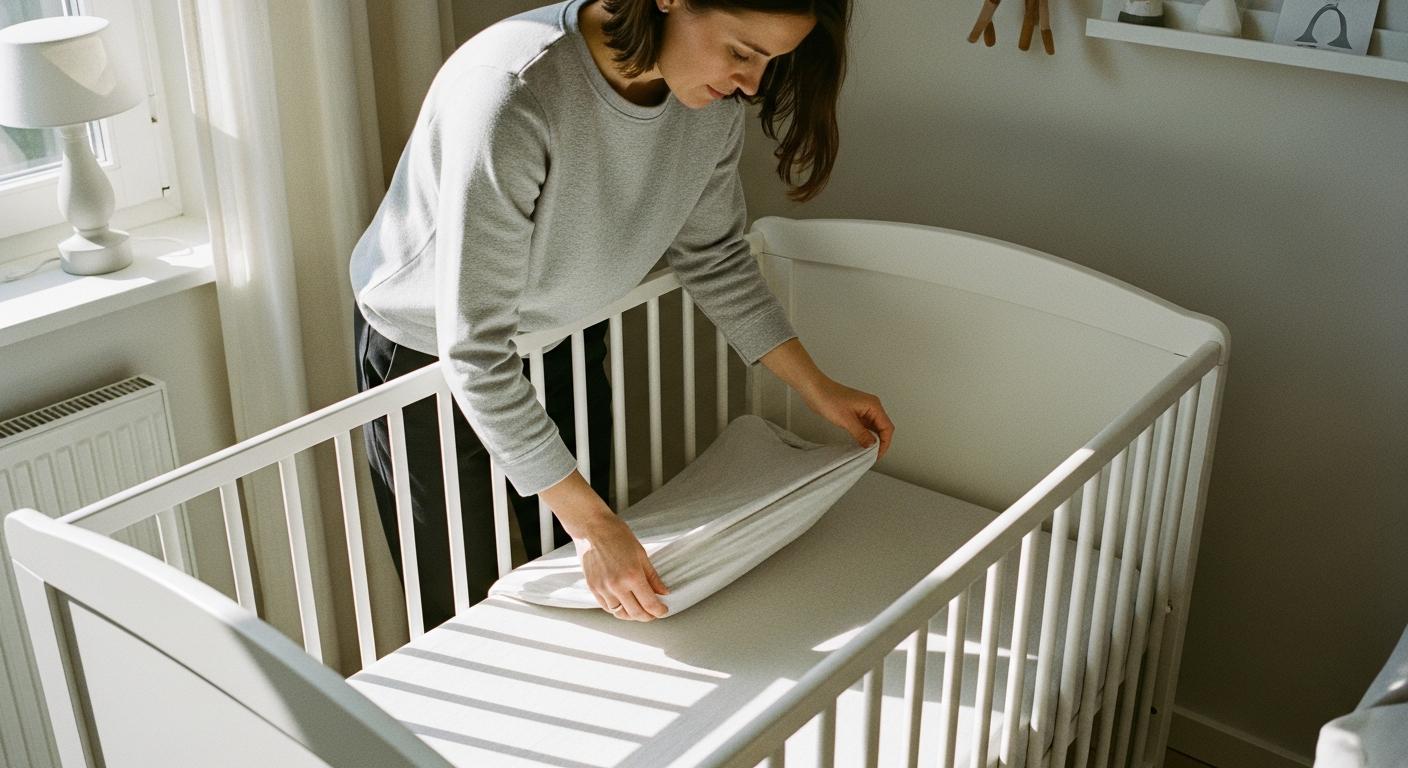
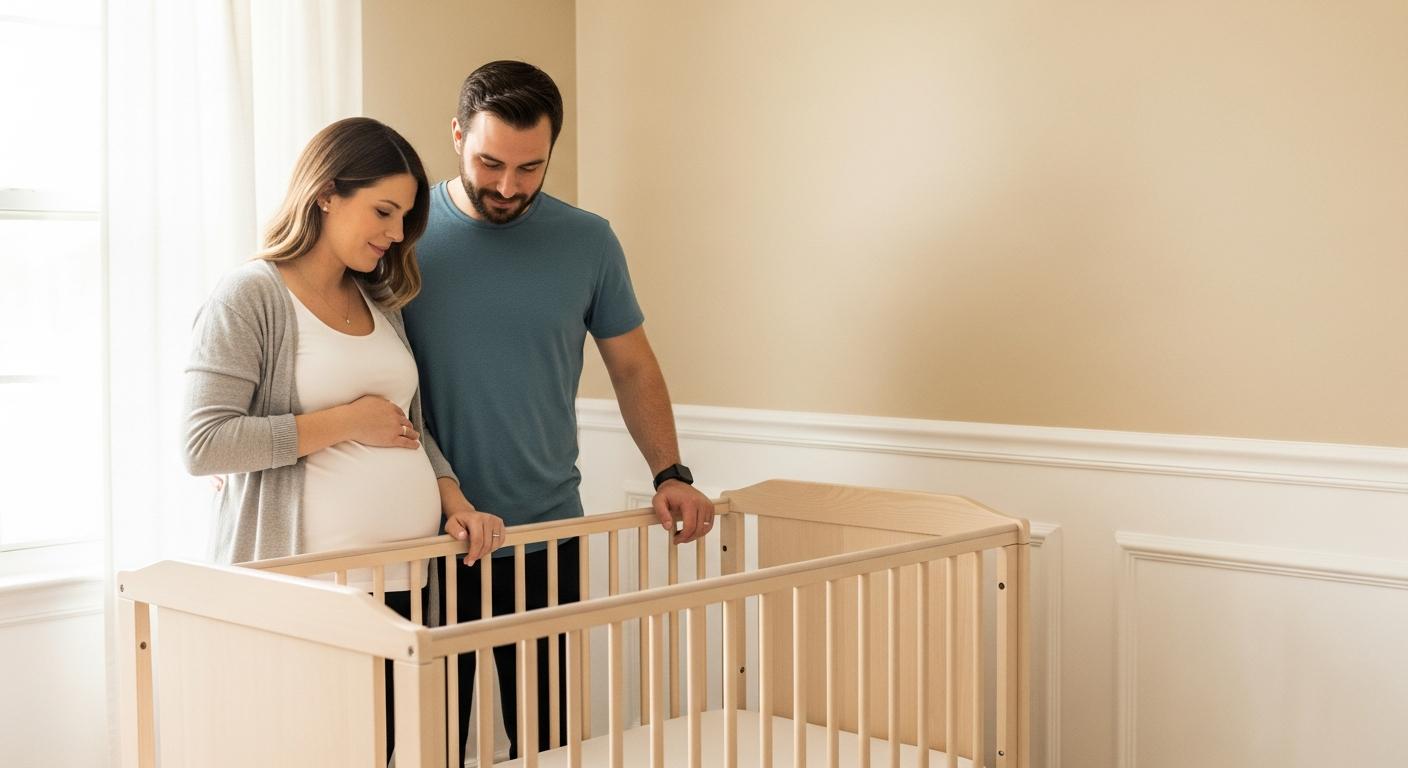
A crib can look perfect in a nursery photo… and still be a poor choice for sleep safety. Parents usually feel it right away: the questions arrive fast. Should the crib be in your room or the baby’s? Do you start with a bedside sleeper first? How do you know if the mattress is truly firm, and not just “firm-ish”?
Safe decisions are rarely about fancy extras. They’re about a few measurable points—a firm, flat sleep surface, correct dimensions, sturdy hardware, and a setup that stays intentionally simple.
What a crib is, and when it’s useful
A crib is an enclosed sleep space built for infants and young children. Its job is straightforward: keep baby on a stable, flat mattress while reducing falls and limiting spaces where a head or limb could become trapped (that’s “entrapment”).
You may also see the word “cot” on international listings. Names change, what matters is the safety label and the standard the crib meets.


Crib vs bassinet vs bedside sleeper vs playard
- Crib: long-term. Often usable from birth until toddlerhood.
- Bassinet: small and convenient for the first weeks/months, then outgrown quickly (weight limit or baby starts rolling/pushing up).
- Bedside sleeper: attaches to the adult bed. Helpful for feeds, but only safe when installed exactly as instructed—secure attachment and no gap.
- Playard (Pack ’n Play style): portable sleep surface for travel or short-term use. Safe sleep still means firm, flat, and using only manufacturer-approved mattresses.
How long a baby can use a crib
Many full-size models work from birth to roughly 2–4 years, but transitions are driven by development:
- Rolling, sitting, pulling to stand → mattress platform goes lower.
- Climbing attempts → the crib becomes a fall risk and the sleep setup needs to change.
Always follow the manufacturer’s height/weight limits.
Newborn convenience vs long-term planning
A newborn phase can feel like a marathon run in short bursts. Proximity matters. So does your back.
A compact newborn sleep space (bassinet or bedside sleeper) can make night feeds easier. A full-size crib often becomes the stable “home base” once baby grows heavier and more mobile.
Pre-purchase priorities
Before color, before drawers:
- Safety standard compliance and clear labeling.
- Room fit (interior dimensions for mattress fit, exterior footprint for your space).
- A firm mattress that fits snugly.
Crib safety standards: what “safe” means in practice
Safety standards target predictable injury patterns—collapse, gaps, breakage, and entrapment.
U.S. regulations (CPSC)
In the U.S., the Consumer Product Safety Commission (CPSC) sets mandatory rules for full-size and non-full-size cribs (strength tests, safe openings, durable hardware, required labels).
Parent checklist:
- Find the compliance label (manufacturer, model, date of manufacture).
- Keep the manual.
- Use the model/date to check recalls.
ASTM and JPMA
- ASTM performance standards focus on durability and dangerous openings.
- JPMA certification suggests third-party testing.
A certified crib can still become unsafe if it’s assembled incorrectly, missing parts, or paired with the wrong mattress.
International standards
Depending on your country, you may see EN 716 (Europe), SOR/2010-261 (Canada), or AS/NZS 2172 (Australia/New Zealand). The goals are similar: prevent entrapment, keep the frame stable, require clear instructions.
Drop-side cribs: why they’re a no
Drop-side designs rely on moving hardware. Over time it can loosen, creating a gap between rail and mattress—an entrapment and suffocation hazard. Many markets removed these designs after serious injuries and recalls.
Recalls: a step that takes minutes
Before using any crib, especially secondhand:
- Identify the exact model and manufacture date.
- Check official recall lists in your country.
- If the label is missing or unreadable, consider it a red flag.
Safe crib design checklist
Slat spacing
Slats must be close enough to reduce head entrapment risk. A commonly cited maximum is about 2 3/8 inches (≈ 6 cm), but always prioritize the standard required where you live.
Mattress fit: the “gap” issue
A crib mattress should fit tightly on all sides. A practical home check: if you can fit more than about a finger width between mattress and frame, the fit is too loose. Gaps raise entrapment risk.
Hardware and stability
A safe crib feels rigid: no wobble, no rattling joints, screws sitting flush.
If fasteners keep loosening, or rails don’t align, treat it as a mechanical problem—not “just cosmetic.”
Paint, finish, emissions
Babies chew rails. Look for finishes described as lead-free and low-VOC (low chemical emissions). If a strong odor lingers after unboxing, ventilate and allow time for airing out before regular sleep.
Crib sizes: what to measure
- A standard crib uses a standard crib mattress size.
- A mini crib needs a mini crib mattress—these are not interchangeable.
Measure exterior footprint for your room, and check interior dimensions for mattress fit. Also think about doorway clearance and assembly space.
Non-standard shapes (round/oval) can complicate bedding availability, safe sleep relies on exact fit.
Types of cribs: which one matches your life?
Standard fixed-side crib
A fixed-side, full-size crib is often the simplest path: predictable compatibility for mattresses and sheets, strong structure, fewer unusual parts.
Convertible crib
Convertible designs may transition to a toddler bed. They can be cost-effective—if you can obtain the exact conversion kit for your model and install it correctly.
Mini, portable, travel
Mini cribs suit small spaces. Portable and travel cribs help for moves and holidays, practice setup at home, and avoid aftermarket mattresses unless explicitly allowed by the manufacturer.
Bedside sleeper
A bedside sleeper can support room-sharing early on. Safety depends on secure attachment, aligned height, no gap, and a firm surface with a bare sleep space.
Choosing a crib for your space and budget
Small nursery
A mini crib or compact full-size model can work well. Keep the area around it clear for nighttime movement and route cables along walls so nothing drapes near sleep.
Total cost
Budget usually includes:
- a quality crib mattress,
- 2–4 fitted sheets,
- a thin waterproof protector,
- conversion kits if needed.
Buying checks
On delivery:
- confirm all parts/hardware are present,
- check for cracks, warped rails, chipped finish,
- locate the model/date label and keep the manual.
Register the crib with the manufacturer when possible, so recall notices can reach you.
Crib mattress guide: firmness, fit, and marketing claims
What “firm” means
Firm means the surface does not allow a deep, lasting indentation when pressed. An overly soft mattress increases suffocation risk because the face can sink into the surface.
Fit test
Place the mattress, then run your hand along all sides. The mattress should not slide easily, gaps should stay minimal. Recheck after adding the fitted sheet.
Materials and “breathable” claims
Foam or innerspring can both be safe if the sleep surface is firm and flat.
Airflow features may help comfort, but they do not replace the foundation: a bare crib, a firm, flat surface, and baby placed on the back.
Setting up a crib safely
Before you assemble: confirm the label (model/date), check recall status, lay out parts, and work on a flat surface.
Follow the manual step by step. Use only manufacturer hardware. If parts don’t align, stop—forcing pieces can create weakness or hidden gaps.
After assembly: push gently at each corner (no wobble), verify the mattress support is locked, and confirm snug mattress fit.
Lower mattress height as soon as baby can sit or pull to stand, if climbing begins, go to the lowest position immediately.
Safe sleep in a crib: simple routines
The power is in doing less:
- Baby placed on the back for every sleep.
- A firm, flat mattress.
- A snug fitted sheet (and, if you choose, a thin well-fitted protector).
- Nothing else.
Keep out pillows, quilts, stuffed toys, wedges, sleep positioners, and bumpers.
For warmth, prefer a sleep sack. Many families aim for around 20–22°C (68–72°F) and adjust clothing layers to avoid overheating.
Nursery layout and crib placement
- Keep the crib away from windows and blind cords.
- Avoid radiators, space heaters, and direct vents.
- Don’t hang heavy frames or shelves above the crib.
- Keep monitors/chargers off the crib, route cables along walls.
Remove mobiles once baby can roll or reach up.
Crib maintenance and when to stop
Monthly:
- tighten screws and bolts,
- inspect slats/rails for cracks,
- confirm the crib still feels rigid,
- recheck mattress fit.
Stop using the crib if your child can climb out, exceeds limits, or containment is no longer reliable even at the lowest mattress setting.
Key takeaways
- A crib is a long-term sleep space, bassinets and bedside sleepers often suit the early months, and playards help for travel and short-term needs.
- Choose a crib that meets current safety standards where you live, and always check recalls—especially secondhand.
- Focus on basics: slat spacing, sturdy hardware, and a snug, firm, flat crib mattress.
- Keep sleep minimal: baby on the back, fitted sheet only, sleep sack for warmth.
- Re-check safety over time: tighten hardware, lower mattress height as milestones appear, and keep cords and heat sources away.
- For tailored guidance and free child health questionnaires, you can download the Heloa app.
Questions Parents Ask
Can I safely use a secondhand crib?
Yes—many families do, and it can be a great budget choice. What matters is the exact model and its condition. Try to find the label with the manufacturer, model name/number, and manufacture date so you can check recalls and confirm it meets current standards. If parts are missing, the frame feels loose, the hardware isn’t original, or the label/manual can’t be found, it may be safer to choose another option. When in doubt, asking the manufacturer about replacement parts can be reassuring.
What crib accessories are actually safe (bumpers, sleep positioners, blankets)?
It’s completely normal to want the crib to look cozy. For sleep safety, though, “simple” tends to be the most protective: a firm, flat mattress with a snug fitted sheet. Items like bumpers, pillows, loose blankets, wedges, and sleep positioners can add risks because they introduce soft surfaces and extra objects near a baby’s face. If you’re worried about warmth, a well-fitted sleep sack can feel like an easy, comforting compromise.
When is it okay to start using pillows or a blanket in the crib?
This question comes up a lot—especially when nights get colder. Many families wait until their child is out of the crib stage (or very close to it), because pillows and loose bedding are harder to use safely with younger children. If you’re unsure about timing, a sleep sack and appropriate pajamas often help you stay flexible without adding extra items to the sleep space.