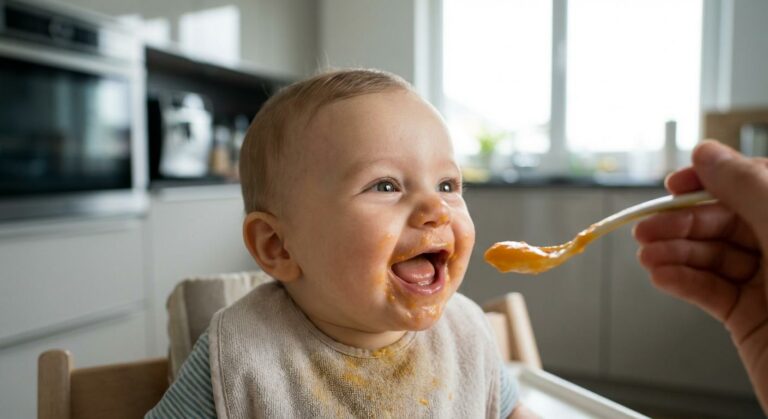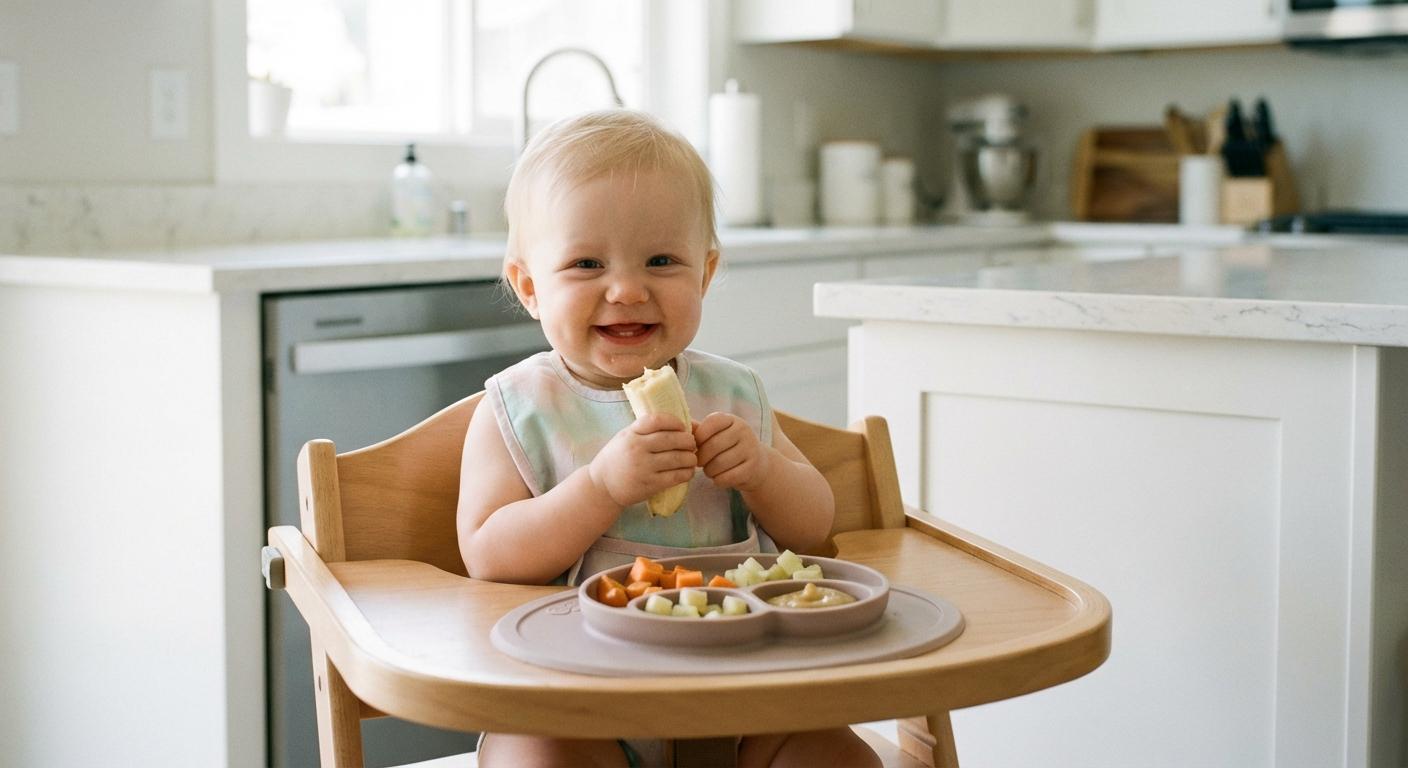
Baby food 9 months can suddenly feel like your baby wants to eat “like us” – but only on their own terms. One day they happily take dal-rice mash, next day they push the bowl away and only want to play with banana. Is it enough? Are pieces safe? Why is everything on the floor?
At this age, progress is not measured in clean bibs. It is measured in skills: sitting, chewing practice, tasting variety, and learning to stop when full.
Baby food 9 months: what changes at this age
At 9 months, family foods become more relevant, especially in Indian homes where meals are naturally mix-and-match: dal, khichdi, soft idli, curd rice, vegetable mash. The difference is in texture, salt, and safety.
With baby food 9 months, aim for:

- variety across the week (not perfection daily)
- positive exposure (no force-feeding)
- oral-motor development (lips + tongue + jaw coordination)
- a routine that does not exhaust the family
Feeding milestones at 9 months (skills and self-feeding)
Many babies can sit steadily, bring food to the mouth, and refine the pincer grasp (thumb + index finger). Finger foods start to make sense now, and so do pre-loaded spoons (you load, baby holds).
Appetite can vary due to teething, minor illness, sleep changes, constipation, or growth spurts. Usually, day-to-day swings are normal.
Purées, mashed foods, and family foods
Many babies move from smooth purée to thicker purée, fork-mash, and soft “melt-in-the-mouth” pieces. Chewing is mostly “gumming”, teeth are not required for soft foods.
A practical test for baby food 9 months: if you can squash it easily between two fingers, it is generally soft enough.
For family foods:
- keep baby’s portion aside before adding salt
- mash/shred/finely chop
- keep it moist (cooking water, a little ghee/oil, curd)
Milk still matters
Breast milk or infant formula remains the main source of calories and fluids until 12 months. Many 9‑month‑olds take around 500–800 mL/day (wide normal range).
Solids are complementary: they build skills and help cover nutrients, especially iron, without suddenly replacing milk feeds.
Baby food 9 months: key nutrition goals to cover
Variety is powerful, yet a few nutrients deserve extra attention during baby food 9 months.
Iron, protein, and zinc: everyday priorities
Common reference targets for 7–12 months: iron 11 mg/day, zinc 3 mg/day, protein 11 g/day.
- Iron supports haemoglobin (oxygen transport) and neurodevelopment. Iron stores from pregnancy gradually fall, so daily iron-rich foods help.
- Protein supports growth, but portions remain small.
- Zinc supports growth and immunity.
Indian-friendly options for baby food 9 months:
- egg (fully cooked, scrambled pieces or mashed hard-boiled)
- chicken/fish (well cooked, shredded, fish checked for bones)
- dals and legumes (moong/masoor/chana) cooked very soft and mashed
- tofu or soft paneer (pasteurised)
- iron-fortified infant cereal (useful when time is tight)
Healthy fats and omega-3s
Babies need fat for growth, energy, vision, and brain development. Add healthy fats daily.
A simple habit: about 1 teaspoon of oil or ghee per day, preferably after cooking. For omega-3 (ALA), many families use canola/rapeseed oil, olive oil is also fine. Ghee can be used in small amounts.
For DHA (omega-3), offer low-mercury fish, well cooked and flaked, and check carefully for bones.
Calcium, vitamin D, B12 (including vegetarian patterns)
- Calcium: breast milk/formula covers a lot, curd/yogurt and pasteurised cheese can add more.
- Vitamin D: supplementation is common, especially for breastfed babies – follow your paediatrician’s advice.
- Vitamin B12: mainly in animal foods (meat, fish, eggs, dairy). Vegetarian patterns can cover it with eggs/dairy, vegan patterns need a plan with a health professional.
Daily rhythm: a 9-month feeding schedule that works
A realistic rhythm for baby food 9 months: milk feeds spaced through the day with 2–3 meals. Offer water in a cup with meals (a few sips).
Example (adjust to naps):
- Wake: milk
- Breakfast: solids + water
- Mid-morning: milk
- Lunch: solids + water
- Mid-afternoon: milk
- Dinner: solids + water
- Bedtime: milk
Many babies do well with roughly 120–240 mL water/day, more in hot weather, but water should not replace milk.
How many meals per day?
Two meals can be fine if milk intake and growth are steady and your baby seems content. Many families settle into three meals, a snack is optional.
If adding a meal creates stress, keep it simple and build gradually.
How much should a 9-month-old eat?
Portions vary a lot. A sensible starting offer per meal is 1/4 to 1/2 cup total solids, across 2–3 foods.
Benchmarks for baby food 9 months (then follow cues):
- iron/protein: 1–2 tbsp (egg, dal, fish, chicken, beans, tofu, yogurt, paneer)
- veg or fruit: 2–4 tbsp
- starch: 2–4 tbsp (rice, suji, oats, ragi, potato)
- fat: small add-on (ghee/oil, avocado, full-fat curd)
Hunger and fullness cues
More:
- leaning forward, reaching, open mouth, staying engaged
Done:
- turning away, pushing food, slowing down, closed mouth, losing interest
Respecting these cues supports responsive feeding and reduces mealtime conflict.
Textures at 9 months: moving beyond smooth purées
A practical texture ladder:
- smooth purée → thick purée with soft micro-lumps
- fork-mash (khichdi mash, dal-rice mash)
- finely chopped/shredded foods
- soft bite-sized pieces and tender finger foods
Aim for tender, melt-in-the-mouth pieces that are not dry.
Introducing pieces gently
If pieces feel challenging:
- thicken purées first
- add tiny soft lumps
- offer very well-cooked foods finely cut
- increase texture slowly
If gagging increases, reduce lump size and softness rather than going back to only smooth purée.
Gagging vs choking: know the difference
Gagging is common when learning textures, it is often noisy and your baby can cough.
Choking is different: airway blockage, little/no sound, breathing difficulty, colour change. If your baby cannot cough or breathe, treat it as an emergency and call for help.
Seek medical advice if there is frequent coughing during meals, repeated choking episodes, or persistent refusal of textures beyond smooth purée.
Finger foods at 9 months: safe self-feeding (spoon + fingers)
A spoon + finger-food approach works well for baby food 9 months if your baby is upright and supervised.
Good finger foods (soft, nutritious)
- ripe banana, avocado, very ripe mango/pear
- steamed carrot sticks, soft pumpkin, sweet potato chunks
- soft idli fingers, well-cooked rice clumps, soft suji upma (not dry)
- fully cooked scrambled egg pieces
- shredded chicken, flaky boneless fish
- soft tofu cubes, mashed beans/lentils
- small pieces of tender pasteurised cheese or soft paneer
Cutting and cooking safely
Many babies handle:
- small soft cubes (about 0.5–1 cm)
- soft strips easy to hold, cooked until they squash easily
Remove pits, seeds, bones, and tough skins. Always feed seated, in a stable high chair.
Choking hazards to avoid (and safer swaps)
Avoid or modify foods that are round, hard, sticky, or crumbly:
- whole grapes, whole cherry tomatoes
- nuts, popcorn, hard biscuits
- blobs of nut butter
- raw apple chunks, raw carrot rounds
Safer swaps for baby food 9 months:
- grapes: quarter lengthwise, then small pieces
- cherry tomatoes: halve/quarter lengthwise
- nut butter: thin and mix into porridge/curd, never offer a blob
What foods to offer at 9 months (Indian-friendly)
For baby food 9 months, build meals from these blocks:
- Vegetables/fruit: cooked very soft, or fruit very ripe/mashed
- Starch: rice, suji, oats, ragi, potato, soft pasta
- Legumes: moong/masoor/chana, cooked thoroughly and mashed
- Protein: egg, chicken, fish, tofu/paneer (fully cooked, small portions)
- Added fat: small daily amount (oil/ghee), often added after cooking
- Dairy: pasteurised curd/yogurt, fresh cheese (milk drink remains breast milk/formula)
Seasoning can be gentle (jeera, dhania, a pinch of haldi). Avoid added salt and sugar.
Iron-rich meals made easier: smart pairings
Non-heme iron (dal, beans, tofu, spinach, fortified cereal) absorbs better with vitamin C.
Easy pairings:
- dal + tomato
- chickpeas + mashed capsicum
- fortified cereal + mashed papaya/guava
- tofu + mango
If your baby has a large curd serving, consider offering it at a different meal than the main non-heme iron dish, as calcium can reduce non-heme absorption.
Allergens at 9 months: introducing calmly
Common allergens: egg, peanut, tree nuts, dairy, wheat, soy, fish, sesame.
How to introduce (steady and practical):
- one new allergen at a time, at home, earlier in the day
- start tiny
- observe for 2–3 hours
- if tolerated, repeat regularly (1–2 times/week)
Stop and seek medical advice for hives, swelling, repeated vomiting, wheeze, or any breathing trouble. Emergency care is needed if breathing becomes difficult.
Meal ideas for baby food 9 months
Breakfast:
- full-fat curd + mashed banana
- very soft oats/ragi porridge + mashed fruit + a little ghee
- fully cooked scrambled egg + avocado
Lunch:
- moong dal khichdi mash + a little oil + mashed veg
- carrot-potato mash + flaky fish + oil drizzle
- shredded chicken + mashed sweet potato
Dinner:
- thick vegetable soup + suji
- chickpea mash + soft rice + cooked lauki
Optional snack:
- stewed apple/pear + curd
- soft fruit pieces
Foods to skip at 9 months
- honey (before 12 months)
- added salt and added sugar
- unpasteurised dairy/juice
- undercooked egg/meat/fish
- cow’s milk as the main drink (before 12 months)
- juice and sugary drinks
- very salty ultra-processed foods
Everyday feeding safety and hygiene
For baby food 9 months, safety is simple and strict:
- upright seating in a stable high chair (ideally with foot support)
- close supervision, within arm’s reach
- serve warm, not hot, stir well after microwaving
- wash hands, avoid cross-contamination
- refrigerate leftovers within 2 hours, reheat once until steaming hot
Troubleshooting common 9-month feeding challenges
Throwing food is often experimentation or a “done” signal. Offer smaller portions and end the meal when fullness cues appear.
If pieces are refused:
- step back one level (fork-mash)
- change shapes (strips vs cubes)
- alternate spoon and finger foods
- continue offering without pressure
Constipation, diarrhoea, teething, illness
- Constipation: keep milk steady, offer extra water sips, try pear or prune purée.
- Diarrhoea: focus on hydration, avoid juice, watch for dehydration.
- Teething: softer textures may be accepted for a few days.
Seek medical advice for fewer wet nappies, marked sleepiness, blood in stool, persistent vomiting, or fever with diarrhoea.
Key takeaways
- Baby food 9 months still relies on breast milk or formula, solids build skills and nutrients gradually.
- Focus on daily iron, modest protein, healthy fats, and variety across the week.
- Move textures step by step towards fork-mash and soft pieces, gagging is common, choking is an emergency.
- Keep safety front and centre: upright seating, constant supervision, careful cutting, and hygiene.
- If you want extra support, health professionals can guide you, and you can download the Heloa app for personalised advice and free child health questionnaires.
Further reading :