Baby food 9 months can feel like a turning point: a spoonful of purée one day, a fistful of pasta the next, and suddenly the high chair looks like a small science experiment. How much is “enough”? Are pieces safe? What if dinner ends on the floor? At this age, the win is not a perfectly clean plate. It’s steady exposure, skill-building, and nutrition that matches a fast-growing brain and body.
Baby food 9 months: what changes at this age
At baby food 9 months stage, many babies sit more steadily, bring food to the mouth with purpose, and practice the pincer grasp (thumb + index finger). That’s why self-feeding often takes off – sometimes beautifully, sometimes messily.
Appetite can swing with teething, minor infections, growth spurts, or a rough night. That variability is usually physiological (your baby’s internal regulation doing its job).
Purées, mashed foods, and family foods
Most babies tolerate a shift from smooth purée to thicker purée, fork-mash, and soft “meltable” pieces. Chewing is often “gumming”: even with few teeth, gums can crush soft foods.


A quick texture test: if you can squash the food between two fingers, it’s generally soft enough.
Family foods can fit baby food 9 months routines if you:
- set baby’s portion aside before adding salt
- keep it moist (cooking water, olive oil, yogurt)
- shred, mash, or finely chop as needed
Milk still matters
Breast milk or infant formula remains the main source of energy and fluids until 12 months. Many babies take roughly 500–800 mL/day (wide normal range). Solids complement milk: they teach chewing, widen taste, and help cover nutrients – especially iron.
Baby food 9 months: nutrition priorities parents can actually track
You may wonder what to “focus on” without turning meals into math. A simple hierarchy helps.
Iron, zinc, protein (the growth trio)
From 7–12 months, common reference targets are iron 11 mg/day, zinc 3 mg/day, protein 11 g/day.
- Iron supports hemoglobin (oxygen transport) and neurodevelopment. Iron stores from pregnancy gradually decrease, so daily iron-rich foods matter.
- Zinc supports growth and immune function.
- Protein supports tissue growth, but portions stay small.
Good fits for baby food 9 months:
- well-cooked meat or poultry (shredded)
- boneless flaky fish (fully cooked)
- egg (fully cooked)
- lentils/beans (very soft, mashed)
- iron-fortified infant cereal
Fats and omega-3 (brain-friendly energy)
Fat is not “extra” for babies, it’s a core fuel. Add a small daily boost: about 1 teaspoon of oil per day, preferably after cooking. Rapeseed/canola oil brings omega-3 (ALA), olive oil works well too.
For DHA (an omega-3 used by the brain and retina), offer low-mercury fish like salmon or trout, well cooked and carefully checked for bones.
Iodine and vitamins: variety does the heavy lifting
Iodine supports thyroid hormones (which influence growth and brain maturation). Babies often get iodine through breast milk/formula, foods like fish and dairy can contribute too.
For vitamins, a practical rule is “many colors, many weeks”: orange (sweet potato), green (broccoli), red (tomato), purple (berries). Not every color needs to appear daily – balance is often clearer over a week.
Vitamin D, calcium, B12 (especially with vegetarian patterns)
- Vitamin D supplementation is common, particularly for breastfed babies – follow your clinician’s advice.
- Calcium largely comes from breast milk/formula, yogurt and pasteurized cheese can add variety.
- Vitamin B12 is mainly in animal foods (meat, fish, eggs, dairy). Vegan patterns need a personalized plan with fortified foods and supplements.
Daily rhythm: making baby food 9 months fit real life
A typical pattern is milk feeds plus 2–3 meals. Water can be offered in a cup with meals (a few sips).
Example flow (adjust to naps):
- Morning milk
- Breakfast + water sips
- Midday milk
- Lunch + water sips
- Afternoon milk
- Dinner + water sips
- Bedtime milk
How much water? Many babies do well with a few sips at meals, often totaling about 120–240 mL/day. The point is practice and comfort, not replacing milk.
How many meals per day?
For baby food 9 months, 2 meals can be fine if milk intake and growth are on track. Many families move toward 3 meals, a snack is optional.
If adding a meal triggers tension, simplify. Consistency beats perfection.
When a snack helps (and when it backfires)
A snack can be useful when there’s a long gap between lunch and dinner, or daycare timing dictates it. But frequent nibbling can blur hunger cues and make meals harder.
If you want one, keep it small and nutrient-dense:
- plain yogurt
- a soft fruit
- a few tender cubes of pasteurized cheese
Baby food 9 months: how much should a baby eat?
Portions vary – wildly. Start small, then let hunger and satiety cues lead.
Simple portion benchmarks
A practical starting offer per meal: 1/4 to 1/2 cup total, across 2–3 foods.
- Iron/protein food: 1–2 tbsp
- Vegetable/fruit: 2–4 tbsp
- Starch: 2–4 tbsp
- Fat: a small add-on (oil, avocado, full-fat yogurt)
If you prefer gram guides, some families use flexible references such as 15–20 g/day of well-cooked meat or fish, or about 1/2 fully hard-boiled egg – helpful for perspective, not for policing intake.
Hunger and fullness cues
More:
- leaning forward, reaching, open mouth, engaged
Done:
- turning away, pushing food, slowing down, closed mouth, loss of interest
Following these signals supports responsive feeding and reduces power struggles – an underrated part of baby food 9 months success.
Balancing solids with milk
Some days solids are tiny and milk does most of the work, other days your baby surprises you. A calmer “big picture” check is growth, energy, and wet diapers, not the exact number of bites.
Textures at 9 months: moving beyond smooth purées without fear
Think of texture like a ladder:
- smooth → thick purée
- fork-mash with soft micro-lumps
- finely chopped/shredded
- soft pieces and tender finger foods
If lumps trigger lots of gagging, step back slightly (smaller, softer lumps) and progress again.
A gentle step-by-step if pieces feel hard
You might try:
- Thicken the purée (less liquid, more body).
- Leave a few soft lumps.
- Offer one “easy” finger food alongside the spoon.
- Increase variety of pieces once swallowing looks confident.
A baby who coughs frequently during meals, however, deserves a discussion with a clinician – sometimes reflux, coordination issues, or an underlying swallowing difficulty can play a role.
Gagging vs choking (the difference matters)
Gagging is common when learning, it’s often loud and your baby can cough.
Choking is silent or near-silent: air can’t pass, breathing is impaired, color may change. Treat choking as an emergency and call for help.
Seek medical advice if there is frequent coughing during meals, repeated choking episodes, or weeks of persistent refusal of any texture beyond smooth purée.
Finger foods and self-feeding: safe choices for baby food 9 months
A spoon + finger-food mix works well when your baby sits upright and is closely supervised.
Easy finger foods (soft, nutrient-dense)
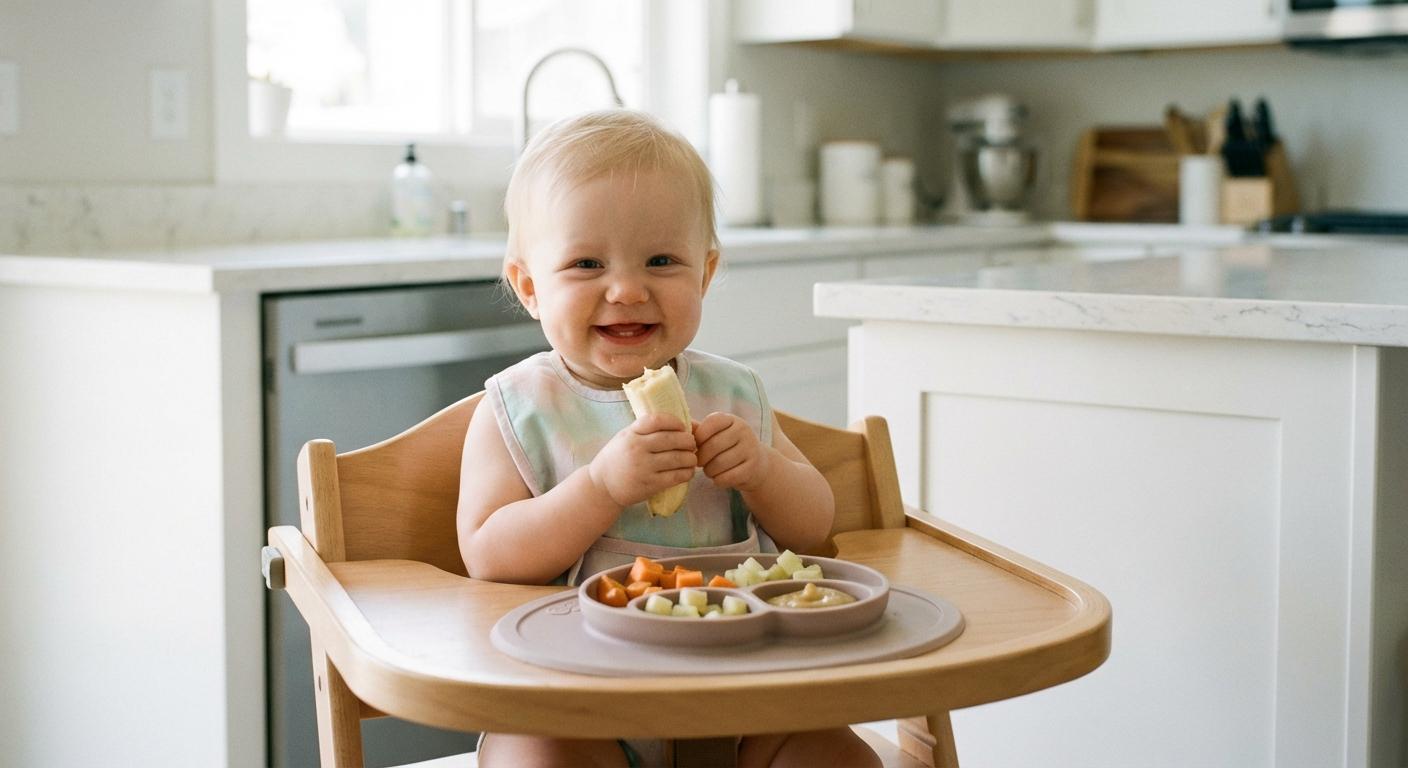
- ripe banana, avocado, very ripe pear (soft)
- steamed broccoli florets, very soft sweet potato
- soft pasta, well-cooked rice clumps
- scrambled egg pieces (fully cooked)
- shredded chicken, flaky boneless fish
- soft tofu cubes
- lentils/beans (mashed or gently squashed)
- small pieces of tender pasteurized cheese
Safe cutting and cooking
Aim for pieces that are soft and not dry. Remove pits, seeds, bones, and tough skins.
What shape? Many babies manage either:
- soft sticks/strips (easy to grasp)
- small soft cubes (about 0.5–1 cm)
Keep your baby seated in a high chair (not in a car seat, not walking around).
Choking hazards to avoid (and safer swaps)
High-risk foods are often round, hard, sticky, or dry:
- whole grapes and cherry tomatoes
- whole nuts, popcorn, hard crackers
- blobs of nut butter
- raw apple chunks, raw carrot rounds
- hot dogs in round slices
Safer swaps for baby food 9 months:
- grapes: quarter lengthwise, then into small pieces
- cherry tomatoes: halve/quarter lengthwise
- nut butter: thin to a runny texture (mix with water, breast milk, or formula) and spread thinly or stir into oatmeal
- hot dogs: avoid rounds, slice lengthwise into strips, then tiny pieces
What foods to offer at 9 months (and how to prep them)
A balanced day of baby food 9 months usually includes:
- vegetables and fruit (cooked or very ripe, texture-adapted)
- starches (potato, pasta, rice, quinoa, semolina)
- legumes (well cooked, mashed)
- proteins (fully cooked, small portions)
- added fats (small daily amount)
- dairy (pasteurized yogurt/cheese, milk drink stays breast milk/formula)
Season with herbs and mild spices if you like – skip added salt and added sugar.
Iron made easier: smart pairings
Heme iron (meat/fish) is absorbed well. Non-heme iron (lentils, beans, tofu, fortified cereal) absorbs less efficiently – unless vitamin C joins the meal.
Easy pairings:
- lentils + tomato
- beans + mashed bell pepper
- fortified cereal + mashed berries
- tofu + mango
- meat/fish + steamed broccoli
If you’re offering a large portion of calcium-rich foods (like a big yogurt bowl), it can be simpler to place it at a different meal than the main non-heme iron dish.
Allergens at 9 months: introducing calmly
Common allergens: egg, peanut, tree nuts, dairy, wheat, soy, fish, shellfish, sesame.
A steady approach for baby food 9 months:
- introduce one new allergen at home, earlier in the day
- start with a tiny amount
- observe for 2–3 hours
- if tolerated, repeat regularly (1–2 times/week)
Safe forms:
- peanut/tree nuts: smooth butter thinned and mixed into yogurt/oatmeal
- egg: fully cooked scrambled egg or mashed hard-boiled egg
- fish: well-cooked, flaky, boneless
- sesame: tahini thinned into a sauce
If your baby has significant eczema or a strong family history of allergy, ask a health professional for a plan.
Seek medical advice urgently for hives with swelling, repeated vomiting, wheeze, widespread rash, or any breathing difficulty.
Meal ideas for baby food 9 months (fast, balanced)
Breakfast:
- full-fat plain yogurt + mashed banana
- very soft oatmeal + fortified infant cereal + mashed fruit
- fully cooked scrambled egg + avocado
Lunch:
- carrot-potato mash + flaky fish + oil drizzle
- red lentil mash + tomato + soft rice
- shredded chicken + peas + mashed potato
Dinner:
- thick vegetable soup + semolina
- salmon flakes + sweet potato mash + very soft greens
- chickpea mash + soft couscous + cooked zucchini
Optional snack:
- unsweetened compote + yogurt
- a few soft fruit pieces
Foods to skip at 9 months
For safety and nutrition:
- no honey before 12 months (botulism risk)
- avoid added salt and added sugar
- avoid unpasteurized dairy/juice
- avoid undercooked egg, meat, or fish (infection risk)
- avoid cow’s milk as the main drink before 12 months
- skip juice and sugary drinks
- limit very salty ultra-processed foods
Everyday safety and hygiene
- Upright posture in a stable high chair, ideally with foot support
- Close supervision, within arm’s reach
- Serve warm, not hot, stir well after microwaving
- Wash hands, separate raw and cooked foods
- Refrigerate leftovers quickly (within 2 hours), reheat once until steaming
Troubleshooting common feeding moments at 9 months
Throwing is often experimentation (“What happens if I drop this?”) or a sign of being finished. Offer smaller portions, and end the meal when satiety cues appear.
Refusing textures can happen if the jump felt too fast. Consider:
- going back one step (fork-mash instead of pieces)
- changing the shape (strips instead of cubes)
- alternating spoon and finger foods
Constipation, diarrhea, teething
- Constipation: keep milk steady, offer extra water sips, and try pear or prune purée.
- Diarrhea: prioritize hydration, continue usual feeding, avoid juice.
- Teething: softer textures may be accepted for a few days (yogurt, compote, warm purées), then return to tender pieces.
Contact a clinician for signs of dehydration, blood in stool, persistent vomiting, or symptoms lasting more than a couple of days.
Key takeaways
- Baby food 9 months works best when milk (breast milk or formula) stays the foundation and solids build skills and variety.
- Prioritize daily iron, regular zinc/protein sources, and a small daily fat addition (including omega-3 sources).
- Progress textures gradually toward fork-mash and soft pieces, gagging can be part of learning, choking is an emergency.
- Safety is practical: upright seating, constant supervision, careful cutting, pasteurized dairy, fully cooked proteins.
- For extra support, parents can download the Heloa app for personalized tips and free child health questionnaires.
Questions Parents Ask
What should my 9-month-old eat in a day (sample menu)?
A simple day can look like: milk feeds + 2–3 meals with water sips. For meals, many parents find it easier to think in “building blocks” rather than exact quantities:
- 1 iron-rich food (meat, fish, egg, lentils, fortified cereal)
- 1 fruit or vegetable (cooked or very ripe)
- 1 starch (potato, pasta, rice, quinoa)
- + a little fat (oil, avocado, full-fat yogurt)
If your baby eats very little some days, that’s often normal. Over a week, variety tends to balance out.
Is it normal if my 9-month-old suddenly eats less?
Yes—appetite can dip with teething, a minor virus, constipation, or a change in routine. Try keeping the atmosphere calm, offering smaller portions, and letting your baby lead with hunger/fullness cues. It can also help to keep milk intake steady and avoid grazing all day. If your baby seems unusually sleepy, has fewer wet diapers, or weight gain worries you, you can check in with a clinician for reassurance.
My baby gags a lot on finger foods—should I stop?
Gagging can be part of learning textures, especially when pieces are new. You can simplify without giving up: offer softer foods, larger easy-to-grip strips, or fork-mashed textures with tiny lumps, then progress gradually. Stay close and seated upright. If there is repeated choking, frequent coughing during meals, or ongoing difficulty swallowing, it’s important to seek medical advice.
Further reading :