Many Indian parents wait for a baby first word the way they wait for the first monsoon shower—excited, a bit impatient, and quietly checking every small sign. One day it sounds like “ma…”, the next day it disappears. Then the mind runs fast: Is this normal? Am I talking enough? Did that cold and ear infection affect hearing? What about a bilingual home where Hindi and English (or Tamil, Bengali, Marathi, Telugu, Kannada, Malayalam…) flow together? And yes, what about screens that keep playing rhymes in the background?
A baby first word is not mainly about crystal-clear pronunciation. It is about intention, context, and repetition. It sits on an invisible scaffold built much earlier: listening, babbling, gestures, pointing, and shared attention (also called joint attention, meaning you and your baby focus on the same object or event together). The aim is simple: recognise what counts, support speech gently in everyday routines, and know when a paediatric discussion is sensible.
Baby first word: what counts (and what doesn’t)
Babbling vs first word: a difference that calms the mind
Babbling is sound play—often repeated syllables like “ba-ba” or “ma-ma.” Babies experiment with voice, loudness, rhythm, and intonation. Sometimes it even sounds like a tiny speech. But it may not be directed at anyone.
A true baby first word is different: it carries a message. Pronunciation can be unclear, shortened, or invented, yet the function is clear. Your baby uses a sound (or a sign) to influence you and the situation.

The markers of a true first word: intention, context, repetition
A baby first word is an intentional sound (or sign) linked to a specific meaning. Not perfection—reliability.
A “real” early word usually shows:
- Intention: getting your attention, requesting, protesting, greeting, or sharing excitement.
- Context: it appears in the right moment (for example, the same sound at bedtime, or when a parent enters the room).
- Repetition over time: it turns up across several days, not as a lucky one-off.
Between about 8 and 12 months, many babies produce proto-words—stable, word-like sounds tied to meaning. Think of proto-words as a runway: not “less than,” simply earlier.
Pronunciation doesn’t need to be perfect
Early speech has simplified patterns because the oral-motor system (lips, tongue, jaw, breath control) is still maturing.
A word can still count even if:
- only part is produced (“nana” for banana)
- consonants are swapped or dropped (“gog” for dog)
- the rhythm is clearer than the individual sounds
The key remains the sound-meaning link: your baby uses that form on purpose, with stable meaning.
Why this moment feels so big: emotion, connection, confidence
When your baby makes a sound and you respond—look up, smile, move closer, help—something powerful clicks: my voice changes what happens. That emotional loop supports attachment and builds motivation to communicate again.
Do partial words count? Understanding word approximations
Yes. Partial words and approximations are common, and they often indicate healthy progress.
What word approximations look like (and why they happen)
Approximations are your baby’s best attempt with the sounds they can manage right now.
Examples many families notice:
- “dah” for dog
- “bah-bah” for bottle
- “nana” for banana
Why does it happen? Some consonants and syllable shapes are easier early on, and babies naturally simplify longer words into familiar patterns.
When an approximation is a real word
An approximation behaves like a baby first word when it is:
- consistent (used again and again for the same meaning)
- context-appropriate (at the dog, at the bottle, at bedtime)
- recognisable to caregivers (even if guests may not guess)
A practical test: if you can write it down as “my baby’s way of saying X,” it likely counts.
How to respond so speech becomes clearer (without pressure)
Aim for warm modelling—no drilling.
- Acknowledge: “Yes, dog!”
- Recast: baby “dah” → “Dog. The dog is here.”
- Expand: “Dog! Big dog.”
When do babies say their first word?
Typical age range: a guideline, not a deadline
Many babies say a meaningful baby first word around 12 months, with a wide normal range. First words may appear gradually between about 12 and 18 months.
“Averages” are not appointments. Timing shifts with temperament, daily interaction time, and what else your baby is working on (standing, cruising, walking—big neural workloads).
Before 12 months: proto-words and animal sounds can be meaningful
Before 12 months, some babies use stable sounds like “ma,” “pa,” or onomatopoeia like “woof” or “vroom.” These can count as a baby first word if intention and stability are there.
After 15 months: variation can still be normal, but look at the whole picture
A slower start can still fit typical development—especially if nonverbal communication is rich:
- steady eye contact
- gestures (showing, giving, waving)
- pointing
- good understanding of routines (bath time, feeding cues)
By around 18 months, some children have 5–20 words and others have many more. By around 2 years, two-word combinations (“more milk,” “mumma come”) become more common and vocabulary often accelerates.
However, no words or proto-words around 15–18 months, or loss of previously gained skills, deserves a professional conversation.
Before the first word: communication milestones that lead to talking
0–6 months: coos, vocal play, early turns
In the beginning, crying communicates needs. Then come coos and vowel-like sounds. Even without words, babies learn a core rule: when I vocalise, someone responds.
6–9 months: canonical babbling and new consonants
Babbling becomes more structured (“ba-ba,” “ta-ta”), and more consonants appear. This supports articulation and early speech-sound organisation.
9–12 months: intention, sound-meaning links, and gestures that “speak”
Understanding grows, and gestures become powerful: giving, waving, and especially pointing. Pointing often signals a shift towards intentional communication and supports word learning.
12–18 months: after the first word, vocabulary may stretch, then speed up
After a baby first word, some children add words slowly and then suddenly take off. Others grow steadily. The reassuring sign is direction: more understanding, more attempts, more shared moments, and words that gradually accumulate.
Signs your baby is close to their first word
Social foundations: joint attention, eye contact, turn-taking
A baby close to a baby first word often:
- shares attention with you around a toy, pet, utensil, or object
- looks between you and the object as if asking, “Are you seeing this too?”
- enjoys back-and-forth games (peekaboo, vocal play)
Gestures that support speech: pointing, showing, giving, waving
Gestures are communication.
Helpful ones include:
- index-finger pointing
- showing you something to share interest
- giving an object to request help or continue a game
- waving hi/bye
Sound and imitation clues
You may notice rhythmic babbling with pauses, watching your mouth when you speak, and attempts to imitate right after you say a word.
Common first words babies say (with examples)
A baby first word often comes from daily life: people, routines, favourite objects, emotions.
People words: mama, dada, names
- mama, dada
- sibling names
- pet names
Even “ma” or “pa” can count if the use is stable and intentional.
Needs and routines
Words that get quick results are motivating:
- milk, water
- eat
- sleep
In many Indian homes, you might also hear early routine labels like “appa,” “paani,” “doodh,” “anna,” “bye,” “come”—any language is fine, meaning and use are what matter.
Small “power” words
These help your baby steer interaction:
- no, yes
- there
- more, all done
Objects and comfort items
Concrete items are easier to link to meaning:
- ball
- bottle
- book
- favourite blanket/soft toy
Animal sounds and exclamations: do they count as first words?
Often, yes—when they are intentional and consistent.
Why onomatopoeia is often an early word
Onomatopoeia (“woof,” “meow,” “vroom”) can be easier than adult forms. The sound is distinct, fun, and strongly tied to a clear referent. For some babies, “woof” is the first stable label for “dog.”
Exclamations like “uh-oh” can be meaningful too
Exclamations count when they appear:
- in the right moment (something falls → “uh-oh”)
- with clear intention (sharing surprise, getting you to react)
- more than once in similar situations
What influences first words (and what can slow them down)
The invisible foundations: gaze, joint attention, pointing
Before words, your baby learns to share a target with you: look at the object, then your face, then back again. That is joint attention. If you label right then (“Ball!”), the word has something to stick to.
Everyday interaction: quality, pauses, turn-taking
What helps most resembles conversation:
- label what you see and what you are doing
- leave small pauses (silence makes space for an attempt)
- respond to your baby’s sounds like a real turn
A few calm minutes of one-to-one time can change the communication climate, even in a busy joint family home.
Health and personal factors: hearing, ear issues, sleep, family traits
Temperament matters: some babies watch and listen for a long time, then speak later.
Hearing is central. Middle-ear fluid (often linked with repeated ear infections/otitis media) can cause fluctuating conductive hearing loss—your baby hears, but muffled. That can make speech sounds harder to discriminate and words slower to settle.
If ear infections repeat, if your baby reacts less to sound, or if responses feel inconsistent, discuss it with your paediatrician. Sometimes an audiology hearing test is suggested.
Screens and language: the brain prefers real interaction
Screens provide sound, but they rarely provide responsive back-and-forth: eye contact, timing, shared attention, and tailored responses. Heavy passive screen time can reduce chances for real conversation practice.
Bilingual homes: two languages, one child—no bug
Bilingualism does not block a baby first word. Words may be distributed across languages, totals are often comparable when you count all languages together.
How to encourage your baby to talk (gently, without forcing)
Lean on routines: meals, bath, diapering, outings
Routines create repetition.
Try short phrases:
- “Water? Water.”
- “Sleep time. Sleep.”
- “Shoes on.”
Model language: label, repeat, and leave space
Modelling means giving the example without demanding performance:
- “Ball. Ball rolls.”
- “Cat. Cat sleeping.”
Then pause. A sound, a gesture, or a look—still a turn.
Books and songs: vocabulary plus sound-play
A few minutes a day is enough:
- picture books: point, label, wait
- reread favourites: repetition supports learning
- songs and rhymes: rhythm and repetition strengthen memory for words
Games that invite response: imitation, turn-taking, simple choices
Imitation games are powerful. Simple choices create a reason to respond:
- “Banana or curd?”
- “Red book or blue book?”
If your baby points, translate it: “Curd. You want curd.”
Gestures and simple signs: a bridge to words
Gestures and simple signs (more, all done, eat, drink, sleep) support expression and reduce frustration. They do not prevent speech. Say the word while signing.
When to seek extra support (without panic)
Signs worth discussing
Consider a chat with your paediatrician if you notice:
- little or no babbling after about 9–10 months
- limited response to sound or voice
- few communicative gestures around 12 months (showing, giving, waving, pointing)
- very limited joint attention
Delays and regression: be more alert if skills are lost
Seek advice sooner if there is:
- no words or proto-words around 15–18 months
- clear stagnation over time
- regression (loss of words, gestures, or social communication skills)
What professionals usually explore
If a baby first word is late, clinicians often consider hearing and ear health, overall development, and sometimes developmental language disorder (persistent difficulty learning language). A hearing evaluation and, when suitable, referral to a speech-language pathologist may be suggested.
À retenir
A baby first word is a milestone, yes, but it is also a process—built from tiny daily exchanges. Keep interaction warm and responsive, keep expectations realistic, and treat attempts as communication, not performance.
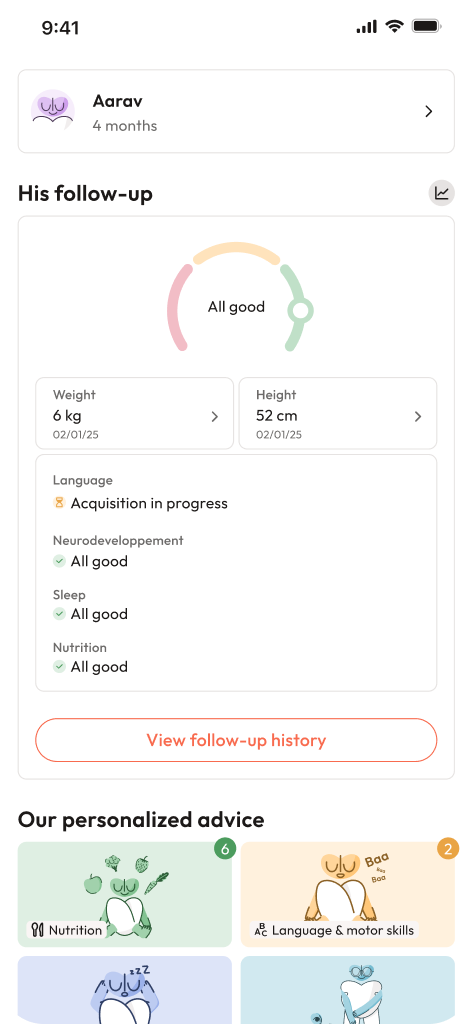
If doubts remain, your paediatrician, an audiologist, or a speech-language therapist can clarify what is going on and suggest practical steps. You can also download the Heloa app for personalised tips and free child health questionnaires.