Blurry vision in infants can make even a calm day feel uncertain. One moment your baby seems to study your face, the next the gaze slips away, or the eyes look slightly off-centre. Is it just sleepiness? Normal visual development? Or something that needs quick medical attention?
Blurry vision in infants is often linked to the eyes and brain still learning to work as a team, yet there are a few red-flag signs—like a white pupil or a cloudy cornea—that should never be ignored. You’ll find what is typically expected by age, what parents often notice at home, the most common medical causes, and how vision is checked and treated in babies.
What’s normal as vision develops (newborn to 12 months)
At birth, the visual system is immature. The retina (light-sensing layer), the lens (focusing structure) and the brain’s visual pathways are still building connections. In the first days, many parents notice a “catch and drift” gaze, or brief eye crossing when baby is sleepy—often part of early coordination.
What newborns usually see: distance, contrast, colour
Newborns see best up close, roughly the distance from your face during feeding. High-contrast shapes (eyes, hairline, simple black-and-white patterns) are easier than fine details. Colour vision develops gradually, and the visual field widens month by month.

How much blur can be typical by age
Some blur is expected early—especially for far objects. Tracking can look jerky at first.
- Birth to 3 months: brief fixation, then improving gaze holding around 6–8 weeks. Limited tracking, mostly slow, high-contrast targets.
- 2 to 6 months: stronger fixation, smoother tracking, improving convergence (both eyes turning towards a near object). Depth cues start building.
- 6 to 12 months: steadier attention. Babies track people and toys across a room, reach more accurately, and coordinate eyes and hands better.
With blurry vision in infants, what matters is the overall pattern. Steady progress is reassuring. No improvement, repeated concerns, or warning signs deserve a professional check.
How blurry vision in infants may show up in daily life
Because babies can’t say “it’s blurry,” you may see behaviours such as:
- Only noticing toys/faces when very close
- Reaching inaccurately, or only grabbing when the toy touches the hand
- Bringing objects extremely close to the eyes
- Frequent blinking, rubbing, squinting (more obvious in older babies)
- Fussiness in bright light
- Head tilt or turning the face to look
Signs parents may notice (and when to act)
Early behavioural clues
Eye contact in the first 6–8 weeks can be brief. Still, you should see change over time: longer gazes at faces, more “locking on,” and curiosity about lights and shapes.
Between 3 and 6 months, babies start reaching for what they see, not only what they feel. If your baby consistently misses, avoids faces, or needs objects extremely close over several weeks, blurry vision in infants becomes a reasonable concern to discuss.
Tracking and visual attention concerns
Tracking develops step-by-step. Early on, a baby may follow your face for a moment and then lose it.
Book an assessment if you notice:
- Not following a moving face or toy by 2–3 months
- Ongoing difficulty tracking side-to-side by 3–4 months
- Little visual exploration by 6–8 months
- Loss of a skill (used to track you, then stops)
Eye alignment and eye movement clues
Brief drifting in the first weeks can be normal. By 3–4 months, the eyes should be aligned most of the time.
Seek care if you see:
- An eye turning in or out often after 4 months (strabismus)
- Eyes not moving together while following an object
- Persistent head tilt/face turn
- Eyes that “shake” rapidly (nystagmus)
One practical note: if baby strongly objects when one eye is gently covered but not the other, mention it to your clinician. It can hint at unequal vision between the eyes.
Visible eye changes that need prompt attention
Call promptly (same day if possible) if you notice:
- White/grey reflection in the pupil (leukocoria) or an abnormal red reflex in photos
- Cloudy or hazy cornea
- Droopy eyelid (ptosis) covering part of the pupil
- Marked light sensitivity (photophobia) with tearing
- Significant redness, swelling, or thick discharge
Causes of blurry vision in infants
Blurry vision in infants is a symptom with many possible causes—some common, some rare but urgent.
Refractive errors (focus problems)
A refractive error means the image is not focused sharply on the retina. Babies can “over-focus” (accommodate), so accurate measurement often needs dilating drops.
- Hyperopia (farsightedness): mild is common in infancy. Higher amounts, or a big difference between eyes (anisometropia), can cause blur, eyestrain behaviours, or trigger an inward eye turn.
- Astigmatism: uneven cornea/lens curvature causing blur at multiple distances.
- Myopia (nearsightedness): distant faces and objects look blurry, baby may prefer close targets.
Uncorrected refractive error can disturb binocular vision development and increase the risk of strabismus or amblyopia.
Strabismus and how it affects clarity
When eyes point in different directions, the brain struggles to merge two images. Over time it may suppress one eye’s input to avoid confusion, which can reduce visual development in that eye.
Some infants with strong hyperopia develop accommodative strabismus: focusing effort pulls the eyes inward.
Amblyopia (“lazy eye”) and why timing matters
Amblyopia is reduced vision due to how the brain processes input during early development. Triggers include strabismus or unequal refractive error. Early childhood is a sensitive period, so timely treatment supports better outcomes.
Visual maturation delay and optic nerve differences
Some babies simply develop visual skills later without a visible lesion, then catch up. Follow-up matters to confirm steady improvement.
More rarely, the optic nerve may have structural differences that limit signal transmission. Diagnosis relies on a detailed eye exam.
Congenital cataract and other opacities
A congenital cataract (cloudy lens present at birth) or corneal opacity blocks a clear image from reaching the retina. Parents may notice leukocoria, a dull red reflex, or poor fixation. These findings need rapid specialist review.
Retinal conditions, including retinopathy of prematurity (ROP)
The retina converts light into signals for the brain. Retinal disease can reduce vision even if the front of the eye looks normal.
In premature babies, ROP may occur because retinal blood vessels are still developing. Screening is usually scheduled by the neonatal team. Later follow-up is common because risks include refractive errors and strabismus.
Congenital glaucoma
Rare, but urgent. High intraocular pressure can damage delicate eye structures.
Common clues:
- tearing
- photophobia
- cloudy cornea
- sometimes an eye that appears larger
Nystagmus and neuro-visual causes (including CVI)
Nystagmus may occur on its own or signal reduced vision. It often affects steady fixation.
In cortical visual impairment (CVI), the eyes may be structurally healthy, but the brain struggles to interpret visual input. Responses can vary and may improve with movement, high contrast, and simple backgrounds.
Infection, inflammation, trauma, systemic illness
If there is fever, marked redness/swelling, significant discharge, or symptoms after an injury, assessment should not be delayed.
When blurry vision in infants needs urgent care
Seek urgent medical review if you notice:
- White/cloudy pupil or abnormal red reflex
- Sudden change in visual behaviour (stops tracking, new droopy eyelid, sudden eye turn)
- Eye/head injury with eye symptoms
- Chemical exposure (rinse immediately with clean water or saline and go for emergency care)
- Very red, swollen, painful-looking eye, especially with fever or strong photophobia
How doctors check vision in babies
You may wonder: how can anyone test vision in a baby? Clinicians use observation plus age-appropriate tools.
Who to see
- Paediatric optometrist: refraction, glasses, many amblyopia and mild alignment concerns.
- Paediatric ophthalmologist: medical/surgical specialist for red flags (leukocoria, cataract, glaucoma), retinal/optic nerve concerns, significant strabismus, prematurity/ROP history.
- Orthoptist: in many centres, supports assessment of fixation, tracking, binocular vision and follow-up using play-based testing.
What to expect in an infant eye exam
The clinician usually combines:
- Birth history (prematurity, NICU stay, ROP screening) and family history
- Observation of fixation and tracking
- Pupil exam and red reflex screening
- Eye alignment and movement assessment
- Dilating drops to examine lens, retina and optic nerve
Measuring refractive error (cycloplegic refraction)
Because babies can accommodate strongly, cycloplegic drops relax focusing and allow accurate retinoscopy measurements.
Extra tests (when needed)
If findings are unclear or deeper issues are suspected, a specialist may arrange tests such as OCT, B-scan ultrasound, ERG or VEP.
When to schedule an eye exam
Routine screening
Paediatricians usually check red reflex and general eye health at newborn and well-baby visits. Some families also prefer a baseline comprehensive eye check between 6 and 12 months.
Earlier evaluation when symptoms appear
Book earlier if you notice persistent poor eye contact, tracking difficulties, frequent misalignment after the early months, nystagmus, or visible eye changes. With blurry vision in infants, trusting the pattern you see at home is sensible.
Risk factors that may need closer follow-up
Closer follow-up is commonly suggested for:
- Prematurity, low birth weight, NICU admission
- Previous ROP screening
- Family history of strabismus, amblyopia, early cataract
- Genetic syndromes or medical conditions linked with eye findings
Treatment options and what improvement can look like
Glasses (yes, even for babies)
If blurry vision in infants comes from refractive error, glasses can sharpen the image and support normal development. Frames are made for infant faces and need regular adjustment.
Signs of improvement may include steadier eye contact, smoother tracking and more accurate reaching.
Orthoptic support and structured visual play
Some babies benefit from guided play activities to monitor and support eye coordination and binocular vision.
Strabismus treatment
Depending on the cause, treatment may involve glasses, orthoptic follow-up and sometimes surgery to align the eyes, with ongoing monitoring afterwards.
Amblyopia treatment
Management often combines optical correction with patching (occlusion therapy) for prescribed times. In selected cases, atropine drops are used under close supervision.
Cataract, ROP and other specialist treatments
- Cataract may need early surgery, followed by vision rehabilitation (glasses/contact lens for aphakia, amblyopia management).
- ROP may need monitoring or treatment (laser or anti-VEGF in selected cases) with long-term follow-up.
- For CVI/low vision, early intervention, therapy and home adaptations (high-contrast targets, predictable lighting, uncluttered backgrounds) can support functional vision.
What you can do at home
Monitor milestones with notes and short videos
Write down what you notice and when it happens. Short clips (10–20 seconds) can be very helpful for intermittent eye turning or nystagmus.
Prepare for the appointment
Bring:
- Your concerns and timelines
- Birth history (gestational age, NICU details, ROP screening)
- Family history of eye conditions
- Photos showing leukocoria or uneven red reflex
Questions you may ask:
- What is the likely cause?
- Is one eye weaker?
- Do we need glasses now, and for how many hours daily?
- How will you monitor amblyopia?
- Which signs mean we should come sooner?
A supportive visual environment
- Comfortable, steady lighting
- One simple target at a time (less background clutter)
- High-contrast cards or toys in early months
- Start play close and gradually increase distance
Practical play ideas
- Face-to-face time during calm alert periods
- Slow tracking games (side-to-side) with a quiet sounding toy
- Tummy time with one clear toy in front
- From 4–6 months: reaching games at different distances
- After 6 months: rolling a ball, stacking/nesting toys, simple hide-and-seek
Screens, outdoor time and daily rhythm
Screens do not treat blurry vision in infants. Real-world play is more meaningful for visual development.
Limiting screen exposure under 2 years is a common health recommendation. Outdoor time is a good habit, more daylight exposure has been linked with a lower risk of myopia later. Sleep and nutrition also support brain maturation.
Common misconceptions
- “Crossed eyes are always normal.” Brief drifting can happen early, but persistent misalignment after about 4 months should be checked.
- “They will grow out of it.” Some immaturity improves, but cataract, persistent strabismus and amblyopia risk benefit from early care.
- “Screens help babies focus.” They do not correct blur.
À retenir
- Blurry vision in infants can be part of normal development, but steady progress in fixation and tracking is expected.
- Persistent poor tracking, frequent eye turning after 4 months, head tilt, discomfort, or skill loss should be assessed.
- Urgent signs include leukocoria, abnormal red reflex, cloudy cornea, strong photophobia with tearing, sudden changes, or a very red swollen eye.
- Causes range from refractive errors and strabismus to amblyopia, cataract, glaucoma, retinal disease (including ROP), optic nerve differences and CVI.
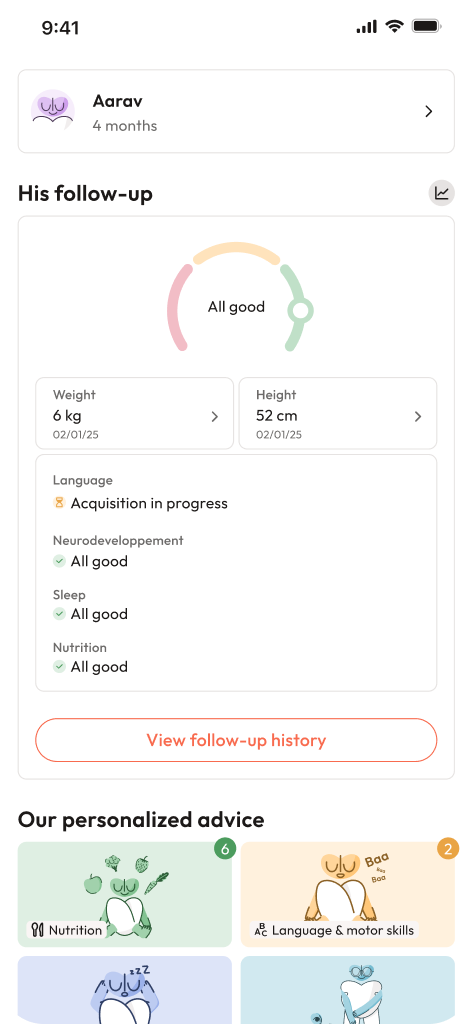
- Support is available through your paediatrician and eye specialists. You can also download the Heloa app for personalised tips and free child health questionnaires.
Further reading:
- NIH-funded study proposes blurry vision in babies may … (https://www.nei.nih.gov/research-and-training/research-news/nih-funded-study-proposes-blurry-vision-babies-may-guide-brain-development)
- Newborn Warning Signs | Children’s Hospital of Philadelphia (https://www.chop.edu/pages/newborn-warning-signs)