Language development can feel like a daily puzzle in Indian homes—especially when grandparents compare, neighbours comment, and every child in the playgroup seems to be doing something different. One baby babbles nonstop in the pram, another watches quietly with sharp eyes. You may be thinking: Is it just a phase? Talk more? Or is it time to consult someone?
The aim stays steady: protect your child’s confidence and relationships while strengthening language development through warm, realistic routines.
Language development basics parents can relate to
Language development is not only talking. It begins very early—in a shared look, a smile answered by your voice, a tiny pause where you and your baby take turns.
What language development includes (receptive, expressive, speech, communication)
Language development includes understanding what others say, expressing ideas, and communicating effectively in everyday life.

- Receptive language: what your child understands (words, sentences, routines, meaning).
- Expressive language: what your child communicates outwardly (sounds, meaningful gestures, words, signs, sentences, grammar).
Speech is not the same as language.
- Speech is the physical production of sounds (how the lips, tongue, jaw, breath, and voice work together).
- Language is the system behind those sounds: vocabulary, word order, grammar, meaning.
- Communication is broader still: pointing, showing, facial expression, eye contact, later drawing or writing.
A child can have clear speech but struggle to find words or build sentences. Another child can have strong ideas and vocabulary, but speech that is hard to understand because sound production is still immature—or disordered.
The building blocks of language development (sounds, words, grammar, social use)
Language is a system of signs used to communicate—and to organise thinking. It relies on several interacting components:
- Phonology: speech sounds, rhythm, and intonation (prosody)
- Semantics: word meanings and concepts (vocabulary depth matters, not only the number of words)
- Grammar: morphology and syntax (small word parts, agreements, word order)
- Pragmatics: using language in real situations (requesting, narrating, joking, repairing misunderstandings)
Many parents ask, “If I keep talking to my baby, is that enough?” Not exactly. What supports language development most is interaction: eye contact, responses, turn-taking, and pauses that invite your child to reply—by gesture, sound, or word.
Spoken, signed, and early written-language foundations
Spoken languages and signed languages are complete languages. If a child uses signs (family choice, hearing needs, or speech needs), it often reduces frustration and increases back-and-forth—again, a driver of language development.
Early written-language foundations start long before a child reads. Picture talk, naming objects, rhymes, and shared books build skills later used for decoding and comprehension.
Typical variation vs language delay and speech delay
Variation is normal. Some children say first words at 10–12 months, others closer to 15–18 months. Some speak early but with unclear pronunciation, others are quiet initially and then progress fast.
A delay becomes more likely when progress stalls, understanding stays limited, or day-to-day communication is difficult.
Signs that deserve medical attention include:
- No babbling or very limited vocal play by around 9–12 months
- No meaningful gestures (pointing, showing, waving) by 12 months
- No words by around 16 months
- No two-word combinations by around 2 years
- Loss of skills at any age (regression)
- Persistent difficulty following simple directions compared with peers
- Speech that remains very hard to understand for age
When concerns arise, a hearing evaluation is often an early step. Even mild or fluctuating hearing loss (for example due to middle-ear fluid after frequent colds) can reduce access to speech sounds and slow language development.
Before words: nonverbal communication, joint attention, and turn-taking
Before producing words, a baby already communicates: staring, relaxing to your voice, vocalising, stiffening, reaching arms out. These signals build two foundations:
- Joint attention: you and your child focus on the same thing at the same time.
- Turn-taking: your baby sounds/looks, you respond, then you pause.
These early conversations made of coos, babbles, and shared silences count—deeply—for language development.
How language development grows over time
Language acquisition: trajectories, variability, and “late talkers”
Language growth is not a straight line. Many children show bursts of progress, plateaus, and then another leap—especially between 18 months and 3 years.
“Late talkers” usually refers to toddlers with slower expressive vocabulary around 18–24 months. Many catch up by age 3, particularly when receptive language is strong and overall development is typical.
A practical question helps: over the months, is your child adding new ways to communicate—more gestures, more sounds, more words, more combinations? That direction of change is central to language development.
Receptive vs expressive language development (understanding often comes first)
It is common for receptive abilities to lead expressive skills. A toddler may follow “Put the cup on the table”, yet only say “cup”.
This gap is often reassuring when progress continues and communication becomes richer. When receptive language is also behind—difficulty understanding everyday words, not following simple directions, seeming “lost” in routine talk—this may point to broader language processing difficulties and deserves early assessment.
For bilingual children in India (for example, home language plus English at preschool), receptive skills can look uneven depending on exposure. For language development, it is more accurate to look at communication across both languages than to count words in only one.
Speech development vs language development (clear distinctions)
Speech development is about sound patterns and clarity. Language development is about vocabulary, grammar, meaning, and social use.
- A speech delay may look like: your child wants to talk, understands well, uses sentences, but many sounds are unclear, so unfamiliar people struggle.
- A language delay may look like: speech sounds are fairly clear, but vocabulary is small, sentences stay very short for age, or your child struggles to understand and follow language.
Because these profiles can overlap, evaluation usually looks at speech and language together, plus hearing and overall development.
Language development milestones from birth to 6 years (without obsessing over numbers)
Milestones are trends, not a competition. A useful question is: “Is it moving forward? Is my child trying to communicate?”
0–6 months
- Reacts to intonation and orients towards voices
- Builds eye-contact-and-voice exchanges
- Produces varied cooing and early vocal play
6–12 months
- Babbling becomes more structured (sometimes repeated syllables)
- Imitates and uses intentional gestures (reaching, showing)
- Responds to name, understands routines and simple requests in context
Red flags to discuss with a clinician: no babbling by 12 months, no gestures by 12 months, or limited response to sounds/name.
12–24 months
- First words often emerge between 12 and 18 months (wide variation)
- “Single-word sentences”: one word can carry a full intention
- Vocabulary often accelerates after 18 months
- Two-word combinations usually appear between 18–24 months (“more milk”, “daddy go”)
Red flags: very few words by 18 months, no two-word combinations by 24 months, or limited understanding of simple requests.
2–3 years
- Longer phrases (often 3–4 words), grammar under construction
- Understands richer instructions when the situation is familiar
- Begins to tell a small event (“park… swing… fall”)
- Speech clarity improves, unfamiliar listeners usually understand a good portion by age 3
Red flags: limited sentence use by 3 years, little vocabulary growth, persistent comprehension difficulties, or speech that is very hard to understand outside the family.
3–6 years
- More precise articulation and more complex sentences
- Talks beyond the present (yesterday, tomorrow, pretend)
- Growing narrative skills: describing feelings, explaining, recounting events
- Social communication strengthens: turn-taking, staying on topic, adjusting speech to the listener
Red flags: limited sentence complexity after 4 years, persistent difficulty being understood, frequent trouble understanding everyday language, or ongoing difficulty using language socially.
The science behind language development
Brain development, neuroplasticity, and sensitive periods
The brain builds and strengthens connections based on experience. Repeated, meaningful interactions—talking, singing, reading, playing—support the neural networks involved in listening, understanding, and producing language.
There are sensitive periods when certain learning is especially efficient. Speech sounds, first words, and early combinations are often learned quickly with warm, regular input. Later learning remains possible—nothing is fixed—but it can require more support.
Learning mechanisms: statistical learning, pattern detection, distributional cues
Children learn language by detecting patterns:
- statistical learning helps them notice which sounds and words often occur together
- pattern detection supports finding word boundaries in fluent speech
- distributional cues help infer meaning and grammar from context
This learning happens mainly through everyday exposure, not formal teaching.
Social-cognitive foundations: joint attention, theory of mind, executive functions
Language grows inside relationships:
- joint attention helps children link words to what they see and do
- theory of mind supports understanding that others have thoughts and intentions
- executive functions (attention, working memory, flexibility) help children follow directions and shift topics
What can influence language development
Everyday interactions: the real engine
The number-one driver is daily life: meals, bath time, dressing, school drop-off, errands, temple visits, a walk downstairs—anything. The setting matters less than the quality: speech directed to your child, matched to what they are doing, and pauses that leave room to respond.
Shared reading (yes, even the same book again and again)
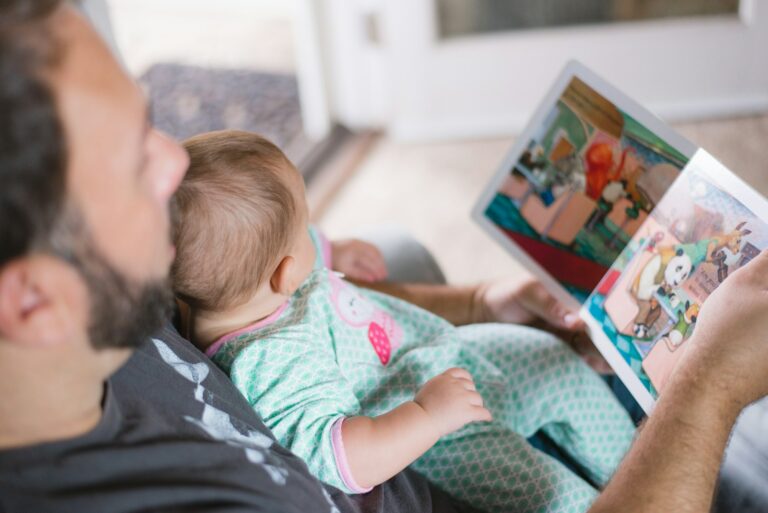
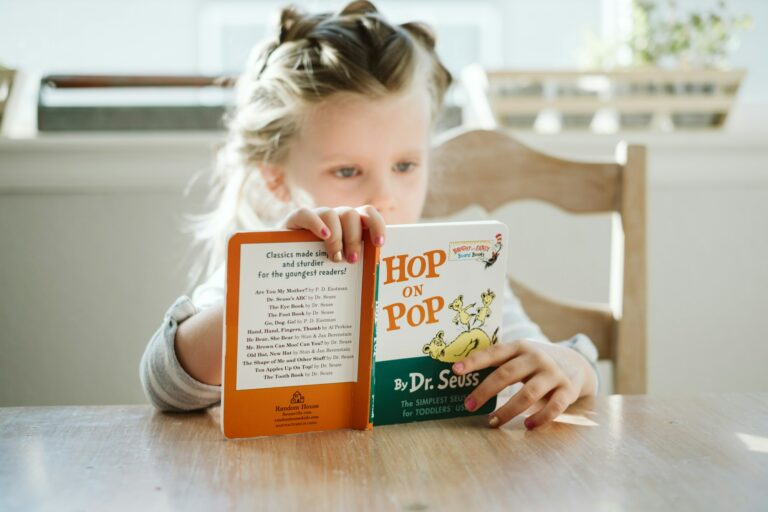
Shared reading brings vocabulary, sentence patterns, and story sense. Repetition feels safe and predictable, and it helps your child anticipate what comes next and start participating.
Interactive reading helps most: naming pictures, predicting, and linking the story to your child’s daily life.
Hearing and the sound environment
To learn sound contrasts, children need clear access to speech sounds. Fluctuating hearing changes (such as persistent middle-ear fluid) can slow language development: consonants may sound muffled, word endings may be missed.
Simple habits that help:
- Get face-to-face at your child’s level
- Reduce background noise (especially TV)
- Speak clearly without exaggerating
Media and technology: screens, content quality, and co-viewing
Passive screen time can crowd out interaction.
- For toddlers, prioritise real conversation and play
- If screens are used, co-view and talk about what you see
- Avoid background TV, it reduces conversational turns
Bilingual and multilingual development
Bilingualism is not a cause of language delay. Children can build two (or three) language systems well.
Vocabulary is often distributed across languages. Mixing languages in a sentence is common and usually purposeful. A true language disorder tends to affect communication across languages, not only in the less-exposed one.
Practical ways to support language development day to day (without pressure)
Support works best when it feels like connection, not a lesson.
Responsive interaction: follow your child’s lead and build back-and-forth
Watch what your child is focused on, join in, and talk about that. Pause often. Give time for a response—words, sounds, or gestures all count for language development.
Try commenting and then waiting 2–3 seconds.
Name, comment, connect (short is enough)
Put words on:
- Actions (“You pour”, “You stack”)
- Your actions (“I open”, “I keep it back”)
- Feelings (“You’re proud”, “You’re upset”)
Two simple sentences can create a mini-story: “Shoes on. We go outside.”
Expansions and recasts: model richer sentences without pressure
- Recasts: repeat correctly without demanding repetition
- Child: “More juice.”
- Parent: “You want more juice.”
- Expansions: add one detail
- Parent: “Yes, you want more juice in your cup.”
Songs, rhymes, and sound play
Rhymes train the ear: rhythm, repetition, rhyme. Between about 3 and 6 years, these games support phonological awareness (syllables, rhymes, beginning sounds), which supports reading later.
Pretend play (symbolic play)
Kitchen sets, toy cars, dolls, “doctor-doctor”, pretend shop—pretend play supports requesting, explaining, negotiating, and inventing.
When extra support helps
If concerns persist, do not wait for school age.
Contact a professional if you notice:
- Prolonged stagnation (few new words, few new communication intentions)
- Understanding that seems weak (does not respond to name, simple requests are hard)
- Few communicative gestures (showing, pointing, waving)
- After age 2–3, no word combinations or speech that is very difficult to understand in most contexts
Regression (loss of skills)
Losing words or gestures that were already present, or a clear drop in interaction, needs prompt medical attention.
Hearing checks can change the whole plan
When speech or language progress is slow, checking hearing is often an important step—especially with recurrent ear infections or concerns about middle-ear fluid.
What a speech-language evaluation looks at
Speech-language pathologists look at receptive and expressive language, phonology, articulation, pragmatics, and how your child communicates during interaction. Your child’s language exposure and medical and hearing history guide interpretation.
Key takeaways
- Language development starts before words: eye contact, gestures, joint attention, and turn-taking are foundational.
- Understanding often comes before speaking, steady progress matters more than one milestone.
- Daily routines, shared reading, songs, and pretend play support language development.
- Hearing and a calmer sound environment help children hear speech sounds clearly.
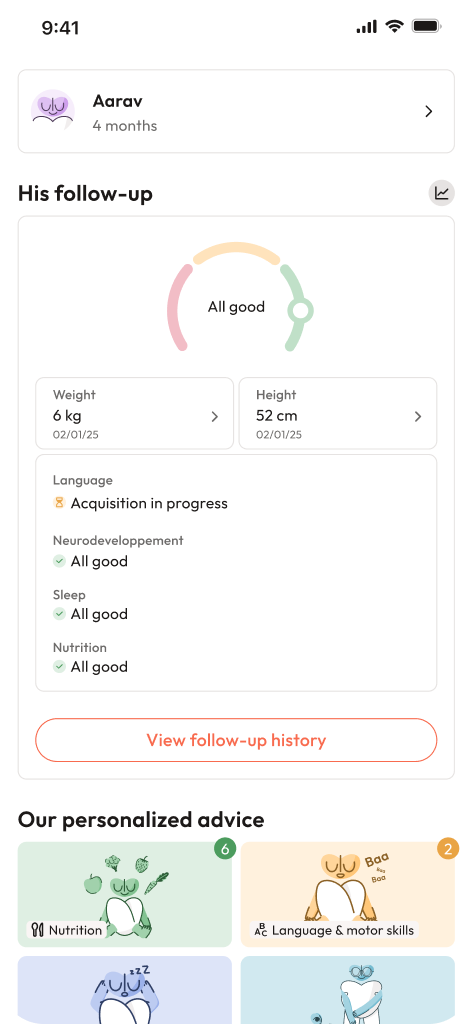
- If progress stalls, skills go backward, or worries persist, your paediatrician and a speech-language pathologist can support your family. You can also download the “Heloa app” (https://app.adjust.com/1g586ft8) for personalised advice and free child health questionnaires.

Further reading:
- Speech and Language Developmental Milestones – NIDCD: https://www.nidcd.nih.gov/health/speech-and-language
- Speech and language development from birth to 12 months: https://www.gosh.nhs.uk/conditions-and-treatments/procedures-and-treatments/speech-and-language-development-birth-12-months/