Language development can feel like a daily mystery. One day your baby “answers” with a squeal and a wide-eyed stare, the next, silence—then a sudden burst of new sounds at bedtime. Many parents start wondering: Is my child simply taking their time? Should we talk more, read more, worry less… or ask for help sooner?
The aim stays steady: support language development with strong, calm foundations—without turning family life into a training session.
Language development: what it really includes
When people say “language,” they often mean “words.” Yet language development is bigger, earlier, and more multi-layered than that.
Receptive, expressive, speech, and communication: four pieces that don’t always match
- Receptive language = what your child understands (words, routines, simple instructions, meaning). It often runs ahead of speaking.
- Expressive language = what your child communicates outwardly (sounds, gestures, signs, words, sentences, grammar).
- Speech development = the motor and acoustic side: how lips, tongue, jaw, breath, and voice produce sounds clearly.
- Communication = the whole package: pointing, showing, facial expression, eye contact, later drawing and writing.
So yes: a child can speak clearly but struggle to build sentences. Another can have rich ideas, but speech that is hard to understand because sound patterns are still immature.


The building blocks that drive language development
Think of language development as a system with interacting parts:
- Phonology (sound patterns, rhythm, prosody: intonation and stress)
- Semantics (meaning: vocabulary, concepts—depth matters, not only quantity)
- Grammar (morphology + syntax: word endings, word order, agreements)
- Pragmatics (social use: requesting, narrating, joking, repairing misunderstandings)
You may be asking: “If I talk all day, will that do it?” Talking helps—interaction helps more. Face-to-face exchange, pauses, turn-taking, and responding to your child’s attempt (even a grunt) are the real fuel for language development.
Spoken language, signed language, and early literacy foundations
Signed languages are full languages with grammar and vocabulary. For some families, baby signs are a communication bridge, for others, sign language is essential due to hearing needs. Either way, giving a child a way to express wants can reduce frustration and increase back-and-forth—the heart of language development.
Early literacy starts long before reading:
- naming pictures,
- sharing books (often the same one, again),
- playing with rhymes,
- scribbling and “pretend writing,”
- noticing letters (especially in a name).
These small moments build later reading and comprehension skills.
Normal variation vs speech delay vs language delay
Variation is expected. Some children say first words at 10–12 months, others closer to 15–18 months. Some talk early but are hard to understand, others are quiet, then suddenly accelerate.
A delay becomes more likely when progress stalls, understanding is consistently limited, or daily communication feels hard for your child.
Signs that deserve medical attention
Talk with a clinician if you notice:
- little or no babbling by about 9–12 months
- no meaningful gestures (pointing, showing, waving) by 12 months
- no words by around 16 months
- no two-word combinations by around 2 years
- loss of skills at any age (regression)
- difficulty following simple directions compared with peers
- speech that stays very hard to understand for age
One early step is often a hearing assessment. Even mild or fluctuating hearing loss (common with middle-ear fluid) can reduce access to speech sounds and slow language development.
Before words: nonverbal communication that counts
Before “mama” and “ball,” a baby already communicates: looking, vocalizing, reaching arms out, stiffening, calming to your voice. Two foundations matter a lot:
- Joint attention: you and your child focus on the same thing at the same time.
- Turn-taking: your baby makes a sound, you respond, your baby pauses—then tries again.
Those early “conversations” made of coos, babbles, and shared silence are not filler. They are core language development work.
How language development grows over time
Bursts, plateaus, and “late talkers”
Growth is rarely linear. Many toddlers show a plateau, then a leap—especially between 18 months and 3 years.
“Late talker” usually describes slower expressive vocabulary around 18–24 months. Many children catch up by age 3, particularly when receptive skills are strong and overall development is typical. A smaller group continues to have difficulties into preschool and school age, more often when:
- comprehension is also weak,
- gestures are limited,
- family history suggests language difficulties.
A helpful question is simple: Is your child adding new ways to communicate over months—more gestures, more sounds, more words, more combinations? Direction matters for language development.
Receptive vs expressive language development: understanding often leads
A toddler might follow “Put the cup on the table” while saying only “cup.” This gap can be reassuring if your child keeps progressing.
If receptive language is also delayed—difficulty understanding everyday words, not following simple directions, seeming “lost” in routine talk—an early assessment is wise.
In bilingual children, receptive skills can develop unevenly depending on exposure. For language development, look across both languages: total concepts often tell a truer story than counting words in only one language.
Speech development vs language development: not the same problem
- A speech delay can look like: strong understanding and good sentence use, but unclear sounds so unfamiliar listeners struggle.
- A language delay can look like: relatively clear sounds, but small vocabulary, short sentences, limited comprehension, or trouble using language socially.
These profiles may overlap, so evaluations usually explore speech, language, hearing, and overall development together.
Language development milestones from birth to 6 years (trends, not a contest)
Milestones are patterns. A better question than “Is my child on time?” is: “Is communication moving forward?”
0–6 months
- reacts to voices and intonation
- builds eye-contact-and-voice exchanges
- coos, experiments with early vocal play
6–12 months
- babbling becomes more structured (often repeated syllables)
- uses intentional gestures (showing, reaching)
- responds to name, understands routines in context
Talk with a clinician if there is no babbling by 12 months, no gestures by 12 months, or limited response to sound/name.
12–24 months
- first words often appear between 12 and 18 months (wide variation)
- “single-word sentences” (one word can carry a full message)
- vocabulary often accelerates after 18 months
- two-word combinations usually appear between 18–24 months (“more milk,” “daddy go”)
Red flags: very few words by 18 months, no two-word combinations by 24 months, or limited understanding of simple requests.
2–3 years
- 3–4 word phrases, grammar under construction
- follows richer directions when the situation is familiar
- begins mini narratives (“park… swing… fall”)
- speech clarity improves, unfamiliar listeners understand a good portion by age 3
Concerns: limited sentence use by 3 years, little vocabulary growth, persistent comprehension difficulties, or speech that remains very hard to understand outside the family.
3–6 years
- clearer articulation, more complex sentences
- talks beyond the present (yesterday, tomorrow, pretend)
- growing narrative skills: feelings, explanations, recounting events
- stronger pragmatics: turn-taking, staying on topic, adjusting to the listener
Concerns: limited sentence complexity after 4 years, persistent difficulty being understood, frequent trouble understanding everyday talk, or ongoing social-communication difficulties.
The science behind language development (in parent-friendly terms)
Brain development, neuroplasticity, and sensitive periods
The brain strengthens connections based on experience—especially repeated, meaningful interaction. Warm routines (talking, singing, reading, playing) support the neural networks used for listening, understanding, and speaking.
There are “sensitive periods” when certain learning is especially efficient (like tuning into speech sounds). Later learning still happens—nothing is fixed—but it may require more support for language development.
How children learn: pattern-finding in real life
Children detect patterns constantly:
- statistical learning (what sounds/words tend to occur together),
- word-boundary detection (finding “where a word starts” in fluent speech),
- distributional cues (meaning and grammar inferred from context).
It’s not school-style teaching. It’s everyday exposure, repeated many times, in many contexts.
Social-cognitive foundations: why relationship matters
Language grows inside relationships:
- joint attention links words to what a child sees and does,
- theory of mind supports conversation and storytelling (others have thoughts and intentions),
- executive functions (attention, working memory, flexibility) help children follow directions and shift topics.
What influences language development day to day
Everyday interaction: the real engine
Meals, bath time, dressing, errands—these are prime time for language development. The setting matters less than the quality:
- talk that matches what your child is doing,
- short phrases,
- pauses that give room to respond.
Shared reading (even the same book again)
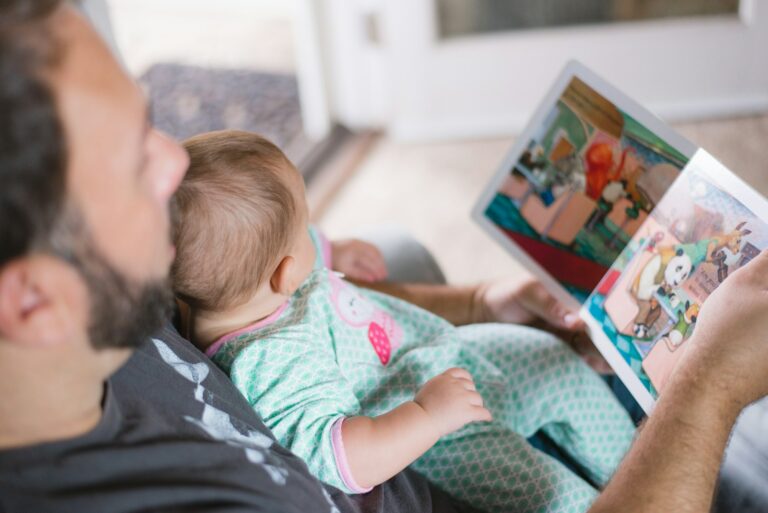
Repetition is not wasted. Predictable books feel safe and let children anticipate, point, and eventually “fill in” words. Interactive reading helps most:
- name pictures,
- ask simple prediction questions,
- connect the story to your child’s life.
Social life: siblings, childcare, preschool
More partners can sharpen pragmatics: waiting, clarifying, adapting the message. Some children talk little in groups but a lot at home (or the reverse). Focus on functional communication and forward movement in language development.
Hearing and the sound environment
Clear access to speech sounds supports learning sound contrasts. Middle-ear fluid can blur consonants and word endings.
Helpful habits:
- get face-to-face at your child’s level,
- reduce background noise (especially TV),
- speak clearly, without exaggerated “baby voice.”
Media and technology
Passive screen time can replace interaction. Content quality and adult involvement change the effect:
- for toddlers, prioritize real play and conversation,
- if screens are used, co-view and talk about what you see,
- avoid background TV, it reduces conversational turns.
Bilingual and multilingual development
Bilingualism does not cause language delay. Vocabulary is often distributed: “spoon” in one language, “kitchen” in another. Mixing languages in one sentence is common and often intentional.
When evaluating language development, describing exposure (who speaks which language, how often, in what routines) is more informative than comparing a child to monolingual word counts.
Practical ways to support language development (without pressure)
Support works best when it feels like connection, not performance.
Responsive interaction: follow your child’s lead
Join what your child is focused on. Comment, then pause 2–3 seconds. That pause is often where a gesture, sound, or word appears—small, but meaningful for language development.
Name, comment, connect: short is powerful
Put words on:
- actions (“You pour.”)
- your actions (“I open.”)
- feelings (“You’re upset.”)
Two short sentences can make a mini story: “Shoes on. We go outside.”
Expansions and recasts: richer models, no pressure
Two effective techniques:
- Recasts: repeat correctly, no demand
- Child: “More juice.”
- Adult: “You want more juice.”
- Expansions: add one detail
- Adult: “You want more juice in your cup.”
This builds grammar and vocabulary while keeping the moment relaxed—excellent for language development.
Songs, rhymes, and sound play
Rhymes train the ear: rhythm, repetition, rhyme. From about 3 to 6 years, these games support phonological awareness (syllables, rhymes, beginning sounds), which later supports reading.
Pretend play (symbolic play)
Dolls, toy cars, “doctor,” “kitchen”—pretend play encourages requesting, explaining, negotiating, and inventing. A few minutes together can launch the whole scenario.
Age-based activity ideas that fit real life
0–12 months
- imitate your baby’s sounds, then pause (turn-taking)
- peekaboo and facial-expression games
- simple picture books: one word, one sentence, then silence
12–24 months
- books: “Show me the cat,” then “The cat says meow”
- guided choices: “Apple or banana?”
- mini stories with 2–3 pictures
2–3 years
- sorting by categories (animals, vehicles, “things that roll”)
- pretend play with short dialogues
- describe a picture, then ask: “And then what?”
3–6 years
- sequence pictures: “First… then…”
- rhyming games, clap syllables
- adult dictation: your child says a sentence, you write it down
When extra support helps: acting early, without panic
If concerns persist, waiting for school age can mean losing valuable time for easier progress.
Consider a professional exchange if you notice:
- prolonged stagnation (few new words or new communication intentions)
- weak comprehension (name response inconsistent, simple requests stay hard)
- few communicative gestures (showing, pointing, waving)
- after age 2–3, no word combinations or speech that is very difficult to understand in most contexts
Regression (loss of skills) needs prompt attention
Losing words or gestures that were present, or a clear drop in interaction, warrants rapid medical evaluation.
Hearing checks can change the plan
With slow speech or language development, checking hearing is often decisive—especially with recurrent ear infections or suspected middle-ear fluid.
What a speech-language evaluation usually explores
A speech-language pathologist may look at:
- receptive and expressive language
- phonology and articulation
- pragmatics (social communication)
- interaction style and play
- medical history, hearing history, and language exposure
Teamwork makes the path clearer
Support may involve a primary care clinician, audiology/ENT, a speech-language pathologist, and childcare or school staff. Shared goals reduce mixed messages and help daily life feel steadier.
Key takeaways
- Language development begins before words: eye contact, gestures, joint attention, and turn-taking are foundational.
- Understanding often comes before speaking, progress over months matters more than a single milestone.
- Daily routines, shared reading, rhymes, and pretend play strengthen vocabulary, grammar, and social communication.
- Hearing and a calmer sound environment support access to speech sounds and smoother language development.
- If progress stalls, skills go backward, or worries persist, professionals can help (and hearing checks are often an early step). For personalized guidance and free child health questionnaires, you can also download the Heloa app.
Questions Parents Ask
Can my child understand language even if they don’t say many words yet?
Yes—this is very common, and often reassuring. Many toddlers develop receptive language (understanding) ahead of expressive language (speaking). Signs to look for include: responding to familiar routines, bringing objects when asked, or reacting appropriately to simple questions. If understanding also seems limited over time (not following simple directions, inconsistent response to name), a gentle check-in with a clinician can help clarify the next step—often starting with hearing.
Does using two languages confuse a child or cause a delay?
Rassurez-vous: bilingualism does not cause language delay. Vocabulary can be “shared” across languages—your child may know spoon in one language and kitchen in another. Mixing languages in the same sentence is also typical and usually reflects flexible communication, not confusion. When you wonder about progress, it’s often more meaningful to consider what your child can communicate across both languages rather than counting words in only one.
Is early stuttering normal in toddlers?
It can be. Between about ages 2 and 5, many children go through phases of repeating words or sounds, especially during big language leaps. A supportive approach helps: slow your own pace, keep eye contact, and let them finish without rushing. If stuttering lasts several months, seems effortful (blocks, tension), or your child starts avoiding speaking, a speech-language pathologist can offer calm, effective support.

Further reading:
- Speech and Language Developmental Milestones – NIDCD: https://www.nidcd.nih.gov/health/speech-and-language
- Speech and language development from birth to 12 months: https://www.gosh.nhs.uk/conditions-and-treatments/procedures-and-treatments/speech-and-language-development-birth-12-months/