Parents in India often ask a very practical question: “Which toys will my child actually use… and not forget in two days?” With pretend play toys, the real magic is not batteries or big promises. It is the moment your child starts acting “as if”: serving chai to a teddy, running a kirana shop on the sofa, or giving a “doctor check-up” before bedtime. Simple scenes, big learning.
Many families are balancing limited space, joint family routines, siblings of different ages, and genuine safety worries (tiny parts, magnets, button batteries). So let’s keep it clear and doable: how pretend play develops, why pretend play toys matter medically and developmentally, which sets suit each age, and how to choose safe materials.
What pretend play toys are (dramatic play, make-believe, small-world play)
Pretend play toys are props that help children act out real or imagined situations: cooking, caregiving, repairing, travelling, shopping, teaching. In early childhood development you may hear:
- Dramatic play: taking roles (parent, chef, firefighter) and acting them out with words and actions.
- Make-believe (symbolic play): using one thing to represent another (a block becomes a phone, a dupatta becomes a cape).
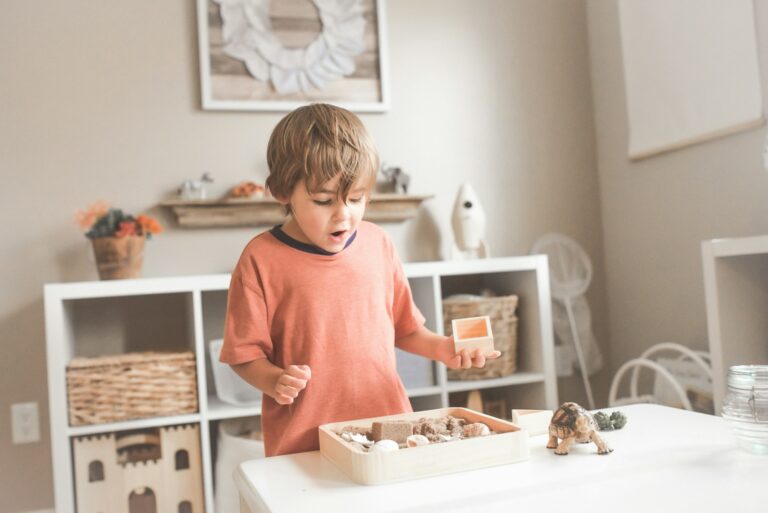
- Small-world play: building stories with miniatures, animals, vehicles, people, dollhouses, little scenes.
From a paediatric viewpoint, the value is not perfect realism. The value is flexibility: can the toy allow your child to repeat routines, link steps, and practise social exchanges, without the pressure to “do it correctly”?

Pretend play vs role play vs sensory play
These terms overlap. The easiest way is to look at the goal.
- Pretend play: the umbrella term, acting “as if”.
- Role play: pretend play with a clear role (doctor, teacher, shopkeeper).
- Sensory play: touching, shaking, banging, mouthing. Important in infancy, but not mainly about storytelling.
If your toddler “calls” someone using a TV remote, they are practising a social gesture that already carries meaning.
Why pretend play toys matter for child development
You may be wondering: “It looks like timepass… but is it really building skills?” Yes. Children learn through repetition, emotion, and connection.
Brain-building through sequencing (planning, linking steps, working memory)
When a toddler reenacts “bath time” or “meal time,” they practise:
- organising a sequence (start -> middle -> end)
- cognitive flexibility (if the spoon falls, try a different way)
- working memory (hold the goal: feed the doll)
Even “I pour” is a tiny plan being executed. Over weeks, these small plans support attention span and problem-solving.
Language and communication (vocabulary, storytelling, turn-taking)
Pretend play toys naturally create reasons to speak: naming, requesting, negotiating roles, and narrating.
Children practise:
- vocabulary (food items, tools, body parts, community helpers)
- narrative structure (beginning-middle-end)
- pragmatic language (politeness, turn-taking, asking for help)
A parent technique that works well is recasting: slightly upgrading your child’s words.
Child: “Baby sick.”
You: “Baby is feeling sick. Let’s check temperature.”
No drilling. No “say properly.” Just a calm model.
Social-emotional learning (empathy and emotion regulation)
Pretend play lets feelings sit at a distance: “Teddy is scared” can be easier than “I am scared.” This distance is useful for emotion regulation (the ability to return to calm after stress).
Try one short adult sentence:
“You are rocking him, he is calming down.”
That kind of narration links emotion + body cue + soothing action.
Executive function (self-control, planning, shifting)
Executive function is the brain’s management system: planning, switching strategies, and controlling impulses.
Pretend play strengthens it when children decide roles, remember a routine (check-in -> exam -> treatment), and adapt when the story changes.
A small but powerful sign is when your child can pause and say, “Wait, first we do this.” That is impulse control growing in front of you.
Motor skills (fine motor and whole-body coordination)
Many pretend play toys build fine motor control and coordination:
- zips, buttons, Velcro in dress-up
- toy utensils, tongs
- opening and closing containers
- dressing a doll
- pushing a stroller, sweeping, carrying a basket
If your child struggles with frustration, start with bigger pieces. Small pieces can come later.
Real-life transfer (confidence, routines, participation)
Many parents notice the shift from “as if” to “I can”: after play practice, children often want to help for real. Participation matters more than perfection.
In Indian homes, pretend routines often mirror daily life: setting plates, mixing “dal,” packing a school bag, doing a “video call” to grandparents. That familiarity makes pretend play feel meaningful.
When pretend play emerges: developmental landmarks (0 to 3 years)
Pretend play develops gradually.
- 0-6 months: face-to-face exchanges, smiles, cooing
- 6-12 months: imitation of gestures (clapping, waving)
- 12-18 months: single imitated actions with objects (feeding, brushing)
- 18-24 months: chaining actions (“prepare, serve, clean up”)
- 24-36 months: richer scenarios, early dialogues
You may be wondering what is “expected.” Children vary, but if shared attention and communicative gestures feel consistently limited (little pointing, showing, giving), or symbolic pretend play is absent after age 2-3, do consider discussing it with your paediatrician or a developmental specialist.
Clinicians often look at joint attention (the child and adult sharing focus on the same object) because it supports language and social development. It can look like: your child points at a toy, looks at you, then looks back at the toy. Simple, but important.
Types of pretend play toys families often choose first
Dress-up pretend play toys and role play costumes
Costumes trigger instant role exploration. In Indian homes, even everyday items can become costumes: an apron, a cap, a scarf. Avoid long cords.
What works well:
- breathable fabric (children overheat easily)
- simple closures
- items a child can remove independently (this reduces power struggles)
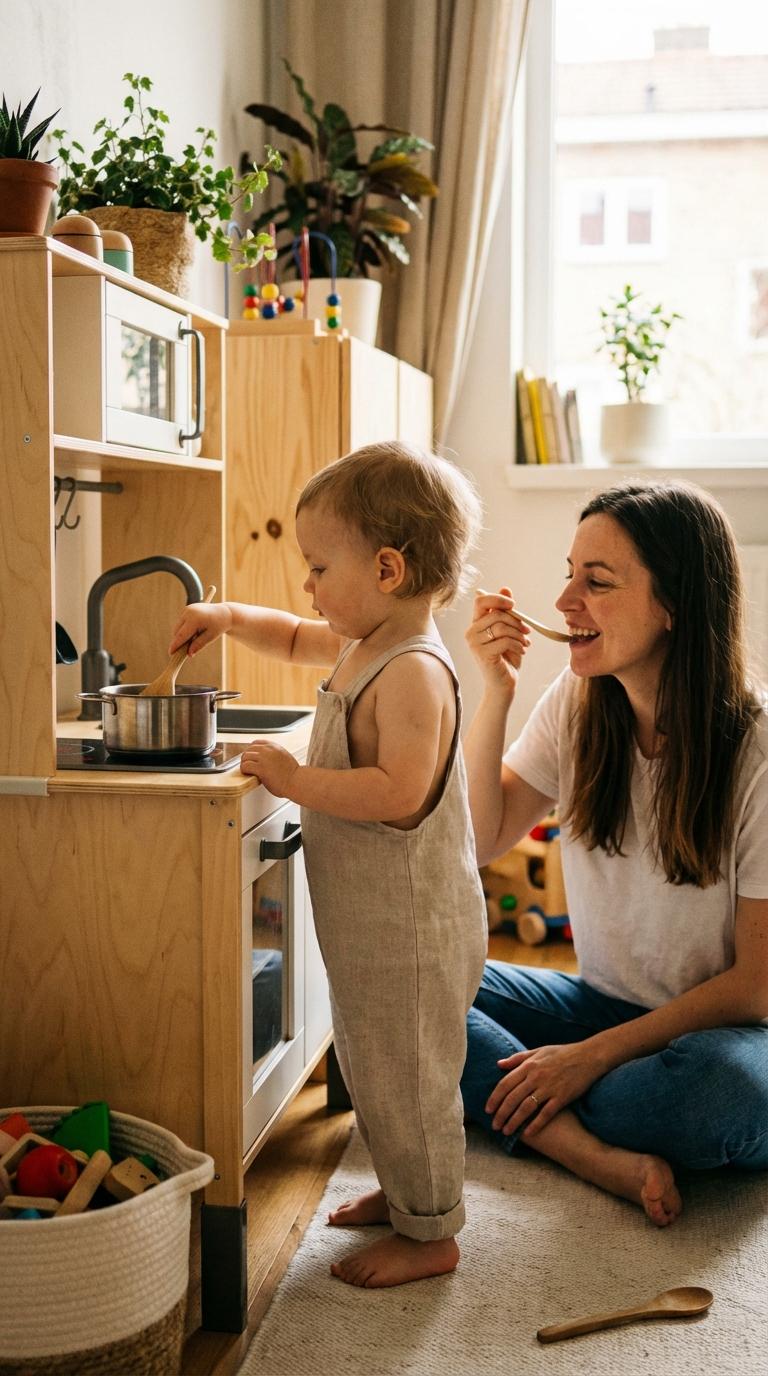
Pretend play kitchen toys and play food sets
Kitchen play supports sequencing (“wash -> cut -> cook”), vocabulary, and concepts like hot/cold and full/empty.
If you want long-term use, look for:
- pieces that can be wiped (toddlers share toys with their mouths)
- large food pieces for under-3s
- a few containers that open and close (excellent fine-motor practice)
Grocery store pretend play toys and shopping role play
A “shop” game is very natural for Indian children: kirana store, fruit vendor, bill counter. Add a paper bag and a notepad, and suddenly the story becomes longer.
Language you will hear (and can model):
- “How much?”
- “Give change”
- “One kilo” (even if it is imaginary)
Keep play coins large for safety.
Doctor kit pretend play toys and medical role play
Medical role play can reduce worry by making things predictable.
Choose sets without sharp points and with large pieces if younger siblings are around. If the set has sound, check that the battery compartment is screwed shut.
A gentle approach:
- let your child be the doctor first
- treat a doll or stuffed animal before “examining” you
- keep the storyline short (hello -> check -> bandage -> bye)
Safety note: never use real medicines, real syringes, or pill-like objects in play.
Tool set pretend play toys and pretend workbench toys
Tool sets give strong “I can fix” satisfaction. They support hand strength and problem-solving language.
For under-3s:
- avoid small detachable parts
- avoid loose magnets
Magnet ingestion can cause bowel injury. If you ever suspect it, urgent medical care is needed.
Doll pretend play toys and family role play
Dolls support caregiving scripts and emotional processing. Many children replay separations and reunions from their day (daycare drop-off, a parent leaving for work).
Prefer washable dolls and skip tiny accessories when a younger child may access them.
Puppet pretend play toys and pretend theatre toys
Puppets can help children speak “through” a character. Some children will share worries via a puppet that they will not say directly.
A simple idea: give the puppet one feeling and one need.
“Puppet is worried. Puppet needs help.” Then pause.
Outdoor pretend play toys and nature role play
Gardening sets, water play, and sandbox tools mix movement with pretend.
Outdoors needs extra supervision: small stones, mud, seeds, and water are mouth-magnets for toddlers.
Pretend play toys by age: best picks for each stage
0-12 months: faces, sounds, and simple imitation
At this stage, pretend play toys are mostly about social imitation: peekaboo, action songs, copying sounds. A baby-safe mirror can help.
Try: one expression, then wait. Waiting time invites response.
12-18 months: one action at a time
Good early pretend play toys:
- a sturdy cup and spoon
- a plush to “feed”
- a chunky toy phone
- a soft doll
Safety basics: avoid cords, button batteries, and tiny removable parts.
18-24 months: first action chains
Common chain: “prepare -> serve -> feed -> wipe -> tidy.” Add one accessory, then let your child lead.
If your child repeats the same chain 10 times, it is not pointless. It is their brain rehearsing predictability.
24-36 months: role play and mini-stories
Stories deepen: doctor, shop, cooking, repairs. Very simple dress-up (hat, scarf) often triggers longer play.
3-5 years: longer narratives
Preschoolers may plan menus, shopping lists, and “appointments.” Add paper signs and notepads to extend play.
If you have older siblings, store tiny accessories separately. What is safe for a 6-year-old may be a choking risk for a toddler.
Pretend play ideas at home (simple, quick, repeatable)
You don’t need a fancy setup. You need a spark.
- 3-step kitchen: “I pour. I mix. I serve.” Ask: “Hot or cold?”
- Express grocery store: two piles, “for sale” and “sold,” swap roles.
- Gentle doctor play: treat teddy, name body parts calmly, add an imaginary bandage.
- Doll routine: feed -> change -> sleep (child chooses the order).
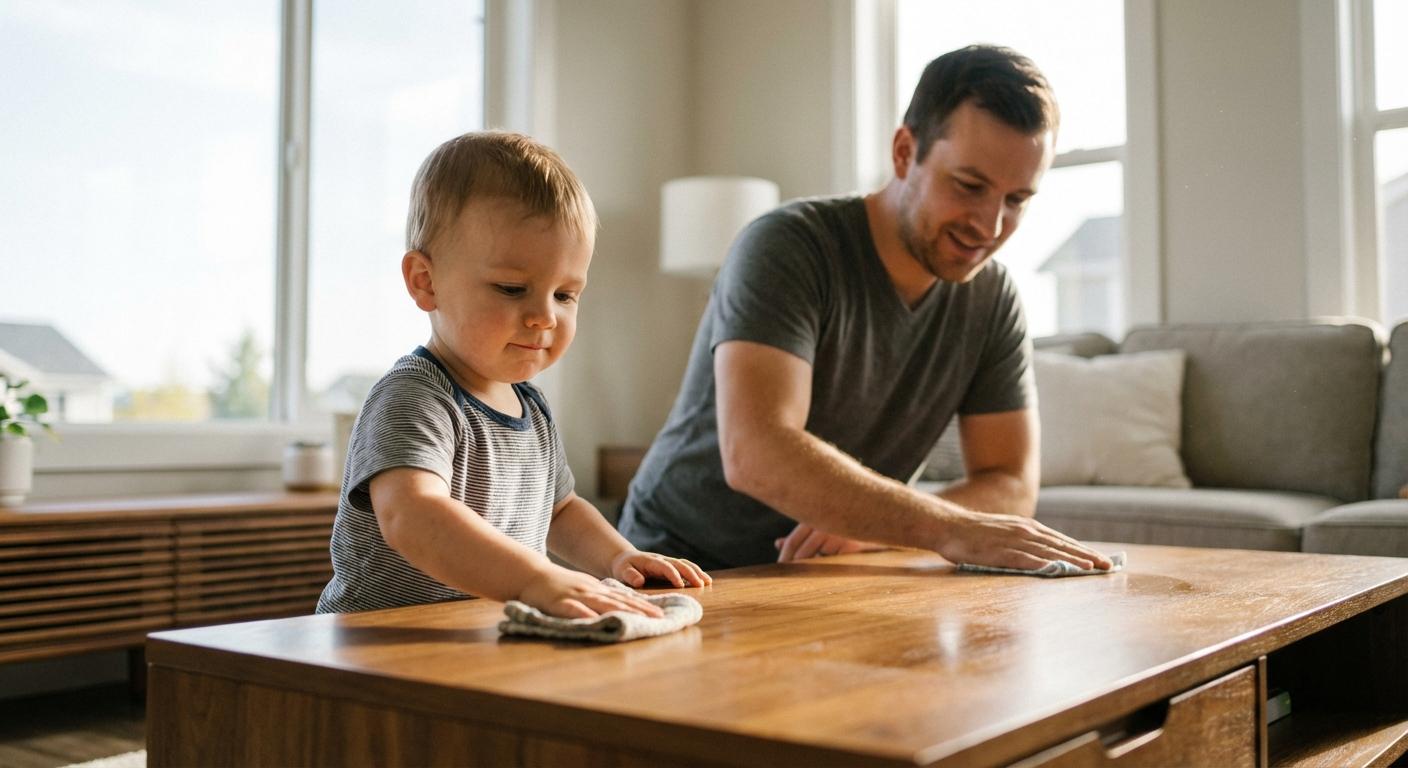
- 2-minute mini-clean: blocks in a basket, quick wipe, stop early.
- Repair shop: prepare -> screw -> test.
- Rhythm concert: tap-tap… pause, add “stop/again.”
Real routines are the best fuel: dress a doll before going out, wash a stuffed animal during bath time, “serve” an empty spoon at meals.
How to choose pretend play toys (safety, materials, common sense)
Match toys to your child’s interest
Interest is the strongest driver of learning. Follow what your child imitates at home: cooking, caring, fixing, travelling.
Open-ended plus themed sets: the best balance
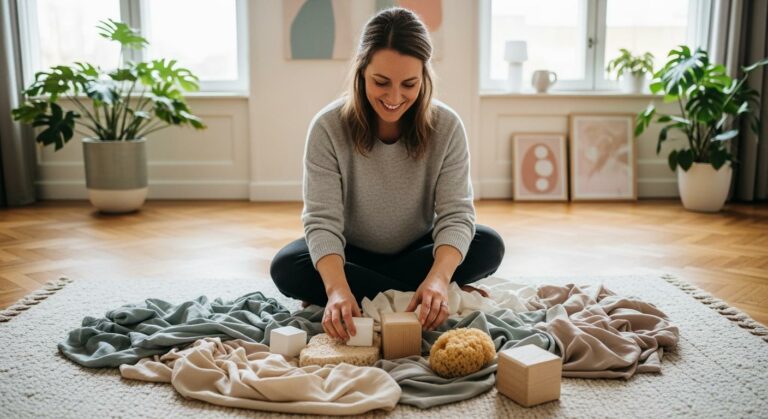
Open-ended props (scarves, boxes, blocks) offer high replay value. Themed sets (kitchen, doctor) act as anchors. Together, they keep play flexible.
Materials and finishes
Wood, plastic, fabric, silicone can all work.
What matters:
- smooth edges
- strong construction
- child-safe finishes
- secured battery compartments (if any)
Re-check regularly for cracks and breakage.
Safety details to check (under 3 especially)
- Small parts: avoid for under-3s
- Magnets: loose magnets are dangerous
- Button batteries: must be secured, keep spares out of reach
- Cords/strings: avoid long cords
Supporting pretend play as a parent
Watch for 30 seconds first. Then join with one simple role that supports your child’s idea. Children often play longer when the adult is a steady helper, not a director.
Keep language brief. One sentence is often enough.
For turn-taking, start with one rule: “Your turn / my turn.” Dialogues often come later.
If frustration rises, shorten the activity: one successful step, then pause. Offer a simple choice: “Continue or take a break?”
Care and maintenance for pretend play toys
Cleaning by material
- Wood: wipe with a damp cloth, do not soak, dry fully
- Plastic: warm soapy water, rinse and dry
- Fabric: machine wash if possible, otherwise spot-clean and dry well
- Silicone: follow maker’s instructions
Store by theme
Closed bins by theme reduce lost pieces and daily stress. For older children’s smaller pieces, use a pouch inside the main box.
When to replace
Replace toys if you notice cracks, sharp edges, exposed stuffing, loose magnets, or a battery compartment that no longer closes securely.
DIY pretend play toys (budget-friendly and effective)
A carton becomes an oven, a shop counter, or a garage. Use tape (not staples), trim sharp edges, and keep the structure stable.
Scarves, aprons, caps, clean old bags create easy roles.
Menus, tickets, and receipts support early writing and counting. Keep coins, buttons, and other small household items away from under-3s.
Conclusion: Key points to remember
- Pretend play toys support language, sequencing, motor skills, executive function, and emotional growth.
- In Indian homes, everyday themes work best: kitchen, kirana shop, doctor, cleaning, dolls, travel.
- Keep safety first for under-3s: small parts, cords, button batteries, magnets.
- If play or communication feels consistently limited after age 2-3, a paediatrician can guide next steps.
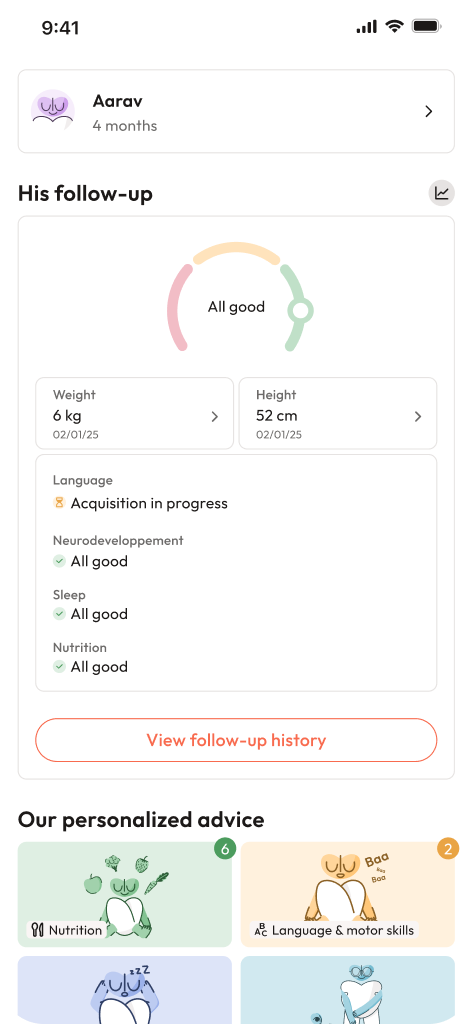
- For personalised tips and free child health questionnaires, you can download the Heloa app.