

Infantile spasms can be one of the most confusing seizure patterns to spot in a baby—quick, repetitive movements that may look like reflux discomfort, colic tightening, or even a harmless startle. Many parents notice “something odd after waking” and then doubt themselves because the baby settles and looks normal again. That doubt is common. Still, when Infantile spasms are the reason, early action matters because ongoing seizure activity and an abnormal EEG can interfere with brain development.
The reassuring part? There is a clear, practical path: learn the typical look and timing of Infantile spasms, record a short video when safe, get an EEG quickly, and start treatment early if confirmed.
Infantile spasms: what they are, and what doctors may call them
Infantile spasms are a seizure type seen mainly in infants. A single spasm often lasts 1–2 seconds, but the hallmark is clusters: many spasms grouped close together, with short pauses in between.
Because babies may look “back to baseline” between spasms, Infantile spasms are easy to misread. Some babies also show a developmental pause (skills stop moving forward) or regression (skills are lost) around the time spasms begin.

You may hear several medical terms:
- Infantile spasms: the seizure type.
- Epileptic spasms: the broader neurologic label.
- West syndrome: spasms plus a typical EEG pattern (often hypsarrhythmia) and developmental impact.
- IESS (infantile epileptic spasms syndrome): another term some specialists use for the same electroclinical syndrome.
Different names, same urgency: suspected Infantile spasms should be confirmed with an EEG (ideally including sleep) and treated without delay.
Why Infantile spasms are treated as urgent
In infancy, brain networks are wiring rapidly. When seizures repeat in clusters and the EEG remains abnormal, the brain’s developing circuits can get disrupted. That is why clinicians treat Infantile spasms as time-sensitive: earlier seizure control is linked with better seizure outcomes and, in many children, better developmental progress.
When Infantile spasms usually start
Age of onset
Most Infantile spasms begin in the first year of life, commonly between 3 and 12 months, with a peak around 4–6 months (many begin around 4–8 months). After 1 year, spasms are less common but can still occur, especially if there is an underlying neurologic condition.
Typical timing during the day
Clusters often appear:
- Soon after waking
- During sleep–wake transitions (falling asleep or just waking)
- Sometimes after a feed, though waking-related clusters are more typical
Babies at higher risk
A NICU stay itself is not the key factor, the reason for intensive care matters. Higher risk is seen when there has been:
- Hypoxic-ischemic encephalopathy (reduced oxygen/blood flow around birth)
- Neonatal hypoglycaemia
- Low birth weight
- Prematurity with complications, including periventricular leukomalacia (a type of white matter injury)
Genetic and neurodevelopmental associations
Infantile spasms are more frequent in certain conditions, such as:
- Tuberous sclerosis complex (TSC)
- Chromosomal conditions (Down syndrome is one example)
- Neurocutaneous syndromes (e.g., Sturge–Weber)
- Genetic epilepsies and some brain malformations
What Infantile spasms can look like
Parents often expect a dramatic convulsion. Infantile spasms can be far subtler.
Common movement patterns
Spasms may be:
- Flexor spasms: head and trunk bend forward, arms draw in, knees may lift towards the tummy.
- Extensor spasms: stiffening/straightening of limbs, back may arch.
- Mixed spasms: bending plus stiffening, sometimes less “textbook”.
Spasms can involve the trunk, neck, arms, legs, or only one region.
Clusters and rhythm
A classic pattern is many brief spasms in a row. Each one is followed by a short pause (seconds, sometimes up to ~15 seconds), then another spasm. A cluster may last minutes and often occurs after waking.
Subtle signs to watch
Some Infantile spasms look like:
- quick head nods
- a brief abdominal crunch
- a small jerk of one arm or leg
- repeated blinks
- a brief grimace
- a momentary “far away” look or gaze change
When events repeat in a similar way and come in clusters, it is worth acting quickly.
Behaviour after a cluster
Some babies pause briefly, seem irritable, cry after the cluster, or appear unusually tired. These details help clinicians match the history to Infantile spasms.
Developmental plateau or regression
A major warning sign is developmental plateau or regression, for example:
- babbling reduces or stops
- less interest in interaction
- rolling/sitting attempts stall
- social engagement looks different
How to recognise Infantile spasms at home
Patterns parents commonly notice
Parents often describe “odd little crunches” or startle-like movements that:
- happen in clusters
- are very brief
- occur especially after waking
- repeat day after day in a similar fashion
If clusters appear along with developmental slowdown or skill loss, treat it as urgent.
Describe what you see (without guessing the cause)
When you see a doctor, it helps to report:
- time and context (waking, after feed, falling asleep)
- how long the cluster lasted
- approximate number of spasms
- how your baby behaved afterwards
Filming episodes: quick tips
A good video can speed up diagnosis of Infantile spasms:
- start recording a few seconds before the movement begins
- keep face, trunk, and limbs in view
- use good light, hold the phone steady (landscape is often best)
- record the end of the cluster and 20–30 seconds of recovery
- keep sound on
- note date/time and whether it was after waking
When to seek urgent care
Seek same-day medical evaluation if you suspect Infantile spasms.
Go to emergency care immediately if your baby:
- has breathing difficulty, turns blue/pale
- is unresponsive
- has a prolonged seizure, or repeated seizures without recovery
- remains unusually sleepy for a long time after an episode
During an episode:
- do not put anything in the mouth
- loosen tight clothing around the neck
- if needed, place your baby on the side and stay close
Bring videos, a written log, milestone notes, and key birth/medical history.
Infantile spasms or something else?
Common look-alikes
Several conditions can resemble Infantile spasms:
- Moro reflex: a normal startle, usually single, triggered by noise/movement, fades by 4–6 months.
- Sandifer syndrome (reflux-related posturing): arching/twisting often around feeds, not typically brief identical clusters.
- Colic/gas discomfort: fluctuates with crying/settling, movements vary.
A practical clue: digestive discomfort changes from moment to moment, while Infantile spasms in a cluster often look very similar each time.
Other non-epileptic events
Shuddering attacks, jitteriness/tremor, or benign myoclonus (including in sleep) can occur in infants. When there is doubt, EEG is usually decisive.
Clues that point towards Infantile spasms
Clinicians become more concerned when they hear:
- repetitive clusters of nearly identical brief movements
- events around waking or sleep–wake transitions without a clear trigger
- head/trunk moving “as a block”
- gaze change or brief pause in activity
- developmental plateau/regression
- abnormal EEG findings
Causes of Infantile spasms
Infantile spasms can have many causes, sometimes more than one factor is involved.
Structural brain causes
These include brain malformations, perinatal stroke, and injury patterns related to lack of oxygen around birth. Tuberous sclerosis complex is also a common brain-based association.
Perinatal history and prematurity-related complications
Prematurity with complications can increase risk, including periventricular leukomalacia.
Genetic causes
Genetic causes include TSC, chromosomal differences, and many epilepsy-related genes identified through modern testing.
Metabolic causes
Some babies have inborn errors of metabolism. Doctors look for these because a subset are treatable.
Infectious causes
Certain prenatal/perinatal infections can contribute in some cases, including congenital CMV, depending on the overall clinical picture.
Unknown (cryptogenic/idiopathic)
In some babies, no cause is found even after investigations. When no cause is identified, outcomes can sometimes be more favourable than in forms linked to major brain lesions—though each child’s course is individual.
What is happening in the brain: EEG and hypsarrhythmia
In early life, the balance between excitation and inhibition is still maturing. If development is disrupted by a structural, genetic, metabolic, or perinatal factor, brain networks may become hyperexcitable and produce clustered spasms.
Many babies with Infantile spasms show hypsarrhythmia on EEG: a chaotic pattern of high-amplitude slow waves and spikes across large parts of the brain. Some have “modified hypsarrhythmia.” Sleep can make the pattern more obvious.
Because epileptic activity itself can worsen development, doctors aim to stop spasms and improve the EEG.
Getting a diagnosis
What to expect at the first evaluation
Clinicians usually ask about timing (especially after waking), clustering, and developmental changes. A neurologic examination and developmental review set a baseline.
EEG and video-EEG
EEG is essential to confirm Infantile spasms and guide treatment. An EEG including sleep is often helpful, because spasms cluster around sleep–wake transitions. Video-EEG links the movement to the brain tracing and can rule out non-epileptic events.
Developmental baseline
Milestones (motor, language, social) are documented to track progress after treatment and plan early therapies.
Tests to find the cause
Brain MRI
MRI is often done early with an infant epilepsy protocol. It can show malformations, injury patterns (including hypoxic-ischemic injury), tumours, infection sequelae, or signs suggesting TSC. A normal MRI does not rule out Infantile spasms.
Genetic testing
Testing may include chromosomal microarray, epilepsy gene panels, and exome sequencing. Results can clarify the cause and support counselling.
Metabolic screening
Blood and urine tests may be ordered when the clinical picture suggests a metabolic disorder.
If TSC is suspected
Evaluation can include skin and eye checks, MRI review for tubers, and targeted genetic testing (TSC1/TSC2), with specialist follow-up for other organs.
Treatment goals and why timing matters
Treatment aims to:
- stop Infantile spasms
- improve/normalise EEG abnormalities
- support better neurodevelopment
- reduce risk of later epilepsy syndromes
Earlier control is associated with better outcomes. If spasms persist, doctors usually adjust therapy promptly.
Hormonal treatment options
ACTH
ACTH is used as first-line therapy in many settings, given as injections for a defined course with tapering. Clinicians monitor for spasm cessation and often repeat EEG.
High-dose prednisolone
High-dose prednisolone is an oral alternative when injections are not feasible. Many babies who respond do so within days to a couple of weeks, though timing varies.
Side effects and monitoring
Hormonal therapy can increase blood pressure and blood glucose and raise infection risk. Monitoring often includes:
- blood pressure checks
- glucose monitoring when indicated
- weight/growth monitoring
- prompt review for fever or signs of illness
Vigabatrin
How it works
Vigabatrin increases brain GABA by inhibiting GABA transaminase. It is a first-line option for Infantile spasms in many babies.
Vigabatrin in TSC
In TSC, vigabatrin is often considered the preferred treatment because response rates are relatively high.
Side effects and vision monitoring
A key safety issue is peripheral visual field loss. Monitoring plans may include paediatric ophthalmology follow-up and observation of visual tracking at home.
Combination and next-step treatments
If first-line treatment does not fully control Infantile spasms, doctors may switch therapy or use combination approaches.
Options can include:
- hormone plus vigabatrin in selected cases
- other anti-seizure medicines for refractory cases
- medically supervised ketogenic diet
- epilepsy surgery evaluation when a focal lesion is driving spasms
Monitoring progress and relapse
Response is confirmed by:
- parent logs showing spasms have stopped
- follow-up EEG showing improvement or resolution
Relapse can occur. Contact your neurology team promptly if clusters return, development slows again, your baby is unusually sleepy/irritable, or side effects worry you.
Practical life during treatment
Steroids/ACTH: infection precautions
During hormonal therapy:
- wash hands often and avoid exposure to sick contacts when possible
- attend blood pressure checks
- follow advice on glucose monitoring
- seek prompt medical review for fever
Vigabatrin safety
Keep eye follow-up appointments. If you notice reduced visual attention or tracking, report it.
Feeding, sleep, and settling
Steroids can change appetite and sleep. Small frequent feeds, gentle routines, and calm sleep cues can help.
Prognosis and long-term outcomes
Outcomes vary widely. Factors include:
- underlying cause
- delay to treatment
- EEG severity and improvement
- speed of response to first-line therapy
Many children benefit from early intervention therapies (physiotherapy, occupational therapy, speech and language therapy) even when Infantile spasms stop.
Some children later develop other seizure types and, in some cases, Lennox–Gastaut syndrome, especially when the underlying brain condition is significant or spasms are hard to control.
To remember
- Infantile spasms are brief seizures that often come in clusters, commonly after waking.
- Subtle signs (head nods, crunching, repeated blinks) plus a developmental plateau/regression should prompt urgent evaluation.
- A clear home video and a written log can speed up diagnosis.
- EEG (often with sleep) is essential, MRI and other tests help find the cause.
- First-line treatment usually includes hormonal therapy and/or vigabatrin with planned monitoring.
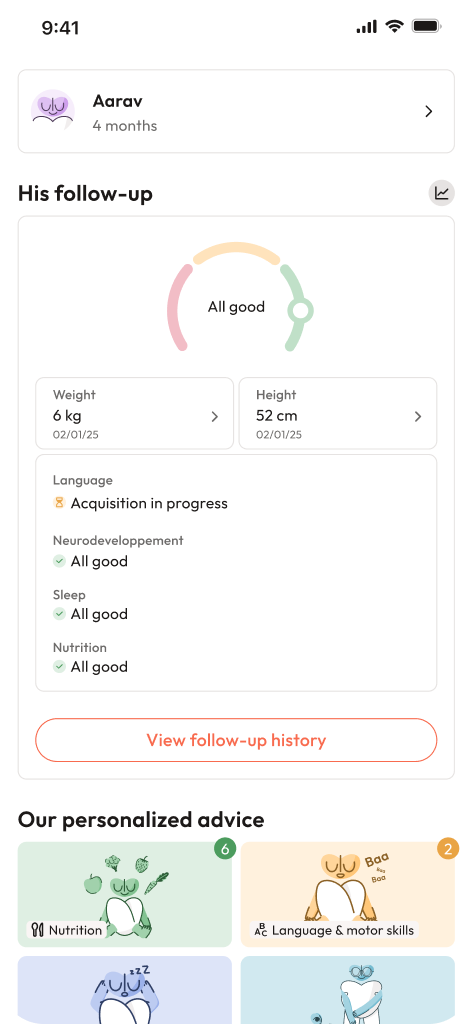
- Support is available through your paediatrician, paediatric neurologist, and early intervention services. You can also download the Heloa app for personalised guidance and free child health questionnaires.

Further reading :