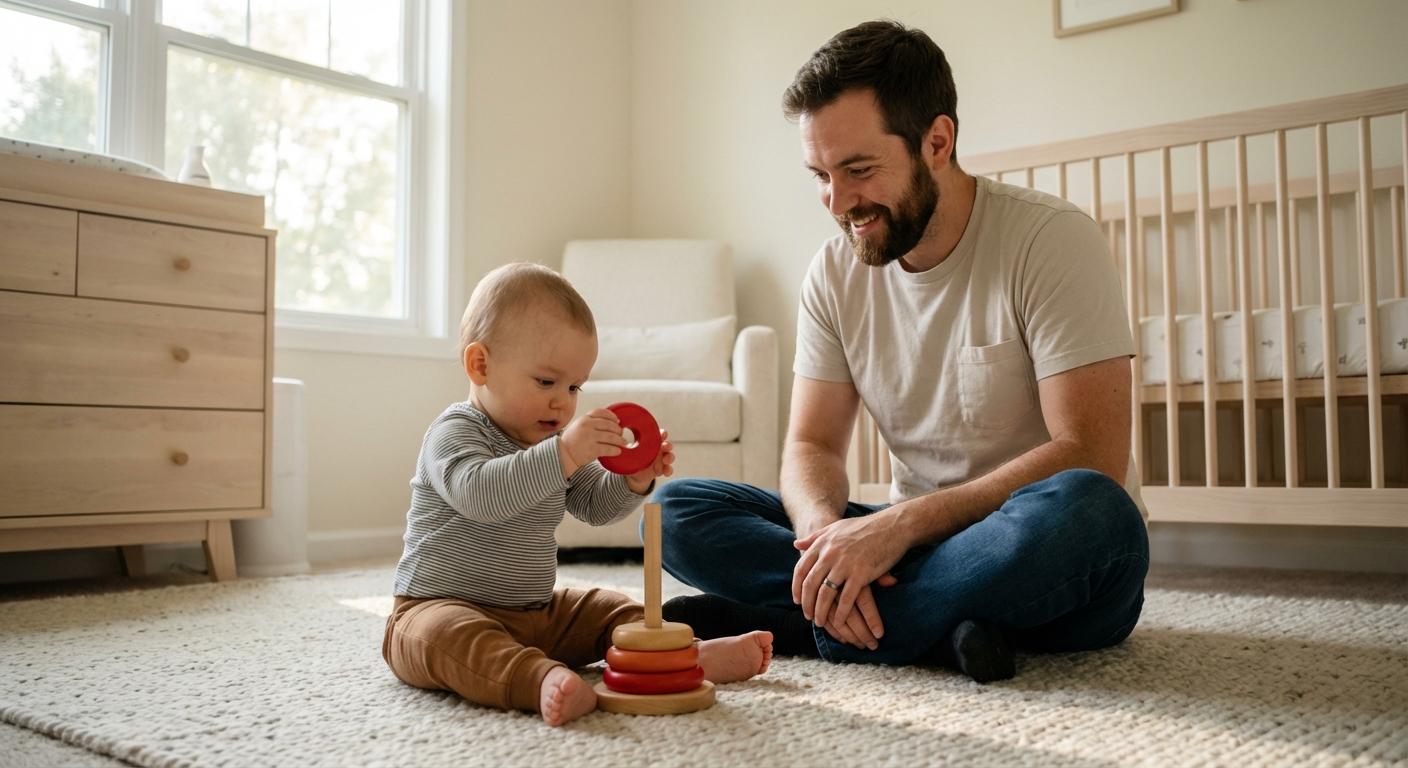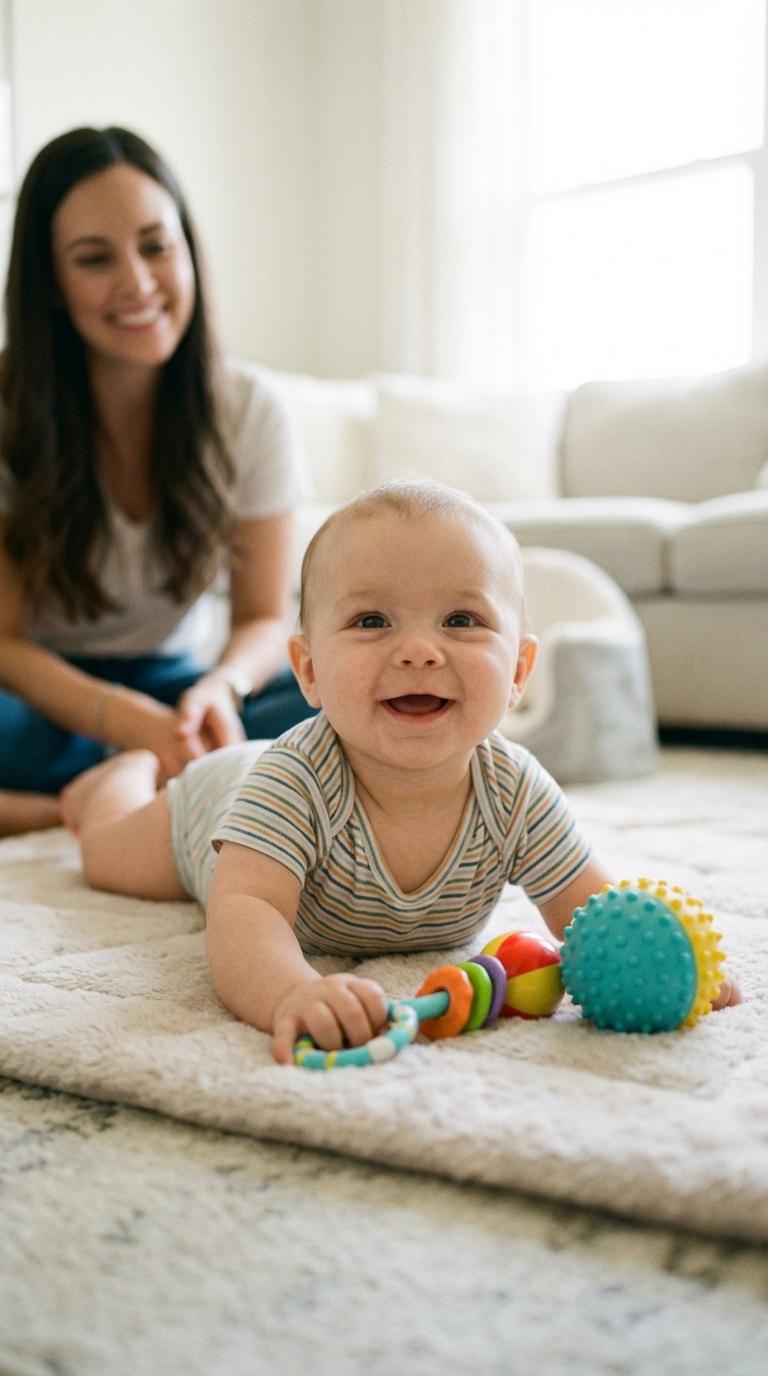
Babies learn with their whole body: eyes, hands, mouth, and movement, often all at once. If you’re looking at Baby developmental toys and wondering what truly helps (and what is mostly noise and blinking lights), you’re not overthinking it. In the first year, play is how the brain wires itself: sensory pathways sharpen, muscles coordinate, and early communication takes shape through tiny back and forth moments with you.
You’ll see how developmental can stay wonderfully simple, how to pick the just-right challenge without pressure, which Baby developmental toys fit each age band from 0-12 months, and how to keep play safe, calm, and realistic in daily life.
What developmental really means (and why simple play wins)
Developmental doesn’t mean complicated. It means a toy, or a safe everyday object, supports the skill your baby is building right now, then leaves room for the next step.
From a pediatric perspective, learning is strongest when:


- your baby is regulated enough to stay curious (not hungry, not overtired)
- the activity is neither too easy nor too frustrating
- repetition is allowed (because repetition is how the brain consolidates new circuits)
A single rattle, a soft block, a baby-safe mirror, or nesting cups often do more than an electronic toy that performs on its own. Why? Because your baby gets to act, wait, observe, and try again.
When parents ask, “Is my baby bored?”, it’s often the opposite. Many babies learn best through the same action repeated with tiny variations.
How play supports development: 6 skill areas parents actually notice
One well-chosen Baby developmental toys set can stimulate multiple systems at once:
- Sensory processing (touch, sound, vision): textures, gentle noises, simple contrast
- Gross motor skills: head control, rolling, sitting balance, crawling practice during floor play
- Fine motor skills: grasping, bringing hands together, transferring hand-to-hand, early pincer grasp
- Cognition: early cause-and-effect, trial-and-error, problem solving at baby scale
- Language: babbling turns, shared attention, pointing, early gestures
- Social-emotional: feeling safe, supported, and proud after small successes
A key nuance: toys don’t teach if your baby is overloaded. Very loud music, flashing lights, and nonstop motion can push some babies into dysregulation (turning away, stiffening, fussing). Calm, predictable play often leads to deeper engagement.
The caregiver effect: serve-and-return and why your face is the best toy
Neuroscience uses a simple phrase: serve-and-return. Your baby serves with a look, a sound, a reach, a wiggle. You return with a timely, warm response.
That loop builds attention, emotional security, and early language. Often more powerfully than any gadget.
Try co-play like this:
- Get close, at baby’s level, and watch first.
- Copy what your baby does (shake, bang, mouth, vocalize), then pause.
- Add one small idea: move the toy slightly farther, change the rhythm, name the action.
- Keep turns short. Your baby’s turn matters most.
Development from 0-12 months: patterns, not pressure
Every baby has their own tempo. Prematurity, reflux, sleep quality, temperament, and daily floor time all shape how skills unfold. It’s also normal to see an uneven profile: a baby who is socially advanced but slower in motor skills, or the opposite.
Helpful developmental arcs clinicians often observe:
0-3 months
Vision is still maturing. Babies focus best close up (about 8-12 inches (20-30 cm)). High contrast tends to pop more than busy patterns. Short, progressive tummy-time moments help neck and shoulder strength.
3-6 months
Reaching becomes more purposeful: aim, miss, try again. Midline play (hands centered in front of the body) becomes a training zone. Mouthing increases, which is normal sensory exploration.
6-9 months
Sitting becomes steadier, freeing the hands for transferring, rotating, tapping, and shaking. The brain leans hard into action-result links: cause-and-effect everywhere. Mobility often increases (pivoting, belly crawling, hands-and-knees crawling).
9-12 months
Upright skills take more space: pulling to stand, cruising, sometimes early steps. Fine motor precision grows (posting, opening/closing, thumb-index grasp). Imitation of daily life fuels communication.
If you ever wonder, “Should I train my baby to sit or crawl?” a reassuring point is that typical motor development is experience-driven: safe floor time, interesting objects, and your encouragement, not drills.
What toys are for in the first year (and why less can mean more)
Good Baby developmental toys don’t demand performance. They support:
- Sensory learning: clear input (one texture, one brief sound)
- Motor foundations: gross motor first (floor time, rolling, moving), then fine motor (grasp, transfer, stack)
- Early thinking: cause-and-effect, then object permanence (things exist even when hidden), then imitation
If toys are piling up and play looks scattered, that may be the explanation: too many choices can reduce focus. Fewer, rotated options often increase depth.
A practical rhythm many parents like: keep a small basket out, then swap a couple of items every 3-4 days. Same home, new interest.
Open-ended vs close-ended toys: choosing the just-right challenge
Open-ended toys
These invite many uses: blocks, nesting cups, scarves, balls, mirrors. They grow with your baby and support flexible thinking.
Close-ended toys
These have a clearer goal: a simple pop-up, a press-to-play sound toy, a basic shape sorter. They can be helpful for targeted practice and clean cause-and-effect learning.
The just-right challenge
A toy is just-right when your baby can do most of it and you support the hardest part.
Signs it fits:
- repeated tries with interest
- success with small help (modeling once, stabilizing the toy)
- frustration is brief and recoverable
Too hard right now:
- quick crying, arching away, tense body
- your baby can’t access the fun part even with help
Too easy:
- rapid boredom
- the same action every time, no exploration
Baby developmental toys by age: using age ranges in real life
Age labels are starting points, not rules. Choose Baby developmental toys based on what your baby does today, then add a small stretch:
- place the toy a little farther to encourage reaching
- offer a second object to practice transferring
- hide part of a toy to encourage searching
Some parents worry about wasting money on toys their baby ignores. A softer approach helps: pick fewer Baby developmental toys, see what your baby repeats, then build from those preferences.
Quick checklist before buying (and before handing it over)
- Can baby see it easily? (simple visuals, high contrast early on)
- Can baby grasp it? (easy-to-hold shapes, light weight)
- Does it invite two-handed play? (rings, soft blocks, cups)
- Does it support floor time? (mirror, tummy-time prop, gentle motivating sound)
- Does it teach a concept? (object permanence, in/out, big/small)
- Is it safe to mouth and bang? (durable, no loose parts)
- Is it easy to clean and dry? (mouthed items need regular cleaning)
Baby developmental toys 0-3 months: gentle sensory foundations
At 0-3 months, babies often do best with one stimulus at a time, often your face plus one simple object.
Best Baby developmental toys ideas:
- High-contrast cards or simple black-and-white cloth books
- A very lightweight rattle (minimal design, nothing detachable)
- A baby-safe mirror
- A simple, stable mobile placed out of reach
- A play mat with only a few hanging items
A small safety detail that matters: keep hanging toys out of reach and check attachment points. Babies surprise adults with sudden kicks and grabs.
Baby developmental toys 3-6 months: reach, shake, mouth, repeat
This stage is hands-and-mouth.
What changes physiologically? Better head and trunk control improves arm freedom, and sensory exploration through the mouth increases because the lips and tongue have rich nerve endings. It’s learning, not mischief.
Best Baby developmental toys ideas:
- Easy-grip rattles and grasping toys
- Soft sensory balls
- One-piece teethers
- Cloth books with crinkle paper and an unbreakable mirror
- Nesting cups for banging and early in/out
Baby developmental toys 6-9 months: sit, transfer, cause-and-effect
As sitting steadies, hands get busy: purposeful banging, shaking, turning, transferring. Dropping becomes an experiment.
Best Baby developmental toys ideas:
- Nesting cups, stacking rings with large pieces, chunky blocks
- A textured ball to roll and chase
- Simple cause-and-effect toys (press then a brief sound, action then a pop-up)
- Bath toys for filling/emptying and squeezing (constant close supervision)
Building object permanence with simple find-it games
Try:
- cover a toy partially with a cloth, pause
- hide a rattle under a cup and tap the cup
- say “Where is it?” then reveal calmly
Baby developmental toys 9-12 months: autonomy, imitation, early problem-solving
Mobility changes everything. Crawling or cruising lets your baby seek toys out and repeat experiments. If your baby opens the same lid 25 times, that’s sequencing practice.
Best Baby developmental toys ideas:
- Posting toys and simple shape sorters with large pieces (do together at first)
- Open/close containers: lids, flaps, simple latches
- Nesting cups and stacking toys
- Chunky board books
- Simple instruments with modest volume
- Push/pull toys with a wide, stable base
If your baby pulls to stand, look at toy height and stability. A light plastic toy that slides away can lead to sudden falls, a heavier, wide-base toy on a flat surface is usually easier to control.
Types of Baby developmental toys that work (and the skill behind the fun)
Rattles
Rattles support listening, tracking, grasping, and early hand-eye coordination.
A simple game: shake once, pause, then wait. That pause invites your baby to answer with a look, a wiggle, or a reach.
Mirrors
Mirrors encourage tracking, head lifting during tummy time, and social interest in faces.
Try naming what you see: “Eyes. Nose. Smile.” Then stop. Silence is part of the conversation.
Sound and musical toys
Sound play supports attention, rhythm, and early communication. If your baby startles, turns away, stiffens, or cries when a sound begins, the input is likely too intense.
Shapes, sizes, blocks
Concept play can be very simple: big/small, in/out, round/square. Blocks evolve from mouthing and banging to knocking down stacks, then placing one block on another with help.
Avoiding overstimulation: subtle signs to watch
Sometimes babies say stop quietly:
- looking away, yawning, stretching
- sudden tension or frantic wiggles
- crying right when a sound or light starts
- seeking the breast, pacifier, or close contact
If you see these cues, you can lower the volume of play: fewer objects, softer voice, slower movements, more breaks.
Organizing Baby developmental toys at home
Toy rotation
Many homes do well with 3-6 visible toys (sometimes 4-8), then partial swaps every few days.
A balanced mini-selection:
- 1-2 sensory items
- 1-2 grasping or teething items
- 1 cause-and-effect toy
- 1 book
- 1 open-ended set (cups or blocks)
A safe floor zone
A clean mat, a low basket with a few safe choices, and open space for rolling and crawling.
Safety and Baby developmental toys (0-12 months)
Safety checklist
- Supervise play, especially with new toys.
- Inspect weekly: cracks, sharp edges, loose seams.
- Discard damaged toys.
- Keep toys out of sleep spaces.
Choking hazards and hidden hazards
Avoid parts that could fit entirely in the mouth. Be strict with:
- button batteries (secured compartment only, suspected ingestion needs emergency care)
- magnets (avoid detachable small magnets)
- cords/strings and loops
If you suspect a baby swallowed a battery or magnet, do not wait for symptoms. Seek urgent medical care.
Materials and hygiene
Choose non-toxic toys meeting recognized standards (e.g., ASTM F963 or EN71). Clean mouthed toys regularly and dry fully.
Daily play ideas that build milestones
- Diaper changes: one high-contrast card or a soft ring
- After naps: 2 minutes of mirror play or gentle rattle tracking
- Midline play: hold a toy at center and wait for two hands
- Reaching: place a toy within reach, then slightly farther
- Narrate simply: “I shake… listen.” Pause. “You shook it!”
Key takeaways
- Baby developmental toys work best when they match today’s skills and offer a small next-step challenge.
- Across the first year, play often follows a progression: sensory input, manipulation, cause-and-effect, imitation.
- Simpler toys and fewer choices often lead to deeper engagement and less overload.
- Floor time builds the motor foundation, short, frequent play windows often beat long sessions.
- Safety matters daily: sturdy items, no small detachable parts, no cords, no accessible magnets or unsecured batteries.
- For tailored guidance and free child health questionnaires, download the Heloa app and use it alongside advice from your pediatric professional.
Questions Parents Ask
Are Montessori toys better for baby development?
Not necessarily—reassure yourself. “Montessori-style” usually means simple, real-world, and baby-led: natural materials, open-ended use, and fewer flashing or noisy features. Those principles can be helpful for focus and calm play, but the “best” toy is the one your baby can explore safely and repeatedly. A plain ball, nesting cups, or a mirror can be just as developmental as a labeled Montessori toy—especially when you’re playing together.
How many developmental toys does a baby actually need?
Many babies engage more deeply with fewer choices. A small set (often around 4–8 accessible toys) can be plenty when it covers different needs: something to mouth, something to grasp, something for cause-and-effect, and a book or open-ended item (cups/blocks). If play feels scattered, rotating toys every few days can refresh interest without buying more. No guilt if your home is already full—sometimes putting a few away is the upgrade.
What toys should I avoid in the first year?
It’s understandable to want the “most stimulating” option, but calmer is often more effective. Toys that are very loud, intensely flashing, or that “perform” nonstop can overwhelm some babies and reduce active exploration. Also avoid anything with small detachable parts, accessible button batteries, cords/loops, or loose magnets. If a toy seems to frustrate your baby quickly, it may simply be a “later” toy—nothing is wrong with your child.