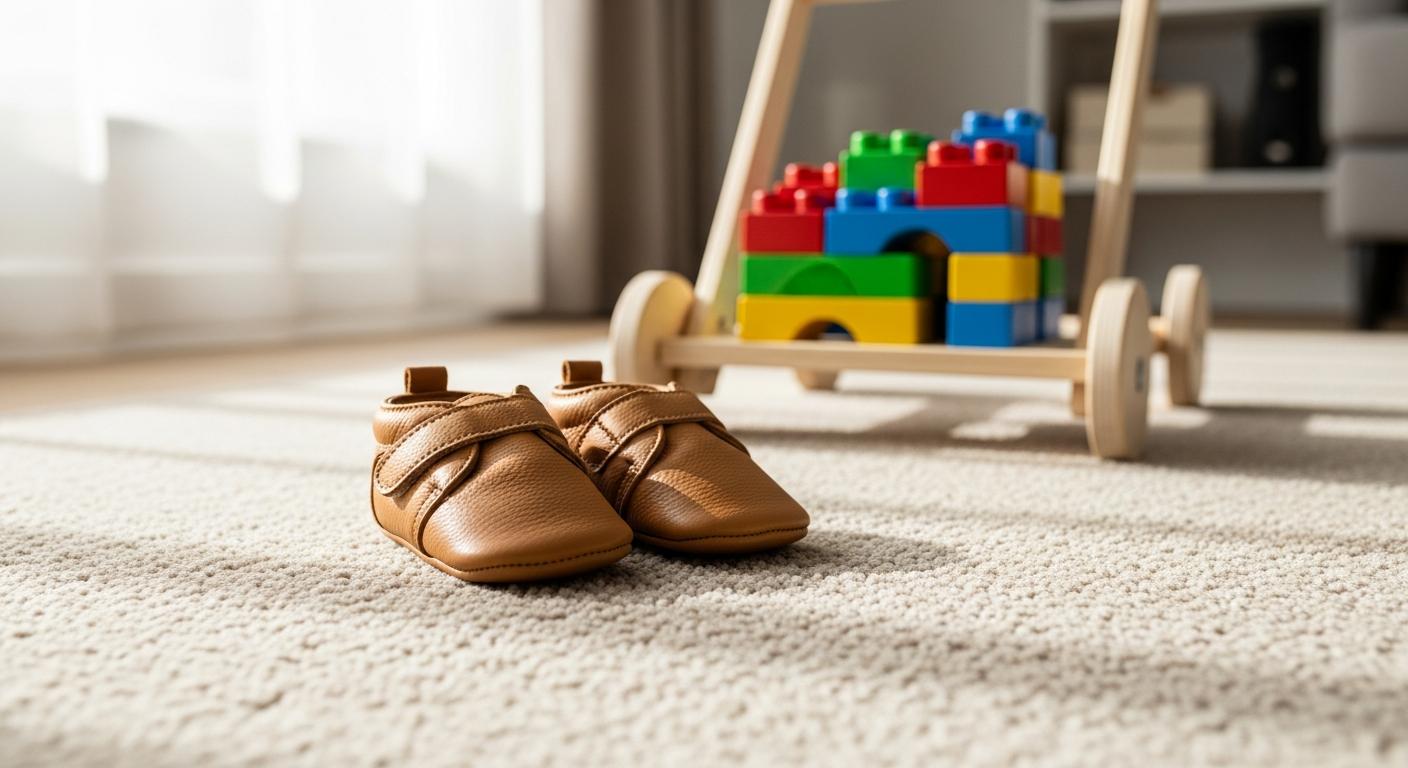
Hearing your baby pull up, wobble at the couch, then suddenly let go can spark a very specific question: when do babies start walking – and is what you’re seeing “on time”? Some children take a few brave steps and tumble. Others cruise for weeks, mastering balance in tiny doses. Both can be normal.
Walking is a whole-body project: brain pathways, muscle tone, joint stability, vision, inner-ear balance, and confidence all have to coordinate. So timing varies. What matters most is the direction of travel: skills stacking up, little by little.
When do babies start walking: what’s typical, and what counts as “normal”
The average age for first steps
Most children take their first independent steps around 12 months. For many families, the real shift to consistent, independent walking happens between 12 and 18 months. Early walking often looks rough:
- Arms lifted for balance (the classic “high guard”)
- Short, fast steps
- A wide stance
- Frequent “planned landings” on the bottom
If you’re asking when do babies start walking, it helps to remember that walking is not a switch, it’s a skill that stabilizes through repetition.


A wide range: early walkers, later walkers
A common window is about 9 to 18 months. Some children start closer to 19–20 months and still develop beautifully, especially if other motor skills are progressing.
Why the spread? Because walking depends on several systems maturing together:
- Neurological maturation (brain and nerve pathways coordinating movement)
- Sensory integration (processing information from feet, joints, eyes, and inner ear)
- Muscle tone and strength (trunk, hips, legs)
- Balance reactions (catching a wobble before it becomes a fall)
So when parents wonder, when do babies start walking, the most helpful question is often: “Is my child gaining skills over time?”
Why one baby walks at 10 months and another at 17 months
Walking is the end result of many “mini-milestones” coming together:
- Stronger hips and core (so the pelvis stays steady)
- Motor planning (shifting weight from one leg to the other)
- Opportunities for floor time (more attempts = more learning)
- Temperament (bold, cautious, observant)
- Home setup (space, safe furniture, traction underfoot)
Some babies even take a few steps… then return to crawling for a while. That back-and-forth is often a smart strategy: crawling is fast, stable, and efficient.
Prematurity: using corrected (adjusted) age
If your baby was born early, clinicians often use corrected age (also called adjusted age): your child’s age counted from the due date, not the birth date. This is commonly used up to about 2 years.
So if you’re asking when do babies start walking for a premature baby, corrected age can change the picture significantly. Your pediatrician can confirm which age to use for milestone conversations.
Baby walking milestones: how the skills usually build
The hidden beginning: head and trunk control
Walking starts far from the feet. Babies first learn to control the head, then the trunk. Supervised tummy time while awake, short sessions, often repeated, helps build:
- Back and shoulder strength
- Core stability
- Endurance for upright posture later
A stable trunk becomes the platform for standing balance.
Sitting balance: twist, reach, recover
A baby who can sit and move (turning to look, leaning to grab a toy, then returning upright) practices shifting the center of gravity. That same skill later prevents topples during standing and stepping.
Floor mobility: crawling, scooting, belly-crawling (and variations)
Crawling-like patterns strengthen the trunk and hips and encourage coordination between the two sides of the body. Some babies:
- Belly-crawl
- Scoot on the bottom
- Bear-crawl
- Skip classic hands-and-knees crawling
Skipping traditional crawling is not automatically worrying if your child keeps progressing and uses both sides evenly.
Pulling to stand: the real bridge to walking
Pulling up loads the legs, stabilizes the pelvis, and teaches foot placement. Repeating “pull-to-stand” many times a day is powerful practice.
Cruising: side-stepping along furniture
Cruising trains weight transfer and dynamic balance. You may notice “micro-risk” moments: one hand lets go to grab a toy, then both hands hover for a second. Those tiny releases are big neurological workouts.
First independent steps, then smoother gait
Early walkers often move “as one piece”, with little trunk rotation and a wide stance. Over weeks, you typically see:
- Arms lowering
- Steps slowing down
- Better foot roll from heel toward toes (still developing)
If you’re still asking when do babies start walking, remember: the first steps are the beginning of refinement, not the final product.
Signs your baby is getting ready to walk
You might see readiness in brief flashes, then nothing, then a sudden leap forward.
More stable trunk and balance recovery
- Less collapsing when turning
- Faster recovery after a wobble
- Better control when lowering to sit
Standing to play (a lot)
Standing at a sofa, coffee table, or activity surface becomes “strength training” in disguise. More time upright usually means more confidence.
The “micro-let-go” moments
A hand releases. Then both hands. Then a pause, two seconds of independent standing. It looks small, it’s major.
From floor to standing with less help
Moving from floor to stand via furniture is a key step: your baby becomes the driver of practice, not a passenger.
Strength and coordination clues
Look for:
- Squatting to pick up a toy and returning to stand
- Weight shifting from one foot to the other
- Controlled lowering (not just dropping)
What first walking can look like (and still be normal)
Wobbly, wide-based steps and frequent falls
New walkers use a wide base for stability. Falls are expected while the brain fine-tunes balance reactions.
Arms up, short steps, “flat” landings
The “high guard” arm position helps balance. Steps are short, the foot may look flat-footed at first.
Toe walking, in-toeing, out-toeing, uneven steps – briefly
Temporary variations can appear:
- Toe walking can show up as a balance strategy early on.
- Mild in-toeing or out-toeing is common while hips and legs mature.
- Uneven steps may happen during turns or over thresholds.
Discuss toe walking if it clearly persists, especially with stiffness, pain, marked asymmetry, limping, or if heels almost never touch down.
Bow legs and flat feet in toddlers
Mild bowing and flexible flat feet are common in early toddlerhood and often improve as alignment changes with growth. Seek advice if there is pain, persistent limping, strong asymmetry, or walking seems to get harder rather than easier.
What influences when babies walk
If you’re circling back to when do babies start walking, these factors often explain the “why now?”
Neuromotor maturation and muscle tone
Muscle tone is the baseline “tension” in muscles at rest.
- Lower tone can make stability harder (more effort to stay upright).
- Higher tone can make movements stiffer and less adaptable.
Temperament: bold versus cautious
Some babies experiment quickly, others analyze, test, and wait. Cautious does not mean delayed, it can mean strategic.
Environment and opportunities
More safe space and stable furniture often equals more attempts.
Less floor time, often due to daily life constraints, usually means fewer practice reps, not a problem with potential.
Different progress patterns
Some children cruise for months, then walk suddenly. Others stand early and gradually add steps. What deserves attention is prolonged stagnation, discomfort, or clear asymmetry.
How to encourage walking safely (without rushing)
Respect your baby’s pace
Walking asks for courage and coordination. Your job is not to speed-run the milestone, it’s to make practice safer and more inviting.
Set up a motivating practice space
- Stable supports at chest height
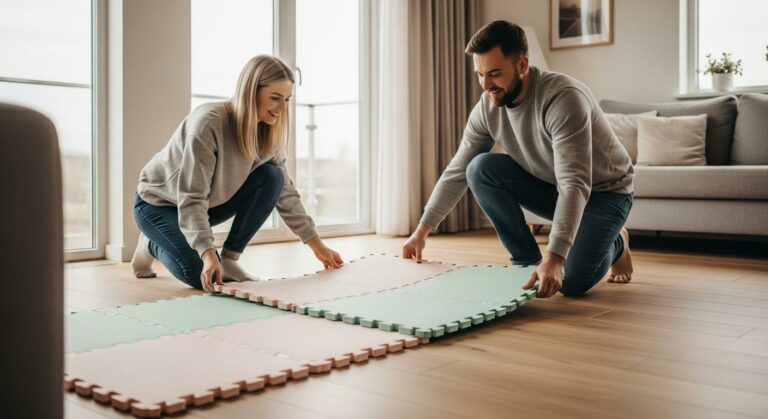
- Rugs or mats that don’t slide
- A short “route” between two sturdy supports
- A firm, non-slip surface (very soft surfaces can make balance harder)
Simple games that build balance
- Place a favorite toy slightly out of reach
- Standing play at furniture (books, stacking cups)
- Roll a ball near the feet during cruising
- Step around a low cushion while holding on
Help just enough – no more
Holding a baby high by the hands to “make them walk” shifts the center of gravity and can overload shoulders.
If support is requested, offer a light, low hold (closer to the trunk, or one hand they can release). Then gradually fade help so your baby does the balancing.
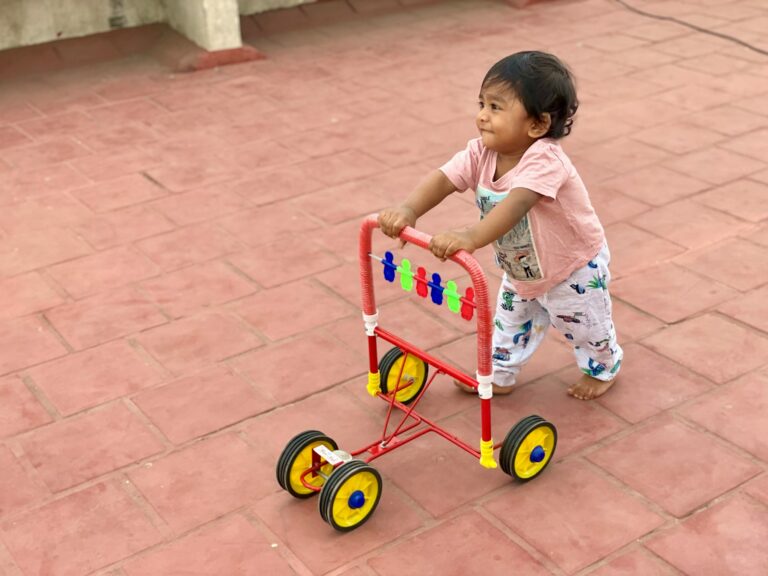
Push toys and walking carts
If you use one, look for:
- A stable base (less tipping)
- Enough weight to avoid shooting forward
- Wheels with resistance or speed control
Supervise closely and keep sessions brief. Push toys can add variety, but they don’t replace unsupported balance practice.
Shoes vs barefoot for new walkers
Barefoot indoors: better sensory feedback
Indoors, barefoot (or grippy socks) often helps babies feel the ground and adjust pressure through the feet. That sensory feedback supports balance and strengthens feet and ankles.
When shoes are truly useful
Shoes are mainly for protection outdoors, on cold surfaces, or where the ground could injure the foot. Indoors on safe surfaces, shoes are usually optional.
What to look for in first shoes
- Flexible sole (bends at the ball of the foot)
- Wide toe box so toes can spread
- Lightweight, low heel
- Non-slip outsole
- Secure closure so the foot doesn’t slide
Very rigid shoes can limit ankle motion and natural foot roll.
Baby walkers and “container time”
Why wheeled baby walkers are discouraged
Wheeled baby walkers increase injury risk (falls, head injuries) and allow fast access to hazards like stairs. They also don’t teach the balance and muscle control needed for real walking, and may encourage less helpful postures.
Jumpers and activity centers: keeping it reasonable
Short periods can be fine. Long daily stretches in restrictive devices reduce free movement and floor time. Aim for varied positions: tummy time, sitting, kneeling, standing at furniture.
Safety as babies start walking
Babyproofing priorities before first steps
Once cruising begins, hazards become reachable. Secure heavy furniture to the wall, remove unstable objects a baby can pull down, and keep small items off the floor.
Floors, corners, cords, and light chairs
- Corner guards on sharp edges at toddler height
- Hot drinks and breakables away from edges
- Electrical cords secured
- Blind cords out of reach
- Lightweight chairs watched closely (they can tip when pulled)
Stairs and water hazards
Use safety gates on stairs (especially at the top). Keep bathroom doors closed, empty buckets and basins promptly, and use non-slip bath mats.
Falls: expected, but know when to seek prompt advice
After a head bump, seek medical advice promptly if there is repeated vomiting, unusual sleepiness, a significant behavior change, a fall from height, or any symptom that worries you.
Late walking: when to ask for medical input
Later walking can still be within a healthy range
Some children walk closer to 15–18 months, and a few a bit later, and still do very well, particularly if they pull to stand, cruise, bear weight evenly, and keep making progress.
If you’re still thinking, when do babies start walking and your child seems “late,” zoom out: are skills accumulating, even slowly?
When it’s worth discussing with a clinician
Consider a check-in if:
- There is no clear progress toward walking by around 15 months (for example, standing confidence and cruising are not increasing).
- Independent walking is not present around 18 months (use corrected age for prematurity).
Red flags beyond timing
Seek advice sooner if you notice:
- Marked asymmetry (one side clearly weaker, dragging a leg, always leaning)
- Very high tone (stiffness) or very low tone (“floppy”)
- Regression (loss of previously gained skills)
- Pain, limping, refusal to bear weight, or unusual fatigue
- Falls that seem consistently to one side
Key takeaways
- When do babies start walking? Many take first steps around 12 months, and consistent independent walking commonly appears between 12 and 18 months, with wide normal variation.
- A typical range is about 9–18 months, some children start closer to 19–20 months while still progressing well.
- Readiness signs include pulling to stand, cruising, brief independent standing, “micro-let-go” moments, squatting, and controlled lowering.
- Early walking often looks wide-based and wobbly, repetition gradually refines balance and gait.
- Encourage walking with safe floor practice, stable supports, and minimal assistance, without rushing.
- Indoors, barefoot or grippy socks often help, outdoors, choose flexible shoes with a roomy toe area. Avoid wheeled baby walkers.
- Ask for medical advice if there is stagnation, unusual tone, asymmetry, regression, pain, refusal to bear weight, or no independent walking around 18 months (corrected age for prematurity).
- For tailored guidance and free child health questionnaires, you can also download the Heloa app.
Questions Parents Ask
Can teething cause a baby to stop walking (or refuse to practice)?
Yes—sometimes. When gums are sore or sleep is disrupted, babies may be fussier, clingier, and less interested in practicing new skills. You might notice more crawling again or a brief “pause” in cruising. That’s usually temporary. Gentle comfort, extra rest, and offering low-pressure play opportunities often help. If your baby refuses to bear weight, seems in pain, or you see swelling/fever that worries you, a quick check-in with a clinician can be reassuring.
Is it normal to walk late if my baby never crawled?
It can be. Some babies scoot, roll, or “bear walk” instead of hands-and-knees crawling and still move on to standing and walking without any issue. What tends to matter more than the exact crawling style is overall progress and symmetry—using both sides of the body, pulling to stand, and gaining confidence over time. If movement seems very one-sided or skills feel stuck for weeks, you can ask for a developmental review.
Do early walkers become better athletes later?
Not necessarily—so no pressure. Walking earlier doesn’t reliably predict future coordination, intelligence, or sports ability. Many later walkers catch up quickly once they start, and long-term outcomes are far more linked to ongoing opportunities to move, play, and build strength at their own pace.

Further reading: