Montessori baby can sound like a big promise: calmer days, fewer toys, more confidence. Yet in real homes, real babies cry, spit up, wake at 5 a.m., and try to eat the cat’s kibble. So the questions stay very practical: How do you support psychomotor development without forcing positions? How do you encourage early language while keeping stimulation tolerable for an immature nervous system? And how do you make safety non-negotiable without turning your home into a padded box?
Montessori baby is a framework you can scale up or down: respectful care, a prepared space, and time for free movement—backed by what we know about early brain plasticity, sensory processing, and attachment.
Montessori baby from birth: what it means (and what it does not)
Montessori baby definition (0–36 months) and the “absorbent mind”
Montessori baby is less a label than a lens: your child is an active learner from day one. In the first three years, the brain is highly plastic (it reorganizes quickly in response to experience). Maria Montessori called this the “absorbent mind”: babies take in language, routines, and social signals simply by living among them.
From a neurodevelopmental angle, this makes sense. Early learning is built through:


- sensory exploration (touch, proprioception—your baby’s sense of body position)
- spontaneous movement (rolling, pivoting, crawling)
- responsive relationships (your voice, your timing, your calm)
The goal is not earlier milestones. The goal is better conditions.
Montessori baby is not “making baby do it”
A Montessori baby approach does not ask you to train your baby. It asks you to slow down and let your baby initiate.
So instead of placing a baby into sitting before they can get there, you offer a firm floor surface and let trunk control emerge through repeated attempts. Instead of entertaining constantly, you keep choices few—and watch what your baby repeats.
Montessori baby vs. directed baby care: where initiative lives
A simple way to compare:
- In Montessori baby care, the baby acts first (reach, mouth, rotate, pause), and the adult supports safety and meaning.
- In more directed care, the adult acts first (demonstrate, prompt, perform), and the baby may watch more than do.
For infants, “doing” is not a lifestyle trend. Active exploration supports muscle tone regulation, coordination, and sensorimotor integration.
Core Montessori principles for babies
- Respect: announce what you will do before you do it.
- Observation: notice what calms, what frustrates, what energizes.
- Independence: tiny chances to participate (hold a cloth, choose between two shirts).
- Prepared environment: safe, reachable, visually simple.
- Order: objects have places, days have rhythms.
- Movement: daily floor time, no forced positions.
- Language: real words, turn-taking, naming actions and feelings.
Sensitive periods: why repetition is not “bad behavior”
You may see intense repetition: dropping, opening/closing, filling/emptying. You may see a fixation: spoons, wheels, animal sounds. These “sensitive periods” are practice windows—your child’s brain is asking for the same circuit again and again.
What helps?
- channel repetition into safe setups (a posting box with large pieces)
- keep one task clear (one action, one object)
- stop before fatigue turns into meltdown
Setting up Montessori baby at home: safety, simplicity, accessibility
The order of priorities: safety, then minimalism
Once mobility starts, risk changes fast: rolling becomes crawling, crawling becomes climbing. Begin with prevention:
- anchor unstable furniture, cover outlets, protect sharp corners
- keep cords, blind strings, and hot drinks out of reach
- use stair gates and window locks where needed
- clear a non-slip floor zone for movement
Then simplify. Too many toys can fragment attention and raise arousal. A low shelf with 4–6 items is often plenty.
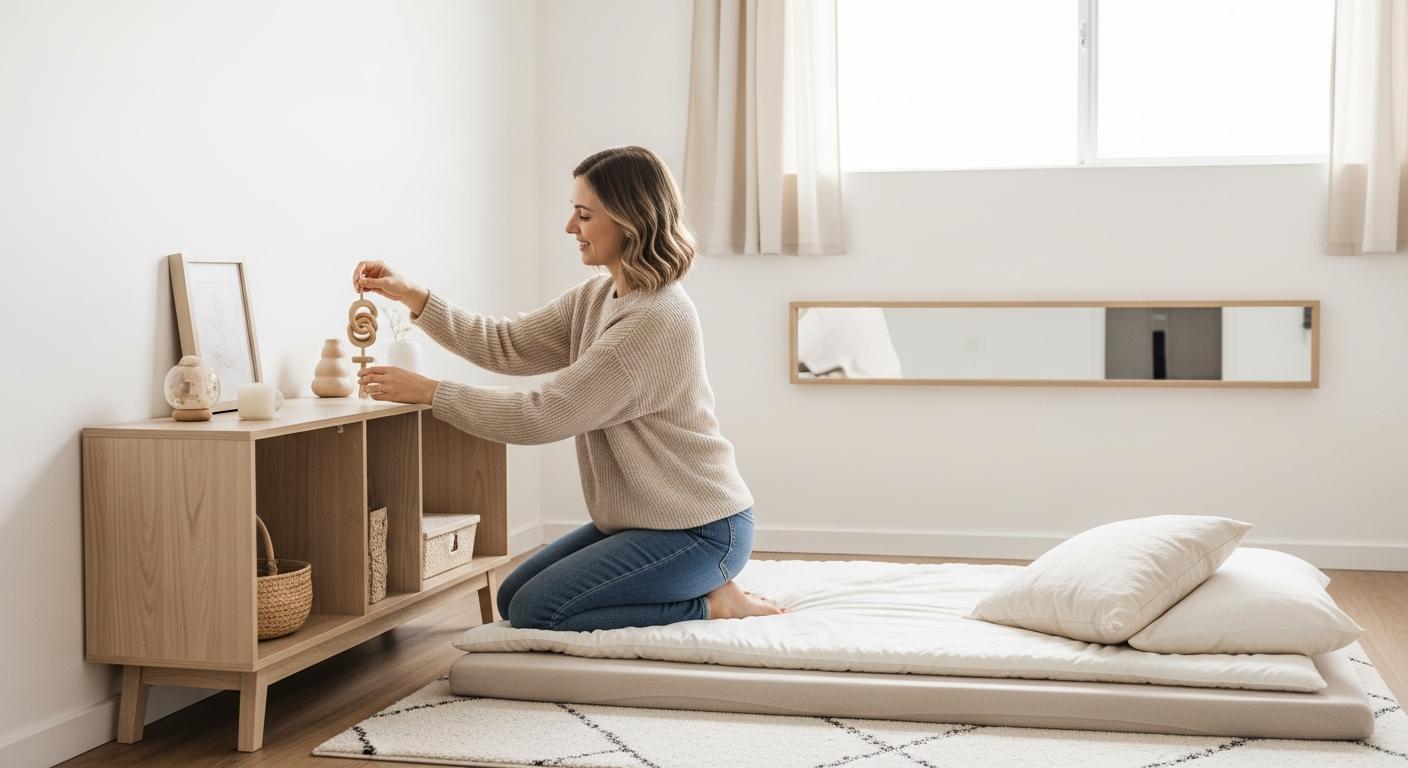
A realistic “yes space” (living room or nursery)
A yes space means: fewer “no” moments because more is truly safe. Not unsupervised—just less constant interruption.
Starter setup that works in most homes:
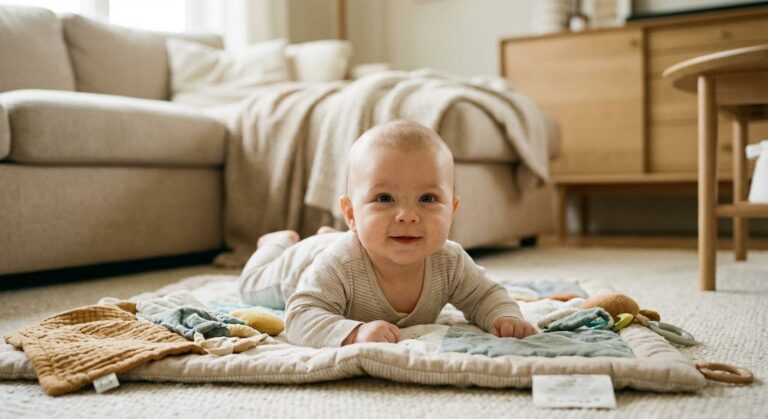
- a firm mat for awake time
- a securely mounted shatterproof mirror
- 2–3 grasping objects
- 1 sturdy board book
In the nursery, keep the sleep area visually quiet (low visual clutter, dimmable light), and separate it from the movement area if possible.
When mobility begins: risks parents often underestimate
As soon as the pincer grasp and fast crawling arrive, new hazards pop up:
- choking risks (small objects, toy parts, older siblings’ beads)
- toxic exposures (cleaners, meds, nicotine liquids)
- button batteries and magnets (medical emergencies if swallowed)
- water hazards (even a shallow bucket)
A well-prepared Montessori baby space often improves the household mood: fewer repeated prohibitions, more safe autonomy.
Montessori baby from infant to toddler: what changes
Infants (0–12 months) build skills through sensorimotor experience: looking, grasping, mouthing, rolling, creeping. Keep things simple and movement-friendly.
Toddlers (1–3 years) want agency: “I do it.” This is where child-sized tools and practical life activities shine—pouring, wiping, dressing practice. Boundaries also matter more, because curiosity and impulse run ahead of danger awareness.
Why Montessori baby appeals: realistic benefits
Independence and self-efficacy
Self-efficacy is the felt sense of “I can.” It grows in tiny steps:
- holding a spoon
- choosing a book
- putting an object back
Aim for the “just right” challenge: engaging, not overwhelming.
Concentration, coordination, and a sense of order
Fewer choices, repeated sequences, and visible order can support longer focus—especially for children who get dysregulated by noise and clutter.
Language through everyday narration
Simple phrases, repeated calmly, build links between word and action:
- “I am lifting your legs.”
- “Your arm goes through the sleeve.”
- “All done, diaper closed.”
You may wonder: does it really matter? Yes—this steady mapping supports receptive language and later expressive language.
Emotional security through predictable care
Predictable routines support regulation (the nervous system anticipates what comes next). Eye contact, a steady voice, and a brief warning before touch can reduce startle responses and increase cooperation.
Montessori baby development goals in daily life
Movement: free floor time as the backbone
Floor time supports postural tone, weight shifts, trunk rotation, and bilateral coordination (using both sides of the body in an organized way). Try to limit long periods in “containers” (bouncers, swings, seats), especially when your baby is awake and alert.
Want to encourage rolling without “helping” too much?
- place a motivating object slightly to one side
- let the head and trunk lead, avoid pulling an arm
- offer traction under the feet if your baby pushes
Seek professional advice (pediatrician, physiotherapist) if you notice marked asymmetry, persistent stiffness, very low tone (hypotonia), or a broad delay across several areas.
Sensory input: stimulate, then let the nervous system breathe
Babies can become overstimulated quickly because their self-regulation systems are still immature.
Signs that sensory load is too high:
- turning the head away, “glazing” the eyes
- sudden agitation, arching, stiffening
- abrupt crying
Lower intensity: reduce noise, dim lights, pause the activity, offer closeness.
Montessori baby materials: simple, useful, evolving
What makes a material “Montessori” for a baby?
A Montessori baby material usually has one clear action (grasp, insert, open), is made of safe materials (wood, fabric, food-grade silicone), and avoids unnecessary sensory overload.
Light-up, noisy toys are not “forbidden.” They simply tend to pull attention automatically, leaving less space for effortful, self-built concentration.
Rotation without stress
Keep 4–6 items visible. Rotate 1–2 items every 1–2 weeks, or sooner if interest fades.
Age-based ideas (flexible)
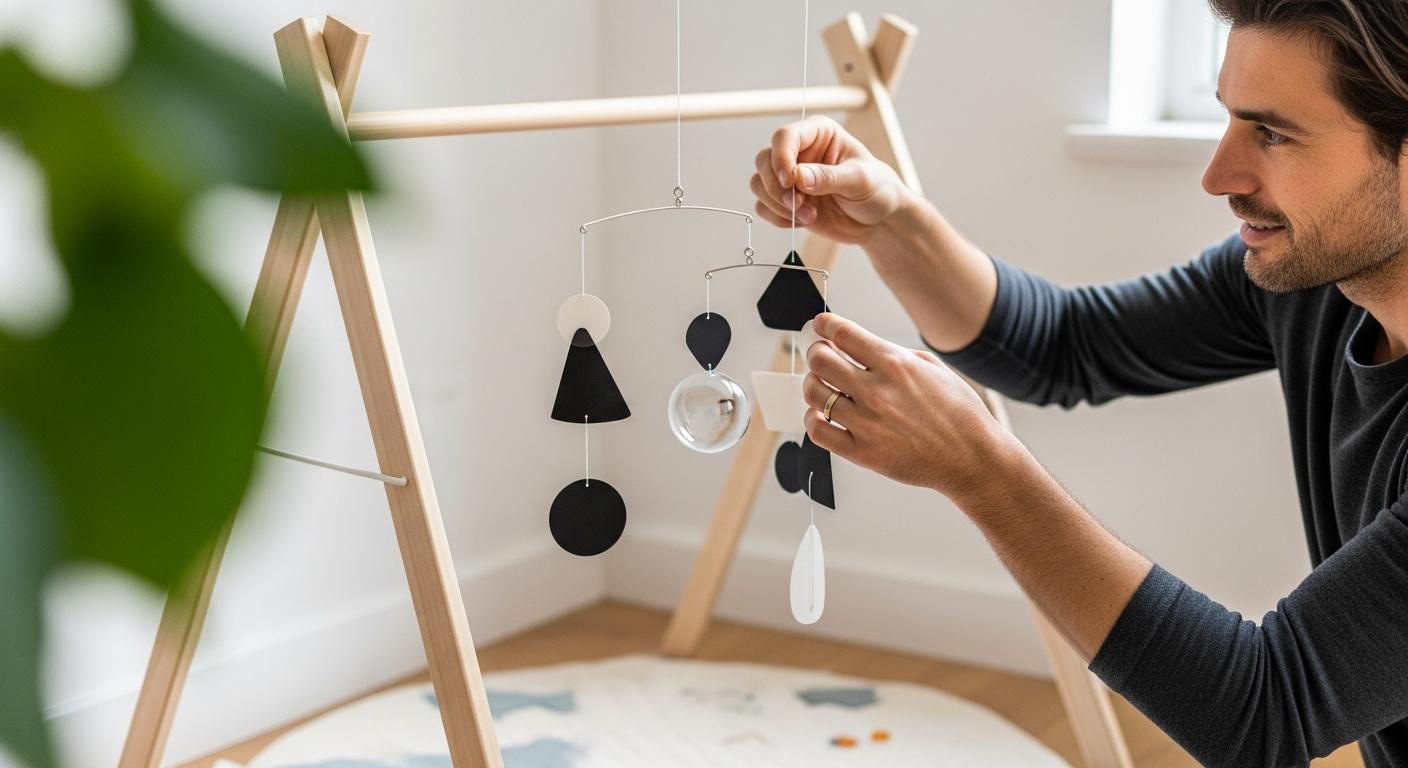
0–3 months: high-contrast cards, a safely installed mobile, mirror, simple rattle.
3–6 months: grasping rings, sensory ball, sturdy board books.
6–9 months: in/out containers with large objects, supervised open/close play.
9–12 months: simple knob puzzles (2–3 pieces), filling/emptying containers.
Montessori baby activities that fit real life
Everyday life beats “special” activities
Safe household objects (supervised) can be perfect: a clean spoon, dish towel, soft brush. During care routines, let your baby participate: holding a diaper, lifting legs when ready.
And talk—quietly, steadily. Language is built in the ordinary.
Tummy time with Montessori baby principles
Short, frequent, supervised. Make it meaningful:
- lie face-to-face
- place a mirror safely at floor level
- offer one simple object to look at or reach toward
Let movement be self-initiated. If your baby dislikes tummy time, micro-sessions (30–60 seconds) can add up.
Treasure baskets and heuristic play
A treasure basket is a small set of safe, real objects with varied textures and weights. Heuristic play means there is no “right” outcome—you observe, keep it safe, and name what you see.
Nature, music, and movement
Outdoor light and fresh air support circadian rhythms and sleep pressure. Gentle songs and rhythmic rocking build timing, coordination, and social connection without flooding the senses.
Eating and weaning with Montessori baby values
Posture: your safety base
Stable posture supports safer swallowing coordination: pelvis stable, back supported, feet resting on a solid surface (floor or footrest). This helps both self-feeding and airway protection.
Simple tools + choking prevention
Expect mess, it is motor learning.
Helpful tools:
- small open cup or two-handle cup
- short spoon with an easy grip
- plate with a rim
Safety reminders:
- no honey before 12 months (infant botulism)
- adapt high-risk foods (grapes quartered lengthwise, nuts avoided or finely ground)
- close supervision during meals
Hunger and fullness cues
Turning away, sealing lips, slowing, pushing food away—these can signal satiety. Respecting cues tends to reduce power struggles and supports long-term self-regulation.
Sleep with a Montessori baby: autonomy, yes—safe sleep always
Floor bed: benefits and limits
A floor bed can match Montessori baby values by allowing free movement—if the room is fully safe.
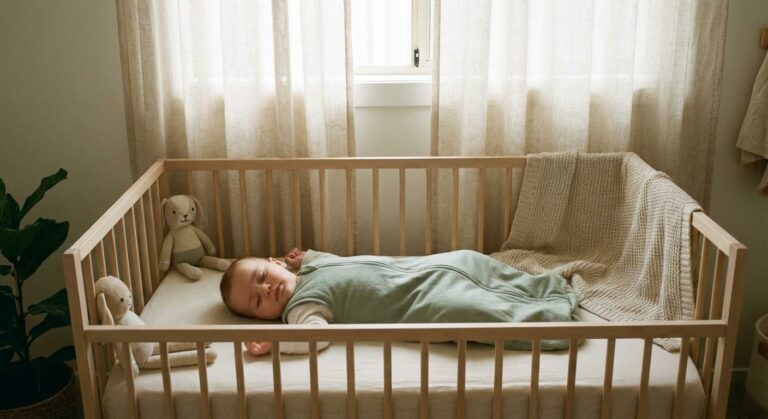
Safe sleep basics remain the same:
- baby on the back
- firm mattress with fitted sheet
- no pillows, loose blankets, bumpers, or soft items
If nights become chaotic (repeated getting up, overstimulation, frequent bumps), it is reasonable to pause and choose a more contained sleep option for a while. Autonomy grows in phases.
Bedtime rituals: the brain loves predictable sequences
Dim lights. Diaper. Sleep sack. Short book. A few calm words. Then sleep.
If your baby cries, staying close and responding with calm consistency supports regulation. Montessori baby does not equal leaving a baby to cry alone.
Gentle boundaries: freedom inside clear limits
Montessori baby is not permissive. Limits are few, consistent, and calm:
- “I won’t let you touch the outlet.” (then redirect)
Prepared spaces reduce the number of times you must intervene.
Key takeaways
- Montessori baby is a mindset: observe, make the space safe, and let your baby act and repeat.
- Fewer, well-chosen items can reduce overstimulation and support concentration.
- Free movement and daily floor time support psychomotor development.
- Feeding: posture first, simple tools, respect hunger/fullness cues, prevent choking.
- Sleep autonomy is possible, but safe sleep rules stay firm.
- If you are worried about tone, asymmetry, or global delays, ask a pediatric professional for guidance.
- For personalized tips and free child health questionnaires, you can download the Heloa app.
Questions Parents Ask
What is the best age to start Montessori with a baby?
You can start from birth—gently. Montessori for babies is mostly about how you care: slowing down, talking through routines, and offering a safe place for free movement. If you’re starting later, no worries: begin with one “yes area,” fewer toys, and a predictable rhythm (wake, feed, play, rest). Progress can be gradual and still very effective.
Do Montessori toys have to be wooden (and expensive)?
Not at all. What matters most is that the item is safe, simple, and supports one clear action (grasping, transferring, opening/closing). Many affordable options work well: a stainless-steel cup, a scarf for peekaboo, nesting containers, chunky board books. If you enjoy wooden materials, great—just remember that thoughtful selection matters more than a specific aesthetic.
How can I follow Montessori if my home is small or shared?
A Montessori setup can be tiny. Think “micro prepared environment”: one low basket or shelf, a firm mat, and a small rotation of 4–6 items. You can also create a portable yes space (a play yard or a corner) and keep the rest of the room adult-friendly. It’s completely normal to adapt—Montessori is flexible, not all-or-nothing.