Parents often discover it at 2 a.m.: a clean-looking onesie can still bother a baby’s skin. A red neck fold after a long nap. A rash exactly where the waistband sits. And then the question lands—should you change baby detergent? Or is it “just sensitive skin”?
Because baby skin is thinner, more permeable, and still building its protective barrier (the stratum corneum), anything left in fabric—fragrance molecules, dyes, detergent film—can become a tiny, repeated exposure. Not dramatic. Just constant.
Baby detergent: what it is (and what it is not)
What “baby” really means on a detergent label
Baby detergent is usually marketed as gentler for infant clothing, bedding, and textiles. In real life, the cleaning action is similar to many standard detergents: it relies on surfactants (the washing molecules that lift oils and dirt) plus builders that help in hard water.
The “baby” part often comes down to what is reduced or removed:


- fragrance (or at least a lower perfume load)
- dyes/colorants
- sometimes optical brighteners
- sometimes enzymes (but not always)
So yes, baby detergent can be a smart pick. But the front-of-bottle branding is not the whole story—ingredients and rinse habits matter just as much.
Why baby detergent can change skin comfort
You may be wondering: can laundry really trigger redness?
It can. Not because detergent is “poison,” but because clothing is prolonged contact. Newborn skin loses water more easily (higher transepidermal water loss), and it reacts faster to friction, sweat, and irritants. If your baby has atopic dermatitis (eczema), the skin barrier is even more fragile.
A baby detergent will not treat eczema. What it can do is reduce—or sometimes increase—residue left on fibers.
Baby detergent vs regular detergent: the differences that matter
Think in triggers.
What tends to influence tolerance most:
- Added perfume (even “fresh linen” type scents)
- Dyes
- Optical brighteners (they deposit on fabric to make whites look brighter)
- Certain preservatives in liquids
- Overdosing (too much product, too little rinsing)
A regular “free & clear” detergent can perform like a baby detergent if it truly avoids fragrance and dyes and if you rinse well.
Benefits and trade-offs
Choosing baby detergent is a balancing act:
- Gentleness: fewer common irritants
- Rinseability: a clean-rinsing routine often matters more than the brand
- Cost: baby-labeled products can be pricier per load
- Cleaning power: many do great on milk and everyday mess, heavy stains may need pre-treatment or enzymes
Do you really need baby detergent?
When baby detergent makes the most sense
A dedicated baby detergent is often helpful when:
- your baby is a newborn or premature
- there is frequent skin-to-fabric contact (sleepers, swaddles, sleep sacks)
- you notice redness where seams and elastic touch
- adult household laundry products are strongly scented
Pre-washing new clothes before the first wear is also useful: it removes manufacturing finishes and residues that can irritate delicate skin.
When a regular “free & clear” detergent can work
Many families do well with a non-baby, sensitive-skin detergent—if it is genuinely fragrance-free and dye-free.
What helps more than upgrading the bottle:
- measuring correctly (no extra cap)
- avoiding overfilling the drum
- adding an extra rinse when needed
Some clinicians find that if skin is calm, families often transition away from baby detergent around 6 months.
Baby detergent for eczema, dermatitis, and very reactive skin
If your baby has recurrent rashes, eczema flares, or suspected contact dermatitis (a skin reaction to something that touches it), reduce the number of variables:
- choose baby detergent that is fragrance-free and dye-free
- consider enzyme-free (“non-bio”) options if flares persist
- add an extra rinse to reduce fiber residue
- stop fabric softener (it coats fibers and is frequently perfumed)
If irritation continues, a clinician can help differentiate eczema from infections, heat rash, yeast in skin folds, or true allergic contact dermatitis.
How to choose baby detergent: a parent-friendly checklist
The simplest checklist for newborns
Look for a baby detergent that is:
- clearly labeled fragrance-free (not just lightly scented)
- dye-free
- minimal additives
- effective at 30°C/86°F if you wash cool
- easy to dose accurately
For sensitive skin: prioritize in this order
1) fragrance-free + dye-free baby detergent
2) correct dose + extra rinse
3) consider non-bio (enzyme-free) if reactions continue
4) avoid optical brighteners and “freshness” additives
“Unscented” vs “fragrance-free”
- Fragrance-free: no fragrance ingredients added.
- Unscented: may still include masking fragrances.
If your baby’s skin is reactive, “fragrance-free” is usually the safer bet.
“Hypoallergenic” claims: helpful, not a promise
Tolerance also depends on your baby’s skin barrier, water hardness, rinse quality, and what else touches fabric (softeners, scented stain sprays, adult perfumes).
Baby detergent ingredients: what to look for (and what to skip)
The core ingredients, explained simply
Most detergents contain:
- surfactants
- builders/chelators (help in hard water)
- pH adjusters
Ingredients families often avoid
If your baby has sensitive skin, consider avoiding:
- perfume/fragrance
- dyes
- optical brighteners
- heavy “freshness” additives that deposit on fabric
Preservatives and isothiazolinones
Liquid detergents often need preservatives. Some isothiazolinones are frequent sensitizers:
- methylisothiazolinone (MIT)
- methylchloroisothiazolinone (MCIT)
- benzisothiazolinone (BIT)
- octylisothiazolinone (OIT)
For highly reactive skin, selecting a baby detergent without these can be a reasonable trial.
Enzyme-based vs enzyme-free baby detergent
Enzymes (proteases, amylases, lipases) improve stain removal—especially for milk, formula, stool residue, and greasy foods. Some eczema-prone babies tolerate enzymes less well, particularly if residue remains.
A flexible approach:
- enzyme-free baby detergent for daily loads
- targeted pre-treatment for tough stains
The “invisible ingredient”: residue from overdosing
Clues of residue:
- clothes feel stiff or slippery
- strong scent remains after drying
- rash appears where fabric sits tight (waist, neck, cuffs)
Reduce the dose, do not overload, and rinse well.
Formats: liquid, powder, pods
Liquid baby detergent
Dissolves easily in cool washes and is simple to pour. The downside is overdosing and the need for preservatives.
Powder baby detergent
Often performs well on stains but can leave deposits if it does not dissolve fully in very cool, short cycles.
Baby detergent pods: convenience with safety rules
Pods are pre-measured, which can reduce overdosing. Two cautions:
- store locked away and high
- if a pod does not dissolve, residue can stick to fabric
Real-life messes: what actually works
Milk, formula, and spit-up
Rinse with cold water first, then wash with baby detergent. If needed, dab a small amount on the stain 5–15 minutes before washing.
Poop stains
Remove solids, rinse cold, pre-treat, then wash promptly. Check before drying—heat sets stains.
Diaper cream (zinc oxide)
Blot excess, pre-treat with a tiny amount of detergent, rinse well, then wash. An extra rinse helps prevent build-up.
How to wash baby clothes with baby detergent
Before first wear
Pre-washing removes finishing agents and residues from manufacturing and transport.
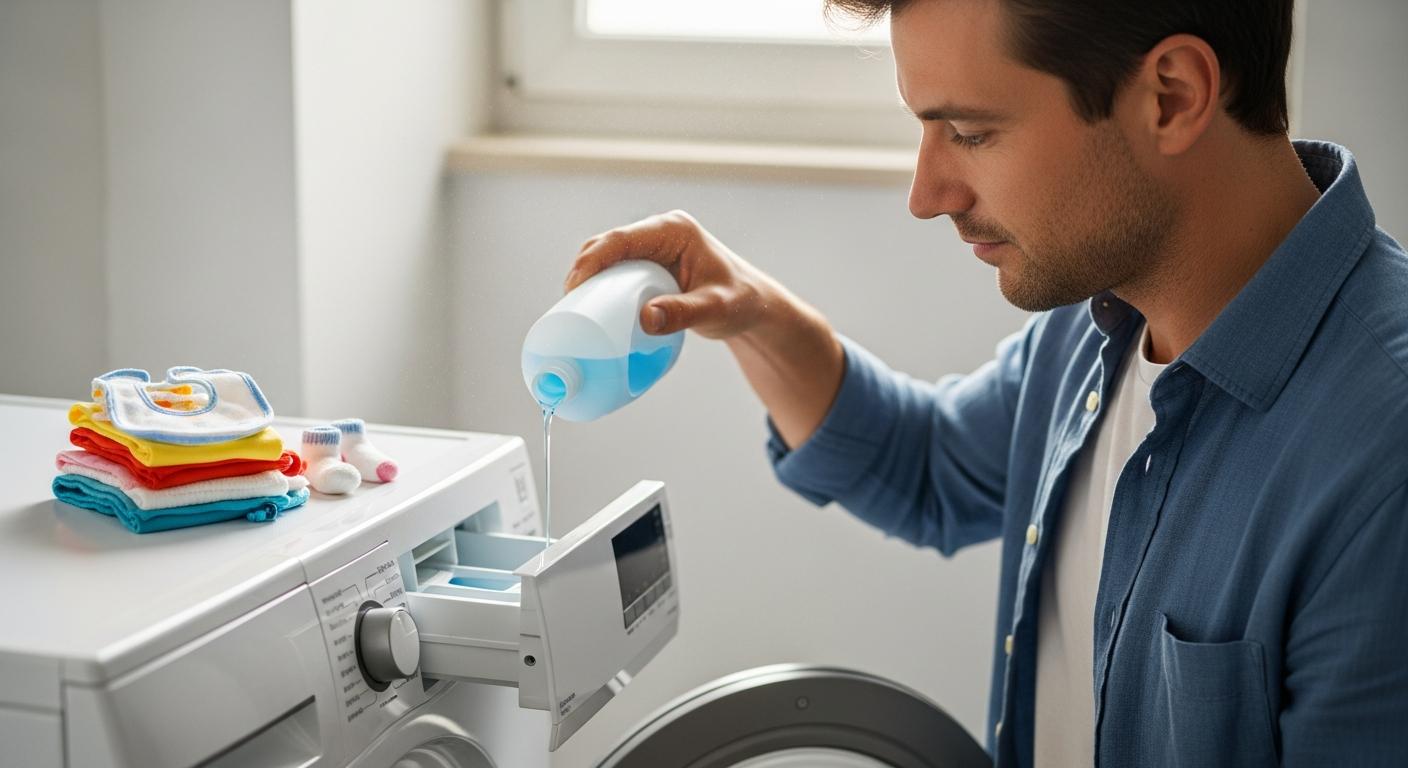
How much baby detergent to use
Use the smallest dose recommended for your load size, then increase only if clothes still look dirty or smell soiled. Baby loads are often small.
Water hardness: adjust the rinse, not the dose
Hard water can contribute to a film on fabrics. Measure accurately and consider an extra rinse.
Temperature and cycle settings
Most baby laundry can be washed at 30–40°C (86–104°F) when the care label allows it. Avoid overloading, clothes need room to move and rinse.
When an extra rinse is a good idea
Add an extra rinse when:
- eczema, dermatitis, or recurrent rashes are present
- you changed baby detergent recently
- items feel stiff, soapy, or strongly scented
- you wash bulky textiles
Fabric softener and cloth diapers
Fabric softener: a frequent irritant
Softener leaves a coating, often perfumed, and it can reduce absorbency—especially for cloth diapers and burp cloths.
Cloth diapers: avoid build-up
Helpful basics:
- no fabric softener
- a baby detergent (or sensitive detergent) that rinses clean
- rinse settings adapted to your machine and water
If diapers feel slick, repel liquid, or smell soapy, reduce dose and add rinses.
Safety at home
Storage and handling
Store detergents high and locked, in original packaging, cap closed. Pods and concentrates deserve extra caution.
Signs your baby may be reacting
Possible signs include new redness where clothing touches, itching after dressing, or eczema flares after a detergent change. Rewash affected items with a simpler baby detergent and an extra rinse.
Seek urgent care for facial swelling, vomiting after ingestion, or breathing difficulty.
When to switch from baby detergent to regular detergent
Many families switch around 6 months if skin has stayed calm. A gradual plan works well: test a fragrance-free, dye-free regular detergent on a small batch first and watch skin over 1–2 weeks, keeping the extra rinse during the transition.
Key takeaways
- Baby detergent can reduce irritating residue sitting against delicate skin for hours.
- “Hypoallergenic” is a clue, not a guarantee, dose and rinsing often decide tolerance.
- Choose fragrance-free and dye-free first, consider skipping optical brighteners for reactive skin.
- For very sensitive skin, avoiding certain preservatives (including isothiazolinones) and trialing enzyme-free options can help.
- Overdosing is a common cause of residue—start with less and add an extra rinse when needed.
- Fabric softener often triggers irritation and reduces absorbency, especially for cloth diapers.
- If skin problems persist, a clinician can help tailor the plan, families can also download the Heloa app for personalized guidance and free child health questionnaires.
Questions Parents Ask
Can I wash baby clothes with the family’s detergent?
Yes, in many homes that works well—especially if the detergent is truly fragrance-free and dye-free. What often makes the biggest difference is the routine: measuring a small dose, avoiding overloading the drum, and adding an extra rinse if your baby’s skin seems reactive. If you’re unsure, you can test on a few bodysuits for 1–2 weeks and see how your baby’s skin responds—no pressure to change everything at once.
Is “natural” or plant-based baby detergent automatically safer?
Not always, and you’re not alone in wondering this. “Natural” can still include fragrance blends or certain preservatives that don’t suit sensitive skin. A simple way to compare products is to focus on what’s most tolerated: fragrance-free, dye-free, and minimal additives. If a “natural” option smells strongly, it may be more irritating than a basic free & clear detergent.
What detergent is best for baby clothes in hard-water areas?
Hard water can make fabrics feel stiff and can reduce how well detergent rinses out. The good news: you often don’t need more product. It’s usually more comfortable for baby’s skin to dose accurately and use an extra rinse (or a longer cycle) so fewer minerals and detergent traces remain on fibers. If clothes still feel rough, a water softener solution can be discussed with your machine’s recommendations.