Montessori baby often appeals when you are craving something simpler and calmer – practical steps that respect your little one’s rhythm. Between contradictory advice from family, social media, and even well-meaning neighbours, plus the fear of “doing it wrong” and plain exhaustion, one question comes up again and again: how do you support motor development, early language, and safety without turning your home into an activity centre?
A Montessori baby approach keeps things grounded: a clear framework, realistic choices for Indian homes (small flats, joint families, frequent visitors), and medically sound reminders about sleep safety, free movement, sensory load, and feeding.
Montessori baby from birth: what it means for your family
Montessori baby definition (0–36 months) and the absorbent mind (0–3)
A Montessori baby approach is less about a label and more about how you see your child from day one: a capable person who learns through movement, hands-on exploration, and warm, predictable care.
From birth to age 3, the brain builds skills at an astonishing speed. Montessori described this as the “absorbent mind”: babies and toddlers take in language, routines, and social cues simply by living in their environment. From a neurodevelopmental angle, early brain plasticity (the brain’s ability to change with experience) is supported by:

- sensory exploration (touch, taste, sound, vision)
- spontaneous movement (rolling, pivoting, crawling)
- responsive emotional interactions (your voice, face, timing)
The aim is not to rush milestones. It is to offer the right conditions so development unfolds with confidence.
Montessori baby is not “making baby do it”
A Montessori baby lifestyle is not about drilling activities or pushing skills. It is about letting your baby act, repeat, pause, and try again. Starting early does not mean doing more. It often means doing less, but doing it with intention: gentle light, simpler visual input, awake time on a firm floor surface, and calm narrated care.
How Montessori baby care differs from more directed baby care
The key difference is where initiative lives.
In Montessori baby care:
- your baby chooses between a few simple options kept at their level
- they explore actively with hands, mouth, trunk rotation, and body support
- they can stop when they are done
In a more directed approach:
- adults demonstrate, prompt, or do things “for” the baby
- the baby may become more of a spectator than an active learner
For infants, active exploration supports psychomotor development in a very concrete, physiological way – muscle tone, balance reactions, and coordination are built through self-initiated movement.
Core Montessori principles for babies
- Respect: speak to your baby before you pick them up, move slowly, explain what you’re doing.
- Observation: watch what captures attention, what frustrates, what calms.
- Independence: offer small opportunities – holding a washcloth, choosing between two shirts, bringing a book.
- Prepared environment: the room works for the baby (safe, accessible, orderly).
- Order: predictable places for objects and rhythms for the day.
- Movement: daily floor time to roll, reach, crawl, and cruise – without forced positions.
- Language: real words, turn-taking sounds, naming feelings and actions.
Sensitive periods in infancy and toddlerhood
Sensitive periods are windows when a child is strongly drawn to practising a skill – grasping, repeating a sound, lining objects up, climbing, pointing to name everything. You may notice:
- intense repetition (dropping, opening/closing, filling/emptying)
- strong interest in one category (animals, vehicles, spoons)
- a need for routines or doing things in a specific order
Rather than stopping repetition, channel it safely: a sturdy container for posting, a low drawer to open, a basket of safe objects to transfer.
Setting up Montessori baby at home: safety, simplicity, and accessibility
The golden rules: safety first, then minimalism
A baby learns with their whole body – and once mobility starts, the “rules” of your home can change within days. Start by securing the space:
- stable furniture (ideally anchored), protected corners, covered outlets
- cords out of reach, stair gates, secured windows and balcony grills
- clear, non-slip floor space (especially if you have polished tiles)
Then simplify. Too many toys often leads to scattered attention and irritability. A small low shelf with 4–6 items in simple baskets is usually enough. Give each item a clear “home”: visual order supports attention and reduces chaos.
Creating a Montessori yes space in Indian homes
A yes space is an area where your baby can explore safely with minimal “no”. It is not a place to leave a child unsupervised. Think safe boundaries, simple choices, and room to move.
A realistic starter setup in a living room can be:
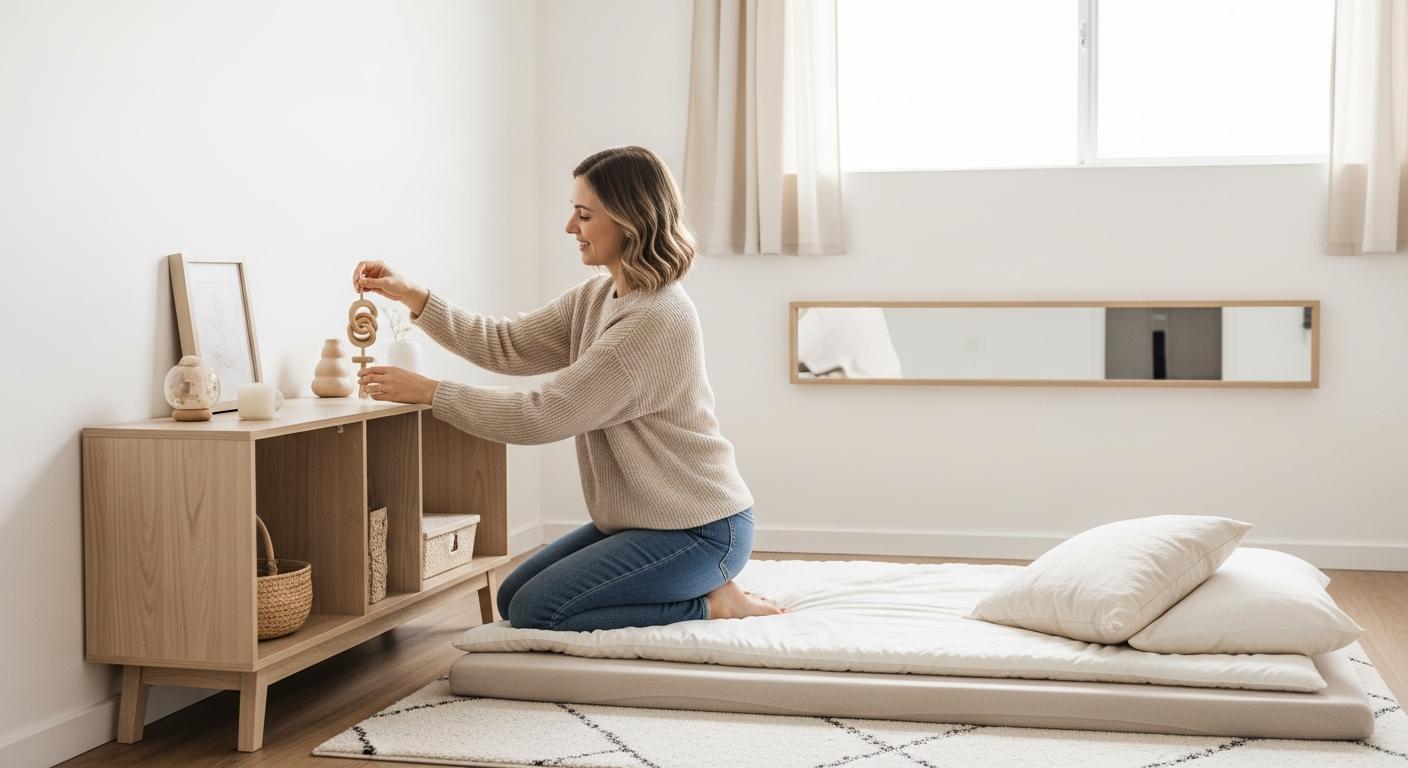
- a firm mat or folded cotton quilt for floor time
- a securely mounted shatterproof mirror
- 2–3 grasping objects
- 1 sturdy board book
In the nursery or bedroom, aim for:
- a calm sleep corner (easy to darken, visually minimal)
- soft evening lighting
- a small movement zone for awake time
Care routines (diapering, dressing) can also happen on the floor on a mat, with essentials within reach – calm, predictable, and unhurried.
When mobility begins: common risks to prevent
Prioritise prevention:
- remove small items that could be swallowed, check toys for wear
- store cleaning products, medicines, button batteries, and sharp objects securely
- watch for tablecloths, pressure cooker cords, blind strings, toxic plants, and water hazards (buckets, bathrooms)
Montessori baby for infants and toddlers (birth to age 3)
What changes from infant to toddler
Infants (0–12 months) learn mainly through sensory-motor exploration: looking, mouthing, grasping, rolling, creeping. The environment should be simple, safe, and movement-friendly.
Toddlers (1–3 years) want participation: “I do it.” They benefit from child-sized tools, clear routines, and practical life activities (wiping, pouring, dressing). Boundaries become more important because mobility and impulse outpace judgement.
The foundations Montessori supports in the early years
For 0–3, a Montessori baby approach supports:
- body awareness through movement
- early executive skills through simple sequences (take, use, return)
- language through real conversation linked to daily life
- emotional security through calm, respectful care
Why parents choose Montessori baby: developmental benefits
Independence and self-efficacy from the early months
Small “I can” moments build self-efficacy: holding the spoon, choosing a book, placing a toy back on the shelf.
Concentration, coordination, and a sense of order
Calm spaces, fewer choices, and repeatable activities support longer focus. Visual order in the environment can reduce stress, especially for children who get overstimulated easily.
Language development through everyday narration
A strong Montessori baby habit is simply describing life as it happens: “I’m wiping you now”, “I’m closing your onesie”, “I’m lifting your legs”. This links action and word and supports early language development.
Emotional security through respectful, predictable care
Trust grows when care is predictable and respectful. Make routine moments slow enough for connection: eye contact, a gentle voice, and a short explanation before you touch or move your baby.
Montessori baby development goals (what you will notice day to day)
Movement and physical coordination: the central role of floor time
Floor time supports muscle tone, trunk rotation, weight shifts, and later mobility. Limit long periods in positions your baby cannot get into by themselves and prolonged time in “containers” (bouncers, seats, car seats used indoors).
To support rolling or early crawling without forcing:
- place a motivating object slightly to the side and let your baby initiate the rotation
- avoid pulling an arm to “help”
- for belly movement, place the object a little farther away on a surface that gives traction
If you notice marked asymmetry, unusual stiffness, very low tone (hypotonia), or a global delay, seek professional guidance.
Sensory input: stimulate, then let the nervous system breathe
Babies can overload quickly. Try one stimulus at a time.
Possible signs of overstimulation:
- looking away
- agitation or sudden tension
- abrupt crying
Lower the intensity, return to calm, and offer comfort.
Montessori baby materials: useful, simple, and evolving
What makes a toy “Montessori” for a baby
A Montessori-style material often has one clear action (grasp, shake, insert, open), uses realistic materials, is a safe size, and is non-toxic and washable.
Light-up, noisy toys can be fun, but they often grab attention automatically. You may see less self-built concentration.
Rotation: keep it small and refresh gently
Keep 4–6 items visible. Swap 1–2 items every 1–2 weeks. Store the rest out of sight.
Age-based ideas (flexible guides)
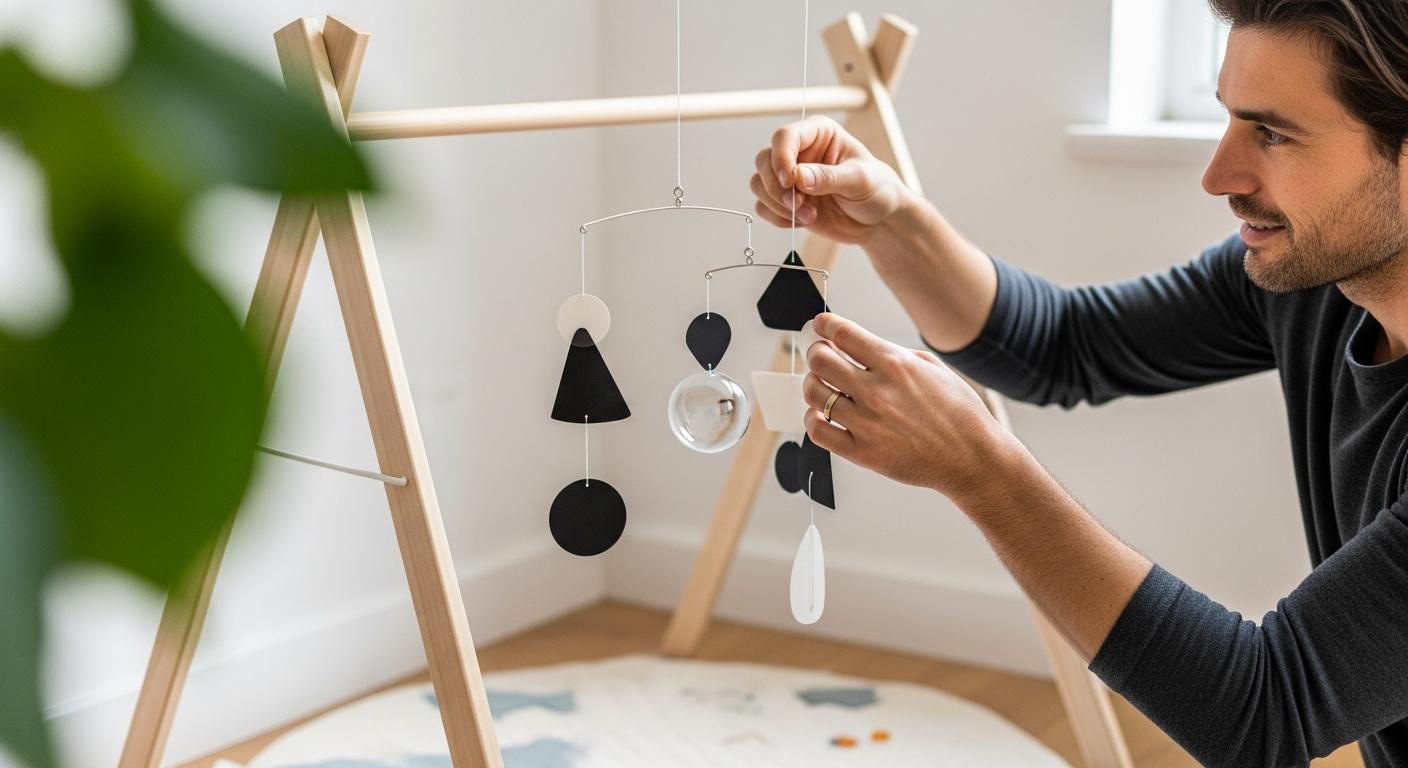
0–3 months: high-contrast cards, safely installed mobile, shatterproof mirror, simple rattle.
3–6 months: sensory ball, grasping rings, sturdy board books.
6–9 months: in/out containers with large objects, basic posting, supervised open/close play.
9–12 months: simple knob puzzles (2–3 pieces), filling/emptying containers.
Montessori baby activities that fit real life
Everyday life is the best classroom
Your baby learns from real life: a clean spoon, dish towel, soft brush (supervised), participating in diapering, and watching meal prep from a safe spot. And above all: talk.
Tummy time the Montessori way
Short, frequent, supervised:
- lie face-to-face
- place a mirror safely at floor level
- offer one simple object
Treasure baskets and heuristic play
Offer a small basket of safe household objects with different textures and weights. There is no “right” way – your role is to observe and keep it safe.
Nature, music, and movement
Outdoor time supports regulation and sleep pressure. Simple songs and rhythmic games build coordination without overwhelming the senses.
Montessori baby daily routines: practical life foundations
Care moments as connection and learning
Tell your baby what is happening before you do it. Offer a small job: holding the washcloth, choosing between two pyjamas, lifting legs when ready.
Going out and transitions
Use short cues: “Now shoes”, “Now car”. For toddlers, a brief warning before transitions can reduce protest.
Eating and weaning with Montessori baby principles
Posture: the foundation of safety and coordination
For eating, posture matters: stable pelvis, supported back, and feet on a solid surface. This stability supports safer swallowing and hand-to-mouth coordination.
Simple tools and key food safety reminders
Helpful tools: small cup, short spoon, plate with a rim.
Safety reminders:
- no honey before 12 months (infant botulism risk)
- adapt choking-risk foods (avoid whole grapes, nuts, hard pieces)
- constant supervision during meals
Respecting hunger and fullness cues
Turning the head away, closing the mouth, slowing down, pushing food away – these can be signs of fullness.
Sleep and rhythms with a Montessori baby: autonomy, yes – safety first
Floor bed overview: benefits and limits
A floor bed can match Montessori baby values if the room is fully safe.
Safe sleep basics stay the same:
- baby on the back
- firm, fitted mattress
- no pillows, blankets, bumpers, or soft toys
If nights become very disrupted, it is fine to choose a more contained sleep option for a period.
Predictable bedtime rituals
Dim lights, diaper, sleep sack, a short book, then sleep. If your baby cries, stay close and respond calmly, emotional presence matters.
Gentle boundaries: freedom within clear limits
Montessori is not permissive
Limits are few, consistent, and calm: “I won’t let you touch the outlet.” Then redirect.
Starting Montessori baby at home: a simple action plan
Five easy steps to begin
- Clear a safe floor space with a firm mat.
- Add a low shelf with 4–6 age-appropriate items.
- Secure outlets, cords, and unstable furniture.
- Rotate 1–2 items every 1–2 weeks.
- Narrate care routines and give your baby time to try.
Adapting to your child and your family life
- Very active baby: more movement, shorter invitations, extra-safe yes space.
- Very sensitive baby: fewer sounds and bright lights, steady routines.
- Siblings at home: keep small parts out of reach, protect a baby zone.
To remember
- Montessori baby starts with a mindset: observe, secure, and let your baby act.
- A prepared environment with few items can prevent overstimulation.
- Free movement and daily floor time support psychomotor development.
- Sleep safety rules stay firm.
- Feeding: stable posture, simple tools, respect hunger/fullness cues, and choking prevention.
- If you feel worried about tone, stiffness, marked asymmetry, or global delays, speak to a child health professional.
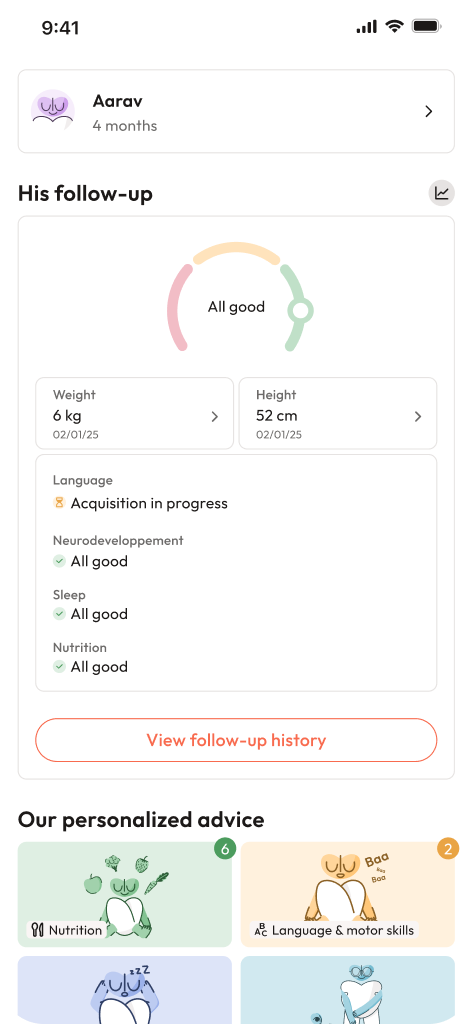
- For personalised tips and free child health questionnaires, you can download the Heloa app.