A baby’s body changes fast: from newborn startles to a toddler who runs, squats, turns, and climbs as if the living room were a mini mountain range. That speed can be thrilling… and a little unsettling. Should your child be sitting already? Is it “bad” if crawling looks unusual? Are all those falls normal?
Gross motor development gives useful reference points without turning childhood into a stopwatch. It covers posture, balance, weight shifting, locomotion (moving from place to place), jumping, climbing, and those protective reactions that appear almost overnight: hands out to stop a fall, a quick step to regain balance.
What gross motor development really means
Gross motor development describes how children learn to coordinate the large muscles of the trunk, shoulders, hips, arms, and legs. Think: head control, rolling, sitting, moving on the floor, pulling to stand, walking, running, jumping, and early ball play.
What makes it “development,” not just “exercise”? The brain and body are building a communication network.


- The nervous system refines muscle tone (the baseline tension that keeps the body ready to move).
- Postural muscles learn to “switch on” at the right time.
- Balance systems learn to predict, react, and correct.
Gross vs fine motor: different muscles, same teamwork
Gross motor skills involve the whole body: getting up, moving around, staying steady. Fine motor skills involve small, precise hand movements: pinching, stacking, drawing.
Here’s the link many parents notice: a stable trunk supports free shoulders, free shoulders support skilled hands. When gross motor development improves, fine motor tasks (spoon use, dressing, drawing) often become easier because the body is not busy fighting gravity.
Typical directions of progress: “top to bottom” and “center to edges”
Many children follow two classic patterns:
- Head-to-toe: head control first, then trunk, then legs.
- Center-to-extremities: stability in the core and shoulder/hip girdles before refined control in hands and feet.
Does every child look identical? No. But these trends explain why wobbly legs often come after solid sitting, and why “whole-body” movements gradually become more segmented and efficient.
What’s happening in the brain and body
Parents sometimes hear technical terms and wonder if they matter. They do, because they explain why patience and practice work.
Neurological maturation: myelination, cerebellum, reflex integration
- Myelination: nerve fibers gain myelin (an insulating sheath). Signals travel faster, movement becomes less effortful.
- The cerebellum: a key player in balance and motor learning, constantly “calibrating” movement.
- Primitive reflex integration: early reflexes (automatic newborn patterns) fade as voluntary control takes over.
You may notice it as a shift: fewer random flails, more targeted reaching, smoother rolling, cleaner transitions.
Sensory foundations: vestibular, proprioceptive, visual input
Movement is guided by sensory messages:
- The vestibular system (inner ear): detects head movement and gravity, central for balance.
- Proprioception: feedback from muscles and joints, “where is my body in space?”
- Vision: supports orientation, anticipating obstacles, aiming a throw.
If one channel is less efficient, gross motor development may look cautious, clumsy, or tiring. Not a flaw. A signal to adapt practice and, sometimes, ask for an assessment.
Motor learning: repetition, variety, and realistic challenges
Children learn by doing the real thing, over and over, on different surfaces, at different speeds, with tiny errors that get corrected.
A question to ask yourself: “Is my child getting chances to try, fail safely, then try again?” That cycle is pure motor learning.
Why gross motor development matters beyond the playground
Daily independence
Getting on and off the floor, climbing into a chair, handling stairs, walking while carrying a toy: these are everyday markers of gross motor development. When they are difficult, children may avoid movement, tire fast, or ask for help frequently.
Confidence and social play
Playground games are physical negotiations: run, stop, climb, wait, jump, land. When a child feels steady, participation rises. When movement feels risky, they may hang back.
Attention, planning, and school participation
Movement also trains the brain’s “organization” skills: sequencing (first crawl through, then step over), inhibition (freeze games), and adapting to rules. At school, good postural control supports sitting endurance, safe transitions in crowded spaces, and PE participation.
Gross motor development milestones by age (with wide normal variation)
Milestones are reference points, not verdicts. What usually matters most is:
- steady progress over time
- movement variety (not just one preferred strategy)
- symmetry (using both sides of the body)
0-6 months: head control, propping, rolling
Common patterns:
- 0-3 months: improving head control, especially during supervised tummy time
- 3-4 months: steadier forearm propping
- 4-6 months: rolling becomes more intentional and coordinated
6-12 months: sitting, floor mobility, pulling to stand
Expect experimentation.
Common patterns:
- 6-8 months: sitting stabilizes (hands down first, then hands-free)
- 6-9 months: floor mobility (pivoting, commando crawling, scooting)
- 7-10 months: hands-and-knees crawling for many children (skipping it can still be typical)
- 8-10 months: pulling to stand at stable furniture
- 9-12 months: cruising, then sometimes first independent steps
12-24 months: walking, early running, stairs
Common patterns:
- 12-18 months: walking becomes more stable, with better stopping and turning
- around 18 months: early running often resembles fast walking
- around 2 years: more coordinated running, stairs improve with hand support
2-4 years: jumping, climbing, expanding ball skills
Common patterns:
- running with direction changes
- two-foot jumping (first in place, then forward)
- climbing with better planning
- throwing improves, catching develops gradually (often later than parents expect)
4-6 years: dynamic balance and coordinated games
Common patterns:
- standing on one foot for several seconds
- walking along a line, then backward
- jumping over low obstacles with softer landings
- more comfort with rule-based games (relays, tag, simple sports)
What’s typical… and what deserves a closer look
Normal variation: why timing differs
One child moves early. Another observes, rehearses, then suddenly “downloads” the skill. Influences include:
- time and space for floor play
- temperament (cautious vs bold)
- temporary illness and fatigue
- prematurity (corrected age can be helpful in the first years)
If progress continues, variation is often just variation.
Patterns to monitor: asymmetry, toe walking, frequent falls
Consider discussing with a clinician if you notice patterns that persist:
- clear asymmetry (always rolling one direction, always pushing off with the same leg)
- toe walking that continues well beyond the early walking phase
- falls far more frequent than peers, marked clumsiness, or avoidance of movement
- limping, pain, or refusal to bear weight
Regression: losing a skill
Loss of previously acquired skills (for example, a child who walked and now no longer does) needs medical advice promptly.
Simple ways to support gross motor development at home
The aim is not to “train.” It’s to offer opportunities, keep things safe, and let your child experiment.
0-6 months: positioning variety and short tummy-time bursts
- brief, frequent tummy time on a firm surface (increase slowly)
- toys at eye level to encourage head lifting and turning
- position changes: back, side-lying, tummy (comfort first)
6-12 months: reach, pivot, crawl, pull up on their timeline
- place toys slightly out of reach to encourage movement on the floor
- cushions to crawl over, or a soft tunnel to move through
- supported standing at stable furniture when ready (close supervision)
12-24 months: tiny challenges that invite practice
- mini obstacle paths: step over a pillow, up/down one step with a hand
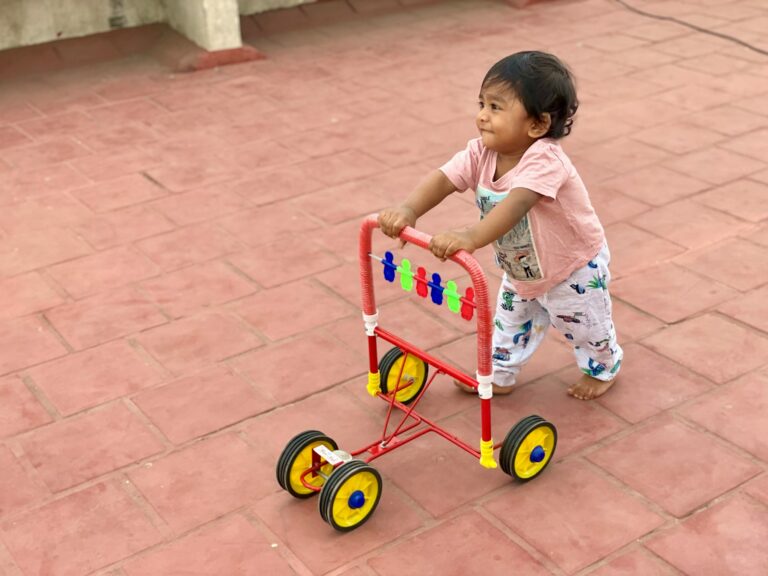
- push/pull play with stable toys (a sturdy wagon, a push walker used safely)
- simple ball games: roll back and forth, throw into a basket
2-6 years: repetition, games, and “one change at a time”
- jumping to floor markers, then jumping off a low step
- stop/go games, follow-the-leader, short relays
- playground routines: climb low, slide, repeat (confidence builds through repetition)
To increase difficulty, change just one factor (height or distance or speed). Small steps prevent overwhelm and keep movement enjoyable.
Indoor ideas for small spaces
- Cushion-and-tape obstacle course: line to follow, pillow to step over, table to crawl under (edges cleared).
- Animal walks and dance: bear walk, crab walk, freeze dance, great for core strength and coordination.
- Balloon play: slower, softer, less intimidating, practice two-hand catches and gentle kicks.
Outdoor ideas that build confidence
- Choose equipment that matches current skills, then progress gradually (low climbs before high ones).
- Run-and-stop games: tag, chase, red light/green light for speed control.
- Riding skills: tricycle, scooter, balance bike. Practice start/stop/turn on flat ground, helmet for bikes and scooters.
When to seek advice (and who can help)
You may wonder: “Am I worrying too much?” Sometimes reassurance is exactly what’s needed. Sometimes a quick check prevents months of doubt.
Discuss with a healthcare professional if you notice:
- little progression over time in gross motor development
- regression (loss of a skill)
- persistent asymmetry
- toe walking that does not fade
- limping, pain, or refusal to bear weight
- movement limited by discomfort or unusual fatigue
Severe pain, fever, or a recent significant injury warrants prompt medical attention.
Possible supports include a pediatrician/primary care clinician, a pediatric physical therapist, a psychomotor therapist, or a pediatric occupational therapist.
Gross motor development across childhood: the long view
Gross motor development keeps feeding other skills. Whole-body control supports hand skills, yes, but also confidence, participation, and willingness to try. A child who trusts their balance explores more, a child who explores more learns faster. A virtuous cycle.
Key takeaways
- Gross motor development includes posture, balance, weight shifting, protective reactions, locomotion, and early ball skills.
- Timing varies widely, steady progress, movement variety, and symmetry are often more informative than a single milestone date.
- Brain maturation (myelination, cerebellar calibration, reflex integration) and sensory input (vestibular, proprioceptive, visual) shape movement quality.
- Daily playful practice: floor time, mini obstacle courses, simple indoor/outdoor games, supports gross motor development without pressure.
- Seek professional advice if there is regression, persistent asymmetry, ongoing toe walking, limping/pain, or very limited progress.
- For tailored guidance and free child health questionnaires, you can download the Heloa app.
Questions Parents Ask
Does skipping crawling affect gross motor development?
Not necessarily—reassure yourself, this can be totally normal. Some babies move by bottom-scooting, commando crawling, or rolling, then go straight to pulling up and cruising. What matters most is that your child keeps progressing, explores different movements, and uses both sides of the body fairly evenly. If mobility looks very one-sided, or your baby seems “stuck” and frustrated for weeks, a quick check-in with a pediatrician or pediatric physical therapist can be reassuring.
How is gross motor development assessed by a healthcare professional?
Most of the time, it’s simple and gentle: questions about milestones, observation of how your child moves (posture, balance, symmetry, transitions), and sometimes a short screening checklist at routine visits. If there’s a doubt, a more detailed standardized assessment may be suggested to understand strengths and what to support next—without blaming anyone. The goal is clarity and practical ideas, not labeling.
Do premature babies follow a different gross motor milestone timeline?
Yes, and it’s common. Professionals often use corrected age (based on due date) for milestones in the first years. Many preterm children catch up gradually, and steady progress is a very encouraging sign. If you feel unsure, asking for a milestone review can bring peace of mind and, if needed, early support.
Further reading:
- Motor development milestones (https://www.who.int/tools/child-growth-standards/standards/motor-development-milestones)