Watching your baby shift from jerky newborn startles to a confident little explorer racing across the park is exciting – and at times nerve-testing. One day there is a wobble, the next day a daring climb on the sofa. Is the pace “right”? Are frequent tumbles normal? And what if your baby never did that classic hands-and-knees crawl?
Gross motor development offers sensible signposts without turning each month into an exam. It covers posture, balance, moving around, jumping, climbing, and learning to shift body weight safely. Some changes come from neurological maturation (myelination, cerebellar calibration, and the gradual fading of primitive reflexes). Others are built through daily life: floor play, trial and error, a few slips, and many small wins.
Gross motor development: what it means for your child
Gross motor development is how a child learns to use the larger muscles of the trunk, shoulders, hips, arms, and legs to move and stay upright. It includes:
- holding the head steady
- rolling and sitting
- moving on the floor (pivoting, bottom scooting, commando crawling, crawling)
- standing, cruising, walking
- running, jumping, climbing
- early ball skills (rolling, kicking, throwing)
Behind the scenes, the nervous system adjusts muscle tone (baseline muscle tension), postural control, and balance. Over time, movements become smoother, safer, and less tiring. Protective reactions are part of gross motor development too – hands going out to break a fall, a quick step to catch balance, or slowing down near an edge.

Gross motor skills vs fine motor skills: how they support each other
Gross motor skills are “whole-body” actions – changing position, getting from one place to another, and maintaining balance. Fine motor skills are smaller, precise actions, mainly with hands and fingers: pinching, stacking blocks, turning pages, scribbling.
They work together all day. A stable trunk “frees” the shoulders, stable shoulders support controlled hand use. When gross motor development improves, many children find feeding, dressing, and table-top play easier because the body is not constantly fighting gravity.
Typical progression patterns: head-to-toe, centre-to-extremities
Many children follow two broad trends linked to nervous system maturation:
- Head-to-toe: head control first, then trunk control, then more refined leg control
- Centre-to-extremities: stability in the trunk, pelvis, and shoulders before finer control in hands and feet
As this unfolds, movement looks less “all at once”. Children begin to separate body segments (turning the head without the whole body twisting), adjust faster, and fall more safely.
The building blocks behind gross motor development
Clinicians often look at a few foundations:
- Muscle tone and stability: how well the trunk, shoulders, and pelvis keep the body aligned
- Postural control: holding a position (sitting, standing) without collapsing
- Balance: controlled weight shifts and recovery from wobbling
- Strength and endurance: staying upright longer, walking without quickly tiring
- Coordination: timing arms and legs for climbing, hopping, running, and ball play
- Motor planning: working out “how to do it” and refining the movement through practice
You may hear:
- Hypotonia (low tone): body feels “floppy”, posture slumps easily, fatigue comes fast
- Hypertonia (high tone): movements can look stiff or less adaptable
How gross motor development happens in the brain and body
Neurological maturation: myelination, cerebellum, reflex integration
- Myelination: nerve fibres gain myelin, so messages travel faster
- Cerebellum: supports balance and motor learning (fine-tuning force and timing)
- Primitive reflex integration: early reflexes fade, voluntary control takes over
In early infancy, reflex-driven patterns are common. With maturation and practice, rolling, sitting, and transitions become more intentional.
Sensory foundations: vestibular, proprioceptive, and visual input
- Vestibular system (inner ear): detects head movement and gravity, supports balance and gaze stability
- Proprioception: signals from muscles and joints about body position and force
- Vision: supports orientation, avoiding obstacles, and aiming (especially in ball play)
If one system is less efficient, gross motor development may look cautious, clumsy, or more tiring. That does not automatically mean a serious issue, but it can explain why your child needs more time or a different kind of practice.
Motor learning through play
Children learn by doing. Repetition builds pathways. Variety across surfaces – mat, bed, grass, sand – builds adaptability. Calm cues from an adult (“slowly”, “hold the rail”) help refine technique.
Why gross motor development matters in daily Indian family life
Good gross motor development supports everyday independence: sitting upright for meals, getting on/off the floor (common in many Indian homes), climbing onto a chair, managing steps, walking safely in crowded places, and playing outdoors.
It also supports confidence. School PE, society play areas, and park games are social spaces, children participate more when movement feels manageable.
Active play strengthens planning and self-regulation too: stop/go games, simple obstacle courses, and rule-based play.
Gross motor development milestones by age (with normal variation)
Milestones are reference points. Timing varies widely. What often matters more is steady progress, movement variety, and symmetry.
0-6 months
- 0-3 months: head control improves mainly during supervised tummy time
- 3-4 months: steadier forearm propping
- 4-6 months: rolling becomes more coordinated
6-12 months
- 6-8 months: sitting becomes steadier (hands for support first, then hands-free)
- 6-9 months: floor mobility (pivoting, commando crawling, bottom scooting)
- 7-10 months: hands-and-knees crawling for many (not mandatory)
- 8-10 months: pulling up to stand with support
- 9-12 months: cruising, then sometimes first independent steps
12-24 months
- 12-18 months: walking becomes safer and more stable
- around 18 months: early running may look like fast walking
- around 2 years: more coordinated running, stairs improve with support
2-6 years (overview)
- 2-3 years: two-foot jumping, climbing, improving throws
- 3-4 years: tricycle practice, early hopping attempts
- 4-5 years: better dynamic balance (one-foot stand, line walking)
- 5-6+ years: agility, smoother direction changes, more confident group games
What’s typical vs what may need a check-in
Variation is common. Some babies skip crawling and go straight to pulling up and cruising, others bottom-scoot for months. What matters is that your child keeps progressing and uses both sides reasonably evenly.
Consider medical advice if you notice:
- persistent asymmetry (always using one side)
- toe walking that continues beyond the early walking period
- frequent falls far more than peers, or avoiding movement because it feels too hard
- limping, pain, or refusal to bear weight
If your child loses previously acquired motor skills, seek medical attention promptly.
Supportive activities by age (easy, pressure-free ideas)
The aim is to offer chances: suggest, make it safe, observe, and adjust.
0-6 months
- short, frequent tummy time on a firm surface, increase gradually
- toy at eye level to encourage lifting and turning the head
- position variety (back, tummy, side-lying), comfort first
6-12 months
- toys slightly out of reach to encourage pivoting and floor movement
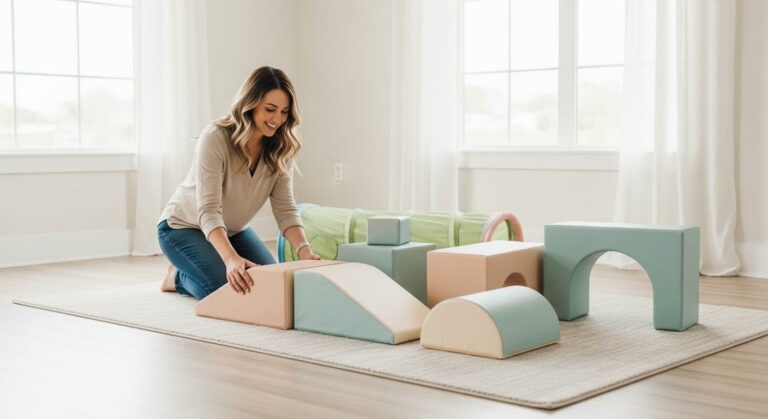
- cushions or a soft tunnel to crawl over/through
- supported standing at stable furniture when ready, close supervision
12-24 months
- mini routes: step over a pillow, climb one small step with your hand support
- push/pull toys that are stable
- ball play: roll back and forth, throw into a bucket or basket
2-6 years
- chalk circles for jumping targets, practise “jump and land softly”
- simple slaloms, line walking, crawl-through games
- playground repetition: low climb, come down, repeat
- stop/go games and short relays
Safety: adjust one thing at a time
Clear the area, use non-slip surfaces, and keep equipment steady. To increase difficulty, change one factor only (height or distance or speed). Small steps build confidence.
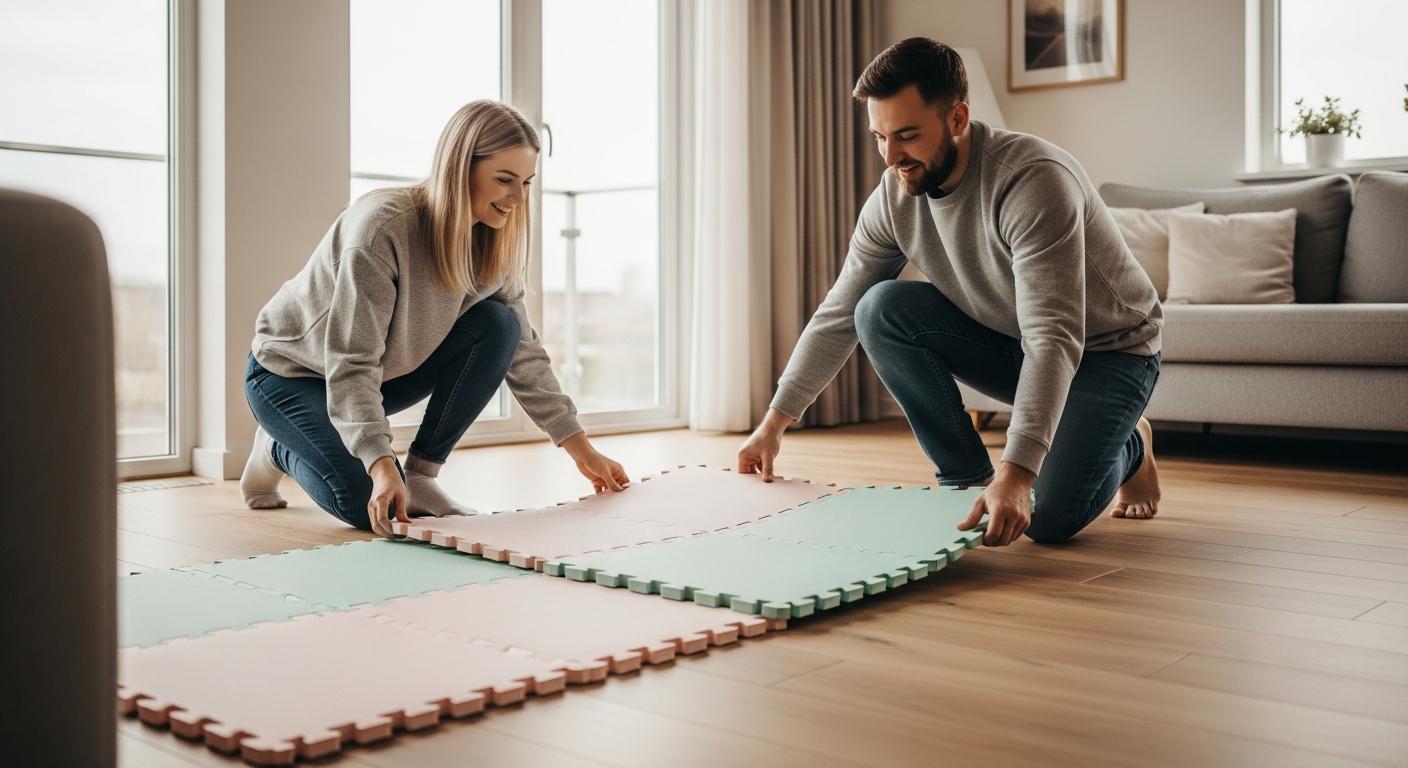
Indoor ideas for small homes
- Cushion-and-tape obstacle course: a short path to follow, one step-over, one crawl-under
- Dance and freeze games: timing + balance in a fun format
- Balloon play: gentle catching and kicking with less fear of injury
Outdoor ideas that build confidence
- Playground progression: low first, then higher, staying close for new attempts
- Running games: tag, follow-the-leader, short relays for turning and stopping
- Riding skills: tricycle/scooter/cycle on flat ground, helmet for cycles and scooters
Signs to watch and when to get advice
A check-in can help if there is:
- little progression over time in gross motor development
- regression (loss of a skill)
- discomfort limiting movement
Examples worth discussing:
- head control not improving
- no stable sitting around 9-10 months
- very limited floor exploration
- no attempt to pull to stand with support while other skills progress
Support may come from a paediatrician/family doctor, a paediatric physiotherapist, a psychomotor therapist, or a paediatric occupational therapist.
Key takeaways
- Gross motor development covers posture, balance, weight shifting, locomotion, protective reactions, and early ball skills.
- Milestones vary, steady progress, movement variety, and symmetry often matter more than exact timing.
- Brain maturation (myelination, cerebellum, reflex integration) and sensory input (vestibular, proprioceptive, visual) shape movement quality.
- Daily play – floor time, small obstacle games, indoor/outdoor practice – supports gross motor development without pressure.
- Seek advice for persistent asymmetry, ongoing toe walking, limping/pain, lack of progress, or loss of skills.
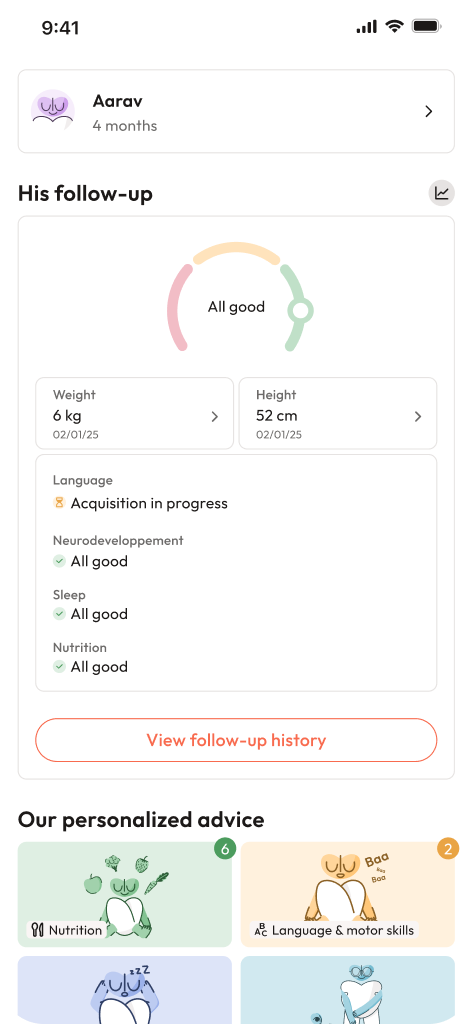
- Families can also download the Heloa app for personalised tips and free child health questionnaires.
Further reading:
- Motor development milestones (https://www.who.int/tools/child-growth-standards/standards/motor-development-milestones)