A play mat can look like a simple square of padding. Then real life arrives: milk dribbles, drool, a sudden roll, a wobbly squat, a toy that clatters at 7 a.m. You may want one place that feels comfortable, predictable, and genuinely safer on hard floors—without turning your home into an indoor playground.
Choosing a play mat is partly about comfort, yes. But it’s also about indoor air quality (VOCs), chemical claims like phthalate-free and BPA-free, traction for crawling knees, and a firmness that supports movement rather than swallowing it. Newborn wiggles, tummy time, crawling lanes, toddler tumbles: the same surface often sees it all.
What a play mat is really for (and why parents notice the difference)
A play mat is a dedicated floor surface for supervised free movement: lying on the back, turning the head, rolling, pivoting, belly exploration, crawling, pulling to stand, and those first daring steps.
From a pediatric perspective, floor time builds the “engine room” of motor development: neck and shoulder stability, trunk control, hip strength, and hand support. Babies aren’t training. They’re wiring their nervous system through repetition—pressure, contact, and balance corrections that shape proprioception (body-in-space sense).


So what does a good play mat do?
- Offers impact absorption for the small, frequent bumps
- Adds thermal insulation on cold tile or wood
- Creates a stable base so hands, knees, and feet don’t slip away
You might be wondering: is it worth it if you already have a rug? Often, yes—because rugs trap dust and moisture, and many are harder to sanitize when your baby lives in hands-to-mouth mode.
Play mat vs rug vs activity gym: quick, practical distinctions
- Play mat: larger, supportive, easier to wipe, built for daily floor life.
- Rug/carpet: cozy, but holds crumbs, allergens, pet hair, cleaning can be slower.
- Activity gym: great for visual and reaching play, but the thin pad underneath rarely replaces a true play mat.
A common, workable setup: the play mat as the base, then an activity gym for short, engaging sessions. Fewer objects, more focus. Does your baby really need a toy storm overhead? Not always.
How a play mat supports motor development—without forcing positions
A play mat shouldn’t be about placing a baby into sitting, or practicing standing before the body is ready. The goal is a safe surface where your child initiates movement, stops, tries again.
Parents often notice:
- Smoother tummy time because the surface isn’t cold or slippery
- More rolling and pivoting (less frustration from sliding)
- More stable hands-and-knees because support points feel reliable
If a surface is too soft, something subtle happens: elbows sink, knees disappear, balance feels fuzzy. Babies can still move, but they work harder—and sometimes they simply give up sooner.
Using a play mat by age: what matters most at each stage
Newborn to 3 months: calm floor time and hygiene basics
A clean play mat can be used early for short awake moments: on the back with gentle interaction, then brief tummy time as tolerated.
Priorities:
- Easy-to-clean, low-odor materials
- Enough warmth between baby and cold floors
- A clear area (no loose small objects)
Notice head turning to both sides. A strong, persistent preference for one side may justify a chat with a pediatric clinician or pediatric physiotherapist.
3 to 6 months: tummy time that actually becomes doable
This phase often brings the tummy time question. Short, frequent sessions usually work best.
Try:
- Place a toy at eye level, then shift slightly side-to-side to encourage rotation
- Use a rolled towel under the upper chest briefly (then reduce support)
Your play mat should feel supportive: firm enough to push into, cushioned enough to prevent face-first discomfort.
6 to 12 months: rolling, creeping, crawling—the practice runway
Now the play mat turns into a movement lane. Bigger often equals calmer because you stop repositioning your baby every two minutes.
Simple ideas:
- A firm cushion to climb over
- Two cushions as a mini bridge
- A soft tunnel (supervised)
If your baby doesn’t sit independently yet, avoid prolonged propped sitting. Fatigue can lead to slumped posture and less joyful exploration.
12 to 24 months: standing, balance, and many small falls
Toddlers fall. A lot. Usually minor, but frequent.
A supportive play mat can soften bottom landings and encourage quick retry moments. Keep edges flat and the surrounding space clear—coffee table corners don’t negotiate.
2 to 4 years: jumps, floor games, and a calm corner
A play mat can stay useful: jumping practice, building blocks, puzzles, pretend play, and a reading nook. For energetic play, quick environment checks help: furniture edges, cords, unstable items.
Play mat types: which format fits your home (not an ideal home)
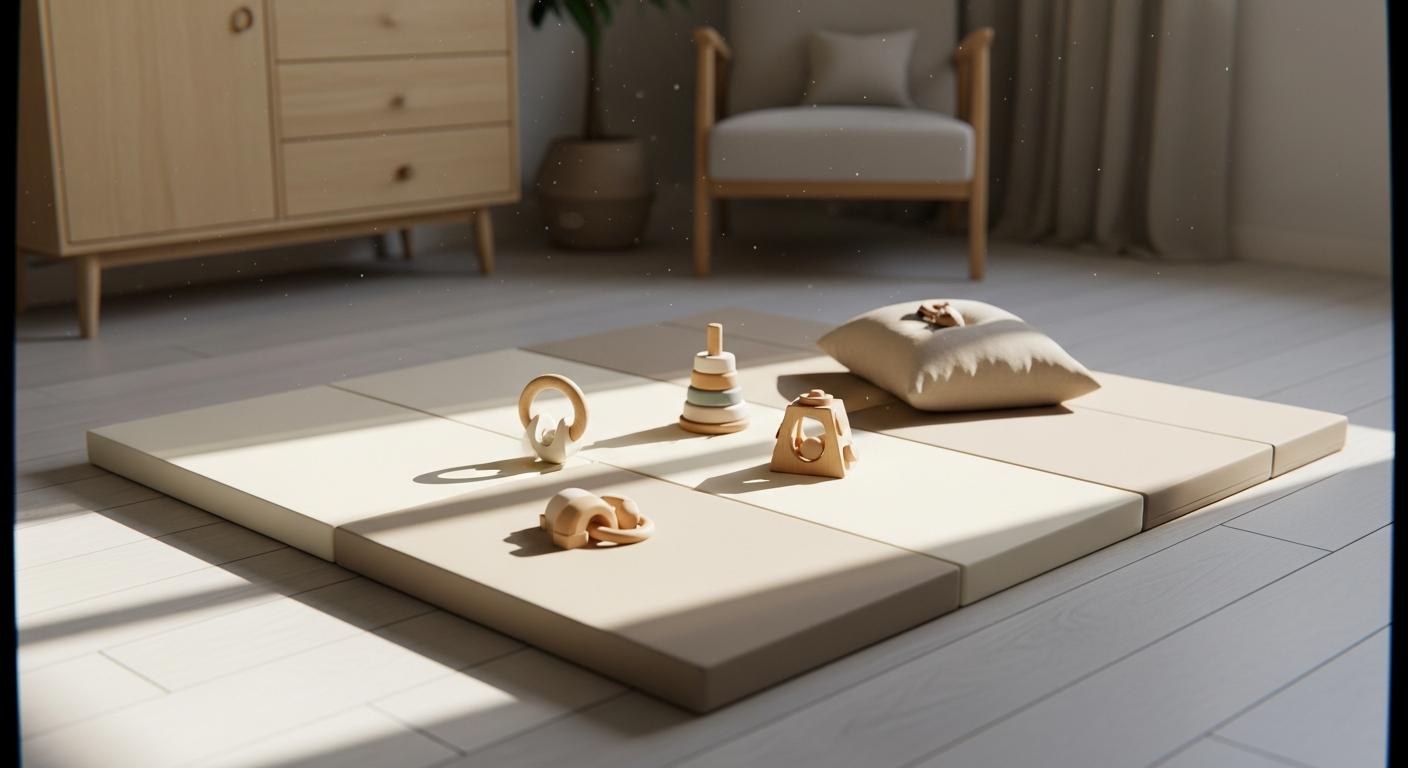
One-piece foldable play mat
Fast setup, easy storage, great for small spaces. Watch fold lines: they should lie flat and resist peeling.
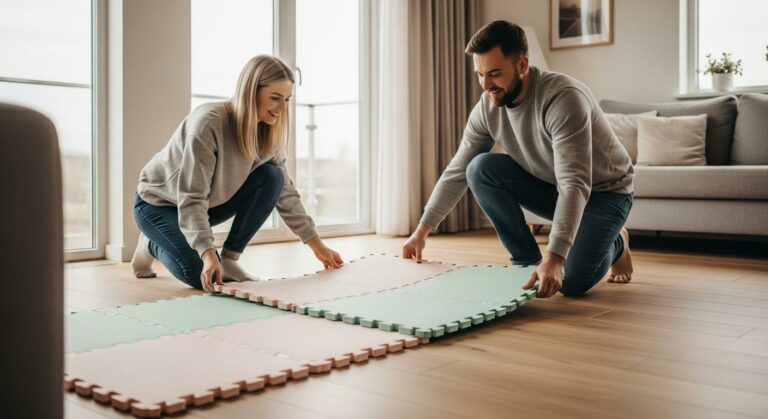
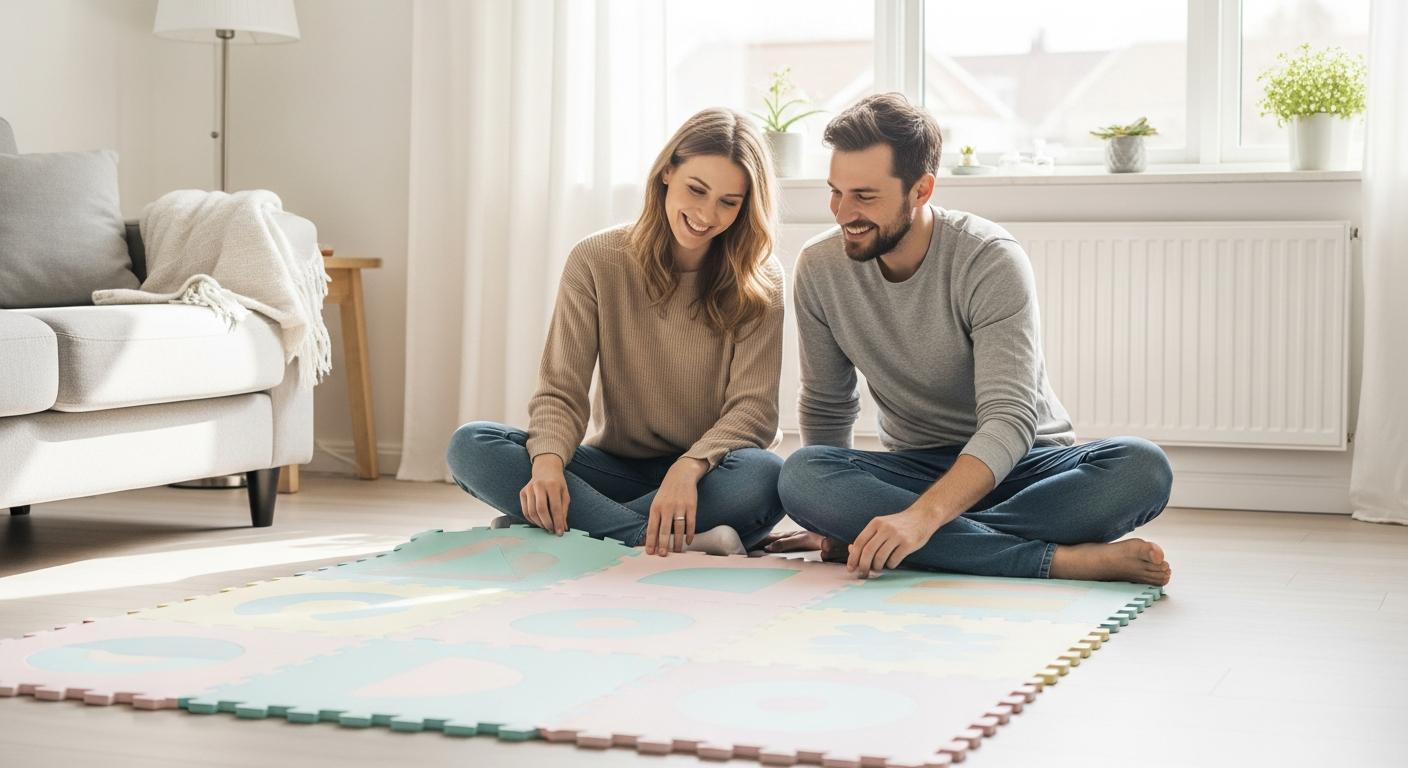
Interlocking foam tile play mat
Flexible sizing and easy replacement of one tile. Trade-off: seams collect crumbs and can tempt mouthing babies. Tight joins matter.
Fabric or play mat rug styles
Soft and living-room friendly, especially with a removable, machine-washable cover. Drying is the non-negotiable part—damp fabric can smell musty and can promote mildew.
Thickness, density, and firmness: the part that changes everything
Thickness helps, but density often decides whether the mat bottoms out. A thick mat that compresses fully can still feel hard underneath.
Practical feel checks:
- Press with your palm: does it spring back quickly?
- Kneel: do your knees sink deeply?
- For tummy time: can your baby push up, or do elbows slide and sink?
Many families like roughly 2–3 cm (about 0.75–1.25 inches) on hard floors when the foam is dense enough to stay supportive. Thicker can work too, as long as stability remains good for standing toddlers.
Materials in a play mat: what parents should know
Common options:
- EVA foam: lightweight, cushioning varies by density.
- XPE/PE foam: often denser, closed-cell (less absorbent), tends to keep shape well.
- PU vegan leather covers: wipeable, practical for snacks and crafts.
- Organic cotton covers: breathable, soft, laundering and full drying required.
- Natural latex cores: supportive, but avoid if latex allergy is a concern.
Heat and sun can deform many foams. If your play mat lives near a window, rotating it or shading the area can reduce warping and fading.
Non-toxic play mat safety: how to read claims without getting lost
What non-toxic usually points to
It often refers to free-from claims, such as:
- PVC-free
- phthalate-free
- BPA-free
- low VOC emissions
The most reassuring situation is when those claims are backed by clear documentation (not just a badge).
Odor and VOCs: when to pause
A mild new product smell that fades after ventilation can happen. A strong, persistent chemical odor deserves caution.
Practical steps:
- Unbox in a well-ventilated area
- Air out 24–72 hours if needed
- If odor persists, pause use and contact the manufacturer about emissions/testing
Certifications you may see (and what they tend to cover)
- REACH: EU restrictions on certain substances
- OEKO-TEX Standard 100: mainly textiles (useful for covers)
- EN71 / ASTM F963: toy safety standards (mechanical + some chemical limits)
- GREENGUARD Gold: indoor air emissions focus
No label replaces common-sense checks: peeling surfaces, loose edges, and small detachable parts are everyday hazards.
Placement safety: the play mat is only as safe as the zone around it
On tile or hardwood, choose a play mat with a grippy underside or add an anti-slip underlay. Keep the floor clean and dry underneath, dust reduces friction, trapped moisture can encourage odor.
Create a clear perimeter:
- Away from stairs
- Away from cords
- Away from sharp furniture corners
A rhetorical question worth asking: if your toddler falls sideways from standing, what do they hit—soft mat, or the table leg?
Cleaning your play mat without damaging it
Daily care
- Wipe with a damp microfiber cloth
- For mess: mild soap + lukewarm water, then wipe again to remove residue
- Dry fully (surface + seams)
After illness
Use a baby-safe disinfectant if desired, then wipe with clean water and dry. Overuse of harsh cleaners can degrade coatings and increase peeling.
Odor, mold, and wear prevention
- Air out after deep cleaning
- Avoid storing the play mat when damp
- Limit direct sun and high heat
- Rotate position if heavy furniture causes dents
If a mat repeatedly smells musty despite drying, moisture may be trapped inside—replacing it can feel more reassuring.
Key takeaways
- A play mat is a daily floor base for supervised free movement: tummy time, rolling, crawling, and toddler balance.
- Comfort is important, but stability matters too—density and firmness can change how easily a baby pushes up, sits, and crawls.
- For a non-toxic direction, look for clear claims like phthalate-free, BPA-free, and low VOC emissions, ideally supported by transparent testing.
- Odor that persists after ventilation is a good reason to pause use and ask the manufacturer for specifics.
- Safety also comes from setup: anti-slip placement, flat edges, and a cleared surrounding zone.
- Cleaning is usually simple (mild soap, thorough drying), persistent musty smell or peeling surfaces justify replacement.
- Support is available: if movement or posture worries you, speak with a pediatric clinician or pediatric physiotherapist. For personalized tips and free child health questionnaires, you can download the Heloa app.
Questions Parents Ask
Can my baby sleep on a play mat?
For supervised play, a play mat is great. For sleep, it’s different. Most play mats aren’t designed or tested as a sleep surface, and they may be too soft, too warm, or placed in an environment that isn’t set up for safe sleep. If your baby dozes off during floor time, no panic—it happens. You can gently move them to their usual safe sleep space when you can.
Are foam play mats safe for babies who mouth everything?
Yes, many are, and you’re not alone—mouthing is a very normal phase. What matters is the mat’s finish and how it’s built. A smooth, intact surface that doesn’t flake, crack, or peel is reassuring. If you choose interlocking tiles, check that little edges can’t be pulled up easily. And if you notice persistent strong smell, visible wear, or tiny bits coming off, it can be a good moment to pause use and switch to a more robust option.
Can I use a play mat on underfloor heating?
Often yes, as long as the brand allows it. Gentle warmth is usually fine, but higher heat can warp foam, increase odors, or damage coatings over time. Keeping the floor on a moderate setting and rotating the mat occasionally helps it age better. If in doubt, the manufacturer’s temperature guidance is the safest reference.