Parents in India often look for DIY baby sensory toys that are safe, simple, and genuinely useful, without adding more plastic, noise, and clutter to the home. You may be thinking: “What exactly is sensory play?”, “From what age can we start?”, and “How do I keep it safe when my baby puts everything in the mouth?” Good questions. With the right materials and a few non-negotiable safety rules, DIY baby sensory toys can support early brain development, motor skills, and day-to-day settling, from newborn days to toddlerhood.
DIY baby sensory toys: what “sensory” really means for babies
Sensory play is your baby’s way of gathering information from the body and the environment, and then adjusting their response. In medical terms, the brain integrates sensory input to shape movement, attention, and regulation.
The main sensory systems involved are:
- Tactile: touch (smooth, rough, cold, squishy)
- Visual: sight (contrast, tracking, slow movement)
- Auditory: hearing (gentle, predictable sounds)
- Vestibular: balance and movement (rocking, rolling, changes in position)
- Proprioceptive: body awareness (pushing, squeezing, resisting)
A practical way to picture it: your baby receives an input (a texture, a sound, a moving object), processes it, then answers with the body (turning the head, opening the hand, gripping, relaxing, trying again). Not a “lesson”. More like daily neural wiring, stronger with repetition.


A good sensory setup stays intentionally simple:
- one new element at a time (one texture or one sound),
- one repeatable action (shake, press, fill/empty),
- one clear play zone (a mat, a tray, a defined floor space).
DIY vs store-bought: why many families prefer homemade
Some store toys are loud, flashy, and overstimulating, especially for younger babies who cannot filter sensory input well yet. With DIY baby sensory toys, you can keep the experience calmer, slower, and matched to your child’s stage.
DIY also tends to be budget-friendly in Indian households: a sturdy dabba, a steel bowl, a cotton cloth, a clean plastic bottle, often that’s enough. Another plus: homemade toys are usually open-ended. A sealed shaker or texture cloth can be used in different ways over months, as skills change.
Who these activities suit (0 months to 3 years)
Sensory play can begin from birth, but the format shifts:
- 0–6 months: mostly looking, listening, brief touching during cuddles or tummy time
- 6–12 months: reaching, grasping, transferring, banging, dropping, mouthing, cause-and-effect
- 12–36 months: sorting, scooping, pretend play, longer attention, more precise hand control
Age ranges are only signposts. Temperament and the “mouthing phase” matter even more.
Why sensory play supports development (what it builds in the brain and body)
Well-chosen DIY baby sensory toys can support multiple developmental tracks at once.
Daily-life benefits parents often notice
- Fine motor skills: squeezing, raking, pinching, scooping and pouring build foundations for the pincer grasp (thumb-index), spoon use, and later drawing.
- Hand–eye coordination: aiming, adjusting force, releasing on purpose. Pouring games are especially telling, your baby learns how much force is “just enough”.
- Language foundations: when you label sensations (“smooth”, “bumpy”, “cold”), your baby begins linking a sensation with an object and an emotion.
- Autonomy: stable materials invite initiative. “I can try again” becomes a pattern.
- Emotional self-regulation: slow pressing can be organising, banging and emptying can be a safe way to release energy.
Skills that grow over time
Sensory play supports:
- visual tracking and attention,
- reaching, grasping, transferring hand-to-hand, grip strength,
- cause-and-effect (“when I shake, it makes sound”),
- early problem-solving through trial, persistence, and adjustment.
Bonding through responsive play
It becomes richer when you stay close, observe, and respond. Offer one object, pause, then follow your baby’s lead. A calm voice with simple narration (“soft”, “slow”, “cold”) adds language without pressure.
Safety and hygiene rules (so you can relax while baby explores)
Supervision and safe setup
DIY baby sensory toys are only for awake, supervised play. Never keep them in a crib during sleep.
Choose:
- floor play on a mat (best),
- uncluttered tummy time space.
If your baby dozes off mid-play, remove toys.
Choking hazards: oversized is safer
Under age 3, choking is a real risk. One rule helps: if something can detach, it eventually will.
Prefer:
- oversized pieces,
- single, solid components.
Avoid:
- beads, buttons, coins, marbles,
- loose pompoms, confetti,
- anything that can fit fully in the mouth.
Strings, ribbons, and loops
Avoid long cords or loops. If you add fabric tabs, keep them short, flat, and stitched firmly into seams.
Materials checklist (mouth-safe and washable)
If your baby can mouth it (and most will), choose:
- food-grade silicone or stainless steel,
- hard, food-safe plastic, ideally BPA-free,
- untreated wood (baby-standard),
- washable textiles (cotton, terry cloth) that don’t shed.
Avoid:
- paints/varnish/glues not intended for children,
- magnets, button batteries,
- balloons,
- loose glitter,
- essential oils (irritant risk for skin and mucosa).
Build checks: pull, twist, shake
Before play:
- Pull test: tug attached parts.
- Twist and shake test: check for loosening caps or shifting parts.
- Think like a baby: biting, bending, throwing.
Retire anything with frayed seams, cracks, leaks, peeling tape, persistent smell, or any sign of mould.
Cleaning, drying, and storage
- Wet items must be washed and dried quickly to avoid mould.
- Dry fillers (pasta, rice, suji/semolina) must stay dry, replace if damp or smelly.
- Store in ventilated bins. Keep a “repair or retire” box.
A small trick that reduces stress: protect the play area first (old bedsheet, washable mat, thick towel).
Choosing DIY baby sensory toys by age and stage
0–6 months: contrast, gentle sound, soft texture
At this age, sensory play is mainly looking and listening, with brief touching.
Good options:
- high-contrast black-and-white panels/cards (rounded edges),
- unbreakable mirror fixed securely,
- soft fabric squares with one texture change,
- gentle crinkle inside a securely stitched pouch.
Priorities: big pieces, simple designs, washable materials, active supervision.
6–12 months: cause-and-effect, banging, dropping, opening/closing
This phase has strong pulling and determined hands.
Good options:
- sealed shakers,
- discovery basket with oversized safe household objects,
- supervised open/close play with large containers,
- beginner pouring/transferring with big cups and bowls.
Priorities: solid closures, frequent inspection, no lids that pop off into mouth-sized parts.
12–36 months: sorting, dough, more precise transfers
Toddlers enjoy sequences and control.
Good options:
- sorting by colour/shape with large pieces,
- scooping and pouring with gradually smaller containers (only when ready),
- manipulation dough,
- simple tactile “paths” (crawl, push, step).
Priorities: keep small hazards out of reach, even if mouthing seems “over”.
Baby-safe materials and tools commonly found at home (Indian household edition)
Containers and bases
- thick plastic bottles for sensory bottles (only if crack-free),
- airtight dabbas for dry sensory bins,
- shallow tubs/trays for easier access.
Reused items are fine only if there are no cracks, sharp edges, or lingering masala smell that won’t wash out.
Textures and fillers
- dry: large pasta, large rajma beans (only if sealed and never loose), rice (often later), suji/semolina (higher risk if mouthed)
- fabric: cotton, terry towel, fleece, satin
- soft: large cotton balls, clean compresses
If your baby mouths everything, stick to large, non-crumbly options.
Simple transferring tools
- ladle,
- large funnel,
- cups, bowls, colander.
Start wide and stable.
Visual and sound elements
- visual: water + oil for slow movement (optional food colouring)
- sound: dry filler in a sturdy sealed container
- contrast: black/white fabric panels
Easy DIY baby sensory toys (step-by-step)
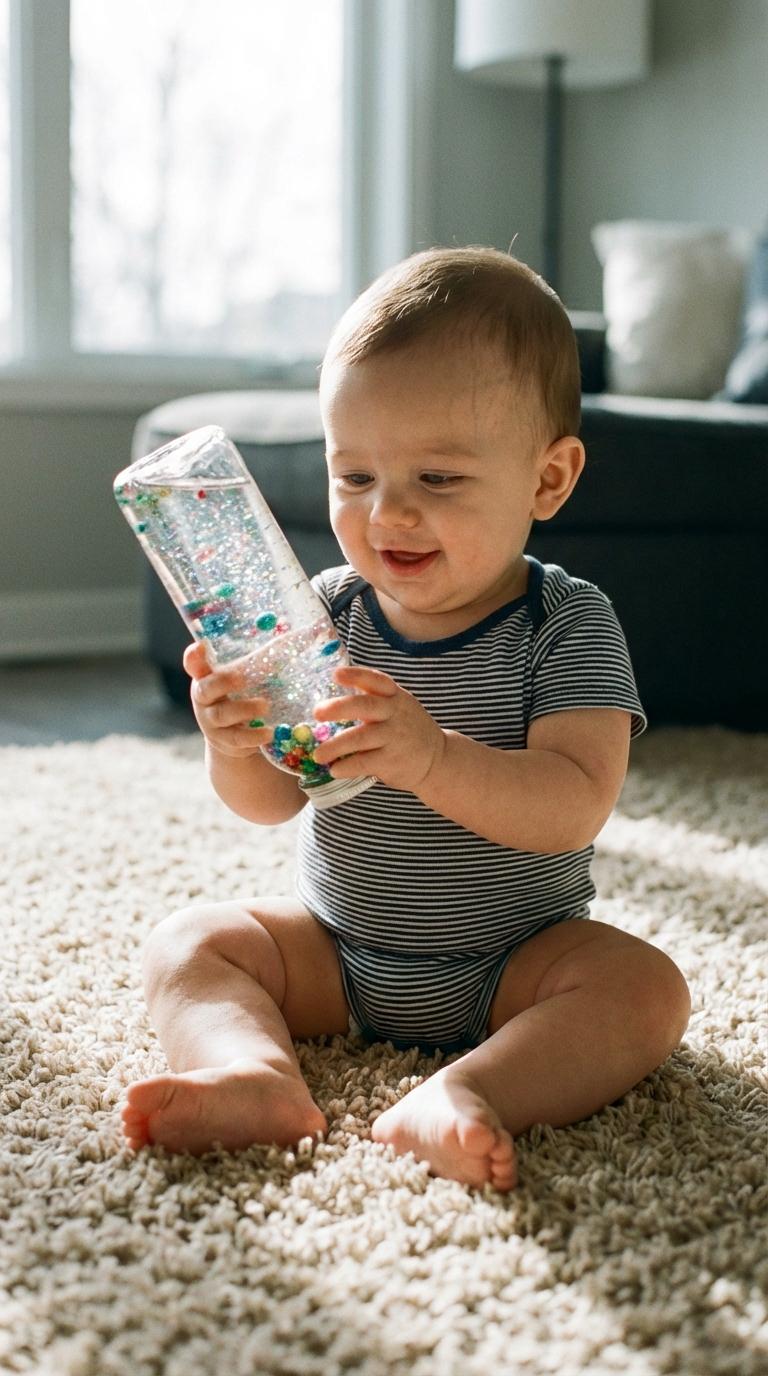
Sensory bottle (visual tracking + calm focus)
Materials: thick plastic bottle, water, a little oil (optional), food colouring (optional), a few large non-sharp items.
Steps:
1) Fill bottle about two-thirds with water.
2) Add a little oil for slower movement.
3) Add a few large items.
4) Close cap very tightly, then secure with strong tape around the cap area.
No micro-items unless sealing is extremely reliable. If it leaks, discard.
Sensory bin for scooping and pouring
Materials: shallow bin, small amount of filler (start with large pasta), 2–3 tools (cup, spoon/ladle, bowl).
Tips:
- start with less filler,
- offer one challenge: “Fill the cup” or “Pour into the bowl”.
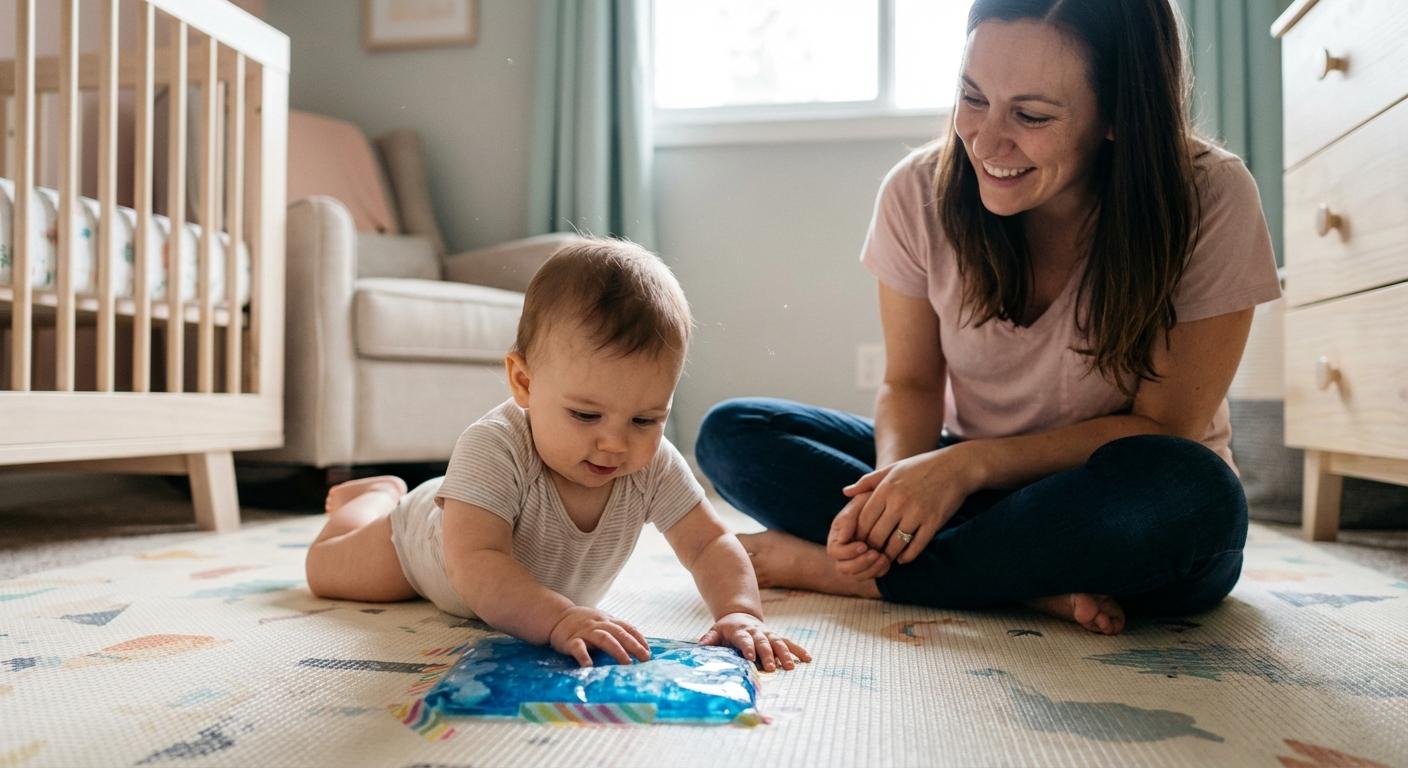
Double-bag sensory bag (pressing and squishing)
Materials: sturdy zip bag (double layer), gentle shower gel/hair gel, optional colour, strong tape.
Steps:
1) Add gel, remove extra air, zip shut.
2) Place inside second bag, zip shut.
3) Tape across closures.
4) Offer on the floor with close supervision.
If your baby bites hard or tries to tear plastic, skip.
Simple sensory mat (textures + optional crinkle)
Sew fabric squares together with reinforced stitching. For crinkle, place crumpled paper between two fabric layers and stitch securely.
Avoid glued decorations.
Homemade shaker (gentle sound)
Use a solid container with:
- rice (soft, fine sound),
- large pasta (duller sound),
- crumpled paper (lighter sound).
Seal tightly and re-check often.
Edible “paint” (low-risk creative play)
Options:
- curd/yogurt + a little puree (beetroot, spinach, carrot),
- cornflour + water heated into a gel texture.
Use a tray or thick paper. Clean soon after.
Dough and salt dough (age-adapted)
- Salt dough suits older toddlers (around 18–24 months) because it is extremely salty.
- Taste-friendlier alternatives: thick mashed potato, thick yogurt, flour + water + a little oil.
Offer simple actions: rolling, balls, pressing, hiding a large object.
More ideas by sensory focus
Visual
- high-contrast panels,
- mirror play (securely fixed),
- slow tracking side-to-side during tummy time.
Tactile
Start with three textures only. Touch, pause, name. If your baby pulls away, respect it.
Auditory
Aim for gentle, predictable sound. One sound at a time, then observe.
Using DIY baby sensory toys in a baby-led way
Short sessions and baby cues
Often 5–15 minutes is enough.
Slow down if you see:
- turning away, yawning, rubbing eyes,
- stiffening, back arching, crying,
- frantic, disorganised movements.
When unsure: simplify. Less noise, less visual clutter, one item.
Rotation (less out, more interest)
- keep 3–5 toys out,
- rotate every 2–3 days,
- store the rest out of sight.
Where play fits in the day
- tummy time: one contrast item in reach,
- calm moments: sensory bottle, mirror, soft textures,
- highchair: wipeable, sturdy items that can’t break into parts.
Model one action, then pause
- “When you shake, it makes sound.”
- “This feels smooth. This one is bumpy.”
- “You pressed it, look, it changed shape.”
Common pitfalls (and easy prevention)
Overcomplicating designs
Too many features mean more weak points and more stimulation. One goal per toy is usually best.
Weak attachments and fragile add-ons
Avoid glue-only builds. Prefer stitching and reinforced seams. Skip decorations that can detach.
Risky details
Avoid:
- small removable parts,
- long loops,
- brittle plastics,
- lids that pop off or twist open.
Skipping inspections
Check before and after play for cracks, loose stitches, dampness, musty smell, seal changes. When unsure, remove.
Cleaning, storage, and maintenance
Cleaning by material
- fabric: warm wash with mild fragrance-free detergent, dry fully
- plastic: warm soapy water, rinse well, avoid abrasive scrubbing
- silicone: wash thoroughly, boil only if heat-safe
- wood: wipe with damp cloth, don’t soak
Drying to avoid mould
Dry completely before storage, especially around seams.
Storage that makes life easier
Ventilated bins, a simple rotation, and a “repair or retire” box keep play safer.
A simple at-home routine that stays fun
Three staples to start
Make:
- a sealed shaker,
- a small texture mat section,
- a sensory bottle.
Match toy to mood
- calm: bottle, mirror, soft textures
- active: shaker, scooping/pouring, supervised open/close play
Track preferences
A small note “liked”, “neutral”, “too much” helps you plan without overthinking.
Key takeaways
- DIY baby sensory toys support attention, fine motor skills, coordination, and self-regulation with simple, repeatable play.
- Safety depends on oversized components, strong build quality, reliable sealing, and active supervision.
- Everyday Indian household items (dabbas, bowls, cloth) can create rich sensory play when used safely.
- Keep sessions short, watch cues, and inspect for leaks, wear, and moisture.
To remember
Parents can always discuss concerns with a paediatrician, paediatric nurse, or occupational therapist, especially for prematurity, developmental delays, or frequent choking scares. For personalised tips and free child health questionnaires, you can also download the Heloa app.