Bath time can feel like a daily test. One minute your newborn is drowsy and milk-drunk, the next, the moment the vest comes off, there’s a startle, a shiver, a cry that fills the bathroom. If you’ve been searching for a gentler way, swaddle bath baby routines are often the sweet spot: warm water, secure handling, and step-by-step washing without leaving baby exposed.
Parents in India often add their own realities: winter nights in North India, humid coastal summers, a bathroom that’s not always heated, a bucket-and-mug setup, help from grandparents, and plenty of traditional advice. The good news? With the right safety basics, swaddle bath baby techniques can fit most homes beautifully.
Swaddle bath baby basics parents can feel confident about
What a swaddle bath is (containment / “burrito” bath)
A swaddle bath baby method is an immersion bath where your baby stays loosely wrapped in a thin cotton cloth (think light muslin, a soft cotton receiving blanket, or even a clean malmal cloth). You lower baby and cloth into warm water up to the shoulders, while keeping the face fully out of the water. Then you wash one small area at a time, rewrapping between steps.
That wrap matters. It creates gentle boundaries for arms and legs, which can reduce flailing and help your baby stay in a flexed, comfortable posture.

In hospitals and NICUs, swaddled bathing is often used with medically stable babies (including some preterm infants) because it supports warmth conservation and calmer handling.
Why many newborns struggle with baths in the first place
If your baby cries as soon as water touches the skin, stiffens, throws arms out wide, or looks startled when undressed, this is common. Newborn physiology explains a lot:
- Immature thermoregulation: babies lose body heat fast (large surface area, thin fat layer). A cool bathroom + wet skin can make them uncomfortable quickly.
- Moro reflex (startle reflex): sudden air on the skin, quick movements, or being uncovered can trigger a dramatic “throwing out” of the arms and crying.
- Delicate skin barrier: the outer skin layer is still developing, hot water, strong soaps, or vigorous rubbing can irritate.
The aim is not to “win” bath time. The aim is to keep baby warm, safe, and settled. Swaddle bath baby routines do that by reducing sudden sensory changes.
How it differs from sponge baths and regular immersion baths
- Sponge bath: you clean baby with a warm wet cloth while baby stays out of bathwater. Many families choose this while the umbilical area is healing, depending on their paediatrician’s advice.
- Regular immersion bath: baby goes into warm water without a wrap. It’s fine for many babies, but some newborns feel too “open” and startle more.
- Swaddle bath baby approach: baby gets the warmth of immersion, but only small areas are uncovered in a predictable sequence.
Swaddle bath vs “newborn spa” baths
You may hear about professional baby bath sessions that focus on prolonged water relaxation, cue-based handling, and a more “experience” style.
A swaddle bath baby routine is different: it’s simple, repeatable at home, and built around everyday safety and comfort.
Technique vs product: do you need a “system”?
Swaddle bathing is mainly a technique: wrap, immerse, then wash and rinse limb-by-limb.
Some swaddle bathing products exist, but most homes can do swaddle bath baby safely with a stable infant tub, or a sink setup lined with a non-slip mat.
Why a swaddle bath baby routine can feel so soothing
Containment: womb-like boundaries and less startle
Newborns are wired for the Moro reflex, it’s protective, but it can make baths messy and loud. The wrap supports midline flexion (arms and legs closer to the body), reducing the “floating, startled” feeling.
Many caregivers notice less crying compared with more exposed washing. And even when fussing happens, the structure helps: pause, rewrap, speak softly, continue.
Warmth and temperature stability
Immersion reduces heat loss compared with repeated wiping in cool air. In swaddle bath baby bathing, most skin stays covered and warm while you clean.
A practical point for Indian homes: if the bathroom is chilly (especially in winter), pre-warm the room a little and keep windows closed during the bath. In summer, watch for overheating, humid heat plus warm water plus a thick cloth can be too much.
Gentler handling builds confidence
A slippery newborn can make anyone tense. The wet cloth improves grip and encourages slower movements. When your hands feel steadier, your baby often settles too.
Sleep after the bath: sometimes
Warm water can relax muscles and lower arousal. If the routine is quiet (low light, calm voice), some babies doze off after a swaddle bath baby session. Others become alert and hungry. Both are normal.
Colic-like evening fussiness: a small nuance
Warmth may ease general tension in the belly area, but timing matters. If your baby tends to spit up or has just fed, bathing immediately can worsen reflux symptoms. Many families find 30–60 minutes after a feed is a comfortable window.
Who can benefit, and when to start
The early weeks: when parents often try it
Many parents try swaddle bath baby routines in the first few weeks, especially if undressing triggers crying.
Hospitals vary on when the first bath happens. Some delay it to support temperature stability and early bonding. At home, you can start when:
- your baby is medically stable
- you can keep the environment warm enough
- you are ready to keep one hand on baby at all times
Age range and when it’s most helpful
Swaddled bathing is often most useful in the newborn phase and early infancy.
Many families continue until 4–6 weeks, sometimes up to 2–3 months, then gradually shift.
Signs your baby may prefer a freer bath:
- pushing the cloth away
- trying to stretch and extend
- looking frustrated when contained
- settling better when more unwrapped
Transition slowly. If crying returns, it’s fine to use swaddle bath baby again for a while.
Preterm babies and NICU graduates
In NICUs, swaddle bathing can be part of developmental care for stable preterm babies. “Stable” typically means steady breathing and heart rate, adequate oxygenation, and good tolerance of handling.
If your baby was premature, very small, or had a medical stay, follow your neonatologist/paediatrician’s plan. Extra care with short duration and temperature stability is often needed.
When another bath approach may be a better fit
Pause and ask for medical advice (illness, wounds, devices)
Choose a different approach and contact your clinician if your baby:
- has fever, unusual sleepiness, poor feeding
- has infected-looking skin lesions, oozing, or open wounds
- has medical dressings, lines, or devices
In such situations, a targeted sponge clean is often safer.
Umbilical cord stump and circumcision: advice can vary
Cord care guidance differs. Some clinicians prefer sponge baths until the stump falls off and the base is dry and healed. Others allow brief immersion if the area is dried well afterwards.
After circumcision, soaking may be restricted for a short period. Follow your clinician’s instructions for gentle cleansing and ointment use.
Skin flare-ups (eczema, very sensitive skin)
For eczema-prone babies:
- keep baths short (often 5–10 minutes)
- use minimal mild, fragrance-free cleanser (or water only)
- rinse well
- pat dry (don’t rub)
Moisturise soon after with an emollient. Applying to slightly damp skin can reduce water loss through the skin barrier.
Cradle cap (seborrhoeic dermatitis): avoid scratching. Depending on redness, your clinician may suggest a softening oil and gentle shampoo.
When to stop mid-bath (baby discomfort signals)
End the bath and focus on warming if you notice:
- intense crying that escalates and doesn’t settle
- marked rigidity, increasing agitation
- shivering, mottled skin, very pale lips
- unusual breathing
- sudden floppiness
Take baby out, dry, warm, comfort. Another day, try again: shorter, warmer, simpler.
Supplies for a swaddle bath baby setup at home
The wrap: fabric, size, and grip
Choose a thin, breathable cotton cloth. Muslin and soft cotton work well.
Have a second cloth ready, once the first becomes cold and heavy, swapping can keep the bath comfortable.
Tub, sink, or bucket setup
A small infant tub is easiest, but many Indian families use a bucket and mug.
If you use a bucket:
- ensure it’s wide enough to avoid crowding
- keep it on a stable, non-slip surface
- never balance it on an uneven stool
Whatever the setup, stability beats style.
Fill shallowly so baby can be immersed up to the shoulders while the face stays completely out.
Helpful extras
- Mug/cup for gentle pouring
- Bath thermometer (helpful, especially in winter)
- Timer
- Mild fragrance-free cleanser (optional)
- Soft towel (hooded towels are convenient)
- Dry nappy, clothes, and moisturiser kept ready
How to do a swaddle bath baby routine (step-by-step)
Preparation: set the stage
A calm bath begins before you undress baby.
Guideposts used in many newborn care settings:
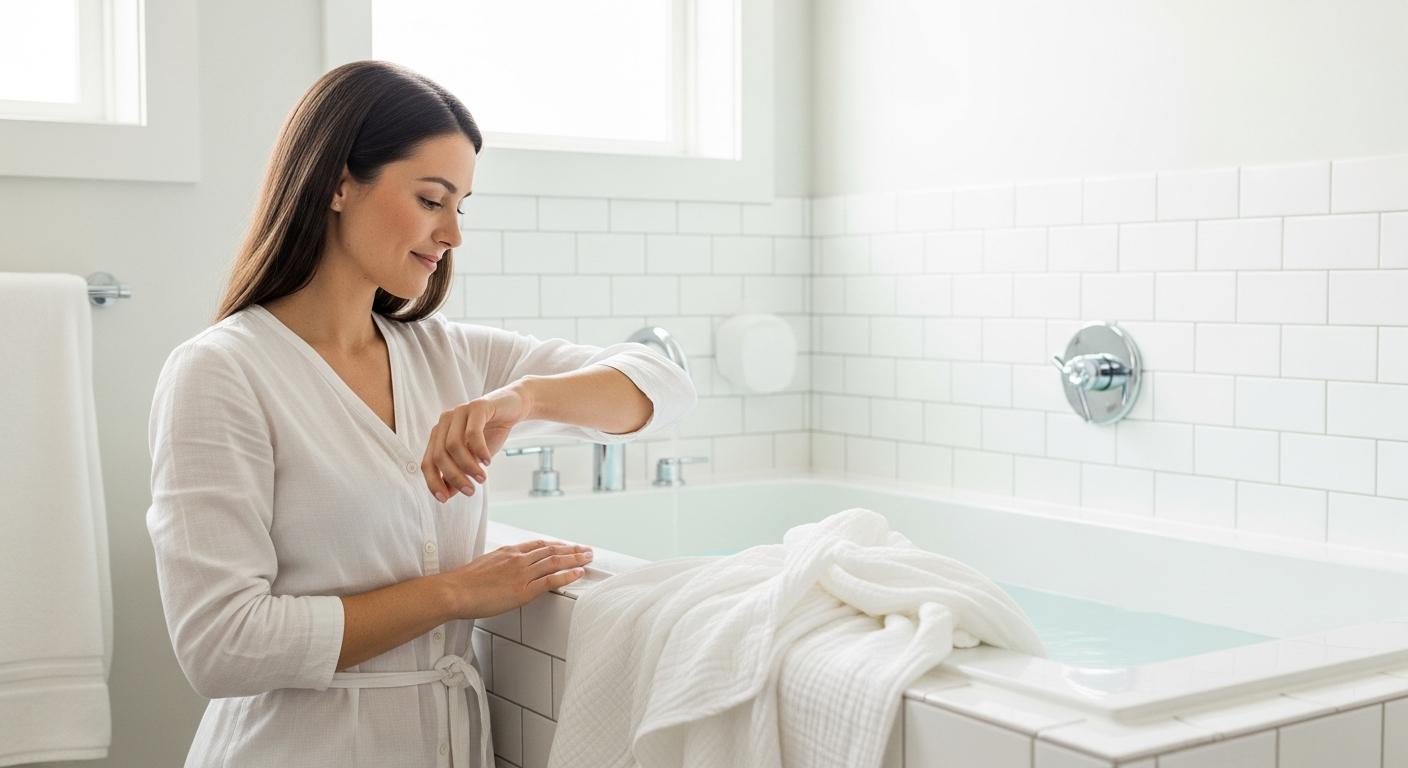
- Water temperature: 36.5–37.5 °C (often around 37 °C)
- Room temperature: roughly 22–24 °C
Choose a time when baby is calm-alert, not hungry, not overtired, often 30–60 minutes after a feed.
Aim for 5–10 minutes.
Set up safely
Keep everything within arm’s reach. One firm rule: never leave baby unattended near water.
Wrap: snug, not tight
Wrap baby so arms and legs feel contained, but:
- chest rises freely with breathing
- hips remain relaxed and mobile (healthy hip positioning matters)
- face stays uncovered
Immersion: lower slowly
Support head and neck with your forearm and hand. Lower baby (still wrapped) into water up to the shoulders.
As the cloth becomes wet, it often feels more stabilising, many babies soften at this point.
Washing sequence: small zones, calm rhythm
Use plain water for the face. Wipe from the inner eye corner outward.
Then wash area by area:
- neck folds
- underarms
- skin creases
- diaper area last
Use minimal cleanser if needed. No scrubbing.
The unswaddle–wash–rinse–reswaddle pattern (arms and legs)
Unwrap one arm only. Wash shoulder to hand, rinse gently, then rewrap.
Repeat on the other arm.
Then one leg at a time: hip to foot, rinse, rewrap.
This gradual exposure is what makes swaddle bath baby feel manageable for many newborns.
Finishing: dry and rewarm smoothly
Lift baby out with head/neck supported. Wrap immediately in a warm towel.
Pat dry, especially folds (neck, behind ears, groin). Dress quickly.
Skin-to-skin contact after the bath can help with thermal regulation. Feeding afterwards is also soothing for many babies.
Two caregivers vs solo
With a helper, one supports while the other washes.
If you’re alone, simplify: keep the bath shorter and keep all items within reach.
Safety essentials that keep bath time truly relaxing
Hands-on supervision and positioning
Never leave baby alone near water. Support head and neck in neutral alignment.
Avoid forcing hips and knees straight. Babies need hips to stay flexible and gently abducted.
Water level and immersion safety
Keep water shallow and controlled. Baby should not float free. Face stays well above water throughout.
Warm, not hot (and not too cold)
A warm room and warm water prevent chilling, but overheating can happen, especially in humid weather. Use a breathable cloth and keep the bath brief.
What to avoid
Avoid essential oils in newborn baths. They can irritate skin and may trigger respiratory irritation.
Common mistakes to sidestep
- Water too cool → crying, stiffening
- Water too hot → redness, distress
- Cloth too tight → discomfort, restricted breathing/hip movement
- Bath too long → fatigue or cooling afterwards
Building a bath routine that suits your family
How often to bathe a newborn
Most newborns do well with 2–3 full baths per week. On other days, a quick clean of face, neck folds, hands, and diaper area is usually enough.
Best timing in the day
Avoid bathing immediately after feeds, 30–60 minutes later often reduces spit-up. Some babies settle better with an evening bath, others find it stimulating. Your baby’s cues are the best guide.
Transitioning from swaddle to regular immersion
Shift gradually: uncover a bit more during each bath while keeping movements slow. If fussiness comes back, return to swaddle bath baby for a while.
To remember
- Swaddle bath baby means bathing your newborn while loosely wrapped and immersed up to the shoulders, washing one small area at a time.
- It can reduce startle, improve warmth stability, and make handling feel steadier, especially in the early weeks.
- Safety comes first: constant supervision, stable non-slip setup, head/neck supported, shallow water, face always out of the water.
- Helpful guideposts: water around 37 °C, room around 22–24 °C, bath time 5–10 minutes, minimal fragrance-free products.
- If something feels off (shivering, unusual breathing, limpness, escalating distress), stop, warm baby, and seek medical advice.
- For personalised tips and free child health questionnaires, you can download the Heloa app.
Further reading: