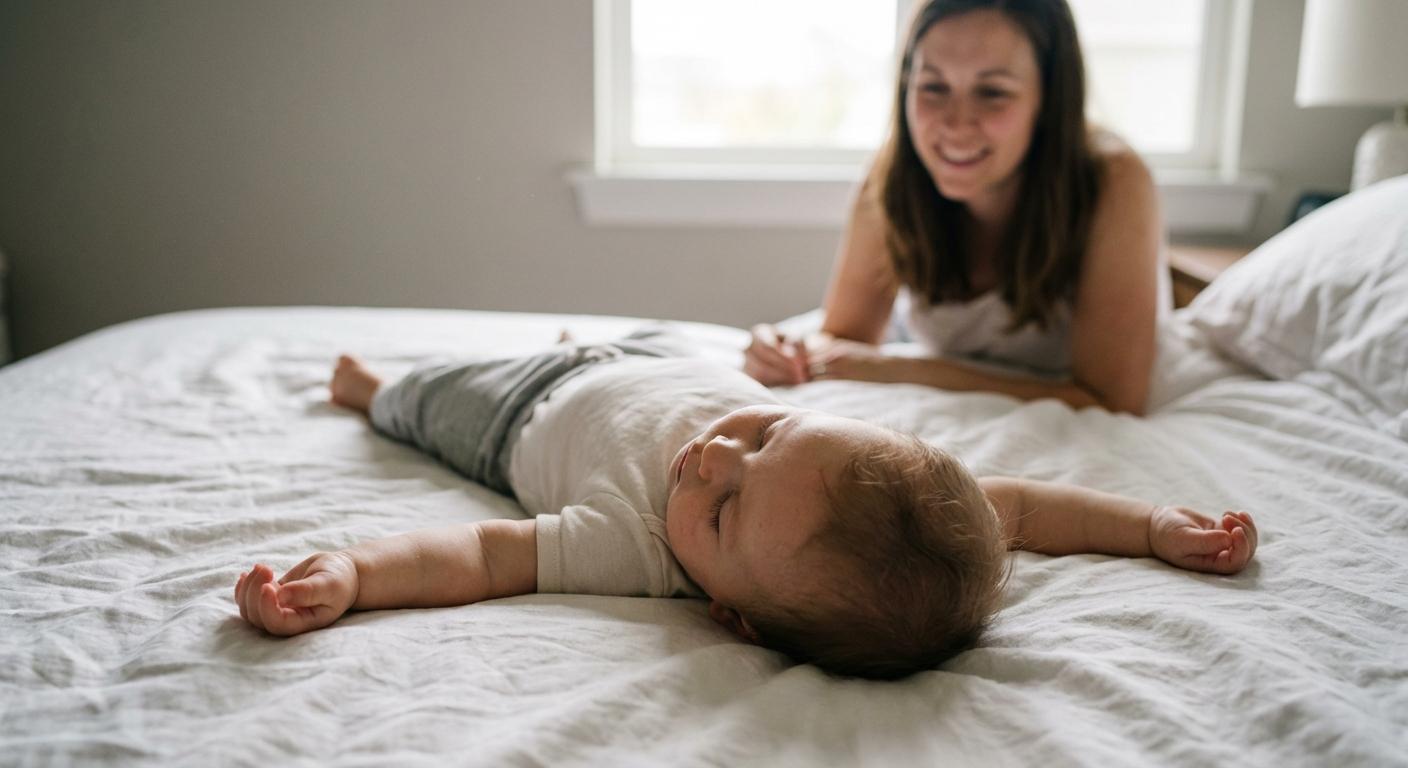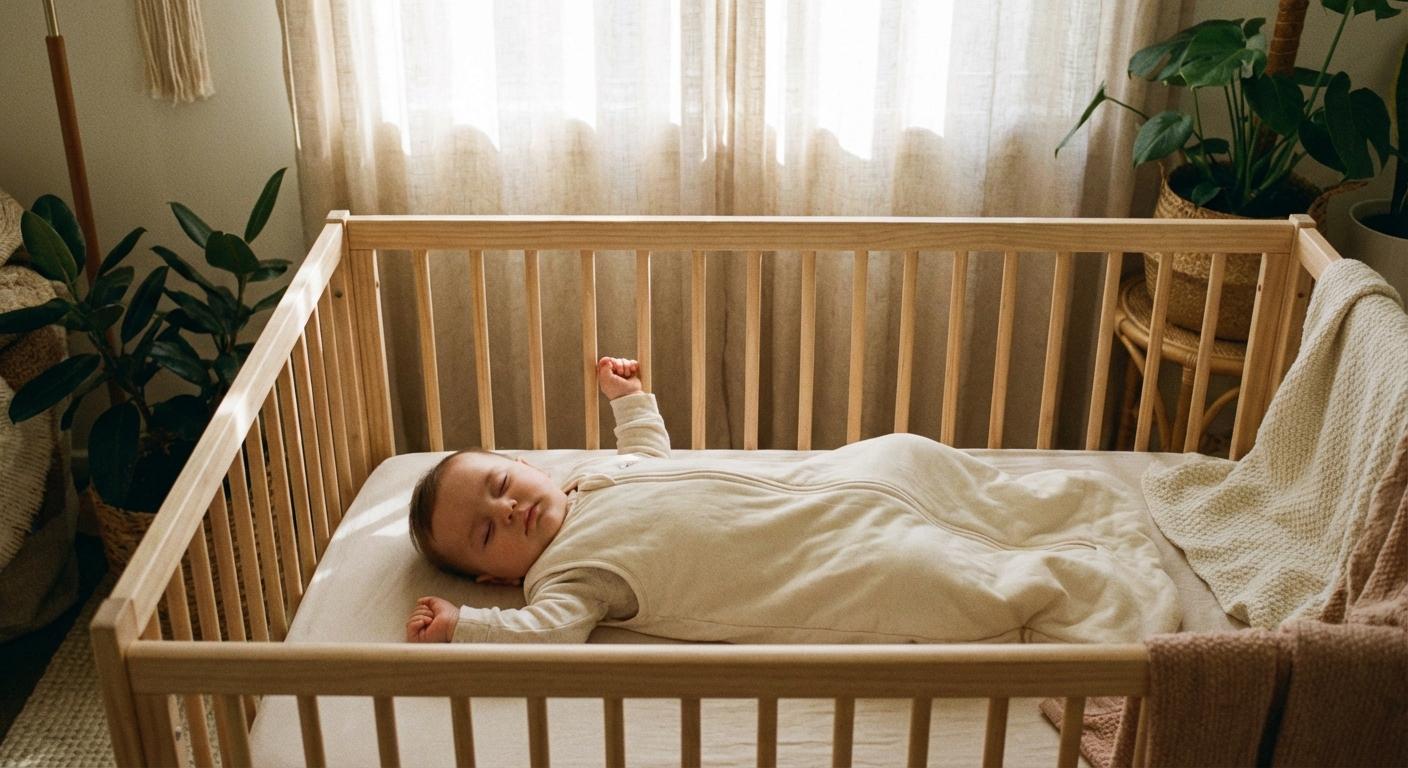
Noticing your baby sleeping with arms up, hands near the face and elbows out in a small “cactus/goalpost” shape, can feel unexpected. Many parents wonder: is it simple comfort, or a sign of a problem? In most cases, baby sleeping with arms up reflects normal infant physiology: an immature nervous system, early reflexes (especially the Moro reflex), and very active sleep cycles. The priority is not to push the arms down, but to keep back sleeping, a firm flat surface, and a clear sleep space, while knowing the few warning signs that should prompt medical advice.
Baby sleeping with arms up: what it can look like
Some babies drift off with both hands beside the head, wrists slightly bent, fingers loosely curled. Others rest a hand on the cheek or keep it near the mouth (ready for self-soothing). A few babies look like a relaxed “starfish”, with arms open and legs slightly apart. It may look like your baby is “posing”, but most of the time it is simply normal newborn posture plus sleep movements.
Why is baby sleeping with arms up so common from birth? Inside the womb, your baby was held snugly on all sides. After delivery, gravity, cooler air, clothes, and new sounds arrive all at once. Muscle tone and coordination are still developing, so arms lift easily and small jerks can appear as the brain learns to regulate responses.
Why babies sleep with arms up
Moro (startle) reflex: when arms suddenly fling up
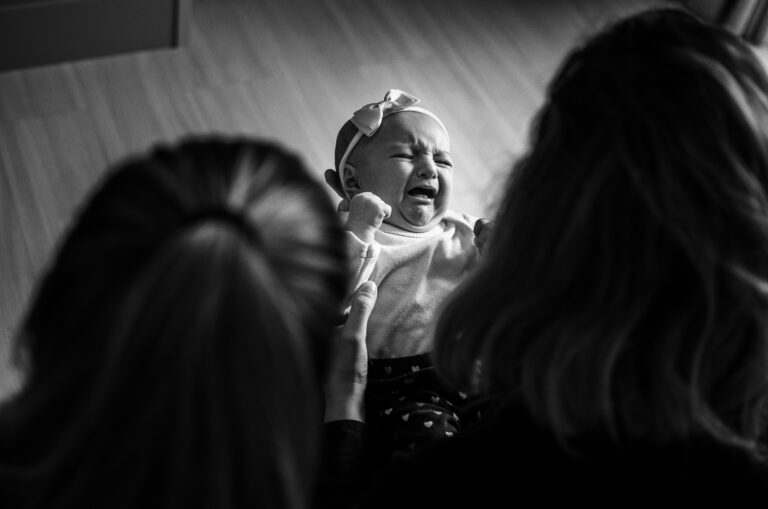
The Moro reflex is a normal newborn reflex. A sudden sound, a quick movement, or the sensation of “falling” can trigger a rapid extension of the arms and opening of the hands, then a pull back in. At night, this can show up:

- while falling asleep,
- during light sleep,
- during transitions between sleep cycles.
You may see arms shoot up, fingers splay, a brief grimace or cry, and sometimes a full wake-up. The Moro reflex usually fades between about 3 and 6 months (sometimes later). Until then, baby sleeping with arms up can be part of this reflex pattern.
Deep sleep relaxation: a genuine resting posture
Not every arms-up position is a startle. In deeper sleep, some babies look heavy and relaxed, with smooth facial features and more regular breathing. Hands may stay gently open. In these moments, baby sleeping with arms up is often just a comfort posture.
Self-soothing: hands-to-mouth, hands-to-face
Hands near the mouth or face are one of the earliest calming strategies. Touching lips, rubbing cheeks, or bringing fingers to the mouth can lower arousal and help a baby resettle between cycles. For many infants, baby sleeping with arms up simply makes self-soothing easier.
Comfort, muscle tone, and chest expansion
Some babies prefer shoulders slightly open with elbows bent. This can reflect normal differences in muscle tone and flexibility. If breathing looks calm and effortless and growth is on track, baby sleeping with arms up is usually just personal comfort.
Heat, digestion, and clothing: small details that change posture
Practical factors can influence sleep posture:
- Overheating: babies may “open up” and lift arms to release heat.
- Tight clothing across shoulders can feel restrictive.
- Very soft or loose clothing can let arms drift upward.
- Post-feed relaxation (breastfeed or bottle) can make babies flop into the easiest position.
- A firm mattress gives stable support, making relaxed open postures more likely.
The aim is not to stop the posture. The aim is comfort and safety.
Baby sleeping with arms up by age: what is typical
Newborn (0–2 months)
In the first weeks, baby sleeping with arms up is extremely common. The Moro reflex is strong, sleep is active, and many movements are reflexive rather than intentional. Short sleep stretches and frequent feeds are normal.
2–4 months
Hands-by-face remains common and becomes more purposeful. Startles may still disrupt settling. Many babies begin early rolling attempts now, so swaddle decisions need extra care.
4–6 months
For most babies, the Moro reflex is fading. Arm position becomes more about comfort and self-soothing. Rolling becomes common, and nighttime movement often increases.
6–12 months
You may still notice baby sleeping with arms up during sleep transitions or resettling. By this age it is usually habit and comfort rather than reflex.
How long can it last?
Arms-up is most obvious in the first 0–3 months, stays common up to around 6 months, and can persist to 8 months in some babies. After that, baby sleeping with arms up may simply be a preferred comfort habit, provided sleep is restorative and the environment is safe.
Arms up and sleep quality: comfort vs wake-ups
Arms-up changes with sleep stages
Infant sleep has lots of movement. In lighter sleep, it is normal to see:
- arm movements,
- facial expressions,
- small sounds,
- brief startles followed by resettling.
So baby sleeping with arms up can come and go without meaning anything is wrong.
Relaxation vs startle: how to tell
- Relaxation: stable posture, slow movements, regular breathing.
- Startle (Moro): sudden extension, arms fling outward/up, sometimes followed by crying and wake-up.
A common early pattern: baby settles, you place them down, then 10–20 minutes later they startle awake. Often this is neurological maturation, not a “bad routine”.
Reassuring signs your baby is comfortable
When baby sleeping with arms up is simply comfort, you often see:
- calm breathing without unusual noises,
- usual skin colour,
- relaxed shoulders,
- soft hands,
- brief wake-ups with easy return to sleep.
Look at the bigger picture: feeding, growth, wet diapers, and daytime alertness.
What fragments sleep more than arm position
The posture rarely “breaks” sleep on its own. More common disruptors are:
- a strong Moro reflex in early months,
- overheating,
- discomfort (blocked nose, reflux-like discomfort, pain).
Is it safe when a baby sleeps with arms up?
Safe sleep basics matter most
Whether it is baby sleeping with arms up or arms by the sides, the key safety rules remain:
- Put baby on the back for every sleep.
- Use a firm, flat mattress with a fitted sheet.
- Keep the sleep space clear: no pillows, loose blankets, soft toys, bumpers, or positioning devices.
- Use a sleep sack (wearable blanket) for warmth instead of loose bedding.
- Ideally, room-share (same room, separate sleep surface) for the first months.
Why the arm position itself is usually not a risk factor
Arms-up, arms-out, or hands-near-face typically does not increase risk when baby is on the back on a firm surface with a bare sleep space. Risk is far more linked to unsafe surfaces, tummy sleeping, soft bedding, and overheating.
Temperature and clothing: preventing overheating in Indian homes
In many Indian homes, the challenge is heat and humidity, especially in summer or when AC is intermittent. Aim for a room that feels comfortable for a lightly clothed adult. If you use AC or a fan, keep airflow gentle and not directly blasting on the baby.
Watch for overheating:
- sweating or damp hairline,
- flushed skin,
- hot chest or back of neck,
- unusual agitation or faster breathing.
Cool hands and feet are common, check the chest or back of neck instead.
Sleep sack: controlled warmth, free arms
A well-fitted sleep sack can be very useful for baby sleeping with arms up: it keeps warmth stable without loose fabric near the face and allows free arm movement. Choose breathable material (cotton is common), correct sizing, and a secure neckline.
Side or tummy sleeping: avoid before rolling is established
Side sleeping can easily tip into tummy sleeping. Until your baby can roll both ways consistently, start sleep on the back. Once rolling begins, keep placing baby on the back at the start, keep the cot empty, and do not add wedges or pillows.
Swaddling and baby sleeping with arms up
Why some babies prefer arms-up swaddling
Some babies settle better when hands stay near the face. An arms-up style can reduce startle intensity while preserving hand-to-mouth comfort.
Swaddling fit and safety
If you swaddle:
- Use light, breathable cloth.
- Keep head and face completely uncovered.
- Ensure the chest is not compressed (breathing must stay easy).
- Keep hips and knees free to flex (avoid tight straight legs).
- Monitor overheating.
A practical check: you should be able to slide 1–2 fingers between the cloth and the chest. If your baby repeatedly breaks free, stop, loose fabric can be unsafe.
When to stop swaddling
Stop at the first signs of rolling or rolling attempts, often 2 to 4 months. Rolling with restricted arms increases risk.
Transitioning out of the swaddle
Why it can feel harder for arms-up babies
If baby sleeping with arms up is part of settling, freeing the arms can temporarily increase startles and wake-ups. This is usually a short adjustment.
A gradual plan
1) One arm out while keeping the torso snug.
2) Switch arms if needed.
3) Both arms out once one arm is tolerated well.
Then shift to a sleep sack with arms free.
Helping your baby sleep well with arms up (practical tips)
Keep the bedtime routine short and repeatable
Dim lights, nappy change, feed, brief cuddle, a calm phrase or lullaby, then baby down on the back.
Environment: dark, calm, steady sound if needed
A darker room supports melatonin release (the sleep hormone). If outside noise is unpredictable (traffic, neighbours, festivities), gentle white noise can help some babies who startle easily, keep it at a low volume and away from the cot.
Settling in the cot without restraining arms
Place baby down drowsy and give a few seconds to settle into their preferred posture. If needed:
- a gentle hand on the chest,
- soft shushing/voice,
- a pacifier if it suits your baby.
Then slowly reduce your help over days.
If baby sleeps only in your arms
This is common in early weeks. Try gradual steps:
- Put baby down when relaxed and sleepy (not only in deep sleep).
- Reassure briefly in the cot before picking up.
- Repeat in a predictable way.
Build familiarity with the cot during the day
When baby is calm and awake, place them in the cot for 2–3 minutes, sing softly, then pick up. For some babies, this reduces stress at bedtime.
Comfort vs discomfort: when to watch more closely
Reassuring: baby on the back, face uncovered, empty sleep space, regular breathing.
Worth discussing with a doctor if persistent:
- heavy sweating with a very hot neck,
- breathing effort (chest retractions, flaring nostrils),
- repeated intense scream-waking right after startles,
- very asymmetric posture (head always to one side, one shoulder higher),
- neck stiffness suggesting torticollis.
When to call the paediatrician
Seek advice if you notice:
- Asymmetry: one arm consistently moves less or seems weaker.
- Pain/swelling: redness, warmth, tenderness, crying with arm movement, reduced range of motion.
- Breathing concerns: persistent loud snoring, repeated pauses, chest retractions, nasal flaring.
- Colour change: blue/grey lips or face, marked paleness.
- Unusual tone: persistent stiffness or unusual floppiness.
- General illness signs: poor feeding, fever with low energy, fewer wet diapers, poor weight gain.
If there is respiratory distress or a colour change, treat it as urgent.
Myths and reassuring facts
Does baby sleeping with arms up increase SIDS risk?
Baby sleeping with arms up itself is not known to increase SIDS risk. Strongest protections remain: back-to-sleep, firm flat surface, and an empty sleep space.
Do babies need their arms restrained to sleep better?
Some settle better with swaddling early on, others sleep better with hands free for self-soothing. Restraining arms is not necessary for good sleep, and swaddling must stop when rolling starts.
Do cold hands mean baby is cold?
Usually no. Hands and feet can feel cool because circulation is still maturing. Check the chest or back of neck and adjust layers.
Key takeaways
- Baby sleeping with arms up is very common, especially in the first months, often up to about 6–8 months.
- Usual reasons include the Moro reflex, deep sleep relaxation, self-soothing, comfort, and sometimes heat or clothing.
- The posture itself is usually not a problem, repeated strong startles can fragment sleep early on.
- Focus on safe sleep: back sleeping, firm flat mattress, empty cot/crib, moderate temperature, and a well-fitted sleep sack.
- Swaddling can help some newborns, but it needs safe technique and must stop at the first rolling signs.
- Seek medical advice for breathing concerns, abnormal colour, very heavy sweating, loud persistent snoring/pauses, asymmetry, stiffness, or signs of pain.
To remember
If baby sleeping with arms up is your main worry, for most infants it is normal development plus comfort. What matters most is a safe sleep set-up. If doubts remain, your paediatrician can guide you.
Download the Heloa app for personalised advice and free child health questionnaires.