Baby weight can quickly become the centre of a parent’s thoughts. One day the nurse says, Normal newborn loss. The next day you see a slightly lower number and your mind starts doing maths at 2 a.m. Is feeding enough? Is the scale correct? Should the curve be smoother?
Baby weight is not just a single number. It is a running conversation between growth, hydration, feeding effectiveness, sleep, illness, and that rapid development happening silently under the skin.
Baby weight basics parents actually need
What baby weight means (birth weight, current weight, weight gain)
Baby weight can point to three different things, and mixing them up is a common reason for worry.
- Birth weight: measured soon after delivery, usually in grams.
- Current weight: the measurement taken today at a clinic visit (or sometimes at home).
- Weight gain: the change over time, often discussed as growth velocity (how fast weight is rising).
In the first days, a dip in baby weight can be normal. Later, the aim is a steady upward trend, even if it comes in spurts.

Baby weight vs postpartum baby weight in mothers (avoiding confusion)
In everyday talk, baby weight sometimes means postpartum weight after pregnancy. Different topic.
Your baby’s baby weight reflects infant growth and how feeding is going. A mother’s postpartum weight is influenced by fluid shifts, uterine involution (the uterus shrinking back), sleep loss, stress hormones, recovery from delivery, and lifestyle changes.
Why weight is only one part of growth (length and head circumference too)
Paediatricians do not track baby weight in isolation. They also measure:
- Length (linear growth)
- Head circumference (a marker for skull and brain growth, especially important in the first 2 years)
Looking at all three helps judge proportional growth.
Birth weight: typical ranges and what they can signal
Typical birth weight range for full-term babies
For full-term babies (about 37–42 weeks), a typical range is roughly 2,500–4,000 g.
Genetics, gestational age, maternal nutrition, placental function, and pregnancy conditions can all influence baby weight at birth.
Low birth weight and small for gestational age: definitions and context
- Low birth weight (LBW): under 2,500 g, regardless of gestational age.
- Small for gestational age (SGA): usually below the 10th percentile for that gestational age.
Some babies are small because they arrive early. Others grew more slowly in the womb (sometimes linked to placental insufficiency). What matters most is how baby weight changes after birth.
High birth weight (macrosomia): definition and what may be checked
Macrosomia is often defined as birth weight ≥4,000 g (some hospitals use ≥4,500 g).
It is more common with gestational diabetes and can also run in families. After birth, the care team may monitor blood glucose, jaundice, and feeding.
Newborn baby weight in the first days: loss, regain, and reassurance
Why newborns often lose weight after birth
Early weight loss is usually physiologic (normal adjustment). Babies pass meconium, lose extra fluid, urinate more, and feeding is still being established.
This is not automatically a sign of not enough milk, particularly in the first couple of days.
How much weight loss is usually expected in the first week
A loss of up to about 7–10% is commonly seen.
Around 10% calls for a closer look at latch, milk transfer, feeding frequency, and hydration.
When babies typically regain their birth weight
Many full-term babies regain birth weight around 10–14 days.
Seek medical advice promptly if weight loss appears more than 10%, if feeding becomes difficult, if wet diapers reduce, or if birth weight is not regained within the timeline your clinician expects.
Baby weight gain from 0–12 months: what tends to happen
Typical weight gain from 0–3 months (often fast)
Many babies gain around 800–1,000 g per month (about 27–33 g/day) in the first 3 months.
Interpret baby weight alongside alertness, comfort, and wet diapers.
Typical weight gain from 3–6 months (gradual slowdown)
A slowdown is expected. Many babies gain around 500–600 g per month (about 17–20 g/day).
Typical weight gain from 6–12 months (slower still)
Many babies gain around 280–400 g per month (about 9–14 g/day).
With more movement, minor viral illnesses, and the start of solids, some months may look like a small plateau in baby weight.
Double and triple birth weight: helpful landmarks, not rules
Many babies roughly double birth weight around the middle of the first year and are about triple by 12 months.
These are landmarks, not targets. Your baby’s personal growth curve is the best tool.
Why growth velocity changes over time (and why ups and downs can be normal)
Teething, fever, cough and cold, sleep disruption, constipation, and new motor milestones can temporarily change appetite.
The reassuring sign is a stable trajectory over time, especially when baby weight, length, and head circumference rise together.
Baby weight percentiles and growth charts: understanding the numbers
Percentiles and the median: what they mean (and what they do not)
A percentile shows where your baby sits compared to other babies of the same age and sex.
- 50th percentile: about half weigh less, half weigh more
- 10th percentile: about 10% weigh less, 90% weigh more
Percentiles are not marks. The goal is to see baby weight follow a consistent pattern over time.
Between the 5th and 95th percentile: what it often means in real life
Many healthy babies fall between the 5th and 95th percentile.
Discuss at check-ups if your child crosses several percentile channels up or down repeatedly, especially with feeding concerns.
WHO vs other growth references: why charts can differ
For children under 2 years, many Indian clinics use WHO growth standards.
Different references can shift the plotted percentile slightly, but the purpose remains the same: follow baby weight over time.
One off point: when it can still be reassuring
A single odd point can happen due to dehydration after fever, a recent infection, a different scale, or weighing with clothes.
Repeated off-range points, a clear break in the curve, or symptoms like marked tiredness, repeated vomiting, fewer wet diapers, or feeding trouble needs medical advice.
Weight-for-age vs weight-for-length: how proportional growth is assessed
- Weight-for-age compares baby weight to age.
- Weight-for-length compares weight to length.
Weight-for-length helps clinicians see whether weight fits the baby’s frame.
Measuring and monitoring baby weight: clinic checks and home tracking
How paediatric visits track weight (and how often babies are weighed)
Baby weight is recorded at birth, then again in the early days/weeks, and at routine immunisation and well-baby visits.
If feeding is being established, if your baby was premature, or if growth is being watched, weigh-ins may be more frequent.
How to weigh a baby at home (simple steps for better accuracy)
If you choose home weighing:
- Use the same scale each time.
- Weigh undressed if possible.
- Weigh at a similar time of day.
- Avoid weighing too often.
No baby scale? Weigh yourself, then yourself holding the baby, and subtract.
What to log alongside weight (feeds, diapers, comfort)
To interpret baby weight better, note:
- feeding method (breast, formula, mixed)
- frequency and duration
- if bottle-fed: approximate volumes and nipple flow
- wet and dirty diapers
- vomiting/diarrhoea/fever
Feeding and baby weight gain: breastfeeding, formula, and mixed feeding
Breastfed baby weight gain patterns: what to watch
Helpful signs include active sucking, audible swallowing, and regular wet diapers.
Seek help if feeds are very painful, extremely long, or your baby is persistently sleepy at the breast.
Formula-fed baby weight gain patterns: volume is not the only factor
Correct preparation and responsive feeding are key.
Also consider nipple flow. If it is too fast, babies may gulp, swallow air, and overshoot fullness cues. Paced bottle-feeding and a suitable nipple flow can improve comfort and stabilise baby weight gain.
Mixed feeding: combining methods while supporting steady growth
Mixed feeding can work well.
If breastfeeding is part of the plan and baby weight is a concern, maintaining supply often needs regular breast stimulation while ensuring total intake stays adequate.
Solids and baby weight: what to expect around 6 months
Introducing solids: why weight gain may slow
Around 6 months, baby weight gain often slows.
Breast milk or infant formula remains the main source of nutrition in the first year. Solids are added gradually.
Special situations: prematurity and multiples
Corrected age for preterm growth
Corrected age is chronological age minus the weeks of prematurity. It is often used up to about 24 months when interpreting baby weight and length.
Twins and multiples: each baby has a personal trajectory
With twins, differences in baby weight are common. What guides decisions is each baby’s trend and overall health.
When baby weight needs extra attention (without panic)
Signs that can suggest low intake or dehydration
Check in quickly if you notice:
- fewer wet diapers than expected
- very dark urine, dry mouth, no tears, sunken fontanelle
- marked sleepiness, weak feeding, or refusing feeds
- persistent vomiting or diarrhoea with reduced intake
Slower gain or dropping percentiles: what it can mean
Patterns that deserve evaluation:
- stagnation or weight loss after the early newborn period
- repeated downward crossing of percentile channels
- a baby who drinks very little or falls asleep quickly during feeds
Often, causes are practical and treatable.
Rapid gain: when it is worth discussing
If the curve rises very quickly, review feeding patterns without guilt: amounts offered, feeding frequency, nipple flow, and fullness cues. Interpret baby weight along with length.
Supporting steady growth without overfeeding
Practical ways to make weight gain feel less stressful
Aim for responsive feeding and a calm routine.
Avoid pressure to finish a bottle. If baby weight is being watched, agree on a short-term plan and a review date.
Key takeaways
À retenir
- Baby weight varies, the trajectory matters more than a single number.
- Newborn weight loss is common, many full-term babies regain birth weight around 10–14 days.
- Percentiles place measurements, they do not grade your baby.
- Weight, length, and head circumference should be read together.
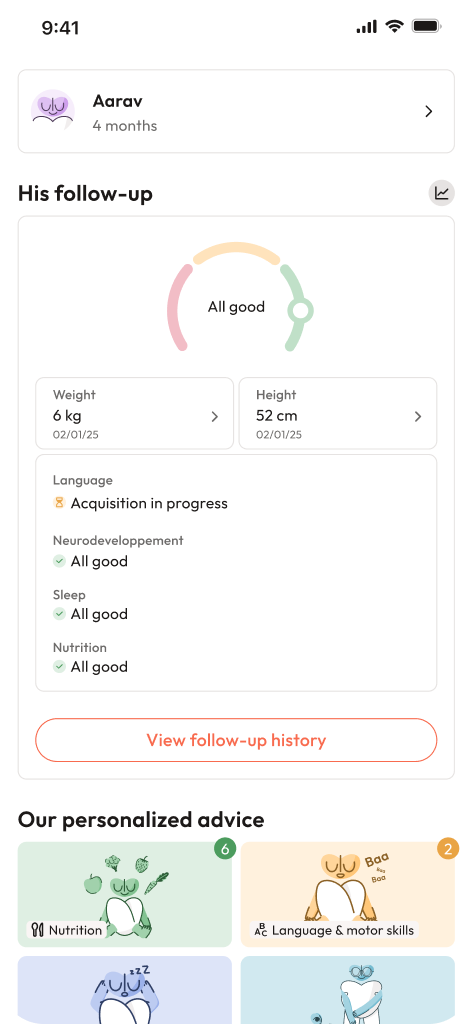
- Support exists: your paediatrician and lactation support can help. You can also download the Heloa app for personalised guidance and free child health questionnaires.

Further reading :