Diaper changes can feel like a small, repetitive task, until the day your baby’s skin turns bright red, a leak reaches the car seat, or night changes start stealing everyone’s sleep. A Diaper change is not only about cleanliness. It is skin physiology (pH, friction, moisture), comfort, and day-to-day observation of what your baby’s body is doing.
You may be thinking: how often is “often enough”? What should you clean with? And how do you keep it safe when your baby suddenly learns to roll? Add Indian weather into the mix. In hot, humid months, sweat and dampness collect faster, and skin folds can stay moist even when the diaper does not look very full. In cooler months, dryness and repeated wiping can irritate too. The goal stays the same: shorter contact time with urine and stool, and kinder handling of the skin.
Why diaper changes matter for skin, comfort, and health
A baby’s skin is thinner than an adult’s, with a still-maturing skin barrier (the protective outer layer that limits water loss and blocks irritants). When urine and stool sit against that skin, several things happen together:
- pH shifts: urine and stool can change the skin’s pH.
- Moisture + heat: the closed diaper area traps humidity.
- Friction: movement rubs damp skin, especially in folds.
That combination leads to maceration (skin that becomes overhydrated, soft, and easier to damage). Add digestive enzymes from stool (lipases and proteases), and irritation can speed up.


A timely Diaper change also gives practical clues: stool frequency, unusual smell, early redness, repeated leaks in the same spot, or discomfort when you wipe.
If a diaper stays on too long: irritation, diaper rash, yeast
A wet diaper creates the perfect environment for redness: warmth + humidity + friction. Stool, especially loose stool, contains enzymes that irritate the skin quickly.
Sometimes this can progress to:
- stronger irritation with red patches,
- diaper dermatitis (diaper rash: inflammation of the diaper area),
- possible yeast overgrowth, often Candida.
Anatomy can influence where irritation settles:
- For babies with vulvas, stool near the vulva can inflame delicate tissue, more rarely, bacteria moving towards the urethra can raise urinary tract infection risk.
- For babies with penises, irritation often sits under the scrotum or around the base of the penis.
In every case, a prompt Diaper change reduces skin contact time with irritants.
Times when it’s best not to wait
Do a Diaper change promptly:
- after any poop, even a small amount,
- after a leak,
- if your baby arches, cries when the area is touched, or seems uncomfortable,
- if the diaper looks swollen, heavy, or oddly shaped.
When to do a Diaper change: frequency by age and baby’s rhythm
Newborn (0–3 months)
From 0 to 3 months, many babies need frequent changes, often 6 to 10 per day (sometimes more). A workable routine is:
- check every 2–3 hours,
- change after every poop,
- look “around feeds” (after breastfeeding or bottle feeds).
Some days there are many stools, other days they are spaced out. That variation is common.
Baby (3–12 months)
Once solids start, stools usually change: denser, stronger-smelling, and sometimes more irritating. They may also happen less often. Urine remains regular.
You may stretch intervals a bit, but the core rules stay steady:
- Diaper change right away when soiled,
- shorten the interval if the diaper saturates fast,
- keep an eye on the skin (redness, marks, damp zones).
Signs a diaper is full
Common clues:
- stronger odour,
- a swollen, heavy diaper that droops,
- wetness indicator (if present),
- dampness in folds, early maceration, red marks at the groin or thighs,
- leaks at the back or sides.
Nighttime: balancing hygiene and sleep
At night, it is often a trade-off. If your baby is asleep, there is no poop, and the diaper is only wet, you do not always have to wake your baby, especially with a highly absorbent diaper.
Do not delay if there is poop, a leak, or already irritated skin. If you do a night Diaper change, keep it minimal: dim light, slow movements, no extra stimulation.
Choosing diapers: size, absorbency, and options that help
Size and fit
A good diaper is first a well-fitted diaper: secure without squeezing. A quick check: around two fingers should fit at the waist. Thigh elastics should follow the skin without leaving deep marks, and the leak guards should be pulled out.
In the early days, if the umbilical cord stump is still present, fold the top edge down to avoid rubbing.
Disposable, cloth, and sensitive-skin options
- Disposable diapers: convenient and usually very absorbent.
- Cloth diapers: less waste and often cost-effective long term, but they need a washing and drying routine.
- Sensitive-skin ranges: fragrance-free is a sensible baseline.
The best choice is the one that fits your daily life.
A mixed approach: home vs outings
Many Indian families mix systems: cloth at home, disposable at night or while travelling. To reduce odour and irritation:
- choose higher absorbency overnight,
- do an earlier Diaper change if the diaper swells quickly,
- limit scented products in the diaper area.
Diaper change supplies and simple organisation
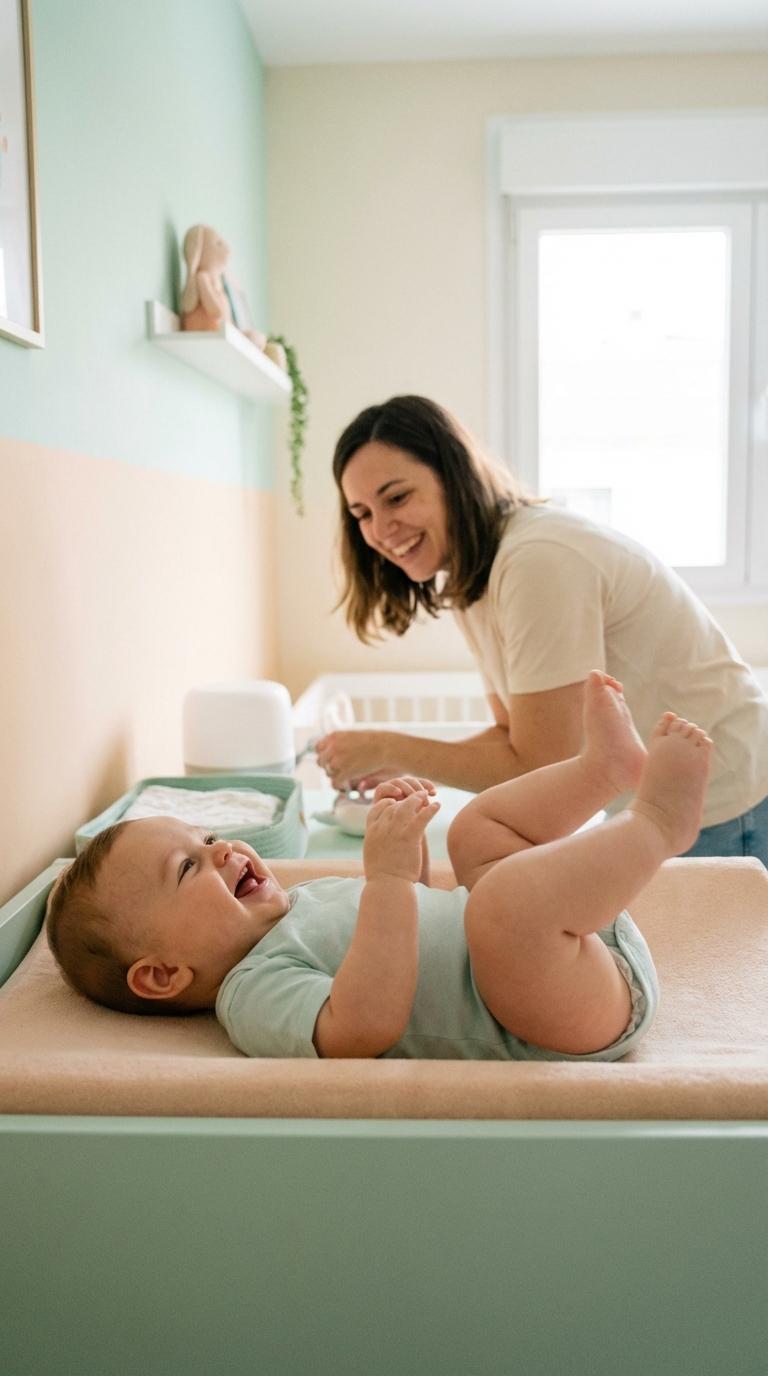
Keep essentials within reach
Prepare everything before each Diaper change. A baby can roll the moment you reach away.
At home, aim for:
- a firm, stable mat (non-slip surface),
- a clean diaper,
- cotton pads and warm water (or suitable wipes),
- a small towel for patting dry,
- a disposal system,
- a clean outfit (plus one spare).
On the go: a changing mat, extra diapers, disposal bags, and spare clothes.
Gentle cleaning: water, wipes, mild cleanser
For urine-only diapers, warm water and cotton are often enough.
For poop, use water and cotton, or a very mild, fragrance-free cleanser, then dry carefully.
Wipes are useful for travel. Choose alcohol-free, fragrance-free wipes. If skin becomes reactive, warm water for a few days can help.
Protective products: when to use what
- Oil-based cleansing balm (liniment-style): can help on healthy skin as a protective film.
- If the skin is red: pause oil-based balm, it can trap irritants on inflamed skin.
- For established redness: a barrier cream or paste (often with zinc oxide) in a visible layer gives a shield effect.
A compact travel kit
Include diapers, mat, wipes or cotton + water, disposal bags, spare clothes, and a small barrier cream.
Safety and setup for a calmer diaper change
Prepare the space first
Open the clean diaper, set out wipes/cotton and towel, and keep disposal ready.
One hand on your baby
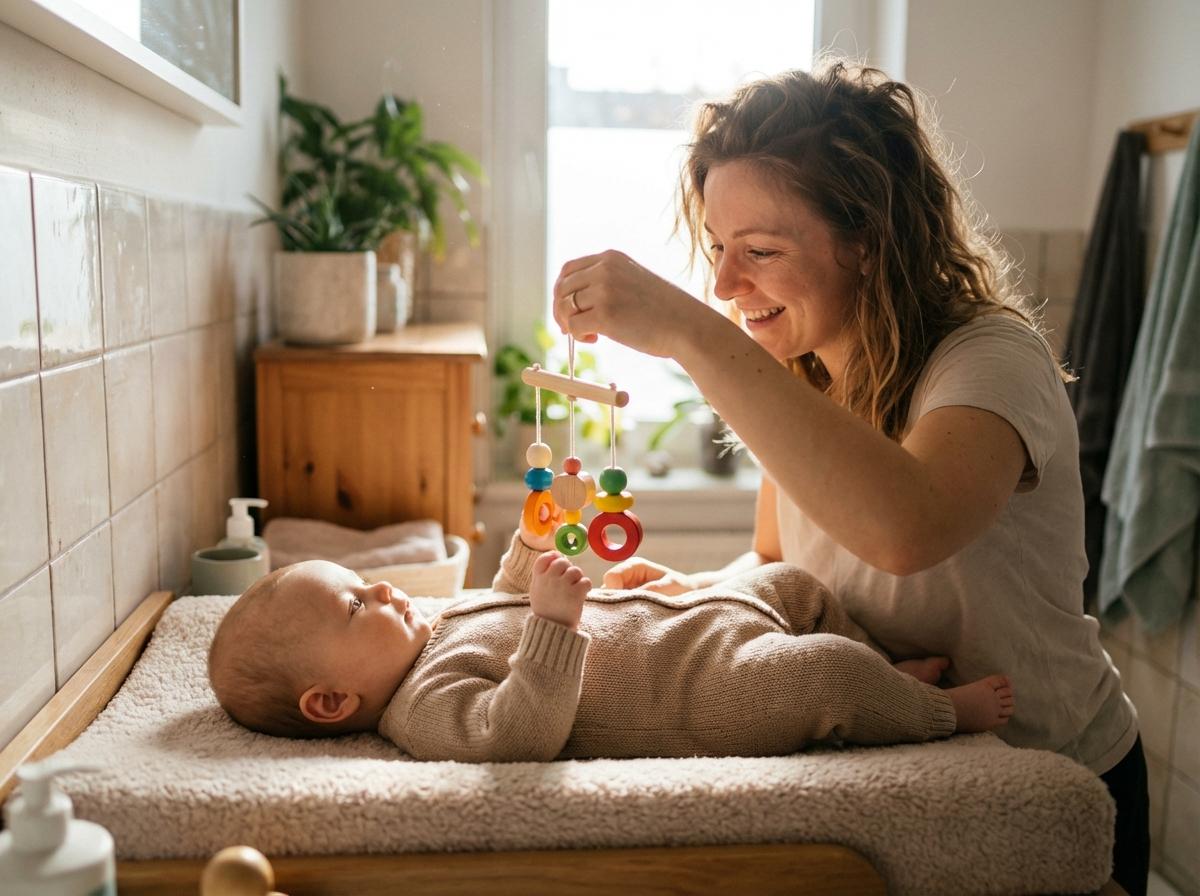
The safest Diaper change habit is keeping one hand on your baby from start to finish.
Safety mistakes to avoid
Avoid leaving your baby alone, changing on an unstable surface, lifting by the ankles (use a gentle side-roll), or keeping supplies out of reach.
How to do a Diaper change step by step
1) Set up a safe area
Choose a flat surface. Floor changes are often safest for a rolling baby.
2) Open the dirty diaper
Open tabs. If there is poop, use the front of the diaper to lift off the bulk, then fold it inward.
3) Clean based on pee vs poop
Pee: quick clean with warm water/cotton or a gentle wipe.
Poop: clean more thoroughly and do not forget creases: thigh folds, groin folds, around the buttocks, and under the scrotum.
4) Wipe direction and anatomy tips
For babies with vulvas: wipe front to back and clean gently between labial folds.
For babies with penises: clean around the penis and scrotum. You can briefly cover the penis with a wipe to prevent surprise sprays. When fastening, point the penis downward to reduce front leaks.
Do not retract the foreskin.
5) Dry and check the skin
Pat dry. Look for redness, shiny skin, sore patches in folds, or persistent dampness.
6) Apply protection when helpful
- Mild irritation: petrolatum-based barrier ointment.
- Clear redness: zinc oxide cream or paste.
If you use an oil-based cleansing balm, pause it during active redness.
7) Put on a clean diaper
Slide the diaper under your baby using a side-roll. Fasten evenly. Pull leg cuffs out fully.
8) Finish up
Dispose waste, separate soiled clothes, clean the surface if needed, and wash hands.
Newborn diaper change specifics
Early output and frequency
In the first 48 hours, changes may be less frequent (sometimes every 4–6 hours). After a few days, many newborns need a Diaper change every 2–3 hours.
Early stools can be meconium (dark, sticky), then shift to yellow stools in breastfed babies or firmer stools with formula.
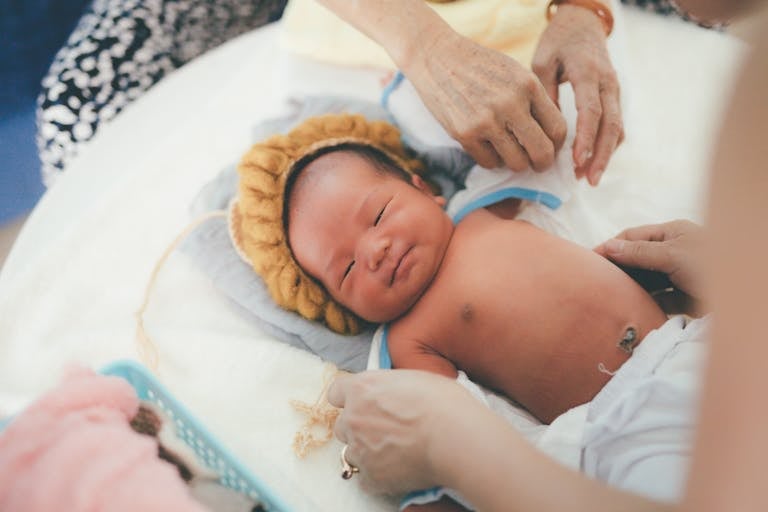
Umbilical cord stump care
Fold the diaper down so the stump stays exposed and dry. Seek care if there is spreading redness, swelling, discharge, foul smell, or fever.
Diaper changes for older babies and toddlers
Changing a wiggly baby
Keep one hand on hips or tummy and use quick distractions. Floor changes reduce fall risk.
Pull-ups and standing changes
Training pants can help for standing changes. Small choices (“this diaper or that one?”) can reduce power struggles.
Potty learning without rushing
Routines (on waking, before nap, before bath) support learning. A Diaper change can stay a calm routine until continence is ready.
Diaper rash: prevention and what to do when redness appears
Most rashes come from moisture + friction + contact with urine and stool. Diarrhoea and stool acidity changes after solids can increase risk.
Helpful habits:
- prompt Diaper change when soiled,
- gentle cleaning and thorough drying,
- fragrance-free products,
- absorbency adjusted for day vs night.
If rash is established: warm water + cotton, pat-dry, barrier paste in a visible layer, a little diaper-free air time, and pause oil-based balm while skin is red.
Seek medical advice if redness lasts several days, if there are blisters/weeping, if pain seems significant, or if there is fever.
Leaks and blowouts: common causes and fixes
Most leaks are fit, tucked-in cuffs, or saturation. Try: reassess size, centre the diaper, pull leak guards out, do an earlier Diaper change, or choose a more absorbent overnight diaper.
Night, travel, and shared caregivers
Night: keep things quiet and quick. If it is only urine and your baby is sleeping, you may wait. If there is poop or a leak, do a fast Diaper change.
Travel: carry mat, diapers, wipes or cotton + water, disposal bags, and spare clothes. Use hand sanitiser if needed, then wash properly later.
Shared caregivers: keep routines consistent and mention redness early.
Key takeaways
- A Diaper change supports the skin barrier: less moisture, less friction.
- Change poop promptly, at night, prioritise stool, leaks, and already irritated skin.
- Correct size, leak guards pulled out, and absorbency matched to the moment prevent most leaks.
- Prepare supplies, keep one hand on your baby, and wash hands after.
To remember
Diaper care is everyday routine and a comfort measure. If a rash does not settle, or looks severe, your paediatrician can assess and guide you. For personalised tips and free child health questionnaires, you can also download the Heloa app.
Further reading :
- Healthy Habits: Diaper Changing at Home: https://www.cdc.gov/hygiene/about/healthy-habits-diaper-changing-steps-at-home.html
- Healthy Habits: Diaper Changing Steps for Childcare Settings – CDC: https://www.cdc.gov/hygiene/about/healthy-habits-diaper-hygiene.html
- How to Change a Diaper: https://doh.wa.gov/sites/default/files/legacy/Documents/8330/130-082-DiaperCCsm-en-L.pdf