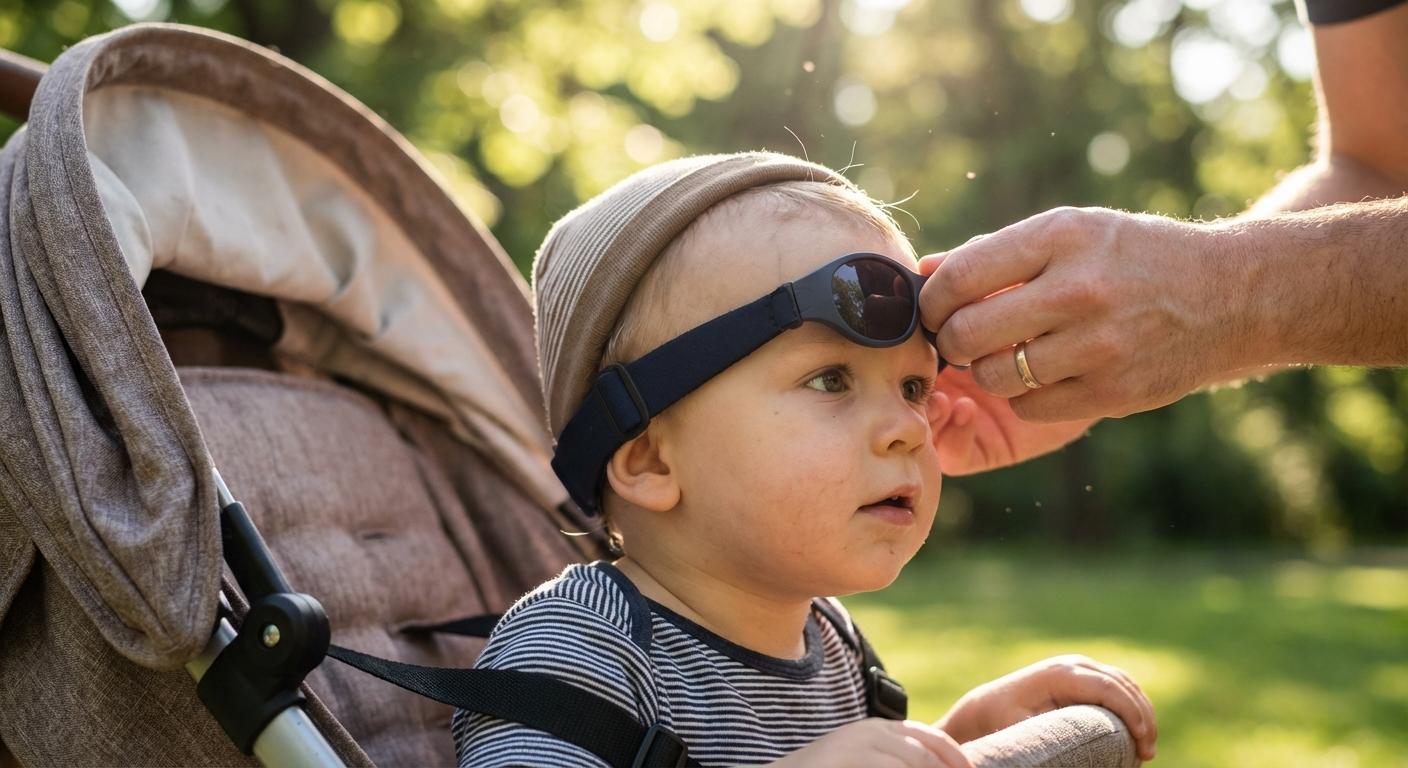
Your baby squints the moment you step out, whether it is a sunny Mumbai morning, a hazy Delhi afternoon, or a breezy coastal walk in Chennai. The light feels “normal” to adults, yet many little ones blink, turn away, or get watery eyes quickly. That’s where baby sunglasses can help: not as a fashion add-on, but as a comfort tool and a long-term habit to reduce cumulative UV exposure (the total ultraviolet dose collected over years).
The aim is simple. Keep it practical. Combine shade, a brimmed cap, and baby sunglasses when conditions demand it.
Why baby sunglasses matter for growing eyes
A baby’s eyes are still developing their natural filters. In early life, the crystalline lens is clearer than in adulthood, so it blocks less UVA and UVB. The iris is also less pigmented early on, especially in light-eyed babies, so bright light can feel uncomfortable very fast.
In day-to-day life, you may notice:

- frequent blinking and squinting
- turning the face away from the sun
- watery eyes or fussiness when glare becomes harsh
Starting early is not about being perfect. It is about repeatable protection. Baby sunglasses can be one small step that makes outdoor time calmer.
UVA vs UVB, and why reflection matters so much in India
UV is not one single ray.
- UVA (315–400 nm) penetrates deeper and contributes to oxidative stress over time.
- UVB (280–315 nm) is more energetic and is linked to surface injury, including corneal sunburn (photokeratitis) and longer-term lens changes.
UV also reaches the eyes by reflection. Common Indian glare traps include:
- water (beach, pool)
- sand
- pale pavements and concrete
- glass buildings
- snow in hill stations and higher altitudes
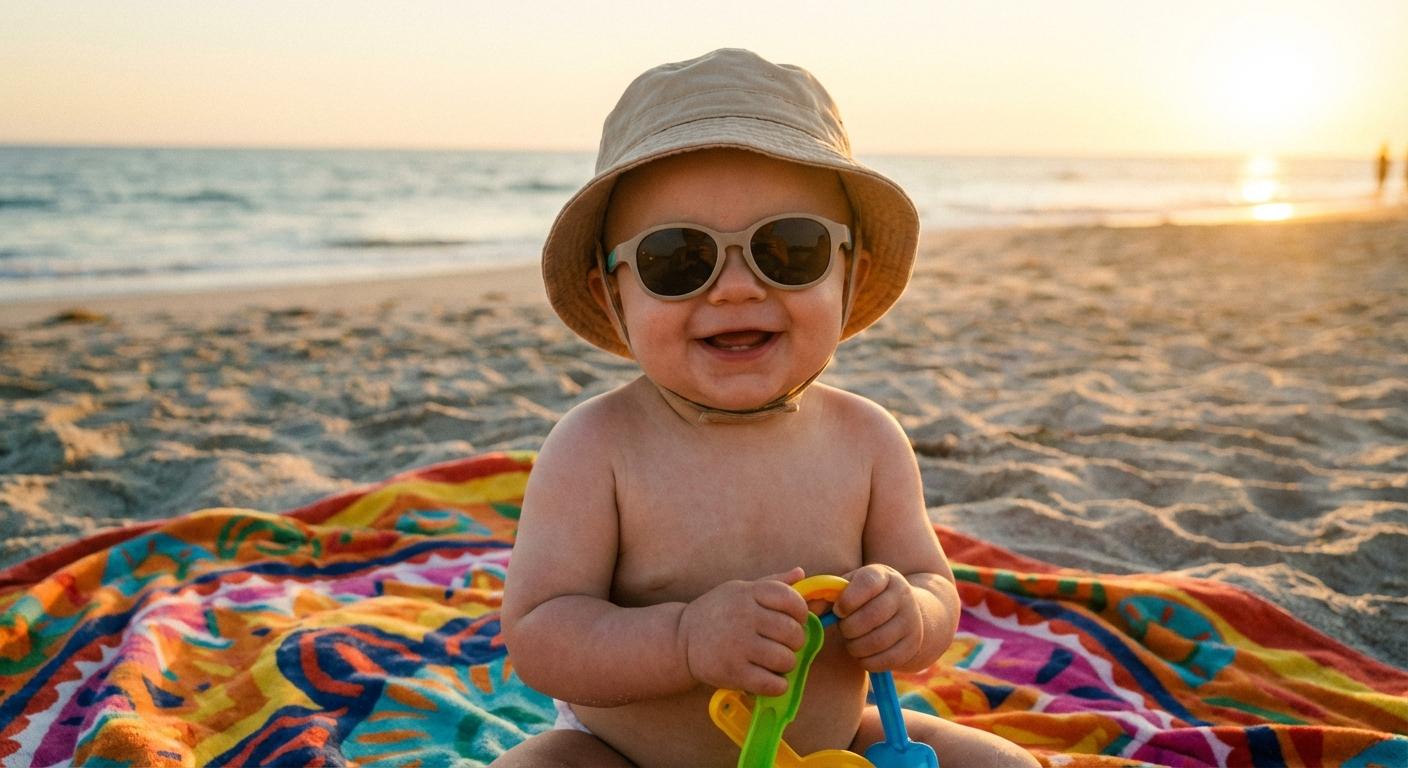
So even under an umbrella at the beach, light can bounce up into your child’s eyes. In those moments, baby sunglasses do real work.
Cloudy days, shade, and winter sun: quick myth-busting
It is tempting to assume, “It’s overcast, UV will be low.” But clouds do not block UV reliably.
- A bright overcast day can still carry substantial UV.
- Winter sun can be strong, and UV rises with altitude.
- Shade reduces UV, but reflected rays still come from the sides and below.
If your baby is squinting in the shade, baby sunglasses may still help with comfort.
When protection is most helpful
Think of situations with high light plus high glare:
- late morning to mid-afternoon outdoor time
- stroller walks where babies look up at bright sky
- beach and pool days (water and sand reflection)
- hill trips and snowy days (altitude plus snow glare)
- long car rides (glare plus UVA through side windows)
What sun exposure can do to a child’s eyes
Short-term effects: when the eye surface reacts
Very intense UV, especially with strong reflection, can trigger:
- photokeratitis (corneal inflammation caused by UV)
- photoconjunctivitis (UV irritation of the conjunctiva)
Possible signs include:
- red eyes and tearing
- eyelids squeezing shut
- strong sensitivity to light (photophobia)
- sometimes temporarily blurred vision
If these appear after a beach day, snow exposure, or a long day outdoors, speak with your paediatrician or an eye specialist.
Long-term effects: cumulative exposure
UV effects are cumulative. Without fear-mongering, consistent habits (shade plus cap plus baby sunglasses) reduce the total UV dose over the years. Lower exposure may reduce the chance of earlier lens changes (including cataract development later in life) and ocular surface damage.
Sunglasses, hats, and shade: the easy layering routine
- Baby sunglasses reduce direct and reflected UV reaching the eyes.
- A wide-brim cap blocks overhead rays that slip above frames.
- Shade lowers overall UV, but does not cancel reflection.
Used together, they reduce both brightness discomfort and UV load, while keeping outdoor time enjoyable.
When babies can wear baby sunglasses
Age and readiness cues
Age matters less than safe fit.
- Newborns and young infants: many families manage best with shade and caps first. If trying baby sunglasses early, pick ultra-soft frames and supervise closely.
- Around 6–36 months: many children accept baby sunglasses more reliably if they are lightweight and do not pinch.
Readiness cues:
- tolerates them for short periods
- does not pull them off instantly
- no pressure marks on the nose or behind ears
UV Index and reflection triggers
The UV Index can guide daily choices:
- UV Index 0–2: optional (mainly for glare)
- UV Index 3–5: baby sunglasses are a good idea outdoors
- UV Index 6+: use baby sunglasses consistently, plus cap and shade breaks
Also upgrade protection around water, sand, bright pavements, and at altitude.
Outdoors, indoors, and the car
Outdoors is where baby sunglasses matter most.
Indoors, they are usually unnecessary, except for strong window glare.
In cars, windshields often block much UVB, but UVA can pass through side windows. If sunglasses do not stay on in a car seat, focus on:
- window sunshades
- seat position that reduces side glare
- a brimmed cap when appropriate
What to look for in baby sunglasses: labels, lens safety, and fit
UV protection you can trust
The non-negotiable: baby sunglasses should filter both UVA and UVB.
Look for clear labelling:
- UV400
- “100% UVA/UVB protection”
Avoid vague claims like “UV protected” without details. You want a real UV filter, not just tinted plastic.
Safety marks and standards (what they add)
Depending on where you buy, you may see CE marking and references such as EN ISO 12312-1 or EN 1836. These can add reassurance, but they do not guarantee comfort, stability on a small nose bridge, or good side coverage.
Dark lenses are not the same as UV protection
A dark lens can feel soothing, but if it does not block UV, it can be risky because pupils may dilate behind the tint and allow more UV in.
Tint equals comfort. UV400/100% UVA-UVB equals protection.
Scratched or warped lenses: when to replace
Scratches scatter light and increase glare. Children often reject lenses that feel hazy.
If lenses are cloudy, deeply scratched, or the frame is warped, replacement is usually the best call.
Lenses: comfort and clarity choices
Polycarbonate and Trivex
- Polycarbonate: lightweight, highly impact-resistant, a common choice for toddlers.
- Trivex: very impact resistant with excellent optical clarity, helpful if your child seems bothered by distortion.
Polarised lenses
Polarised baby sunglasses reduce glare from water, snow, and shiny roads. Very useful for beach days and hill travel. One practical note: some phone or car screens may look darker at certain angles.
Tint colours and useful coatings
- Grey: neutral colours
- Brown/amber: better contrast
- Green: balanced comfort
Coatings that suit real family use:
- scratch-resistant hard coat
- hydrophobic/oleophobic layer for easier cleaning
Lens categories: picking the right darkness
Lens category describes visible light reduction, not UV protection.
- Category 3: the most versatile everyday choice for many families.
- Category 4: for extreme glare like snowfields and high mountains, too dark for routine use.
- Category 2: for milder brightness and mixed days.
If you want one pair that works most days, Category 3 baby sunglasses are often the practical pick.
Frames and fit: the make-or-break factor
What a good fit looks like
- covers the eye area well, with minimal side gaps
- sits evenly and does not tilt forward
- does not press into cheeks
- no pinching at the bridge or squeezing at the temples
Baby-friendly materials and designs
Flexible silicone or rubberised frames tend to be more comfortable and tolerate bending.
Look for smooth finishes and, when available, BPA-free and phthalate-free claims, especially if your child has sensitive skin or eczema.
Wraparound shapes reduce side glare and often stay on better.
Home fit test (2 minutes)
- check coverage in a mirror or photo
- gently move your child’s head: do the frames slip?
- add a strap only if needed, keep it snug, not tight
- try with your child’s usual cap so nothing rubs
Signs the fit is off: deep red marks, constant slipping, immediate pulling off, or eyelashes touching the lenses.
Safety and durability for everyday baby life
- Check for smooth edges and firmly seated lenses.
- Avoid tiny detachable decorations (choking risk).
- If using straps, remove during sleep and avoid long loops that can snag.
- Do not leave baby sunglasses on car dashboards, heat can warp frames and damage coatings.
Buying and usage tips that make baby sunglasses easier
Price: what you are really paying for
It is natural to wonder if a cheaper pair is fine. Sometimes it is. The deciding factor is not the price tag, it is the specification.
Pay for:
- verified UV400 or “100% UVA/UVB” protection
- decent optical quality (less distortion)
- safe construction (no loose parts)
- comfort (soft bridge, flexible frame)
If a listing says only “UV protected” with no UV400 detail, treat it with caution.
Online sizing: making a better guess
Buying baby sunglasses online is common, especially with limited store trials.
If measurements are provided, compare:
- overall frame width
- bridge width
- temple length
Then do a quick home trial. A good pair stays centred, does not dig into cheeks, and does not slide down with gentle head movement. If the nose bridge is very flat (common under 12 months), an adjustable headband can improve stability.
A few small habits that boost protection further
You may be wondering, is it worth doing anything beyond eyewear? Often, yes, because babies do what babies do: they pull things off.
Simple add-ons that work well with baby sunglasses:
- plan outdoor play earlier in the morning or later in the evening when possible
- use the stroller canopy so light comes less directly from above
- keep a spare cap in the bag (caps get lost quickly)
- take short shade breaks at the park, especially on high UV Index days
Helping your baby accept baby sunglasses
Timing matters. Start when your baby is calm and fed.
- try 30–60 seconds, then stop before frustration builds
- repeat often and increase slowly
- model the routine: parents wearing sunglasses before stepping out can reduce resistance
If your child always rejects them, assume discomfort first. A softer bridge or lighter frame can change everything.
Cleaning and caring
- Rinse with cool to lukewarm water.
- Use a drop of mild soap for sunscreen or drool.
- Dry with a clean microfiber cloth.
Avoid tissues and paper towels. Store in a pouch or case in the diaper bag. Replace when lenses are deeply scratched, hazy, or the fit becomes unstable.
Key takeaways
- Baby sunglasses improve comfort and reduce UV reaching developing eyes, especially in glare-heavy settings.
- UV can still be significant on cloudy days, in shade, and during winter travel due to reflection.
- Always choose baby sunglasses with UV400 / 100% UVA-UVB protection, tint alone is not protection.
- Category 3 suits most outings, Category 4 is reserved for extreme snow or high-altitude glare.
- Fit and comfort decide whether baby sunglasses will actually be worn.
- For eye pain, marked redness, or severe light sensitivity, consult your paediatrician or an eye specialist.
- You can also download the Heloa app for personalised tips and free child health questionnaires.