Those first soft “ooohs,” the gentle gurgles, and then (almost out of nowhere) a “ba-ba” that sounds suspiciously like a word… and the questions arrive fast. Is baby cooing a milestone? A sign of comfort? The very first brick of language?
Between crying, shrieks, hiccups, digestive grunts, baby cooing, and later babbling, it’s easy to mix everything up. Yet each sound has a role: your baby is learning to coordinate breathing, voice (phonation), mouth movements, and (just as important) relationship.
So what does baby cooing actually mean, when does it usually appear, how does it evolve across the first year, and when does it make sense to ask for medical or developmental support? Let’s sort it out, calmly and clearly.
Baby cooing: what it is (and what it is not)
Definition: early vowel-like sounds (“oo”, “ah”, “oh”)
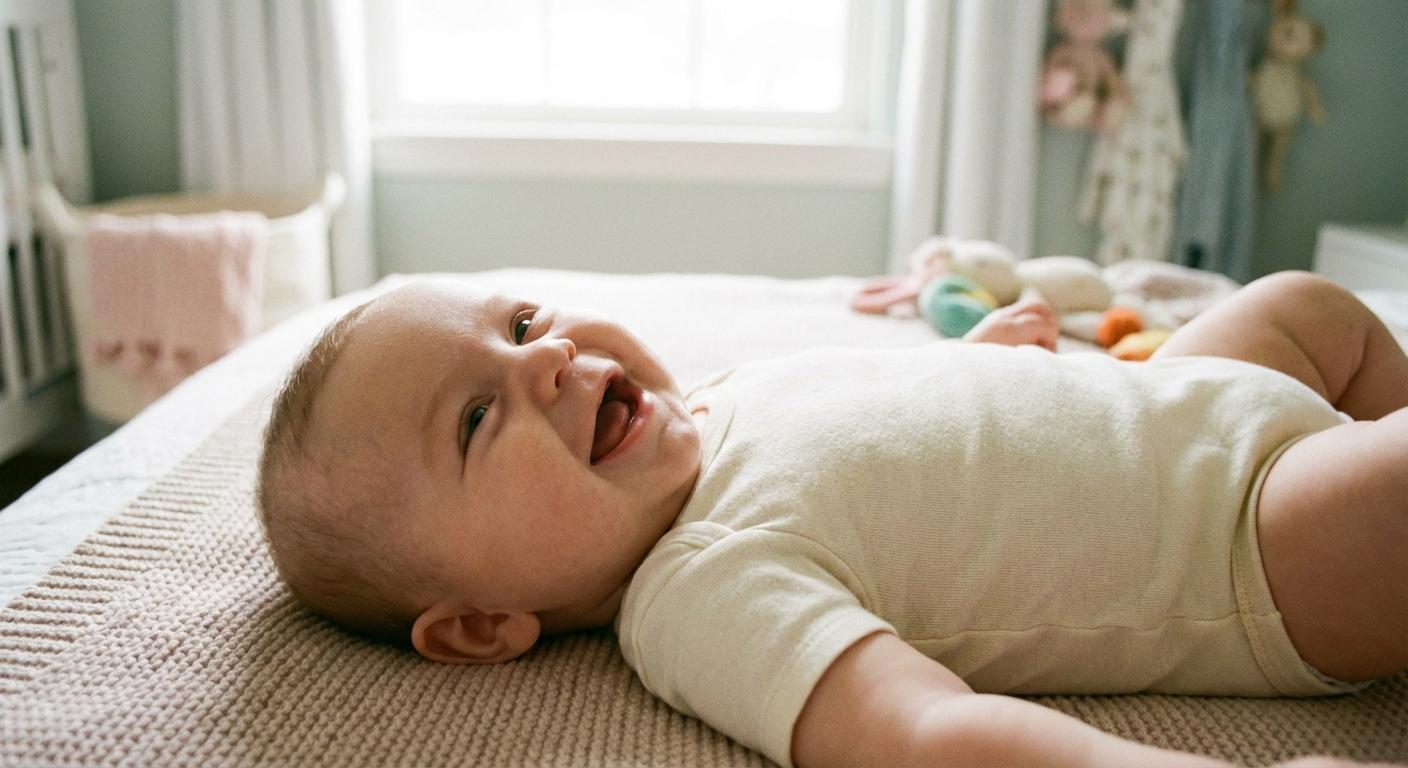
Baby cooing is an early form of preverbal communication: soft, vowel-heavy sounds (often “oo,” “ah,” “oh,” sometimes “agoo”) produced when a baby is calm, comfortable, and alert. Unlike crying, cooing tends to be smooth and sustained, with gentler vocal cord vibration and more organized breathing.


Not words yet. Not even “talking” in the adult sense. But it is real practice: airflow from the lungs, vocal cords vibrating at the right moment, lips and tongue shaping the sound.
Parents sometimes use “cooing” to describe many early baby vocalizations. In the beginning, a chunk of newborn noise is involuntary (breathing adjustments, reflux, secretions). Then, gradually, intention appears: your baby experiments with the voice box (larynx), breath, tongue, and lips, and discovers a powerful loop: make a sound… and someone responds.
Proto-conversations: the earliest back-and-forth
You may wonder: does baby cooing count as communication if there are no words? Often, yes.
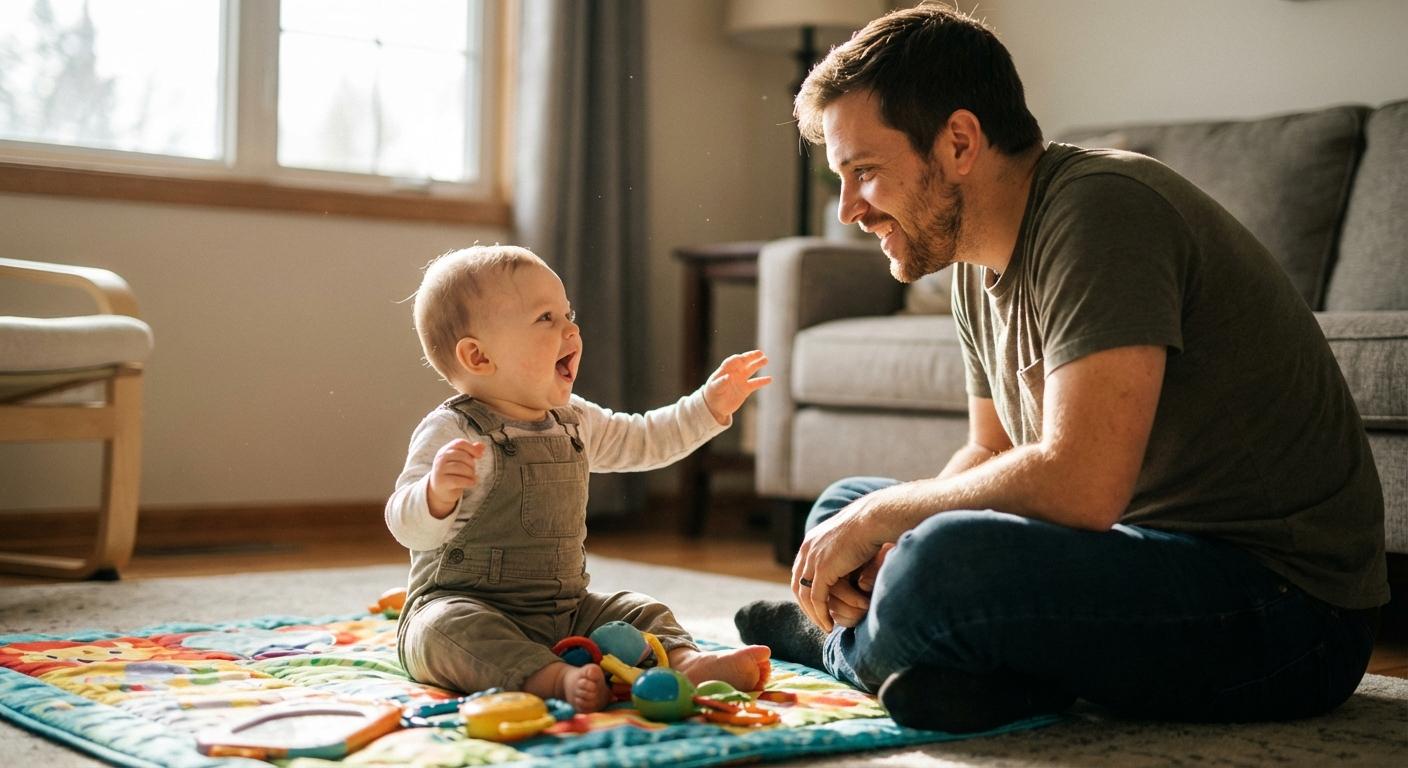
These early exchanges are sometimes called proto-conversations: your baby vocalizes, you answer, you pause, and your baby “takes a turn” again.
Baby cooing vs crying and reflexive newborn noises
In the first weeks, many sounds are not social at all. Context matters as much as the sound.
- Crying: often repetitive and rhythmic, usually linked to a physiological need (hunger, fatigue, wet diaper, discomfort). Look for body clues: agitation, rooting/sucking motions, yawning, grimacing.
- Shrieks or yells: higher-pitched and sudden, sometimes excitement, sometimes protest, sometimes overstimulation. A pain cry is typically abrupt, with a tense body, and can be harder to soothe.
- Reflexive (“vegetative”) sounds: grunts, sighs, throat-clearing noises, sneezes, hiccups, feeding-related sounds, and digestive-effort noises.
Baby cooing is different because it is voiced, more speech-like, and often appears when your baby is enjoying your presence, frequently with eye contact, a relaxed body, or a smile.
The usual sequence: reflexive sounds -> cooing -> squeals/laughter -> babbling
A common pattern (with plenty of normal variation):
- Birth to ~2 months: crying, fussing, reflexive sounds.
- ~6-8 weeks to ~3-4 months: baby cooing, early laughter.
- ~3-6 months: more sound play, pitch changes, squeals, chuckles.
- ~4-6 months onward: early babbling begins.
- ~6-10 months: canonical babbling (clear syllables like “ba-ba,” “da-da”).
Why baby cooing supports language development
Baby cooing strengthens the physical foundations needed for later speech:
- steadier exhalation,
- improved coordination between breathing and voicing,
- early control of pitch and rhythm.
It also feeds the listening side of communication through prosody (the melody and rhythm of speech).
Bonding and “serve-and-return”
When your baby coos and you respond, then pause so your baby can answer, you’re practicing contingent responding (“serve-and-return”).
When baby cooing starts: timelines with room for variation
Typical age range
Many babies begin baby cooing between about 6 weeks and 3 months. Some start earlier, others later. The most useful lens is gradual progress over time.
Early signs cooing is about to show up
Baby cooing often arrives alongside:
- steadier eye contact,
- a social smile (often increasing around 6-8 weeks),
- longer alert windows,
- calming or brightening when you speak.
Why some babies start earlier or later
Normal reasons include temperament, interaction opportunities, and comfort (sleep disruption, congestion, reflux discomfort, ear pain).
Premature babies: use corrected (adjusted) age
If your baby was born early, milestones are best tracked using corrected age:
- Corrected age = chronological age – weeks of prematurity.
Baby cooing milestones from 0 to 12 months (and beyond)
0-3 months: first coos and early social vocalizing
Typical patterns:
- reflexive sounds alongside crying,
- baby cooing and gurgling,
- mostly open vowels,
- early exchange (settling to your voice, looking for your face, answering with a small sound).
3-6 months: richer cooing, squeals, laughter
Often you’ll hear:
- more pitch and volume range,
- squeals, chuckles, giggles,
- clearer vocal play,
- more consistent mini-dialogues.
6-9 months: the bridge toward babbling
Common changes:
- consonant exploration,
- canonical babbling for many (“ba-ba,” “da-da,” “ma-ma”),
- more imitation,
- growing understanding (often responding to their name in context later in this period).
9-12 months: complex babble, gestures, first-word readiness
Toward the end of the first year:
- babbling becomes more varied,
- voice pairs with gestures (reaching, showing, protesting),
- comprehension accelerates, first words may appear around 12 months.
12-24 months: words and intention
After the first birthday, many children move into first words, more intentional communication, and sometimes a vocabulary “spurt” around 18-24 months.
What baby cooing means in everyday life
Comfort, pleasure, connection
Most of the time, baby cooing signals comfort and curiosity, a simple way of saying “I’m okay, and I want contact.”
Engagement vs a need for a break
Look at the whole baby:
- Engagement: soft face, steady breathing, eye contact, smiles.
- Break needed: turning away, yawning, rubbing eyes, stiffening, fussing.
Common scenarios
- Baby cooing and hunger: more often hunger leads to crying, but some babies vocalize while getting impatient. Look for rooting and increased sucking motions.
- Baby cooing before sleep: quiet sounds can be self-soothing.
- Baby cooing for attention: learning cause-and-effect, not “acting out.”
- Baby cooing during play: experimenting with mouth movements and breath.
- Baby cooing with overstimulation: louder, faster sounds may precede fussing, lower the pace and reduce noise.
What baby cooing sounds like
Common examples
Parents often report:
- “oooh,” “aaa,” “eee,”
- “agoo,”
- gentle gurgles during calm, alert time.
When sound is not “communication”: breathing red flags
Noisy breathing is not the same as baby cooing. Seek prompt medical advice if breathing sounds come with visible effort (chest pulling in, flaring nostrils), feeding difficulty, or color change (pale skin or bluish lips). Wheezing (whistling out) or stridor (harsh in) also deserve medical input.
How to encourage baby cooing without pressure
Make room for turn-taking
Pick calm, alert moments, get to eye level, and respond briefly, then pause. That pause is an invitation.
Imitation + one small step
Echo a sound (“oo”), then add a tiny variation (“oo-oo”), then wait.
Parentese, routines, songs, books
Warm infant-directed speech, talking through routines, singing, and short picture books all support attention to speech sounds. Reduce background TV so your baby can focus on voices.
What to avoid
Pressure, overstimulation, and correcting sounds usually shut vocal play down.
Baby cooing vs babbling: the key shift
Baby cooing is mostly vowels and melody, common in the early months. Babbling adds consonant-vowel patterns (“ba,” “da,” “ma”) and becomes more rhythmic, typically from about 4-6 months onward, with wide variation.
When to check in with a clinician
Consider a pediatric check-in if you notice:
- no clear baby cooing (or sustained vowel-like sounds) by about 4-6 months (corrected age if premature),
- low vocalizing plus limited social response (rare eye contact, few social smiles),
- little progression toward babbling and communicative gestures by about 9-12 months,
- regression (fewer sounds than before, less social connection, loss of gestures).
Baby cooing and hearing: what to watch
Hearing supports vocal learning: babies listen, then adjust. Discuss with your clinician if your baby rarely startles to loud sounds, doesn’t seem to notice voices, doesn’t orient to sound as they get older, or shows limited progression in vocal play. Middle-ear fluid (effusion), ear infections, and chronic congestion can temporarily reduce hearing clarity.
Key takeaways
- Baby cooing is an early, vowel-like form of vocal play that often appears between about 6 weeks and 3 months.
- It supports breath control, phonation, prosody, and early turn-taking through warm back-and-forth interaction.
- Baby cooing usually happens when a baby is comfortable and socially engaged, crying and many newborn noises are different.
- Cooing typically shifts toward babbling over the next months.
- Support is simple: respond, imitate, add one small variation, pause, sing, read, and keep background noise low.
- Seek advice if progress is very limited, social responsiveness seems weak, babbling/gestures are missing late in the first year, or there is regression.
- Professionals can help, and you can download the Heloa app for personalized tips and free child health questionnaires.
Questions Parents Ask
Can babies coo while sleeping?
Yes—soft coos, little “ooh/ah” sounds, and gentle gurgles can happen during active (REM-like) sleep. It’s often just your baby’s nervous system practicing and processing the day. As long as breathing stays easy (no pulling in at the ribs, no bluish color, no choking), there’s usually no need to worry. If the sounds come with persistent breathing effort or feeding difficulties, it can be reassuring to check in with a clinician.
My baby started cooing, then stopped—should I worry?
A short pause can be totally normal. Babies sometimes “quiet down” when they’re working on a new skill, feeling tired, congested, or going through a routine change. What matters most is the overall trend: do you still see social engagement (eye contact, smiles, reacting to your voice) and do sounds return over time? If the drop is sudden, lasts a few weeks, or comes with less interaction, it’s important to discuss it with your pediatrician—support is available.
Why is my baby not cooing yet at 2–3 months?
Many babies begin cooing around this time, but variation is common. Some are simply quieter, and some are distracted by reflux discomfort, nasal stuffiness, or frequent sleep disruptions. You can try short “face-to-face” moments, imitate any tiny sound, then pause—no pressure. If there are also concerns about hearing (not reacting to loud sounds or voices) or very limited social response, it’s important to seek advice.