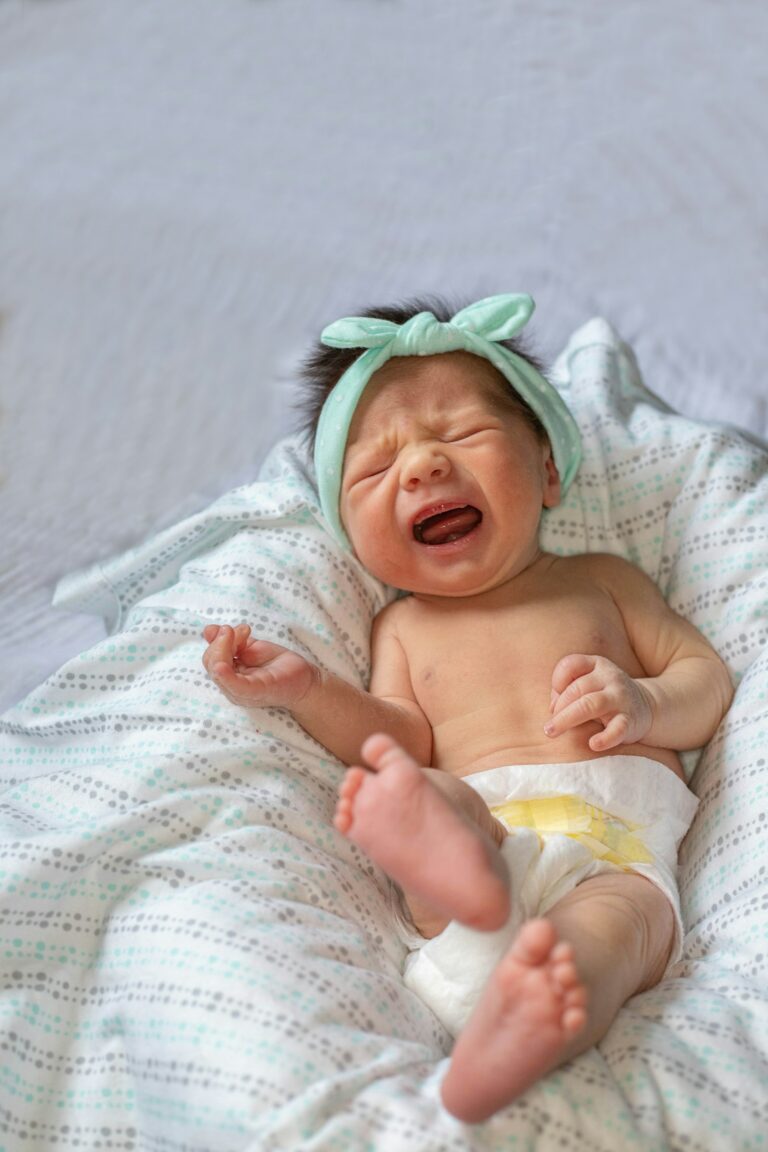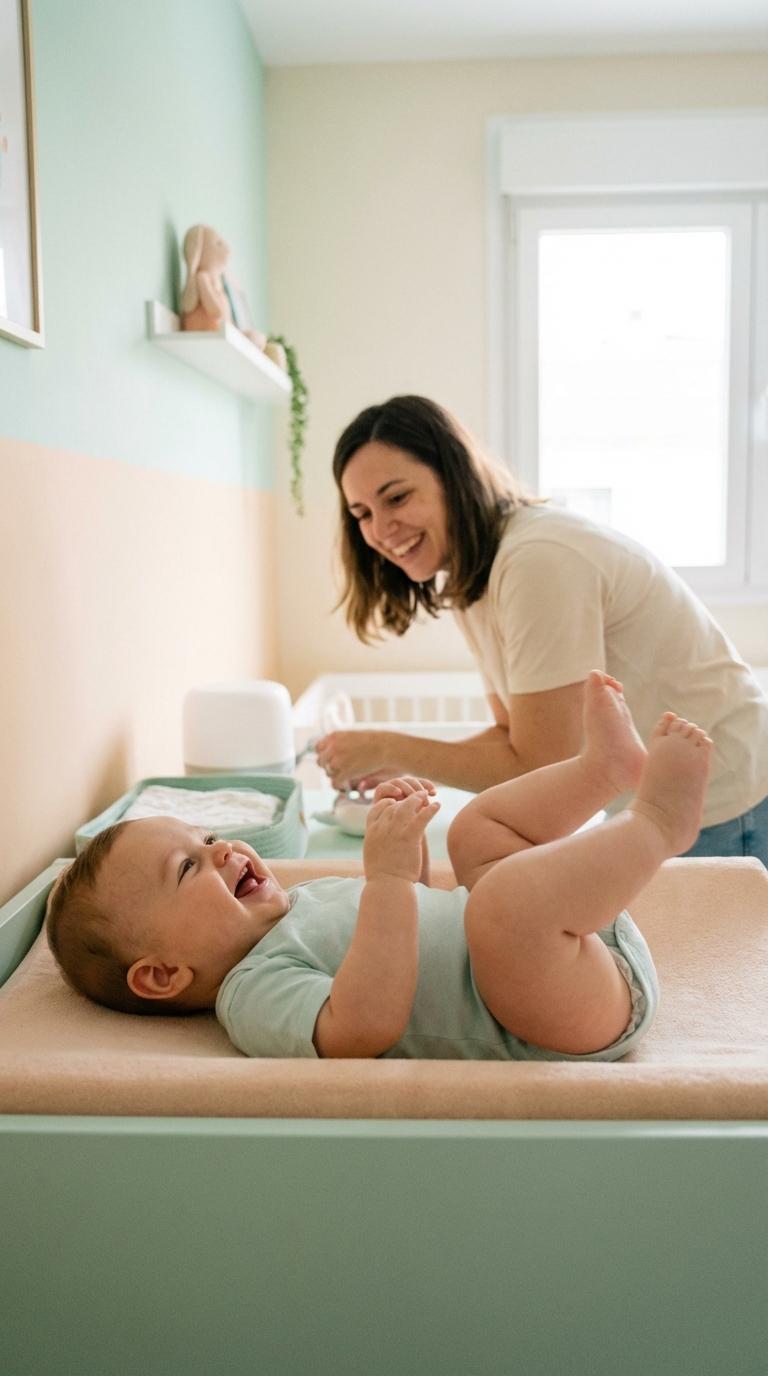
Diaper changes can feel like a small, repetitive task, until the day your baby’s skin turns bright red, a leak reaches the car seat, or nighttime changes start stealing everyone’s sleep. A Diaper change is not only about cleanliness. It’s skin physiology (pH, friction, moisture), comfort, and daily observation of what your baby’s body is doing. You may wonder: how often is “often enough”? What should you clean with? And how do you keep it safe when your baby suddenly learns to roll?
Why diaper changes matter for skin, comfort, and health
A baby’s skin is thinner than an adult’s, with a still-maturing skin barrier (the protective outer layer that limits water loss and blocks irritants). When urine and stool sit against that skin, several things happen at once:
- pH changes: urine and stool can shift skin pH, weakening the barrier.
- Moisture + heat: a closed diaper area traps humidity.
- Friction: movement rubs damp skin, especially in folds.
That trio leads to maceration (skin that becomes overhydrated, soft, and easier to damage). Add digestive enzymes from stool (lipases, proteases), and irritation can accelerate.
A timely Diaper change also gives you quick clues: stool frequency, unusual odor, new redness, repeated leaks in the same place, or signs your baby is uncomfortable when touched.


When a diaper stays on too long: what can happen
A wet or soiled diaper left in place is a classic setup for diaper dermatitis (diaper rash: inflammation of the diaper area). It may start as mild redness and progress to:
- red patches with shiny skin,
- painful irritation in folds,
- superficial erosions (skin that looks “raw”),
- secondary overgrowth of yeast, often Candida (typically a beefy red rash with small satellite spots).
Anatomy can influence where irritation settles:
- For babies with vulvas, stool lingering near the vulva can irritate delicate tissue, more rarely, bacterial spread toward the urethra may increase urinary tract infection risk.
- For babies with penises, redness often concentrates under the scrotum, at the base of the penis, or along thigh creases.
In every case, fast clean-up after stool and a consistent Diaper change rhythm reduce exposure time.
Diaper change timing: moments when it’s better not to wait
Change promptly:
- after any poop (even a small smear),
- after a leak or “blowout,”
- if your baby arches, cries, or seems sore when wiped,
- if the diaper looks swollen, heavy, or misshapen,
- if you notice early redness or persistent dampness in folds.
How often to do a Diaper change: realistic frequency by age
No two babies have identical output. Still, a few landmarks help.
Newborn (0-3 months)
Many newborns need 6-10 changes per day (sometimes more). A practical rhythm is:
- check every 2-3 hours,
- change after every poop,
- glance “around feeds” (after nursing or a bottle often works well).
Stool patterns vary widely in early weeks.
Baby (3-12 months)
After solids begin, stool often becomes denser, smellier, and sometimes more irritating. Frequency may decrease, but urine remains regular.
You may be able to stretch intervals slightly, but the essentials stay stable:
- immediate Diaper change after stool,
- shorter intervals if the diaper saturates quickly,
- regular skin checks (thigh creases, groin folds, buttocks).
Signs a diaper is full
Look for:
- stronger odor,
- a heavy diaper that droops,
- a wetness indicator strip (if present),
- red marks at the groin/thighs,
- leaks at the back or sides.
Nighttime: hygiene versus sleep
At night, it’s a balancing act. If your baby is asleep, there is no poop, and the diaper is only wet, you often don’t need to wake them, especially with a very absorbent nighttime diaper.
Do not delay if there’s stool, a leak, or already irritated skin. When a nighttime Diaper change is needed, keep it boring: dim light, slow hands, minimal talking.
Choosing diapers: size, fit, absorbency, and common options
A leak-free diaper is usually a fit issue before it’s a brand issue.
Size and fit
A good fit means secure without squeezing:
- about two fingers at the waist,
- thigh elastics following the skin without deep grooves,
- leak guards (inner cuffs) pulled fully out.
If the umbilical cord stump is still present, fold the waistband down so it stays clean and dry.
Disposable, cloth, and “sensitive skin” lines
- Disposable diapers: very convenient, high absorbency, often helpful overnight and for travel.
- Cloth diapers: less waste and often cost-effective long-term, they require washing/drying routines, and changes can be more frequent depending on inserts.
- Sensitive-skin options: fragrance-free is a strong baseline, fewer additives may help if your baby gets recurrent redness.
Many families mix: cloth at home, disposable at night or on outings.
Diaper change supplies: simple organization that prevents chaos
A rolling baby can turn a calm change into a sprint. Set up first.
Keep essentials within reach
At home:
- stable changing surface or non-slip mat,
- clean diaper opened and ready,
- cotton pads + warm water (or suitable wipes),
- small towel for pat-drying,
- disposal bag/trash solution,
- spare outfit.
On the go: mat, extra diapers, disposal bags, spare clothes.
Cleaning: water, wipes, and mild cleanser
For urine-only diapers, warm water and cotton are often enough.
For stool, clean more thoroughly, with minimal rubbing. If needed, use a very mild, fragrance-free cleanser, then rinse or wipe away residue and dry well.
Wipes are practical for travel. Choose alcohol-free, fragrance-free wipes. If the skin becomes reactive, a few days of warm water + cotton can calm irritation quickly.
Protective products: what to use, and when
A simple rule of thumb: calm skin needs little, irritated skin needs a stronger barrier.
- Oil-based cleansing balm (liniment-style): can leave a protective film on healthy skin.
- If skin is clearly red: pause the oil-based balm, it may trap irritants against inflamed skin.
- Barrier creams/pastes: often contain zinc oxide, they act like a shield and are useful when redness appears.
Apply products on clean, dry skin.
Safety basics for every Diaper change
Falls from changing tables happen quickly.
Prepare the space first
Open the clean diaper, place wipes/cotton and towel within reach, and have your disposal bag ready. Then place your baby down.
One-hand rule
Keep one hand on your baby at all times. Rails and straps can help, but they don’t replace supervision.
Safety mistakes to avoid
Avoid:
- stepping away “for a second,”
- changing on an unstable surface,
- lifting by the ankles to raise the pelvis (a gentle side-roll is kinder),
- putting supplies out of reach.
Diaper change: step-by-step, calm and efficient
1) Choose a stable surface
The floor is often the safest place once rolling starts. If you use a changing table, stay close, hand on baby.
2) Open the dirty diaper and contain the mess
Open tabs. If there’s stool, use the front of the diaper to remove the bulk. Fold the dirty diaper inward to contain mess.
3) Clean differently for pee versus poop
- Pee: quick wipe with warm water/cotton or a gentle wipe.
- Poop: clean more thoroughly, especially in creases (thigh folds, groin folds, buttocks). For babies with penises, don’t forget under the scrotum.
4) Wipe direction and anatomy tips
- Babies with vulvas: wipe front to back to limit bacterial transfer toward the urethra. Clean gently between labial folds, no scrubbing.
- Babies with penises: clean around the penis and scrotum and nearby folds. To reduce surprise sprays, loosely cover the penis with a wipe or the clean diaper during the change. When fastening, point the penis downward to reduce front leaks.
Do not retract the foreskin. Clean only what is visible externally.
5) Dry carefully and check the skin
Pat dry, don’t rub. Look for early signs: redness, shiny skin, sore-looking patches in folds, or damp areas that persist.
6) Add protection if needed
- Prevention/mild irritation: a thin layer of petrolatum-based barrier ointment.
- More noticeable redness: zinc oxide cream/paste in a visible layer.
If you were using an oil-based cleansing balm, pause it during active redness and switch to barrier protection.
7) Put on the clean diaper and check fit
Slide the clean diaper under your baby (a side-roll is usually more comfortable than lifting by the feet). Fasten evenly: snug, not tight. Pull leg cuffs out fully.
8) Finish up
Dispose of the diaper/wipes (bag if needed), isolate soiled clothes, clean the surface if necessary, and wash your hands.
Newborn specifics: meconium, cord care, and early routines
Early output and frequency
In the first 48 hours, changes may be less frequent (sometimes every 4-6 hours). After a few days, many newborns need a Diaper change every 2-3 hours.
Stool transitions from meconium (dark, sticky, tar-like) to looser yellow stools in many breastfed babies, or firmer stools with formula.
Meconium clean-up
Meconium sticks. Remove bulk with the diaper first, then wipe gently. Warm water on cotton or a soft cloth can be kinder than repeated wiping.
Umbilical cord stump during changes
Fold the diaper down (or use a notch) so the stump stays exposed and dry. Avoid creams/ointments on the stump unless your clinician advised it.
Seek medical care if you see spreading redness, swelling, discharge, foul odor, or fever.
Circumcision care (if applicable)
Follow your clinician’s instructions. Often, an ointment is used to prevent sticking. Seek care if bleeding is more than a small spot, swelling worsens, fever appears, or pain seems significant.
Older babies and toddlers: wiggles, standing changes, and cooperation
Changing a wiggly baby safely
Keep one hand on hips or belly. Use a quick distraction (toy, book, song). Floor changes reduce fall risk.
Pull-ups and standing changes
Training pants can make standing changes easier, especially for toddlers who resist lying down. A simple setup: toddler standing and leaning against a wall, supplies ready, quick clean, refasten snugly.
Small choices can reduce pushback: “this diaper or that one?” Cooperation builds in tiny steps: holding a wipe, lifting hips, throwing a diaper in the bin.
Potty learning without rushing
Some toddlers stay dry longer, hide to poop, or signal discomfort. Predictable routines (on waking, before nap, before bath) support learning without pressure. Diapers and pull-ups remain part of the process until continence is established.
Diaper rash prevention and what to do when redness appears
Why diaper rash happens
Most diaper rash comes from moisture + friction + contact with urine/stool. Scented products or harsh cleansers can prolong inflammation. Diarrhea and stool acidity changes after solids can increase risk.
Daily habits that help
- prompt Diaper change after stool,
- gentle cleaning and thorough drying,
- fragrance-free products when possible,
- absorbency adapted for day versus night.
When redness is established: a short routine
- warm water + cotton (or very mild cleanser for stool),
- careful pat-drying,
- zinc oxide barrier paste in a visible layer,
- diaper-free air time when possible,
- pause oil-based cleansing balm while skin is red.
Seek medical advice if redness lasts several days, if lesions weep or blister, if pain seems significant, or if fever appears.
Leaks and blowouts: why they happen and quick fixes
Most leaks come from fit, tucked-in cuffs, or saturation.
Try:
- reassessing size,
- centering the diaper and fastening evenly,
- pulling leak guards out,
- changing earlier if the diaper swells quickly,
- using a more absorbent overnight option.
A repeated front leak often means the penis is pointing upward, aim downward before closing the diaper.
Night, travel, and shared caregivers
Night: keep it fast and calm
Low light, minimal stimulation. If it’s only urine and your baby is sleeping, you may wait. If there is stool or a leak, do the quick Diaper change and return to sleep.
On the go
Bring a mat, diapers, wipes or cotton + water, disposal bags, and spare clothes. If you must step away for an item, take your baby with you.
Daycare and shared care
Consistency helps: similar products, fragrance-free preferences, and early communication if redness appears.
Key takeaways
- A Diaper change protects the skin barrier: less moisture, less friction, fewer irritations.
- Change promptly after poop, at night, prioritize stool, leaks, and already-irritated skin.
- Correct size, cuffs pulled out, and absorbency matched to the moment prevent most leaks.
- Prepare supplies first, use a stable surface, keep one hand on your baby, and wash hands afterward.
- If skin is red: gentler cleaning, thorough drying, barrier paste, and pause oil-based cleansing balm.
- If irritation persists or looks unusual, a healthcare professional can assess and guide you, you can also download the Heloa app for personalized tips and free child health questionnaires.
Questions Parents Ask
How long can a baby stay in a wet diaper?
It depends on your baby’s skin and the diaper’s absorbency, but many parents find that checking every 2–3 hours in the day keeps things comfortable. If the diaper is very full, drooping, or leaving deep marks, changing sooner can help prevent irritation. After poop, a prompt change is usually the kindest option for the skin.
Is it OK to use baby powder during diaper changes?
Many families ask this. In general, powders aren’t necessary for most babies, and fine particles can be inhaled, especially if they puff into the air. If you’re looking for extra protection, a barrier ointment or zinc oxide paste on clean, dry skin tends to be a simpler, safer choice. If you prefer powder for cultural or personal reasons, consider discussing it with your pediatric clinician to find the safest option for your baby.
What should I do if my baby cries during every diaper change?
You’re not alone—some babies dislike the cold air, the sensation of wiping, or being on their back. A few gentle tweaks can make a real difference: warming the room, using warm water on cotton, patting dry instead of rubbing, and offering a small distraction (a toy, song, or eye contact). If crying seems linked to pain (raw skin, persistent redness, or swelling), it may be important to adjust the routine and seek medical advice if it doesn’t improve.

Further reading :
- Healthy Habits: Diaper Changing at Home: https://www.cdc.gov/hygiene/about/healthy-habits-diaper-changing-steps-at-home.html
- Healthy Habits: Diaper Changing Steps for Childcare Settings – CDC: https://www.cdc.gov/hygiene/about/healthy-habits-diaper-hygiene.html
- How to Change a Diaper: https://doh.wa.gov/sites/default/files/legacy/Documents/8330/130-082-DiaperCCsm-en-L.pdf