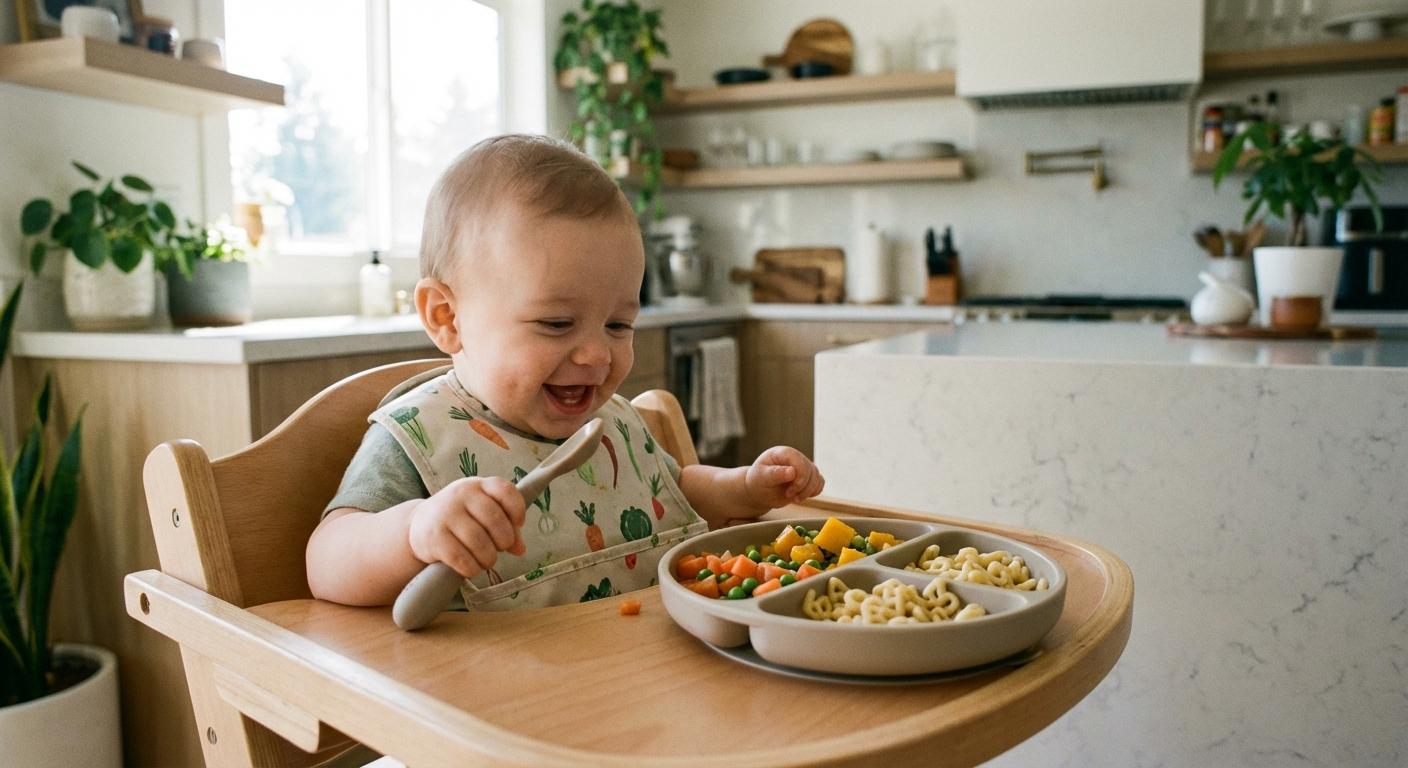
At 11 months, feeding can feel like a puzzle: milk feeds shift, teeth are on the move, and “pieces” may be exciting one day and suspicious the next. The good news? This stage is not only about taste. Your baby is building skills: chewing, moving food around the mouth, coordinating hand-to-mouth movements, and learning that food does not have to be perfectly smooth.
Baby food 11 months: what to expect this month
At 11 months, baby food 11 months routines often become more family-like, but not always predictable. Appetite can swing (hello, teething), and texture tolerance may advance in jumps rather than steady steps. Still, three big themes tend to dominate.
Feeding milestones at 11 months: variety, independence, and chewing skills
Baby food 11 months commonly revolves around:
- Variety: vegetables, fruit, starchy foods, legumes, animal foods, and healthy fats
- Independence: grasping food, bringing it to the mouth, holding a spoon, experimenting with a cup
- Chewing skills: thicker purées, fork-mashed meals, and soft pieces that break easily
Pieces refused today and accepted next week? That is normal. Repeated exposure matters more than speed.


Breast milk or formula at 11 months: how milk fits alongside solids
Breast milk or infant formula still contributes major energy and key nutrients (protein, calcium, iodine, essential fatty acids). Many families find a practical range of about 350-600 mL over 24 hours, often landing near 500 mL/day, other guidance uses around 700 mL/day (24 oz) split into 3-4 feeds. The number is less important than the pattern: steady growth, good urine output, and a baby who looks well.
With baby food 11 months, solids increasingly sit next to milk rather than replacing it. If solids temporarily dip (illness, teething, travel), milk can carry intake for a few days.
Practical note: avoid cow’s milk as the main drink before 12 months, but pasteurised yogurt and cheese can be part of meals.
Water and cups at 11 months: hydration and skill practice
Offer water with meals and when your baby seems thirsty. Water helps comfort with thicker textures and supports oral skills.
This age is perfect for low-pressure cup practice: an open cup with tiny sips, or a straw cup. Expect spills. Skip juice, it is nutritionally unnecessary, and it raises the risk of dental caries.
Daily rhythm for baby food 11 months
A typical day: 3 meals (often a snack) plus milk
Many babies settle into:
- 3 meals per day
- Milk feeds that remain a safety net
- An optional afternoon snack, especially if dinner gets tough when overtired
Some babies thrive without a snack until 12 months, others need one so they do not arrive at dinner ravenous.
Sample timetable (adapt to naps and childcare)
- 7:00-7:30: milk feed
- 8:00: breakfast + water
- 11:30: lunch + water
- 15:30: snack (optional) + water
- 17:30-18:00: dinner + water
- 19:00: milk feed
If your baby seems hungry between meals
Before increasing portions everywhere, check the basics: time since last milk, sleep debt, hydration, and whether teething pain is shortening meals.
Then choose one simple tweak:
- Add an extra milk feed.
- Add 1-2 tablespoons at the next meal, keeping it balanced (iron-rich food + fruit/veg + starch + fat).
- If adding a snack, keep it modest so it does not replace dinner.
If hunger appears at the same time daily, the schedule may need a small shift.
Portion sizes at baby food 11 months (without pressure)
Responsive feeding: your baby leads, you provide
At 11 months, hunger and satiety cues are often vivid:
- Hunger: leaning forward, opening the mouth, grabbing food
- Fullness: turning away, closing lips, slowing down, pushing food away
Stopping when your baby signals “done” supports self-regulation. Look at patterns over several days.
Practical portion ranges you can flex
Portions are starting points, not rules. Many 11-month-olds manage roughly 8-12 tablespoons total per meal across foods.
Common ranges seen in baby food 11 months meal plans:
- Vegetables: 100-150 g at lunch and/or dinner
- Cooked starch (rice, pasta, potato, couscous/semolina): 40-60 g cooked
- Fruit: 60-120 g at dessert or snack
Protein portions at 11 months: small amounts, high value (iron focus)
Iron needs are high between 7 and 12 months. Animal foods provide iron that is generally more bioavailable (haem iron). Legumes provide non-haem iron (absorption improves with vitamin C).
Typical daily guides:
- Meat or fish: 10-15 g/day (about 2-3 teaspoons), well-cooked and finely chopped, minced, shredded, or flaked
- Egg: fully cooked, often 1/4 of a hard-boiled egg as a practical starting portion
Some families offer the protein at lunch and keep dinner mostly plant-based. Others split it.
Snack ideas at 11 months: simple, filling, effective
If you offer a snack:
- Pasteurised plain yogurt or similar plain dairy: 60-90 g
- Fruit: 60-120 g
- Water
Nutrients to prioritise in baby food 11 months
Iron: easy wins for a common gap
Iron supports haemoglobin (oxygen transport) and neurodevelopment.
Two levers help quickly:
- Include an iron source daily: meat, fish, egg, well-cooked lentils/beans, iron-fortified infant cereals
- Pair plant iron with vitamin C to boost absorption: kiwi, strawberries, orange, tomato, bell pepper, broccoli
If your baby is in a phase of refusing meat or fish, you might wonder, “Will they get enough?” Often yes, with planning. Use lentil or bean purées, add fortified infant cereal to yogurt, and keep offering small tastes of animal foods without turning it into a battle.
Healthy fats and omega-3 (DHA): brain and vision support
Babies need fat for growth, myelination (insulation of nerve fibres), and retinal development.
Simple habits in baby food 11 months:
- Add about 1 teaspoon of vegetable oil (rapeseed/canola, walnut, olive) to purées or mash, ideally after cooking
- Offer fish 1-2 times per week, varying species, cook thoroughly and remove bones
Calcium, vitamin D, vitamins A and B12: the clear basics
- Calcium mainly comes from breast milk/formula and pasteurised dairy used in meals.
- Vitamin D is commonly supplemented in infancy, dosing varies by country and clinical follow-up (a daily amount around 400 IU/day is often used).
- Vitamin A: orange/green vegetables (carrot, sweet potato, spinach) and some animal foods.
- Vitamin B12: animal foods (meat, fish, eggs, dairy). For vegan feeding, plan reliable sources and supplementation with a clinician.
Textures and self-feeding in baby food 11 months
Texture progression: thick purées, fork-mash, and soft pieces
Texture is a learning tool. A helpful mix:
- Thick purées that stay on the spoon
- Fork-mashed meals with soft lumps
- Soft, melt-in-the-mouth pieces: very well-cooked vegetables, ripe fruit, well-cooked pasta
A gentle strategy: keep a smooth base, then add a few tender pieces.
Chewing support: small steps that change everything
If textures are hard:
- Cook longer for softer results
- Offer easy-to-hold shapes (soft sticks, broccoli florets cooked until very soft)
- Progress in stages (size first, then wider variety)
Gagging is common when learning textures: it is noisy, with coughing/retching, and breathing continues. Choking is typically silent or involves inability to cough or breathe, and it is an emergency.
Finger foods for baby food 11 months (safe cuts and good options)
Safety foundations: posture, supervision, and setup
Safety is built from texture, size, and supervision:
- Baby seated upright in a stable high chair, strapped in
- Feet supported if possible (a 90-90-90 posture can help stability)
- An adult watching from first bite to last
- No eating in the car, stroller, or on the couch
Finger food ideas that often work well
Choose foods that mash easily between fingers:
- Very cooked sweet potato sticks
- Steamed zucchini cooked until soft
- Very ripe pear slices (thin, soft)
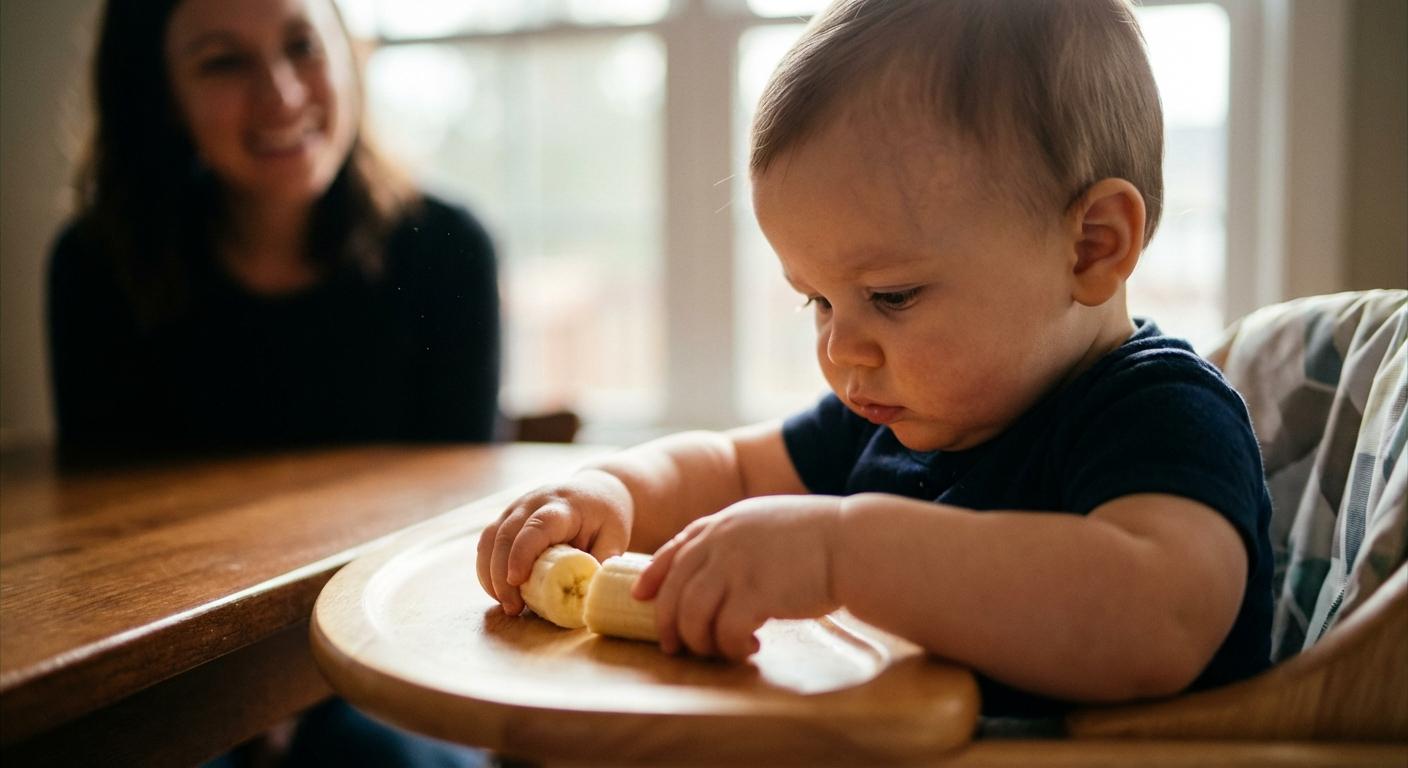
- Avocado, ripe banana
- Well-cooked fish, flaked and deboned
- Small pasta shapes cooked very soft
Choking hazards: what to avoid or modify
Avoid hard, round, or slippery foods:
- Whole nuts, popcorn, hard seeds
- Whole grapes or cherry tomatoes (quarter lengthwise)
- Hard raw vegetables (cook until soft)
Nut products can be offered safely as smooth nut butter thinned with water/yogurt or as finely ground nuts mixed into foods.
Allergen introduction in baby food 11 months
Common allergens include egg, peanut, dairy, wheat/gluten, soy, fish, sesame, and tree nuts.
A practical approach:
- Introduce one allergen at a time
- Offer it earlier in the day
- If tolerated, keep it in rotation (often 2-3 times per week)
If eczema is significant or you see reactions (hives, repeated vomiting, swelling, breathing trouble), seek medical advice.
Foods to avoid or limit at 11 months
Before 12 months: the key avoid list
- No honey (botulism risk)
- No raw or undercooked meat, fish, or egg
- Avoid unpasteurised milk and cheeses
Salt, sugar, and ultra-processed foods
Avoid added salt and added sugar. Use herbs, onion, garlic, lemon, and mild spices instead.
Fish and heavy metals: choose varieties wisely
Offer fish 1-2 times per week, vary species, and remove bones carefully. Limit large predatory fish (swordfish, shark, marlin, large tuna).
Meal ideas for baby food 11 months (realistic and adaptable)
- Morning: milk + very ripe mashed fruit (or plain yogurt + fruit)
- Lunch: vegetables (100-150 g) + cooked starch (40-60 g) + the day’s protein portion + rapeseed/canola oil
- Snack: plain pasteurised dairy (60-90 g) + fruit
- Dinner: vegetables + starch (softer if tired) + a little oil + milk depending on your routine
Quick ideas:
- Sweet potato-carrot mash + rapeseed/canola oil
- Very soft rice + melt-soft broccoli + flaked white fish
- Red lentils cooked very soft and blended + vitamin C-rich fruit
Teething and appetite changes
Teething can reduce interest in solids for a few days. Many babies prefer milk feeds and softer foods. If hydration and wet nappies are normal and your baby seems otherwise well, short dips are usually not harmful.
Comfort-first options:
- Cool plain yogurt with mashed fruit
- Mashed avocado or banana
- Very soft pasta or soft rice
Troubleshooting common challenges
If lumps are refused, step back one level (more mash, smaller pieces) and rebuild gradually. During illness, prioritise fluids and milk, then offer small amounts of soft foods.
Seek medical advice if feeding becomes very restricted, growth seems to slow, meals look painful, or you see signs of dehydration.
Practical prep, storage, and hygiene
Fridge storage is usually 24-48 hours (if unsure, choose 24 hours). Frozen portions keep best quality for about 3 months. Reheat once, stir well, cool before serving.
Key takeaways
- Baby food 11 months is about variety, growing independence, and chewing practice, not perfect intake at each meal.
- Many families do well with 3 meals (often plus a snack), with milk still providing significant nutrition.
- Portions stay flexible: vegetables often 100-150 g, fruit 60-120 g, cooked starch 40-60 g, and small daily protein portions (meat/fish 10-15 g or cooked egg).
- Prioritise iron daily and pair plant-based iron with vitamin C foods.
- Offer healthy fats regularly, vary fish and avoid high-mercury species.
- Support texture progress with soft pieces and close supervision.
- Parents can download the Heloa app for personalised tips and free child health questionnaires.
Questions Parents Ask
Why is my 11-month-old suddenly refusing solids?
This is very common, and it doesn’t mean you’re doing anything wrong. Appetite can dip with teething, tiredness, minor illnesses, or big developmental leaps. You can keep offering 3 meals (and an optional snack) without pressure, and lean on milk feeds for a few days if needed. Many babies need repeated, low-stress exposure before accepting a food again. If refusal lasts more than a few days, seems painful, or growth worries you, don’t hesitate to ask a healthcare professional for support.
What can I do if my 11-month-old is constipated after starting more “real food”?
A change in texture and more starchy foods can slow things down. Often, small adjustments help: offer water with meals, keep milk feeds steady, and add fibre-friendly options such as pear, plum, peach, peas, beans, or lentils. Using a little healthy oil in vegetables can also make stools easier to pass. Seek medical advice if stools are very hard, there is blood, your baby is in significant pain, or constipation persists.
Is it normal for an 11-month-old to gag on finger foods?
Yes—gagging is a common learning phase as babies handle new textures. It’s usually noisy (coughing/retching) and your baby can still breathe. Keep pieces very soft, offer manageable shapes (soft sticks, ripe fruit slices), and ensure upright seating with close supervision. If your baby cannot cough or breathe, that’s different—treat it as an emergency.
Further reading :
- How Much and How Often To Feed | Infant and Toddler …: https://www.cdc.gov/infant-toddler-nutrition/foods-and-drinks/how-much-and-how-often-to-feed.html
- Baby and toddler meal ideas: https://www.nhs.uk/baby/weaning-and-feeding/baby-and-toddler-meal-ideas/