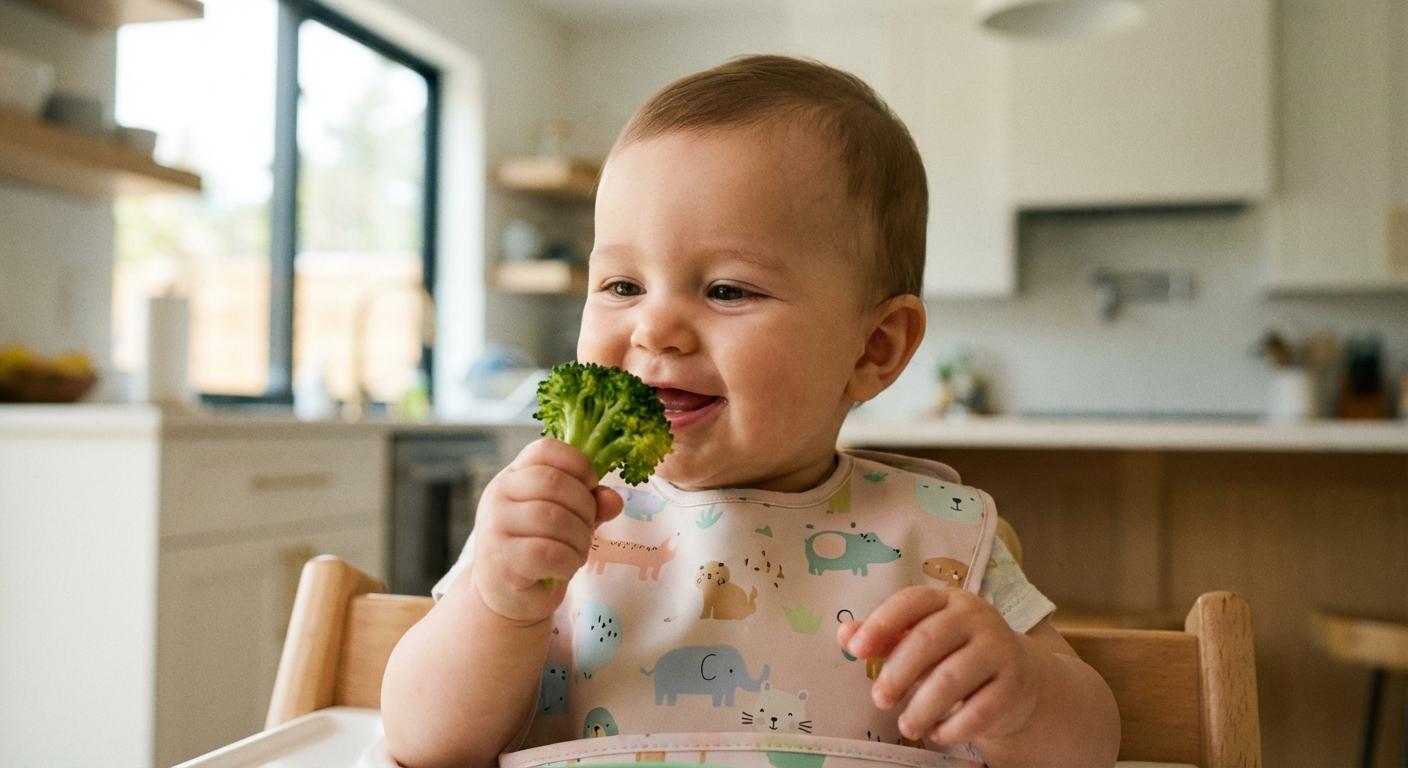
At 8 months, mealtimes can feel like a tiny show: your baby grabs, squishes, spits out… then asks for more. Feeding at this age moves fast, but rarely in a straight line. Milk is still the foundation, solids are settling in, textures start to change, and many parents find themselves wondering (often at bedtime or over the morning bottle): “Are they eating enough?”
Between portion “rules”, fear of lumps, allergens, constipation, or reflux, the aim is to keep a simple, reassuring framework you can adjust to real life, without turning the high chair into a daily negotiation.
8 month old baby food: what changes and what you are building
At 8 months, 8 month old baby food is not only about “eating more”. It is about building skills, tolerances, and a steady nutritional base. Three practical targets tend to guide choices:
- Cover needs for energy (more movement, more calories), iron (to lower the risk of deficiency), and essential fats (brain and retinal development).
- Multiply sensory experiences (textures, temperatures, tastes) while keeping the mood calm.
- Support oral feeding skills: tongue lateralization, jaw and gum work, hand-to-mouth coordination, and early autonomy.
You may wonder if solids should “speed up” now. Variety can widen, yes. Pressure, no.


Breast milk or formula: the base that holds everything together
In 8 month old baby food, breast milk or infant formula remains the main food until 12 months. It still provides a large share of calories, calcium, protein, and key micronutrients (including vitamin D in many fortified formulas).
Common day-to-day ranges (always adjusted to appetite and how much solid food your baby accepts):
- About 500 to 800 ml over 24 hours
- Often 2 to 4 milk feeds (sometimes more, especially with breastfeeding)
If you breastfeed, feeds can stay on demand, with solids placed “around” them. And if some days look mostly milk-based, that is not failure. Variation is normal, especially during teething, illness, or growth spurts.
Texture progression at 8 months: variety without battles
The biggest shift in 8 month old baby food is often texture. Many babies start moving away from perfectly smooth purees toward:
- Thicker purees (less uniform, more spoonable)
- Fork-mashed foods
- Then tiny, very soft, meltable pieces
Why it matters: it trains the mouth. Even without teeth, babies can “chew” using gums plus coordinated tongue movements. This is oral-motor development in action, not a race.
If your baby makes a face, gags briefly, or spits food out, it is often exploration. A food can be refused many times and then accepted later as if nothing happened. Annoying? Yes. Normal? Very often.
Readiness signs for thicker textures and finger foods
Your baby may be ready to progress if they:
- Hold their head steady
- Sit with good stability (in a high chair, hips supported)
- Bring food to their mouth on purpose
- Show interest when you eat
Digestively, the gut is more mature than at 6 months, but sensitivities are still common: slower stools, gas, and gastroesophageal reflux (GER). Small sips of water with meals, age-appropriate fiber, and enough fats often help.
How much should an 8-month-old eat? Helpful guides (without counting every spoon)
Portions are not obligations. In 8 month old baby food, intake varies with growth, sleep, teething pain, infections, heat, and mood. Some days are “tiny tasting days”. Others are “where did it all go?” days.
Milk: how much per day?
A practical overall range is 500 to 800 ml per 24 hours (breast milk or formula), with normal variation.
If solids drop temporarily but milk intake stays good, overall balance is often still fine.
Vegetables and fruit: portions and a simple rotation
Many families land around:
- Vegetables: about 150 to 200 g per day, split across 1 to 2 meals
- Fruit: about 100 g per day, offered 1 to 2 times (ripe fruit, or unsweetened stewed fruit or puree)
A low-stress rotation strategy: alternate a “gentle” vegetable (carrot, squash, sweet potato) with a greener option (zucchini, green beans, well-cooked spinach), changing one element at a time. It keeps flavors moving without overwhelming a sensitive eater.
Starches: steady energy
Think of starch as the slow-burn fuel in 8 month old baby food, often present at lunch (and sometimes dinner if your baby seems to want it). Good options include:
- Mashed potato
- Well-cooked rice
- Very soft pasta
- Semolina
- Well-cooked quinoa
Protein: guides and easy equivalents
A commonly used guide at 8 months is 10 to 15 g per day of well-cooked meat or fish, finely minced and then flaked.
Practical equivalents:
- Meat or fish: 10 to 15 g
- Hard-boiled egg, fully cooked: often 1/4 to 1/2 (depending on tolerance and habits)
- Red lentils: a few spoonfuls, cooked and blended or mashed
Medically, the nutrient that deserves special attention is iron. Meat, fish, and legumes all contribute. Plant iron is less well absorbed, but it remains useful, especially when paired with vitamin C-rich foods (for example, a little fruit after a lentil-based meal).
Fats and water: allies, not extras
Fats support brain development and help meet energy needs, which is why they matter in 8 month old baby food.
A practical guide: add 1 teaspoon of vegetable oil per puree-based meal (rapeseed/canola, olive oil), added after cooking to preserve fatty acids.
Offer water with meals (a few sips from a cup). Milk remains the main drink.
A flexible 8-month feeding schedule (milk + meals)
A routine helps, but it should stay flexible. Some babies eat little at lunch and “catch up” later. Others do the opposite. The goal is rhythm, not rigidity.
Sample day structure
- Morning: milk feed
- Breakfast solids (optional or small, depending on baby)
- Midday: milk feed
- Lunch solids
- Afternoon: milk feed
- Dinner solids (or milk-focused, depending on baby)
- Bedtime: milk feed
Breakfast
- Breast milk or formula: often 150 to 240 ml
- Depending on appetite: ripe mashed fruit or unsweetened fruit puree (60 to 100 g) and/or a small amount of infant cereal
Lunch
- Vegetables + starch: around 150 to 200 g total
- Protein: 10 to 15 g meat/fish, or 1/4 to 1/2 fully cooked egg, or legumes
- 1 teaspoon oil
- Fruit/puree if your baby wants it
Afternoon snack
- Milk: often 150 to 240 ml
- Fruit/puree
- Optional: plain yogurt or fromage frais-style dairy (unsweetened), if it helps round out the snack, without routinely replacing milk feeds
Dinner: two common patterns
Many babies fall into one of these:
- A more milk-focused evening
- A small vegetable puree dinner (sometimes with starch), followed by milk
Which is “better”? You may be asking that exact question. The answer is: whichever fits your child. A heavier dinner disturbs sleep for some babies, while others sleep better when a meal is more filling. Observe, adjust, repeat.
What to offer at 8 months: building balanced meals
For 8 month old baby food, keep the rule simple: age-appropriate foods, well cooked, no added salt, no added sugar.
Key food groups
- Vegetables: wide variety, well cooked
- Fruits: ripe and soft, often cooked or very tender
- Starches: rice, pasta, semolina, quinoa, potato
- Proteins: meat, fish, fully cooked egg, legumes
- Dairy: plain yogurt, fromage blanc-style dairy, unsweetened petit-suisse-style dairy (as a complement to milk, not a replacement)
Foods to limit
- No added salt (kidneys are still maturing)
- No added sugar
- Avoid juice and sweet drinks
- Avoid processed meats, highly processed foods, salty snacks
Higher-risk products and hygiene reminders
- No unpasteurized milk or unpasteurized cheeses
- Watch choking risks: whole grapes, whole nuts, raw carrot, sausage slices, hard chunks
- Cook foods thoroughly and always check temperature before serving
From smooth purees to mash and soft pieces (and what is normal)
A slightly grainy texture is not a mistake. In 8 month old baby food, it is often part of learning.
Moving from smooth to fork-mashed
- Smooth puree: useful when your baby is tired or more sensitive
- Thicker puree: a strong transition step
- Fork mash: with very tender tiny lumps
Tip: keep the food the same and change only the texture. Carrot is a great “texture practice” food.
If your baby coughs a little, gags briefly, spits out, or makes faces without distress, they are practicing. If there is persistent difficulty, repeated vomiting, weight concerns, or a total refusal of textures, a pediatric clinician or feeding specialist can help.
First “meltable” pieces: sizes and examples
Aim for foods that squash easily between tongue and palate (or between your fingers). Examples:
- Steamed carrot sticks
- Very well-cooked sweet potato
- Soft zucchini
- Well-cooked cauliflower florets
- Cooked pear wedges
- Banana
Finger foods and baby-led feeding at 8 months: prerequisites and safety
A baby-led approach can be part of 8 month old baby food if your baby:
- Sits stably
- Controls head and neck well
- Grasps food and brings it to the mouth
Easy options to hold: very ripe avocado, a large piece of banana, steamed sweet potato sticks.
Safety basics: constant supervision, upright seated position, and avoiding higher-risk foods (hard, round, sticky, crumbly).
Allergens: how to introduce without making it scary
Current guidance supports not delaying allergens unnecessarily. Introduce them in small amounts, regularly, when your baby is well (not during fever, acute gastroenteritis, or a very unsettled day).
A simple method:
- One allergen at a time
- Start with a tiny amount
- Choose a day when you can observe
- If tolerated, reintroduce regularly
Possible signs: hives (urticaria), swelling (especially lips/eyelids), repeated vomiting, significant diarrhea, unusual cough, breathing difficulty.
If there are breathing symptoms, faintness, facial swelling, or strong symptoms: seek urgent medical help.
Day-to-day adjustments: cues, common concerns, and organization
Feeding success is as much about observation as what is on the spoon. That is the quiet backbone of 8 month old baby food.
Hunger and fullness cues: the duo that guides you
Hunger cues: leaning toward the spoon, opening the mouth, reaching, vocalizing.
Fullness cues: turning away, closing lips, pushing away, slowing down, switching interest to play.
A helpful mindset: you provide the structure and suitable foods. Your baby controls the amount.
Refusal, constipation, reflux: simple starting points
- Refusal: common with new textures. Offer again later without pressure, alongside a familiar food.
- Constipation: water with meals, fiber-rich fruits (cooked pear, prune puree), vegetables, and balanced starch portions. If there is pain, blood in stools, vomiting, poor feeding, or constipation that lasts, seek medical advice.
- Reflux: smaller, more frequent meals, sometimes thicker textures, and avoiding lying flat right after eating. If there is pain, poor weight gain, or intense crying during meals, medical advice is warranted.
Prep and storage: save time without losing safety
Batch cooking can reduce mental load: steamed vegetables, small portions, freezing.
Practical reminders:
- Refrigerator: clean containers, short storage
- Freezer: single portions, labeled
- Reheating: even heating, stir well, check temperature before serving
Eating out or childcare
Easy options: unsweetened fruit puree, very ripe fruit, a chilled portion of puree, pre-measured formula supplies if needed.
For childcare, share: accepted texture (smooth, thick, mashed, meltable pieces) and the list of allergens already introduced.
Simple menu examples (smooth, thick puree, mash)
Day 1 (meat)
- Breakfast: milk + apple-pear puree
- Lunch: thicker pureed carrot-zucchini + mashed potato + finely minced chicken (10 to 15 g) + 1 teaspoon oil
- Snack: milk + mashed ripe banana
- Dinner: smooth squash puree + milk
Day 2 (fish)
- Breakfast: milk + fruit puree
- Lunch: very well-cooked spinach + soft rice + flaked white fish (10 g), carefully deboned + 1 teaspoon oil
- Snack: milk + cooked pear
- Dinner: sweet potato puree + milk
Day 3 (egg)
- Breakfast: milk (optionally with infant cereal)
- Lunch: pumpkin + semolina + 1/4 to 1/2 hard-boiled egg, fully cooked and mashed + 1 teaspoon oil
- Snack: milk + fruit puree
- Dinner: green vegetables in a thicker puree + milk
Day 4 (red lentils)
- Breakfast: milk + fruit
- Lunch: carrot + well-cooked red lentils (blended) + a small portion of potato + 1 teaspoon oil
- Snack: milk + fruit puree
- Dinner: mashed zucchini + milk
Safety recap: choking prevention and safe habits
- Always seat your baby upright in a stable high chair.
- Stay within arm’s reach and give full attention while your baby eats.
- Avoid common choking hazards (hard, round, sticky, small coin-shaped foods).
- Keep foods very soft and easy to squash.
Key takeaways
- 8 month old baby food is still milk-centered, solids complement without pressure, and day-to-day variation is expected.
- Helpful guides: vegetables 150 to 200 g/day, fruit about 100 g/day, protein 10 to 15 g/day, plus added fats (about 1 teaspoon of oil per puree-based meal).
- Progress textures gradually: smooth to thicker puree/mash to meltable pieces, based on skills and comfort.
- Prioritize variety and iron while limiting salt, sugar, and highly processed foods.
- Safety stays front and center: appropriate cooking, careful deboning, and avoiding higher-risk choking foods.
- If reflux, constipation, persistent refusal, or growth concerns make feeding feel stuck, professionals can support you. You can also download the Heloa app for tailored tips and free child health questionnaires for children.
Questions Parents Ask
Can my 8-month-old eat yogurt or cheese?
Yes, many babies can enjoy plain, unsweetened yogurt (or fromage frais-style dairy) in small amounts. It’s often easiest as part of a snack, while milk feeds still cover most needs. For cheese, choose pasteurized options and offer tiny amounts, as many cheeses are salty. If you notice tummy discomfort, rash, or worsening reflux, you can pause and try again later, or discuss it with your pediatric clinician.
What finger foods are most likely to cause choking at 8 months?
It’s normal to feel nervous here. The most common higher-risk foods are hard, round, sticky, or crumbly items: whole grapes, nuts, raw carrot, apple chunks, sausages cut into coins, popcorn, and thick nut butter. Safer choices tend to be soft “squashable” foods (steamed veggie sticks, ripe avocado, banana). Always keep your baby upright and supervised, and adjust sizes so they’re easy to grasp and mash with gums.
Is it OK if my baby eats solids but drinks less milk?
Sometimes, yes—appetite shifts day to day. Still, at 8 months, milk remains the nutritional base, so it’s worth keeping an eye on overall intake and diapers. If milk drops sharply for several days, weight gain slows, or your baby seems unusually tired or dehydrated, it’s a good idea to check in with a healthcare professional for reassurance and tailored advice.
Further reading :