
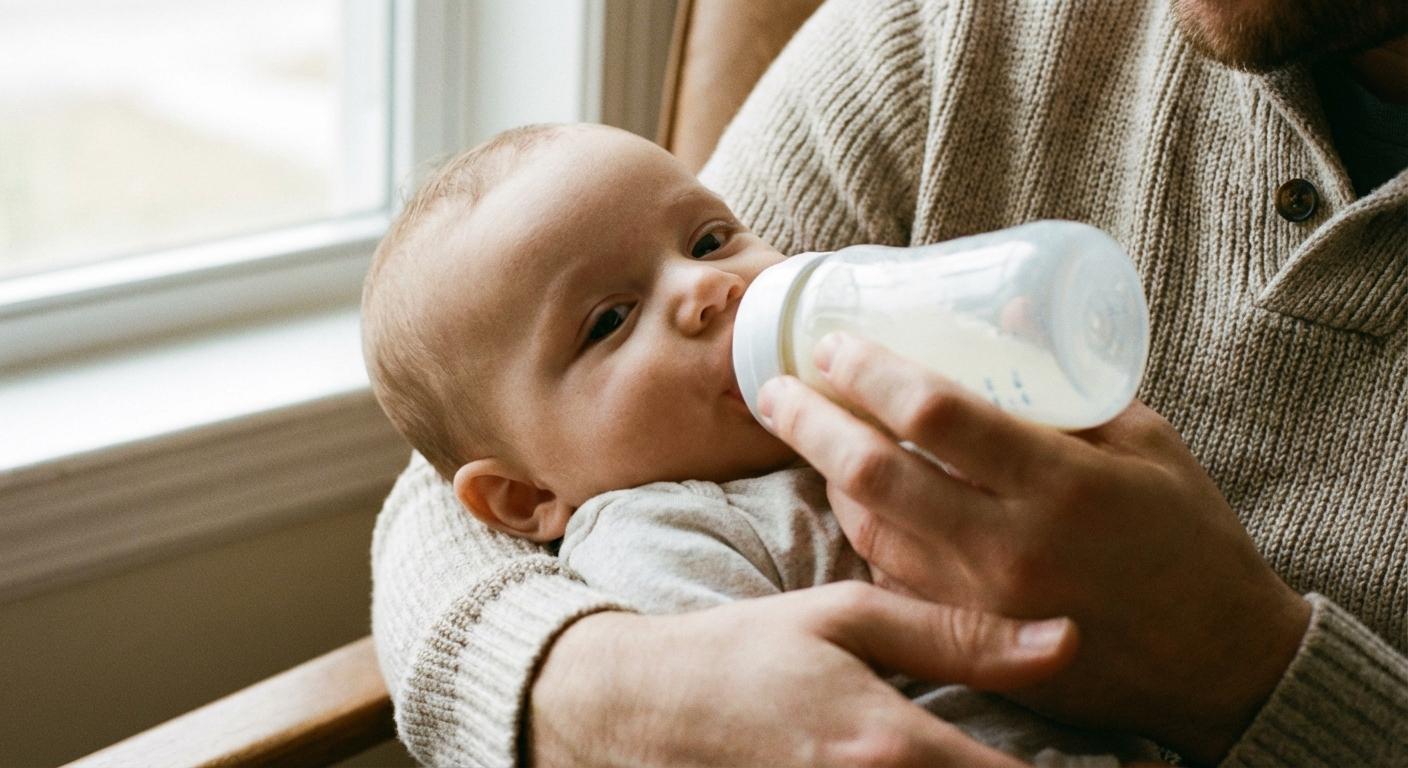
Constipation can look dramatic in a baby: a red face, grunting, knees pulled up, crying, and a belly that seems tight. When stools come out as small, dry balls, or when you notice a tiny streak of bright red blood from a small anal fissure, it is completely understandable to worry that your baby is in pain or that something is “stuck.”
Many families also hope to find something that feels gentle and “natural.” Mineral water is often perceived as milder than medicines, and Hépar has a strong reputation in France as a “constipation mineral water.” The key is to separate what is known in adults from what is appropriate and safe in infants, whose kidneys and fluid balance are still maturing.
Why so many parents search “Hépar baby constipation”
The phrase Hépar baby constipation pops up when parents notice a pattern: stools are rare, then suddenly hard, and the whole diaper change turns into an exhausting episode. Is it “true constipation” or just normal straining? Can mineral water help without upsetting a fragile digestive balance?
That curiosity is logical. Hépar is a highly mineralized natural mineral water, famous for helping adult bowels. But babies are not mini-adults. Their renal function (kidney filtering capacity), electrolyte handling, and hydration needs differ, especially during the first two years.


How to recognize real constipation (frequency versus texture)
A common trap: counting days.
Stool frequency in infancy is wildly variable:
- Some babies poop after nearly every feed.
- Others, especially breastfed babies, may go 48–72 hours without a bowel movement and remain comfortable.
What matters more is a simple triad:
- Consistency: hard, dry, sometimes pellet-like stools
- Effort and distress: prolonged straining with crying or clear discomfort
- Difficulty passing stools: long pushing, minimal result
If stools are soft, even if your baby turns red and grunts, constipation may not be the right label.
When it looks scary but isn’t: infant dyschezia
You may be wondering: “How can my baby scream and still not be constipated?”
Infant dyschezia is a short-lived developmental phase. The baby pushes (increases abdominal pressure) but does not yet relax the pelvic floor and anal sphincter at the right moment. The scene is intense. The stool, however, is typically soft.
In that situation, frequent rectal stimulation, repeated suppositories, or “routine fixes” can irritate tissues and reinforce a cycle of discomfort. Time, calm reassurance, and gentle comfort measures tend to work better.
Functional constipation: the most frequent scenario
Most infant constipation is functional constipation, meaning there is no anatomical or inflammatory disease causing it. The colon slows transit, water is reabsorbed, stools dry out, passing them hurts, and then withholding begins.
This can show up during transitions:
- Switching from breast milk to formula, or changing formula brands
- Bottles prepared too concentrated (too much powder for the volume of water)
- Starting solids
- After a painful stool, when withholding begins (yes, even in very young children)
That “loop” is classic: hard stool → pain → withholding → harder stool. It is often at this stage that families search Hépar baby constipation hoping to soften stools quickly.
Common symptoms that travel with constipation
Hard stools are the centerpiece, but other signs often tag along:
- Crying during bowel movements
- Bloated abdomen, gassiness
- Reduced appetite (a full, uncomfortable belly can blunt hunger cues)
- Anal fissure (a tiny tear) with a small streak of bright red blood on the stool or wipe
If you see vomiting, fever, marked abdominal distension, refusal to drink, unusual sleepiness, or blood that is more than a small fissure streak, home adjustments are not enough. Medical advice is needed promptly.
Why Hépar is mentioned so often
Hépar contains high levels of magnesium and sulfates, along with bicarbonates, and has a very high dry residue (around 2,500 mg/L). That is far above the mineral content of waters usually chosen for preparing infant bottles.
Its adult reputation comes from that composition. And it explains the repeated search term Hépar baby constipation.
The physiology in one minute: osmotic effect
Magnesium and sulfate salts can have an osmotic effect. In plain language: they can draw water into the intestinal lumen, which may:
- increase stool hydration
- make stools softer
- ease passage
A plausible mechanism, yes. A free pass for babies, no.
What a very mineral-rich water means for infants
Infant kidneys are still maturing. A water with high mineral content increases the body’s solute load (the amount of minerals to filter and balance). It does not mean that a tiny, supervised amount automatically causes harm, but it does mean:
- not for routine daily use
- not for prolonged use
- not an automatic replacement for the usual infant-suitable water
Evidence: what we know (and what we do not)
The strongest clinical data involve adults with functional constipation. A randomized, double-blind trial in adult women found that magnesium sulfate-rich mineral water improved constipation outcomes versus low-mineral water, with better results at higher intake.
What is missing: solid infant efficacy trials, infant safety studies, and clear infant dosing protocols. That gap is exactly why Hépar baby constipation remains a question best framed with caution.
Can babies drink Hépar for constipation? Age changes the answer
Before age 2, regular Hépar use is generally discouraged because:
- its mineralization is high
- breast milk or formula already covers hydration and minerals appropriately
- kidney handling of minerals is still developing
So if Hépar baby constipation comes up in a medical visit, it is typically discussed as an exceptional, short-term idea, not a daily habit.
Around 4–6 months (solids): the moment parents ask
As solids begin, some babies experience slower transit: more starch, less fluid, new textures. Parents then wonder whether “just a little Hépar” could help.
When a clinician considers it, the pattern is usually:
- occasional use
- small volumes
- close observation for diarrhea, abdominal discomfort, or diaper rash
If your baby is not on solids and drinks no water, the first step is usually to secure adequate milk intake and avoid painful stools rather than adding mineral water.
If constipation is frequent: check the basics first
Before experimenting with Hépar, review high-impact factors:
- Bottle preparation: correct scoops, level measures, no extra powder
- Water for bottles: appropriate for infant feeding
- Formula tolerance: some babies respond differently (discuss changes with a clinician)
- Solid foods balance: large amounts of rice, carrot, or less ripe banana can slow stools
Frequent constipation deserves a structured plan, and sometimes a targeted medical treatment, rather than many overlapping experiments.
Safety first: key precautions with a highly mineralized water
The question is not only “Will it work?” but “What does it add to the body’s workload?” Extra caution is needed if your baby has:
- diarrhea
- vomiting
- fever
- reduced feeding or fewer wet diapers
When the effect goes too far
A softer stool is the goal. Diarrhea is not.
Stop and seek advice if you notice:
- very watery stools
- worsening diaper rash or irritation
- more agitation, persistent discomfort
- dehydration signs (dry mouth, markedly fewer wet diapers, unusual sleepiness)
When not to keep trying at home
If symptoms persist more than a few days, recur often, or your baby is clearly suffering, it is worth pausing. Repeated switching (water, formula, juices) can blur the picture and delay relief.
If a clinician validates Hépar: how it is sometimes tried
If a clinician agrees that Hépar baby constipation may be worth a brief trial, the safest approach is conservative:
- start small
- reassess after 24–48 hours
- keep it short-term
In practice, some clinicians suggest adding a small quantity (for example 10–20 mL) into a bottle, then evaluating stool texture and comfort. The exact amount depends on age, weight, feeding pattern, and symptoms (pain, fissure, stool frequency).
Once stools soften and your baby is comfortable again, families are usually advised to return to the usual infant-suitable water. Hépar is not meant to become a baby’s daily water.
Breastfeeding: if the parent drinks Hépar
Some wonder whether the breastfeeding parent drinking Hépar could change the baby’s stool pattern. The effect is variable and often mild. If constipation is painful or persistent, relying on this alone is rarely enough. Individual advice is more helpful.
Which water to use daily for bottles
For everyday bottles, low-mineral water limits mineral intake and suits repeated use. Infant formula already contains balanced minerals (sodium, potassium, calcium) tailored to babies.
Understanding “dry residue”
Dry residue is the total mineral content left after evaporation (measured at 180°C). Lower values generally mean a “lighter” water.
Because Hépar’s dry residue is very high, it is usually not suitable as a daily infant water, even if families are searching Hépar baby constipation as a solution.
What to try first for baby constipation (age-appropriate)
Sometimes you want something you can do right now, without adding anything new to the digestive system:
- gentle clockwise tummy massage
- bicycle legs
- bringing thighs toward the belly (without forcing)
- a warm bath to relax the pelvic floor
Feeding foundations (especially before solids)
For young infants, hydration and nutrition come from breast milk or correctly prepared formula. If constipation appears, check for:
- recent reduced intake (illness, hot weather, longer gaps)
- incorrect bottle concentration
After solids: food tweaks that often help
Once solids are established, diet can shift stool texture:
- Foods that may help: prune, pear, apricot, vegetables with more fiber (as tolerated)
- Foods that can slow stools when dominant: rice, large amounts of carrot, less ripe banana
Aim for gradual changes and observe the response over a few days.
When to seek medical advice
Seek urgent advice if your baby has:
- vomiting
- fever with concerning bowel symptoms
- very distended or painful abdomen
- refusal to drink, poor feeding, weight loss or poor growth
- dehydration signs (dry mouth, fewer wet diapers, unusual sleepiness)
- blood in stools beyond a tiny fissure-related streak
For newborns: failure to pass meconium, persistent vomiting, poor feeding, or marked abdominal distension needs prompt assessment.
Medicines, suppositories, enemas: no self-treatment
In infants, laxatives, suppositories, and enemas should only be used with medical guidance. Wrong dosing can lead to diarrhea, irritation, and electrolyte imbalance. When they are appropriate, they come with clear instructions and monitoring.
Key takeaways
- Constipation is mainly defined by hard stools and pain, not stool frequency alone.
- Hépar baby constipation is a common search because Hépar’s magnesium and sulfates can soften stools via an osmotic effect.
- Hépar is highly mineralized (dry residue around 2,500 mg/L) and is not suitable as a baby’s everyday water.
- Before age 2, regular use is usually discouraged, if considered, it should be short-term, small amounts, and clinician-guided.
- Stop and seek advice if stools become watery, irritation worsens, your baby seems unwell, or hydration markers decline.
- Start with bottle-prep accuracy, gentle comfort measures, and diet adjustments once solids begin.
- Persistent constipation or any red flags deserve medical evaluation.
- For ongoing support, parents can download the Heloa application for personalized advice and free child health questionnaires.
Questions Parents Ask
Can I mix Hépar with formula to make a bottle?
It can be tempting to swap your usual water when stools are hard. Still, because Hépar is highly mineralized, many clinicians avoid using it as the main bottle water for babies—especially before age 2. If a healthcare professional suggests trying it, it’s usually as a small, short-term addition rather than a full replacement, with close watch on stool changes and hydration (wet diapers, energy level).
How quickly does Hépar work for baby constipation?
Some parents notice softer stools within 24–48 hours when an osmotic effect occurs (magnesium/sulfates drawing water into the bowel). For others, there’s little change—especially if the issue is infant dyschezia (soft stool but lots of straining). If nothing improves after a couple of days, or discomfort is significant, it’s often more helpful to reassess the cause with a clinician than to keep trying new “quick fixes.”
What are the signs Hépar is too strong for my baby?
A stool that becomes very watery, a sudden increase in diaper rash/irritation, unusual fussiness, or fewer wet diapers can signal that the balance has tipped too far. In that situation, it’s reasonable to pause the trial and seek medical advice, so your baby stays comfortable and well hydrated.
Further reading: