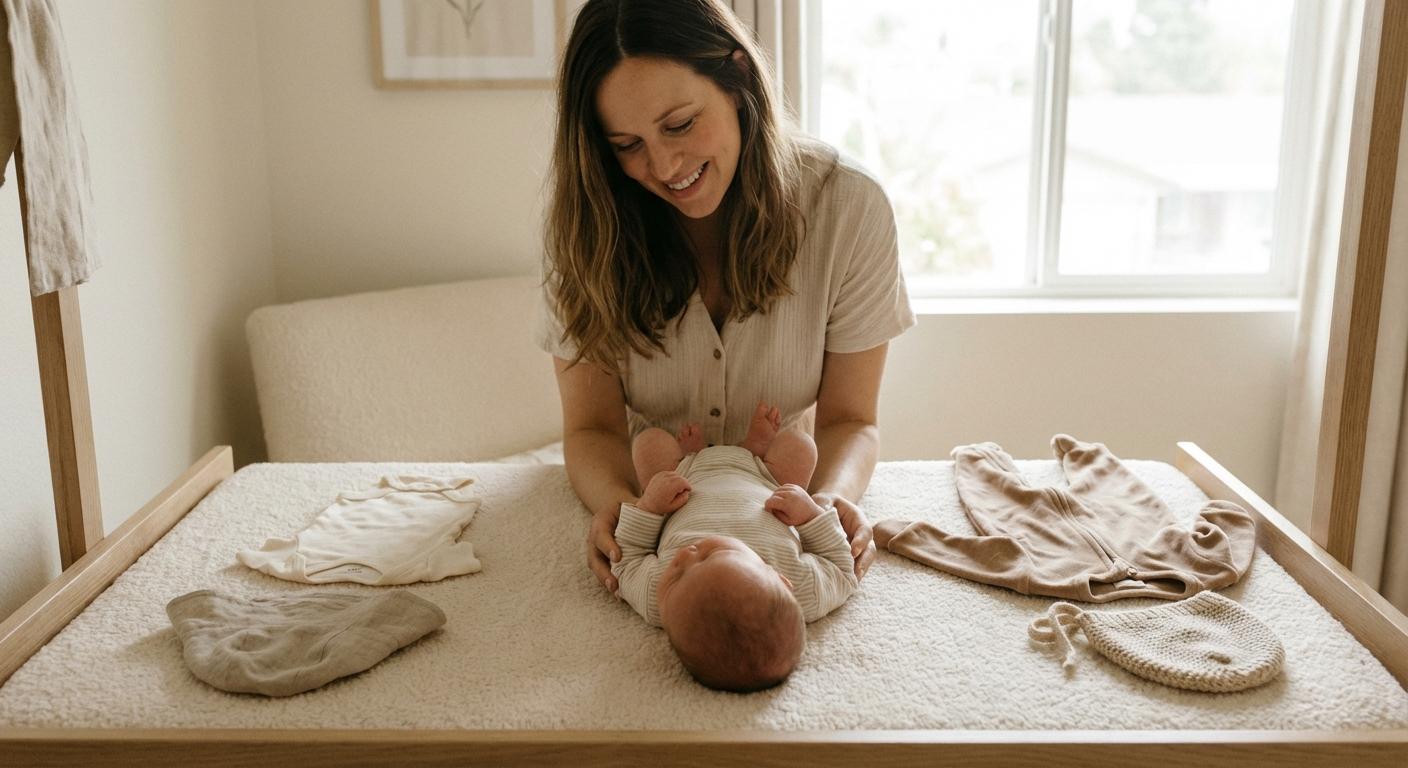
Bringing a newborn home triggers a surprisingly frequent question, sometimes at every diaper change: how to dress a newborn in summer and winter without overheating, without letting them get chilled, and without stacking layers “just in case”? Temperatures swing fast: a heated living room, a breezy hallway, a warm car, an air-conditioned store. And a newborn’s body can’t adapt as smoothly as an adult’s.
A few physiological basics, plus one reliable check (the back of the neck), usually turn clothing decisions into a calm routine: day and night, at home and outdoors, during heatwaves and cold snaps.
Newborn thermoregulation: why clothes matter so much
Newborns have an immature thermoregulation system. In plain terms, their internal “thermostat” is still learning.
Several normal features explain why how to dress a newborn in summer and winter can feel like a moving target:


- The hypothalamus (brain center that helps regulate temperature) is not fully mature.
- The skin is thinner and the skin barrier is more permeable, so heat loss and irritation occur faster.
- A high surface-area-to-weight ratio makes heat exchange quick. Heat can be lost through:
- Convection (moving air, drafts)
- Radiation (cool walls, windows nearby)
- Conduction (cold surfaces: changing table, mattress)
- Newborns produce warmth via brown adipose tissue (“brown fat”) with non-shivering thermogenesis, effective but limited.
- Sweating is less efficient, so overheating may build before you notice obvious perspiration.
Some situations tip the balance more easily: prematurity, low birth weight, fatigue, prolonged crying, high humidity, wind exposure, or infection.
A safety marker to keep in mind during the first 28 days of life: a rectal temperature ≥ 38°C (100.4°F) calls for prompt medical advice.
Warm or cold? Reliable signs (and common false alarms)
You may wonder: “Should I trust the thermometer, the baby’s hands, the baby’s mood?” Use a hierarchy.
The most useful check: the back of the neck
To decide how to dress a newborn in summer and winter, touch the back of the neck or between the shoulder blades.
- Warm and dry: usually comfortable.
- Warm and damp: too warm (or the room is too warm, or your baby has just cried or fed for a long time).
- Cool: consider one light layer.
Hands and feet are a classic false alarm. Peripheral circulation is still maturing, so extremities may feel cool even when core temperature is fine.
Possible signs of overheating
- Damp neck/back
- Flushed skin
- More difficulty settling
- Faster breathing
- Unusual sleepiness (interpret with context: feeding, time of day, illness)
Possible signs of getting too cold
- Cool neck/back
- Pale color, lower tone
- Feeding difficulties
- Irritability
If your baby seems “off”, very hot, very cold, unusually sleepy, or unwell, seek medical advice, especially in the newborn period.
The “one more light layer than you” rule: helpful, but flexible
A practical starting point for how to dress a newborn in summer and winter is the classic rule: one more light layer than an adult wears.
But comfort depends on:
- Actual room temperature (often 18-22°C / 64-72°F for sleep, adjusted to your home and baby)
- Humidity, wind, and sun exposure
- Activity (deep sleep vs feeding vs crying)
- Transitions (cool mornings, warm afternoons, cooler evenings)
Why layering beats one thick outfit
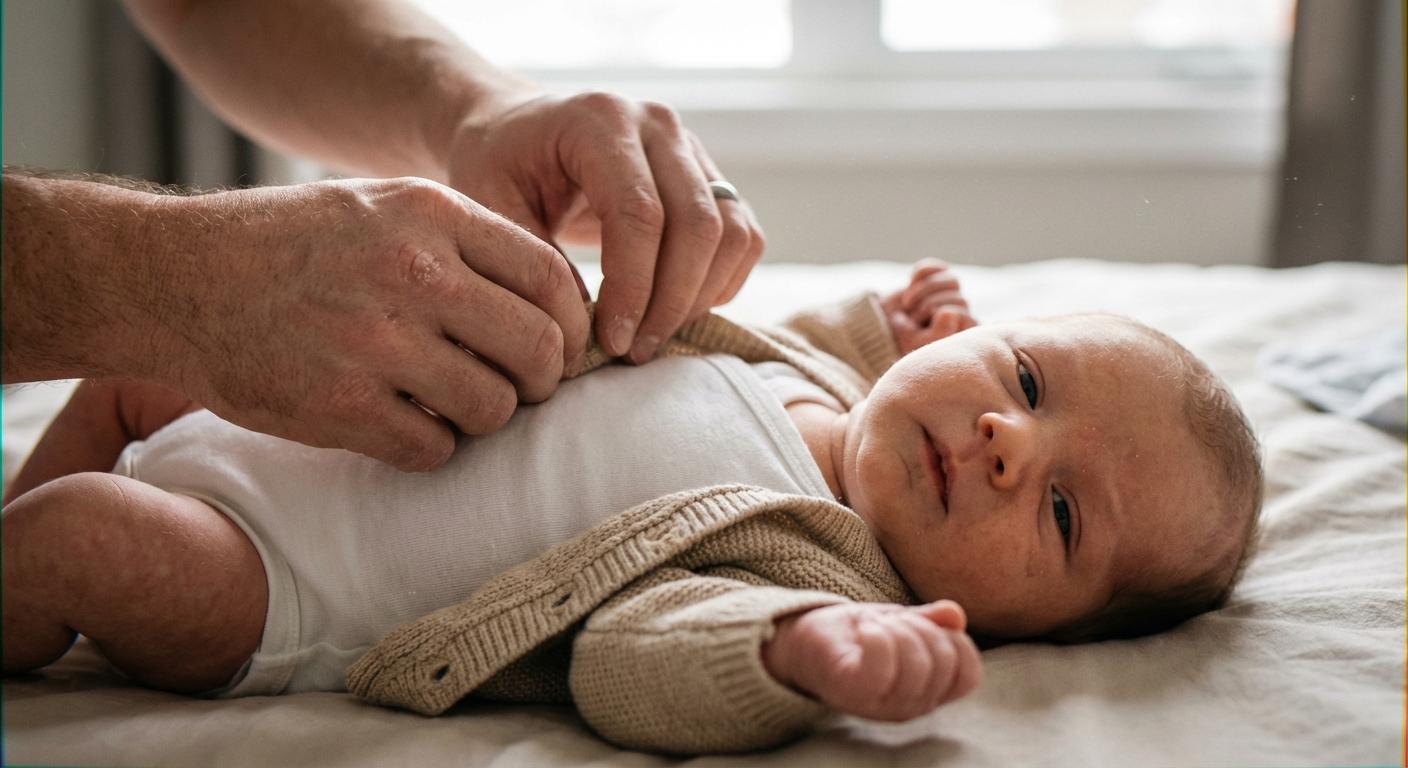
Layering gives you control without fully undressing and without fully waking your baby.
- Base: bodysuit (short- or long-sleeve)
- Layer 2: sleeper/footed pajamas
- Layer 3: thin cardigan or light sweater
- Outdoors: jacket or pram suit, ideally wind-resistant when needed
Aim for comfort and movement: no compressed belly, no tight waistband marks, shoulders free.
Fabrics and tiny details that matter for newborn skin
Newborn skin is reactive. Friction, moisture trapped in neck folds, and detergent residues can aggravate redness or eczema.
Summer: breathe, absorb, dry
When thinking about how to dress a newborn in summer and winter, fabrics are not a footnote, they are a temperature tool.
Good warm-weather options:
- Cotton (often the easiest, well tolerated)
- Linen
- Bamboo/viscose (very soft, watch blends)
- Cotton muslin
Light colors generally absorb less radiant heat.
Winter: insulate without trapping moisture
- Cotton as the layer against skin
- Fine merino wool (warm, breathable, often comfortable when high quality)
- Soft sweatshirt fabric
- Soft fleece (often as mid or outer layer, depending on skin sensitivity)
Some synthetics trap heat and moisture. A damp back can then cool quickly once your baby stops moving, an unpleasant “hot then cold” cycle.
Clothing features that can irritate
- Scratchy tags, thick seams
- Bulky appliques or large buttons pressing while lying down
- Tight necklines
Indoor temperature: the thermostat is not the whole story
Many parents find how to dress a newborn in summer and winter is hardest indoors: heating cycles, hot apartments, cold floors, uneven insulation.
Helpful reference ranges:
- 18-20°C (64-68°F): often comfortable for sleep with an appropriate sleep sack.
- 20-22°C (68-72°F): an “easy zone” for many babies.
- ≥ 23-24°C (73-75°F): overheating risk rises, especially with humidity.
Humidity changes the “felt temperature”:
- High humidity limits heat release.
- Very dry air (common with winter heating) can irritate skin and nasal passages.
Also consider drafts, a cool window, or getting out of the bath, moments when heat loss accelerates. Check the back of the neck then, not ten minutes later.
How to dress a newborn in summer and winter: summer routines
Yes, the big question becomes practical quickly: how to dress a newborn in summer and winter turns into “What do I put on right now?” Here are clear, adjustable starting points.
Summer daytime: light and modular
Common comfortable combinations:
- Short-sleeve bodysuit + loose romper
- If mornings are cooler: add light pants or a thin cardigan
A hat indoors is rarely needed. Outdoors, a lightweight hat mainly helps with shade and eye comfort.
Summer nights: let the room decide
Bedrooms often climb to 24-25°C (75-77°F).
- If it’s warm: light bodysuit + lightweight sleep sack (low insulation)
- If temperature drops overnight: add a thin layer rather than using a loose blanket
Sleep sacks support safer sleep by avoiding loose bedding. Choose warmth based on the real room temperature, then confirm with the neck/back.
Summer outings: sun, heat, air conditioning
- Prefer early morning or later afternoon.
- Choose airy coverage (thin long sleeves, loose pants) rather than bare skin in direct sun.
- Be cautious with muslin draped over a stroller or car seat: airflow can drop and internal temperature can rise.
- Pack a thin cardigan for air-conditioned stores.
How to dress a newborn in summer and winter: winter routines
Winter raises a different worry: “Are they cold?” The aim is warmth without dampness.
Winter daytime: warm, not sweaty
- Long-sleeve bodysuit + sleeper
- Add a thin cardigan/sweater if the neck/back feels cool
- Socks or booties if needed
Hats are mostly for outdoors. Indoors, a hat can push overheating because the head is a major heat-exchange area.
Winter nights: stable and safe
A frequently used reference is a room around 18°C (64°F).
- Long-sleeve bodysuit + sleeper + warmer sleep sack matched to the room
If your room drops toward 16-17°C (61-63°F), socks may help. When possible, improving the room temperature is more effective than endlessly stacking layers.
Winter outings and very cold weather: wind protection first
- Layering + pram suit if needed
- Hat, mittens, booties
- Wind-resistant outer layer in gusty weather
Car seat safety deserves a pause: avoid very thick coats under the harness (the padding compresses and can leave dangerous slack). Use thin layers for buckling, tighten correctly, then place a blanket over the straps if needed.
Special situations: heatwaves, air conditioning, and in-between seasons
These are the moments when parents re-check how to dress a newborn in summer and winter at 2 a.m., after a sudden weather change, or when the apartment feels nothing like the forecast.
Heatwaves: reduce overheating and dehydration risk
- Dress lighter (natural, breathable fabrics, sometimes a single layer)
- Watch for damp neck, flushed cheeks, rapid breathing, agitation, unusual sleepiness
- Stay indoors during the hottest hours
Feeding: breastfed babies may nurse more often. Formula-fed babies generally keep usual volumes, if unsure, ask a clinician.
Air conditioning: avoid abrupt temperature swings
- Don’t aim airflow directly at your baby.
- Add a thin layer if the neck/back cools.
- Keep a spare outfit ready for quick changes.
Spring and fall: the “saw-tooth” day
Temperatures rise and fall fast.
- Use modular layers: long-sleeve bodysuit + pants/sleeper + cardigan
- A light hat can help on a windy morning, remove it as soon as your baby warms up
- Pack one layer “up” and one layer “down”
Quick adjustments: common mistakes (without guilt)
Even when you know how to dress a newborn in summer and winter, real life interferes: a growth spurt, a heater that kicks in, a baby who falls asleep mid-feed.
Frequent missteps
- Overbundling in heated homes
- Trusting hands and feet instead of neck/back
- Choosing less breathable fabrics that cling when damp
- Forgetting wind or air-conditioned rooms
- Not re-checking after a long feed, prolonged crying, or fever
Two extra moments to re-check
Because the question how to dress a newborn in summer and winter is really about timing, two moments deserve a quick touch test:
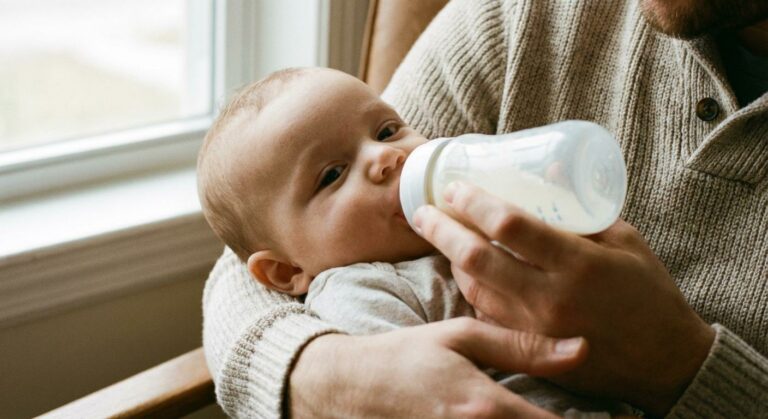
- After a feed: digestion increases heat production (thermic effect of food). Many babies warm up, especially if they were held skin-to-skin.
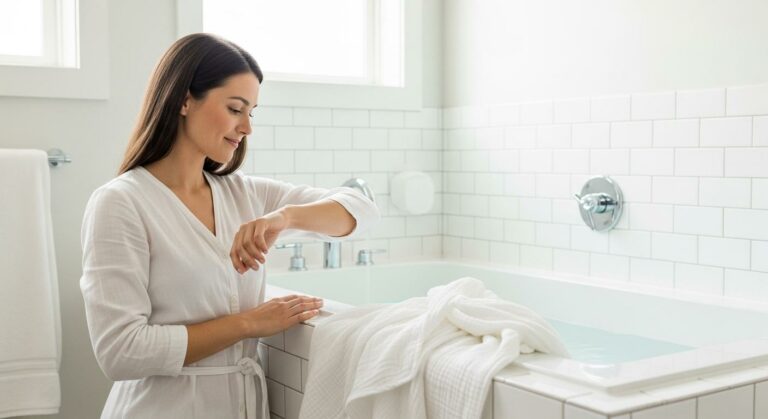
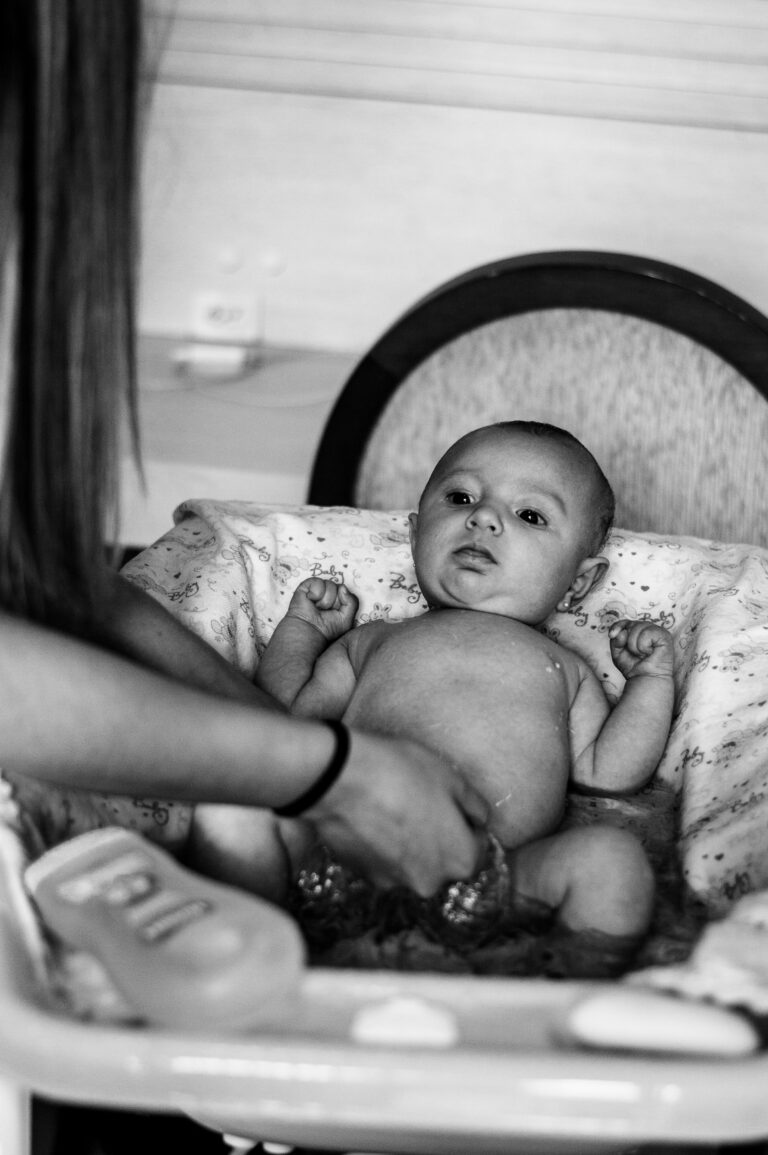
- After bath time: evaporation cools the skin fast. A towel, a quick dry in the folds (neck, groin), then clothing prevents the “warm water, cold air” shock.
When to think about illness rather than clothes
Sometimes parents adjust layers again and again, yet the baby stays unusually warm, unsettled, or sleepy. Clothing is only one variable.
Call a clinician promptly if you notice fever (again, ≥ 38°C rectal in the first month), poor feeding, repeated vomiting, breathing that looks labored (nostril flaring, ribs pulling in), or a baby who is hard to wake. Those signs deserve medical assessment, not just a wardrobe change.
Mini checklists
Summer
- Day: short-sleeve bodysuit + loose outfit, hat outdoors
- Night: light bodysuit + lightweight sleep sack
- Outing: airy coverage + emergency thin cardigan
Winter
- Day: long-sleeve bodysuit + sleeper + cardigan if needed
- Night: long-sleeve bodysuit + sleeper + warmer sleep sack
- Outing: layers + hat/mittens/booties, no bulky coat under the car-seat harness
Key takeaways
- How to dress a newborn in summer and winter comes down to comfort, not piling on layers.
- The back of the neck (or between the shoulder blades) is the most reliable check: warm and dry usually means you’ve got it right.
- If unsure, change one thing at a time (remove a layer, switch the sleep sack, cool the room briefly), then re-check.
- Layering adapts quickly with less disruption.
- Breathable fabrics (cotton, linen, muslin, fine merino in winter) limit moisture build-up and support skin comfort.
- At night, a well-fitted sleep sack replaces loose blankets, match warmth to the room temperature.
- In the first 28 days, a rectal temperature ≥ 38°C (100.4°F) needs prompt medical advice.
- For extra support, resources and health professionals can help you tailor choices to your baby, and you can download the Heloa app for personalized tips and free child health questionnaires.
Questions Parents Ask
Can a newborn sleep in just a diaper or onesie during hot summer nights?
Yes, if the room is truly warm and your baby’s neck/back feels warm and dry. Many newborns are comfortable in a diaper or short-sleeve bodysuit plus a very light sleep sack (or no sack if the room is consistently hot). Rassurez-vous: you don’t need extra layers “just in case.” If the neck becomes damp, simply remove one layer and recheck after a few minutes.
Do newborns need a hat indoors or for sleep in winter?
In most homes, no. Indoors and at night, a hat can trap heat and make overheating more likely, because the head releases a lot of warmth. A hat is usually helpful outside (wind, cold air) or briefly after birth if recommended by your maternity team. If you’re worried, the easiest reassurance is the same: check the back of the neck, not the hands.
How do I choose the right sleep sack warmth (TOG) for summer vs winter?
Think “room temperature first,” then adjust gently. A higher-TOG sack can be great in cooler rooms, while summer often calls for a low-TOG option. If you’re hesitating between two, picking the lighter one and adding a thin layer underneath tends to be simpler. Your baby’s neck/back staying warm and dry is the best sign you chose well.
Further reading: