Wondering when do babies hold their bottle without your hands doing all the work? Many parents picture a neat milestone: one day baby grabs the bottle, drinks calmly, and the feeding “problem” is solved. Real life is messier. Grip appears in bursts, posture wobbles, milk flows too fast or not at all, and what looks like independence may still need your steadying hand.
Most babies begin to hold a bottle somewhere between 6 and 12 months, with early attempts sometimes around 4–5 months. Prematurity, muscle tone, and overall motor development can shift the timing. Safety, however, does not change: bottle feeds always need close supervision.
When do babies hold their bottle? A normal window, and lots of reasons it differs
The question when do babies hold their bottle has a broad, reassuring answer: there’s a wide normal range. Some infants reach and clutch early, others focus their energy on sitting, rolling, or babbling first, then come back to hand skills.
If your baby was born early, think in corrected age (also called adjusted age). In simple terms: you subtract the weeks of prematurity from the calendar age. Feeding coordination and fine motor skills often align better with corrected age than with the birth date.


You may also notice “two steps forward, one step back.” Teething, growth spurts, illness, or tired evenings can temporarily make bottle holding harder.
What “holding the bottle” really means (and what it doesn’t)
Parents often ask when do babies hold their bottle as if it were an on/off switch. It isn’t. Bottle holding is a layered skill: grasp, aim, keep the nipple filled with milk, pause to breathe, and adjust when the bottle gets lighter.
Two distinctions calm a lot of worry:
- Holding the bottle vs finishing the feed: Holding is mainly a grasp and guidance task. Finishing a bottle also requires mature suck-swallow-breathe coordination (the rhythm that keeps breathing safe while drinking), plus pacing, pauses, and sometimes burping.
- Partial vs more complete independence:
- Partial: baby holds with two hands while you support the body, keep posture stable, and correct the angle.
- More complete: baby can drink when you hand them the bottle in a stable position, yet you still supervise closely because coughing, fatigue, or a sudden loss of coordination can happen quickly.
A baby who “can hold” may still need you to manage the flow and the position. That’s normal.
Typical timeline: what you might see by age
If you’re scanning for an age, the common answer to when do babies hold their bottle lands between 6 and 12 months. Here’s how it often unfolds.
Around 4-5 months: curious hands, brief grips
Some babies begin reaching for objects, mouthing toys, and briefly gripping the bottle while you do most of the work. This is often exploration.
What helps at this stage?
- short tries (seconds, not minutes)
- a light bottle
- a calm moment, not when baby is frantic with hunger
Around 6-9 months: intentional holding starts to stick
Many infants become more purposeful: they reach, grasp, and keep hands on the bottle longer. Sitting support improves, and a steadier trunk frees the arms.
You may notice:
- two-handed holding against the chest
- repeated re-gripping (slip… grab… adjust)
- better aiming toward the mouth
Around 8-9 months: holding for much of the feed (for many babies)
For lots of babies, this is the “aha” phase: they can hold most of the time if the setup is right.
Common success factors:
- bottle isn’t too heavy (a smaller volume can change everything)
- posture is supported
- nipple flow matches your baby’s pattern
Around 10-12 months: steadier tilt and pacing
Coordination often becomes more consistent. Baby may control the tilt more smoothly and pause more naturally.
After 12 months: independence depends on context
Even if the motor skills are there, toddlers may switch between “I do it!” and “hold me.” Evening fatigue, illness, or a need for closeness can bring them back to supported feeding.
Why the age range is so wide
If you keep thinking when do babies hold their bottle and comparisons are creeping in, it helps to know what drives the variation.
- Opportunities to practice: floor time, reachable toys, and safe chances to grasp build coordination.
- Gross motor development: when the trunk is stable, hands become more precise.
- Prematurity: corrected age often fits better.
- Muscle tone:
- Low tone (hypotonia): baby may tire quickly, the bottle feels heavy.
- High tone (hypertonia): movements may look stiff, adjusting the angle is harder.
None of these automatically mean something is “wrong,” but they explain why timelines differ.
Skills underneath bottle holding: posture, coordination, and endurance
Bottle feeding is not only about hands. A well-supported body makes swallowing safer and less tiring.
- Head and neck alignment: a neutral head position with the chin free supports smoother swallowing.
- Shoulder and trunk stability: stable shoulders allow controlled wrist and finger movement. Without that base, babies may clamp down with a strong grip yet struggle to aim.
You might see it: when baby slumps, the bottle angle changes and coughing becomes more likely.
Hand skills that mature together
Bottle holding draws on multiple developing abilities:
- Hand-eye coordination: seeing, reaching, grasping, bringing to mouth.
- Micro-adjustments: tiny corrections to keep the nipple filled.
- Hand-to-hand transfer: switching when one arm tires.
- Fine motor control (often 9-12 months): more precise finger movements, even if bottle holding still uses a whole-hand grasp.
Readiness signs: how to know your baby can practice
Instead of focusing only on when do babies hold their bottle, watch for readiness. It’s often clearer than a birthday.
Motor signs
Your baby may be ready to practice if they:
- hold the head steadily
- sit with support (or stay stable on your lap)
- grasp toys and bring them to the mouth on purpose
- let go and re-grip objects
Behavioral signs
Readiness also looks like:
- reaching toward the bottle
- watching you closely (imitation)
- getting annoyed when kept “hands off”
A small, supported turn holding the bottle, then finishing together, can respect both learning and comfort.
How to help your baby hold their bottle (without pressure)
If your question is when do babies hold their bottle, the most helpful shift is often: “How can I make practice safe and pleasant?”
Simple strategies that work
- Hands-on-hands support: let baby hold while you guide, reduce help gradually.
- Take turns: you hold for a bit, then baby holds for a bit.
- Set the angle: enough to fill the nipple, not so steep that milk pours too fast.
- Change positions slowly: arms -> lap -> high chair (when sitting is stable).
- Stop and support more if needed: coughing, fussiness, arching, or fatigue are signals to pause.
A poor angle can increase swallowed air (leading to gassiness) and may trigger coughing.
Mini-activities outside meals (quick, low-stress)
A few minutes, repeated often:
- hand-to-hand transfers (rings, rattles)
- easy-to-grab shapes (thicker, textured, lightweight)
- practice when baby is calm, not extremely hungry
Best positions when baby holds the bottle
- In your arms: semi-upright gives you maximum control.
- On your lap: good support with more freedom for hands.
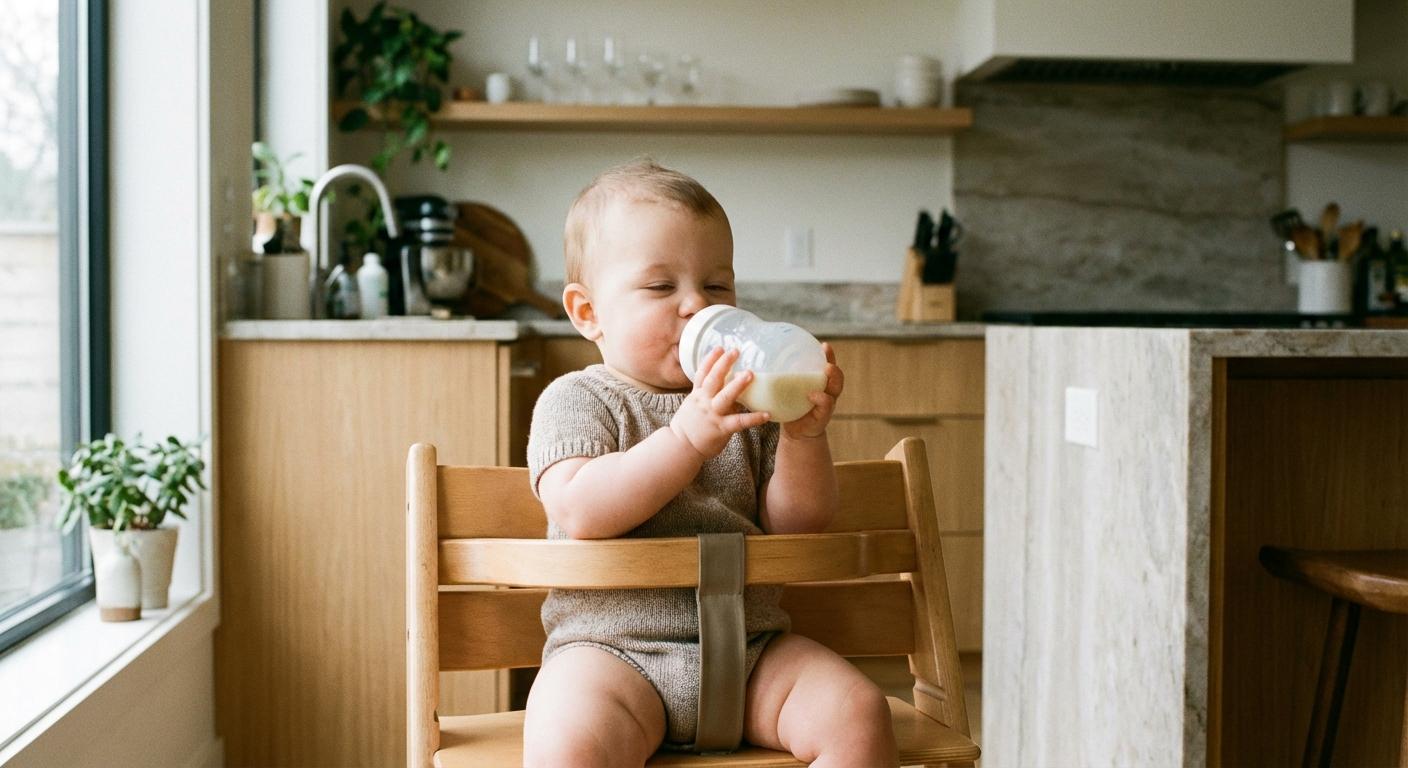
- High chair: once sitting is solid, support the back and keep the pelvis stable.
Reflux, spit-up, and comfort
Position can affect reflux and spit-up:
- many babies do better semi-upright rather than flat, often around 30-45 degrees
- if reflux is frequent, try slower pacing, more pauses, and reassess nipple flow
Safety rules: what never changes
No matter when do babies hold their bottle, safety is the fixed point.
Supervision and “no propping”
- Never prop the bottle with pillows, blankets, or devices. Milk can continue flowing even when coordination slips, raising the risk of aspiration (milk entering the airway).
- Stay close and watch breathing, swallowing, and comfort.
Flow, pacing, and sleep habits
- Choose a nipple flow that matches your baby:
- too fast: coughing, stress, extra air swallowing
- too slow: fatigue, frustration
- No bottle in bed: changing positions and prolonged sucking without interaction increases avoidable risks and can blur hunger/fullness cues.
- Watch the baby, not the clock: pauses, relaxed hands, turning away, and slowing sucking matter more than minutes.
Common warning signs during feeds
If you notice:
- repeated coughing, choking, or wet/gurgly sounds
- milk leaking from the mouth corners
- unusual pauses or breathing difficulty
…stop the feed, bring baby more upright, and restart more slowly. If it keeps happening, discuss posture and nipple flow with a pediatric clinician.
Feeding flat may also encourage milk toward the Eustachian tube, which can contribute to ear discomfort, a more upright posture helps.
Choosing a bottle that’s easier to hold
Small changes often help more than you expect.
- Weight: lighter bottles are easier (plastic often beats glass for early learning).
- Shape and texture: contoured or textured surfaces can improve grip.
- Volume: a smaller, less full bottle is easier to manage than a large full one.
What about handles?
Handles can help some babies at the beginning, but they’re not mandatory. Also, “age” labels on nipples are only rough guidance: your baby’s cues matter more.
If your baby does not hold the bottle yet
Hearing other parents talk can make you loop back to when do babies hold their bottle with extra worry. Many situations are still typical.
Often reassuring
It can be normal if:
- there’s little interest before 6 months
- between 9-12 months baby prefers you to hold the bottle, yet plays well with toys
- the bottle is heavy, posture is uncomfortable, baby is tired, or the flow isn’t matched
When to ask for extra support
Consider a check-in if you see:
- limited reaching, persistent tightly closed hands, or difficulty bringing objects to the mouth
- strong asymmetry (one side used much less)
- very floppy or very stiff movements
- repeated choking/coughing events or consistently stressful feeds
A pediatrician may suggest assessment by a feeding specialist, occupational therapist, or physiotherapist depending on what’s observed.
Moving beyond the bottle: early cup practice
Cup skills can start gently during the first year, often between 6 and 12 months, with small sips of water and close supervision. Spills and sputters are part of learning.
Even after baby can hold the bottle, feeding remains relational: your calm presence helps pacing and supports positive cues. As teeth appear, begin oral hygiene, and between meals, water is usually the best drink.
Key takeaways
- Most answers to when do babies hold their bottle fall between 6 and 12 months, with early tries sometimes around 4-5 months.
- Holding and finishing a full feed are different skills, independence builds in stages.
- Posture, trunk stability, and hand-eye coordination explain many timing differences.
- Readiness includes motor signs (stable posture, grasping, re-gripping) and behavioral signs (reaching, wanting to participate).
- Safety stays the same: never prop a bottle, avoid bottles in bed, match nipple flow, and supervise closely.
- If feeds are stressful or coughing is frequent, professional support can help, and you can download the Heloa app for personalized tips and free child health questionnaires.
Questions Parents Ask
Can a baby hold a bottle but still need help drinking?
Yes—this is very common, so no worries. Holding is mostly a hand-and-arm skill. Drinking well also involves pacing and a smooth suck–swallow–breathe rhythm. Some babies grip the bottle confidently but still need you to steady the angle, offer small pauses, or help when they get tired.
Does my baby need to hold a bottle before starting solids?
Not at all. Many babies begin solids around 6 months even if they’re not holding a bottle independently yet. Solids are more about sitting support, interest in food, and safe swallowing. Bottle-holding often catches up later, in its own time.
My baby still isn’t holding their bottle by 12–15 months—when is it worth checking in?
A later timeline can still be normal, especially if your child uses their hands well for toys and daily play. It may be reassuring to ask for advice if you notice limited reaching, a strong preference for one side, very floppy or very stiff movements, or if feeds often feel stressful (frequent coughing, gagging, or fatigue). A pediatric clinician can suggest simple next steps and, if needed, a feeding or motor assessment.