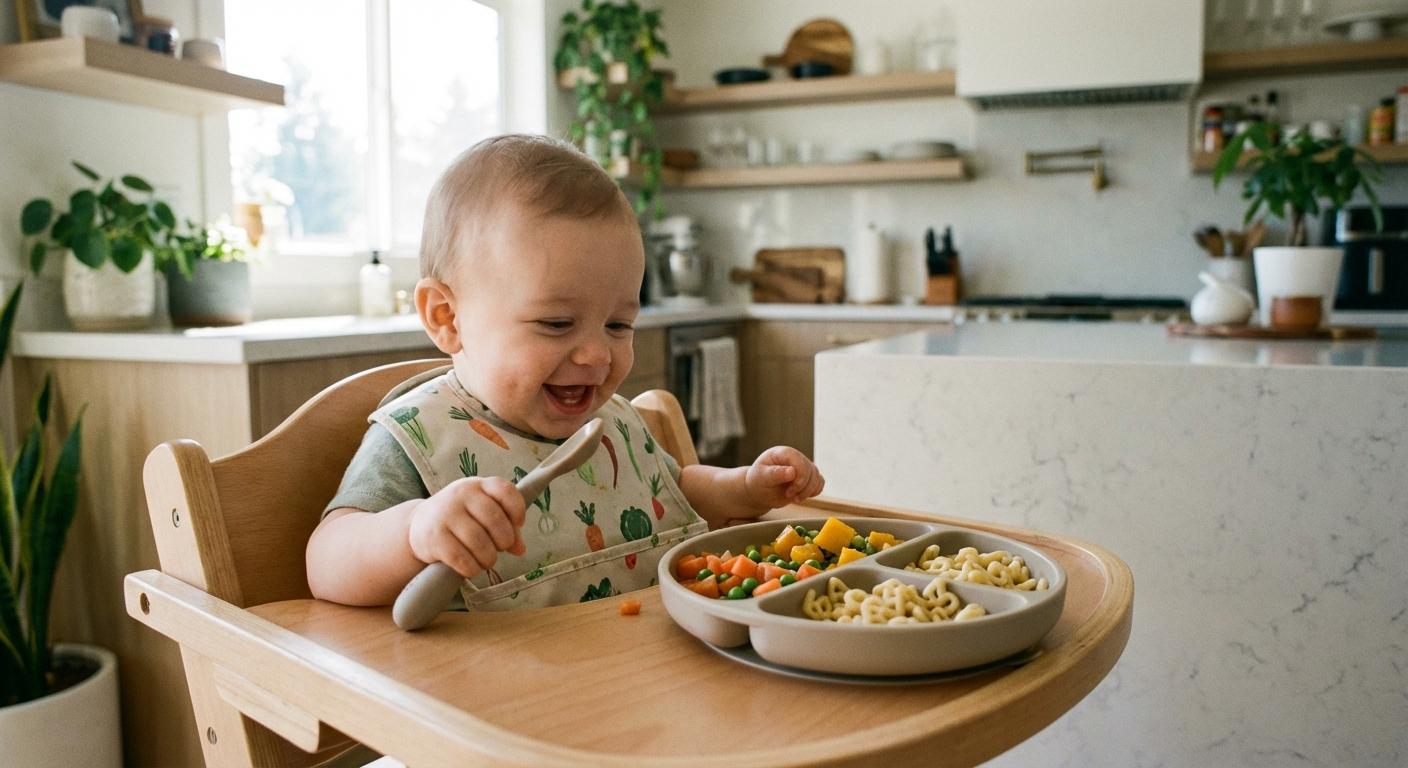
At 11 months, feeding can feel like a daily jigsaw: milk feeds shift, teeth keep erupting, and “pieces” may look exciting today and suspicious tomorrow. With baby food 11 months, the aim is not a perfect plate. It is skill-building—chewing, tongue control, hand-to-mouth coordination—and gradual confidence with textures. You may also be balancing work hours, grandparents’ advice, and Indian family meals (dal, rice, idli, curd) that can be wonderfully baby-friendly with a few smart tweaks.
Baby food 11 months: what to expect this month
Feeding milestones: variety, independence, and chewing
At this age, baby food 11 months usually comes back to three goals:
- Variety: vegetables, fruit, starchy foods, legumes (dal, chana, rajma), animal foods (if offered), and healthy fats
- Independence: picking up food, bringing it to the mouth, holding a spoon, learning to sip from a cup
- Chewing progress: moving from smooth purées to fork-mashed meals and soft pieces
If your baby refuses lumps, it does not mean anything is “wrong”. Some babies accept mashed and chopped textures quickly, others take weeks. Repeated, calm exposure works better than rushing.
Breast milk or formula: where milk fits with solids
Breast milk or infant formula remains a major nutrition source in baby food 11 months, providing energy, protein, calcium, and several micronutrients.

You may see different “targets”. Many families find around 500 mL per day practical, with a common range of about 350–600 mL/24 hours depending on appetite, teething, illness, and how much solid food is going in. Some references mention about 700 mL/day (24 oz), often split into 3–4 feeds. The bigger picture matters most: steady growth, active baby, and good urine output.
Cow’s milk should not be the main drink before 12 months, but pasteurised curd/yogurt and paneer/cheese can be used in meals.
Water and cup practice
Offer water with meals and whenever your baby seems thirsty. It helps with thicker textures and prevents discomfort. At 11 months, practising with an open cup or straw cup is a great idea—small sips, lots of spills, no pressure. Avoid fruit juice, it is not needed and increases tooth decay risk.
Daily routine for baby food 11 months
A typical day: 3 meals (often a snack) plus milk
Most babies do well with:
- 3 solid meals per day
- Milk feeds continuing alongside
- An optional afternoon snack
Some babies manage fine without snacks until 12 months. Others do better with a planned snack, especially if dinner is late or naps are short.
Sample timetable (adjust for naps and childcare)
- 7:00–7:30: milk feed
- 8:00: breakfast + water
- 11:30: lunch + water
- 15:30: snack (optional) + water
- 17:30–18:00: dinner + water
- 19:00: milk feed
If your baby seems hungry between meals
First, check the basics: time since last milk feed, sleep, and hydration. Then choose the simplest change:
- Add an extra milk feed (often the easiest step under 12 months).
- Add a small increase next meal (1–2 tablespoons), keeping balance: iron-rich food + veg/fruit + starch + fat.
- If adding a snack, keep it modest so it does not replace meals.
If hunger comes at the same time daily, a slight schedule shift often solves it.
Portion sizes in baby food 11 months (without pressure)
Responsive feeding: your baby stays in charge
At 11 months, cues are usually clear:
- Hunger: leaning forward, opening the mouth, reaching for food
- Fullness: turning away, sealing lips, slowing down, pushing food away, throwing food repeatedly towards the end
Stopping when your baby shows they are done supports self-regulation. One meal is not the whole story, look across several days (energy, wet nappies, growth pattern).
Practical portion ranges you can adapt
Many 11-month-olds eat roughly 8–12 tablespoons total per meal across foods.
Common ranges used in baby food 11 months planning:
- Vegetables: 100–150 g at lunch and/or dinner
- Cooked starch: 40–60 g cooked (rice, pasta, suji, potato, sweet potato)
- Fruit: 60–120 g (ripe fruit, stewed fruit without added sugar, or correctly cut pieces)
Appetite dips happen—often the next day balances out.
Protein portions: small amounts, big impact (iron focus)
Iron needs are high from 7 to 12 months. Animal foods provide haem iron (generally absorbed better). Plant foods give non-haem iron (absorption improves with vitamin C).
Practical guides:
- Meat or fish: 10–15 g/day (2–3 teaspoons), well-cooked, finely chopped/minced/shredded/flaked
- Egg: fully cooked, often about ¼ of a hard-boiled egg, depending on the day’s overall intake
If you prefer vegetarian feeding, use dals, chana, rajma, soy, and iron-fortified infant cereals—then pair with vitamin C.
Snack ideas at 11 months
If you offer a snack:
- Pasteurised plain curd/yogurt: 60–90 g
- Fruit: 60–120 g
- Water
Nutrients to prioritise in baby food 11 months
Iron: common gap, practical fixes
Iron supports haemoglobin (oxygen transport) and neurodevelopment.
Two effective habits:
- Include an iron source daily: meat, fish, egg, well-cooked legumes, iron-fortified infant cereals
- Improve plant-iron absorption with vitamin C foods: amla (if tolerated), orange, guava, tomato, capsicum, broccoli, strawberries
Easy pairings:
- Moong dal + tomato
- Chana mash + guava
- Iron-fortified cereal + broccoli mash
Healthy fats and omega-3 (DHA)
Babies need fat for growth, brain development, and vision.
Helpful habits:
- Add about 1 teaspoon of vegetable oil to mash (groundnut oil can be used if peanut is already tolerated, otherwise prefer mustard/olive/canola/rapeseed as per family use), ideally after cooking
- Offer fish 1–2 times per week (if non-vegetarian), well-cooked and deboned
Calcium, vitamin D, vitamins A and B12
- Calcium: mainly from breast milk/formula and pasteurised dairy (curd, paneer, cheese) used appropriately.
- Vitamin D: often supplemented in infancy, dosing varies—follow your paediatrician’s plan (400 IU/day is commonly used in many protocols).
- Vitamin A: carrot, pumpkin, sweet potato, spinach.
- Vitamin B12: animal foods and dairy. If your baby is on a vegan diet, discuss supplementation with a clinician.
Textures and self-feeding in baby food 11 months
Texture progression: thicker purées to soft pieces
Texture is a training ground. A useful mix:
- Thick purées (stay on the spoon)
- Fork-mashed foods (soft lumps)
- Soft pieces that melt in the mouth (very well-cooked veg, ripe fruit, soft idli pieces, well-cooked pasta)
A simple trick: keep a smooth base (khichdi mashed, dal purée) and add a few very tender bits.
Chewing support: simple steps
If pieces are difficult:
- Cook longer for softer texture
- Offer easy-to-hold shapes (soft vegetable sticks)
- Progress in stages (smaller pieces first, then more variety)
- Keep meals calm, seat baby well, no screens
Gagging is common with new textures: it is noisy, and the baby can breathe. Choking is silent or with inability to cough/breathe—an emergency.
Spoon, fingers, and cup skills
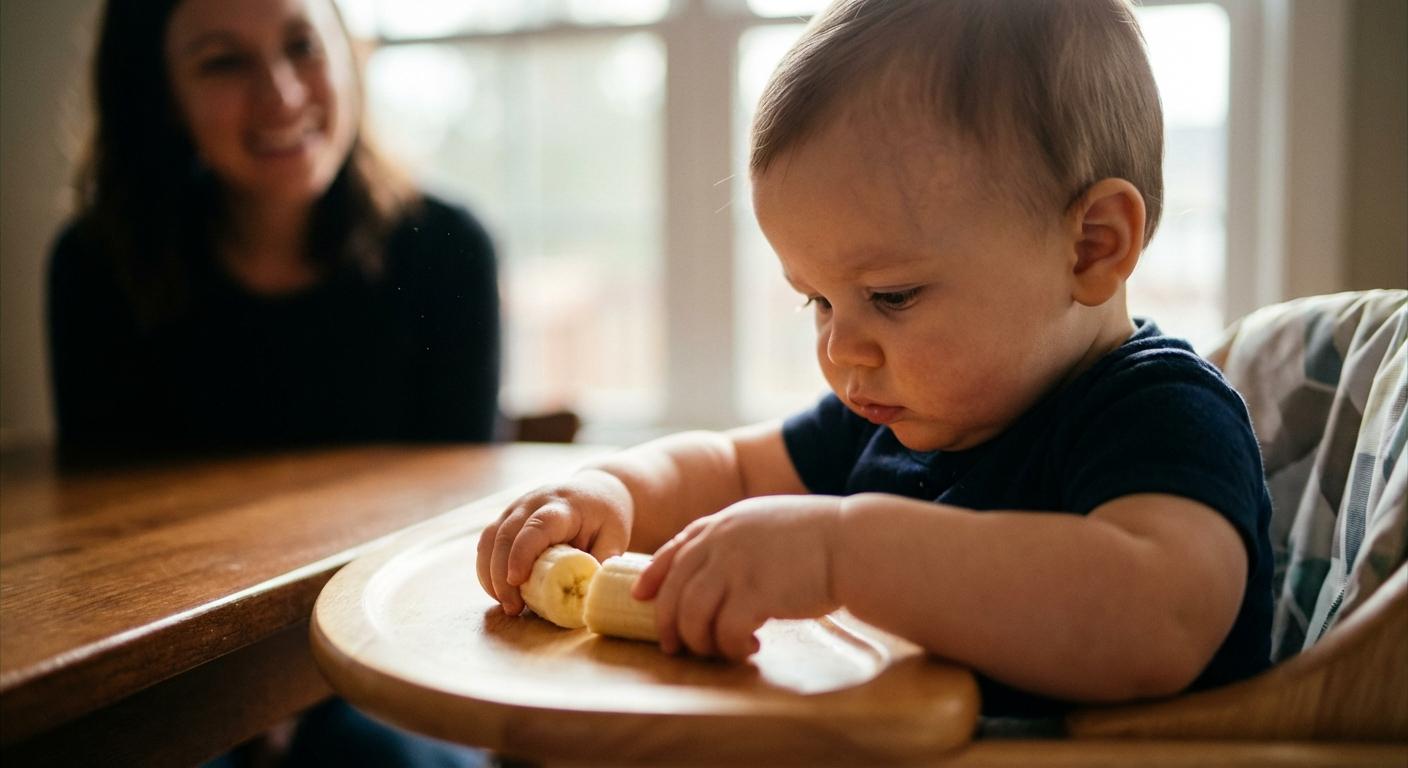
Offer a spoon for practice (even if it gets dropped), plus soft finger foods, plus a cup with water while seated upright. Mess is motor learning, short, calm meals (15–30 minutes) support confidence.
Finger foods for baby food 11 months (safe cuts and options)
Safety foundations
- Upright seating in a stable high chair, strapped in
- Feet support helps stability
- Adult supervision from first bite to last
- No eating while lying down, in car seats, or while playing
Finger food ideas that work well
Choose foods that mash easily between your fingers:
- Very cooked sweet potato sticks
- Soft steamed lauki or pumpkin pieces
- Ripe banana, ripe papaya strips
- Avocado (if available), soft pear slices
- Well-cooked fish flakes (deboned)
- Soft idli pieces, well-cooked small pasta
Choking hazards: avoid or modify
Avoid hard, round, sticky, or slippery foods:
- Whole nuts, popcorn, hard seeds
- Whole grapes/cherry tomatoes (quarter lengthwise)
- Hard raw carrot/cucumber (cook until soft)
Nut products should be in safe forms only: smooth nut butter thinned with water/curd, or finely ground nuts mixed into porridge.
Allergens in baby food 11 months
Common allergens: egg, peanut, dairy, wheat/gluten, soy, fish, sesame, tree nuts.
A practical method:
- Introduce one allergen at a time
- Offer earlier in the day
- If tolerated, repeat regularly (often 2–3 times per week)
If eczema is significant or there is a strong allergy history, discuss timing and approach with your clinician.
Foods to avoid or limit at 11 months
Before 12 months
- No honey (botulism risk)
- Avoid raw/undercooked meat, fish, and egg
- Avoid unpasteurised milk and cheeses
Salt, sugar, and ultra-processed foods
Avoid added salt and added sugar. Babies’ kidneys handle sodium differently, and early sugar exposure can shape taste preferences and affect teeth.
Use jeera, dhania, cinnamon, garlic, onion, lemon, and mild spices instead of salt-heavy mixes.
Fish and heavy metals
Offer fish 1–2 times weekly, vary species, debone carefully. Limit large predatory fish (swordfish, shark, marlin, large tuna).
Meal ideas for baby food 11 months (Indian-friendly)
A simple day example
- Morning: milk + mashed banana/papaya (or plain curd + fruit)
- Lunch: veg (100–150 g) + starch (40–60 g cooked rice/khichdi/suji upma texture) + protein portion + 1 tsp oil/ghee (as per family preference)
- Snack: plain curd (60–90 g) + fruit
- Dinner: softer veg + starch (tired babies do better with softer texture) + little oil + milk as per routine
Quick, realistic ideas
- Moong dal khichdi mashed + a few soft veg bits + ghee
- Daliya (broken wheat) cooked very soft + curd
- Soft idli dipped in dal (no spicy chutney) and mashed lightly
- Sweet potato-carrot mash + oil
- Very soft rice + broccoli + flaked fish (if offered)
Teething and appetite changes
Teething can temporarily reduce interest in solids. Many babies prefer milk feeds and softer foods for a few days. If hydration and wet nappies are normal and your baby seems well, short dips are usually not harmful.
Comfort-first foods:
- Cool curd with mashed fruit
- Mashed avocado/banana
- Soft rice, soft dal, mashed beans
- Lukewarm steamed vegetables
Troubleshooting common challenges
Texture refusal: steady exposure, no pressure
If lumps are refused, step back one level (more mash, smaller pieces) and rebuild gradually. Keep offering tiny amounts alongside familiar foods.
When baby eats less: illness, fatigue, routine
Often it is tiredness, teething, minor illness, or wanting more control. During illness, prioritise fluids and milk, then offer small amounts of soft foods.
Seek medical advice if feeding becomes very restricted, growth seems to slow, meals look painful, choking episodes repeat, or you see dehydration signs (very few wet nappies, lethargy, dry mouth).
Constipation: gentle adjustments
Try:
- Water with meals
- Fibre-friendly fruits/veg (pear, prunes, papaya)
- Well-cooked dals/vegetables
- Movement through play
Seek prompt advice if there is blood in stool, marked pain, a swollen belly, or constipation persists.
Practical prep, storage, and hygiene
Homemade and store-bought foods can coexist. Read labels, avoid very salty, very sweet, heavily processed options.
Storage basics:
- Fridge: 24–48 hours (if unsure, use within 24 hours)
- Freezer: best quality up to about 3 months
Reheat until steaming hot, stir well, cool before serving, and reheat only once. Keep raw meat separate from ready-to-eat foods.
Key takeaways
- Baby food 11 months is about variety, independence, and chewing practice—not a perfect meal every time.
- Many babies do well with 3 meals (often plus a snack), while milk remains an important nutrition source.
- Keep portions flexible: vegetables 100–150 g, fruit 60–120 g, cooked starch 40–60 g, and small daily protein portions.
- Offer iron daily, and pair plant-iron foods with vitamin C.
- Include healthy fats regularly, choose fish thoughtfully if offered.
- For support and personalised tips, parents can download the Heloa app for free child health questionnaires and tailored advice.
Further reading :
- How Much and How Often To Feed | Infant and Toddler …: https://www.cdc.gov/infant-toddler-nutrition/foods-and-drinks/how-much-and-how-often-to-feed.html
- Baby and toddler meal ideas: https://www.nhs.uk/baby/weaning-and-feeding/baby-and-toddler-meal-ideas/