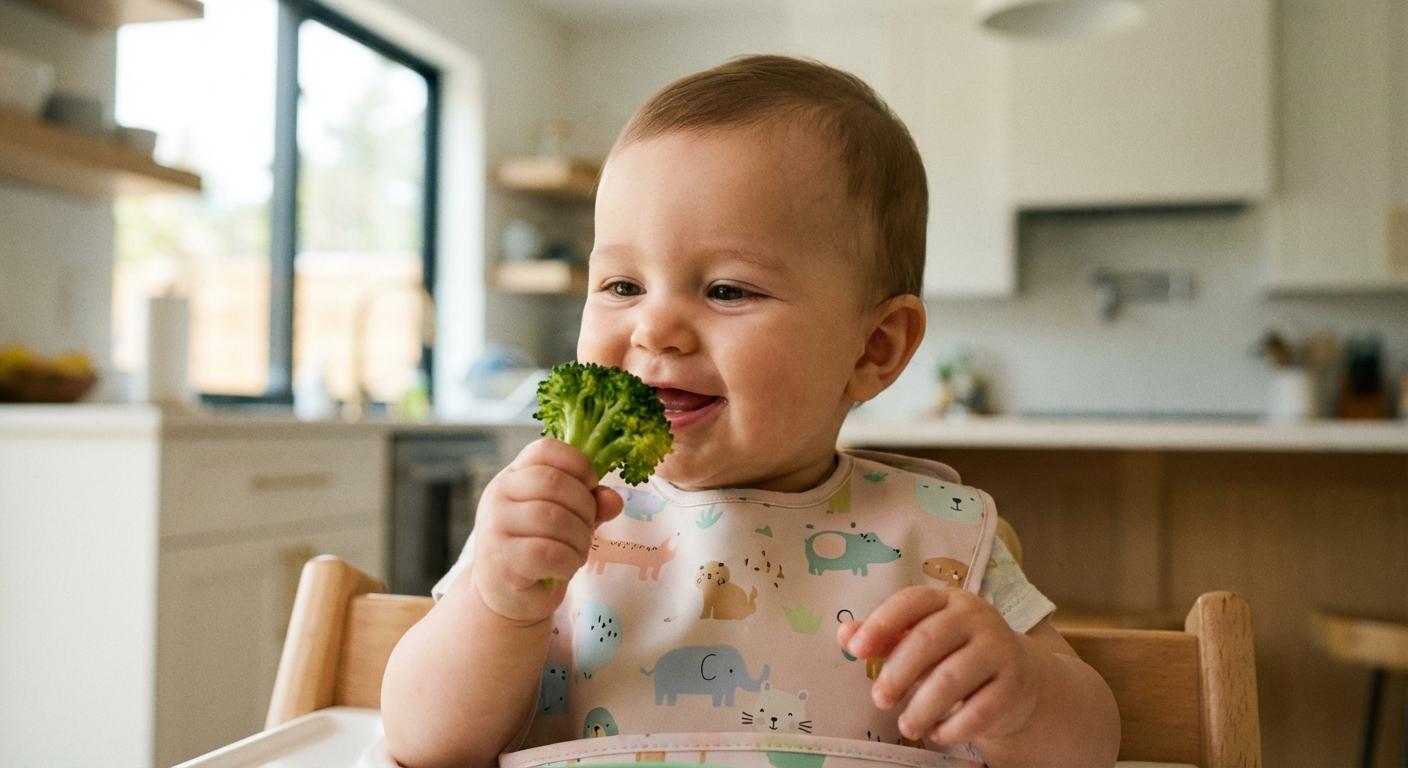
At 8 months, mealtimes can feel like a tiny show: your baby grabs, squishes, spits out… and then demands one more bite. Some days the spoon is welcomed. On other days, the same spoon is treated like a suspicious object. Milk is still the mainstay, solids are finding their place, and textures begin to matter much more. And yes, the late-night thought pops up: “Is my baby eating enough?”
Between portion “rules”, worry about lumps, food allergies, constipation, or reflux, a simple and steady plan helps. Not rigid. Not stressful. Just realistic 8 month old baby food guidance you can actually follow at home.
8 month old baby food: what changes at 8 months
At this stage, 8 month old baby food is about nourishment and skill-building. Three goals usually sit at the centre:
- Meeting needs for energy (babies become more active), iron (to reduce iron deficiency anaemia risk), and essential fats (brain and vision development).
- Expanding sensory learning (taste, smell, temperature, texture) without turning meals into a daily battle.
- Supporting oral-motor skills: tongue movements, gum “chewing”, hand-to-mouth coordination, and early self-feeding.
Do solids need to “speed up” at 8 months? Variety can expand, surely. But pressure tends to backfire.

Breast milk or formula: still the nutritional base
In 8 month old baby food, breast milk or formula remains the primary food until 12 months. It supplies a large share of calories, protein, calcium, and several micronutrients.
Many babies fall roughly into these ranges (appetite varies a lot):
- About 500 to 800 ml in 24 hours
- Usually 2 to 4 milk feeds (sometimes more in breastfed babies)
Breastfeeding can continue on demand. Solids can sit “around” feeds. If a few days look mostly milk-based (teething, illness, travel), it is usually a normal fluctuation.
Texture progression at 8 months: moving beyond smooth purees
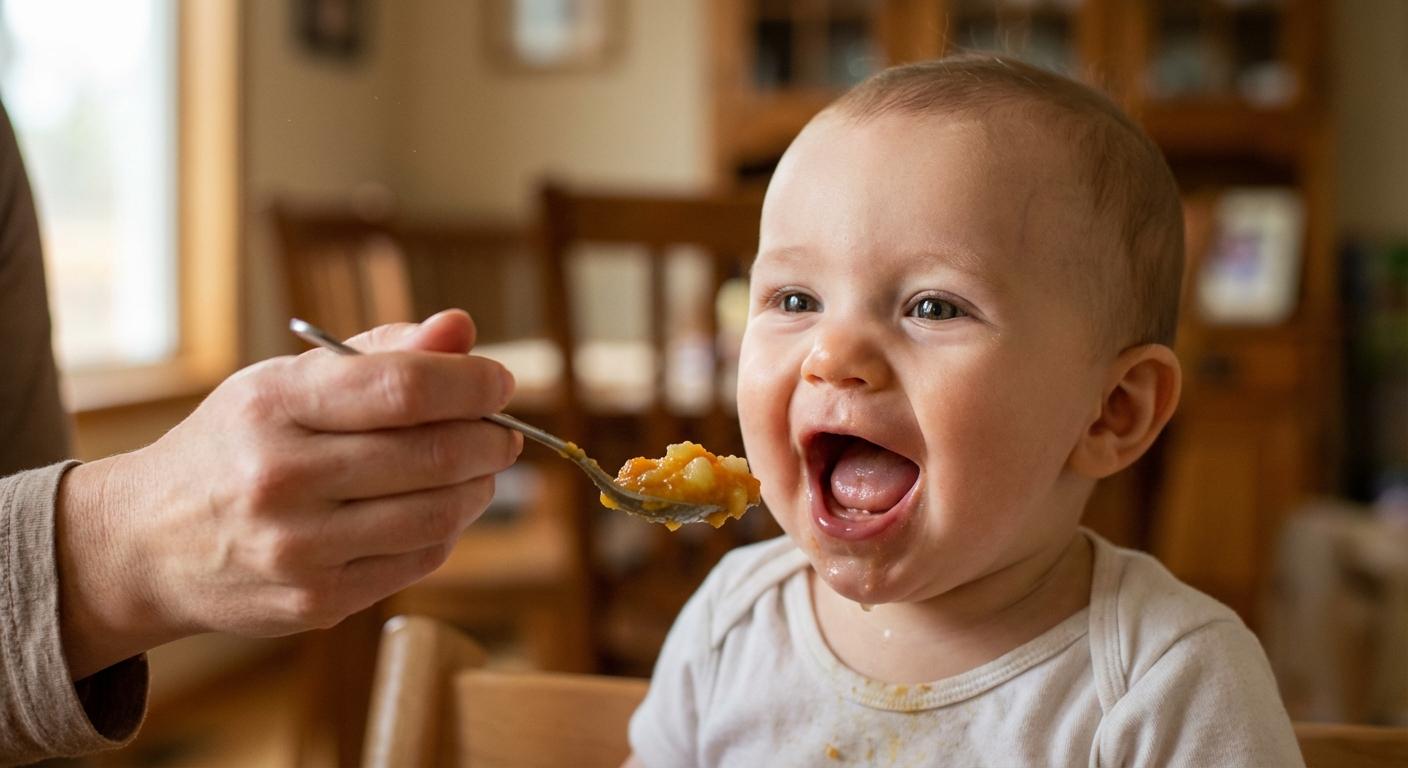
A key shift in 8 month old baby food is texture. Many babies start transitioning from very smooth purees towards:
- Thicker purees (less uniform)
- Fork-mashed foods
- Tiny, very soft, meltable pieces
This matters because it trains the mouth. Even without many teeth, babies manage with gums and tongue. Small gagging can happen during learning (gagging is a protective reflex). Choking is different and needs prevention.
If your baby spits out or “rejects” a food, it may be exploration. It is common for a food to be refused many times and then accepted later.
Signs your baby may be ready for thicker textures and finger foods
Your baby may be ready if they:
- Hold the head steadily
- Sit with good stability (hips supported in a high chair)
- Bring food to the mouth with intention
- Show interest in what you eat
Digestively, the gut is more mature than at 6 months, but minor issues are still common: gas, slower stools, and reflux. Small sips of water with meals, fibre from fruits and vegetables, and enough healthy fats can help.
How much should an 8-month-old eat? Practical guides, not strict rules
In 8 month old baby food, portions are flexible. Intake changes with growth spurts, sleep, fever, heat, activity, and mood.
Milk: how much per day?
A useful range remains 500 to 800 ml per 24 hours (breast milk or formula). If solids temporarily reduce but milk intake is stable, overall balance is often acceptable.
Vegetables and fruits: easy portion ideas
Many families settle around:
- Vegetables: 150 to 200 g/day, across 1 to 2 meals
- Fruit: about 100 g/day, 1 to 2 times (ripe fruit, stewed fruit, or unsweetened puree)
In India, common options that work well (well-cooked, soft):
- Vegetables: lauki (bottle gourd), pumpkin, carrot, sweet potato, beans, ridge gourd, spinach (cooked thoroughly)
- Fruits: banana, stewed apple, papaya, pear (cooked/soft), chikoo (sapota) when ripe
Starches: steady energy foods
Starches provide easy energy in 8 month old baby food. Good choices include:
- Well-cooked rice or soft rice mash
- Suji (semolina) porridge
- Very soft pasta
- Mashed potato or sweet potato
- Soft cooked dalia (broken wheat) if well tolerated
Protein: daily guide and equivalents
A commonly used guide at 8 months is 10 to 15 g/day of well-cooked meat or fish, finely minced or flaked.
Other equivalents:
- Fully cooked egg: 1/4 to 1/2 (start small)
- Well-cooked dals and legumes: a few spoonfuls, mashed or blended (for example, moong dal, masoor dal)
The medical focus is iron. Animal sources provide haem iron (better absorbed). Plant sources still help, especially when paired with vitamin C foods.
Fats and water: small steps that matter
Fats support brain growth and help meet calorie needs.
A simple habit: add 1 teaspoon of vegetable oil or ghee per puree-based meal, added after cooking. Options may include olive oil, rice bran oil, or a little ghee (choose what suits your family and keep quantities modest).
Offer water with meals (a few sips from a cup). Milk remains the main drink.
A flexible 8-month feeding schedule (milk + meals)
Routine helps, but flexibility keeps peace. Some babies eat less at lunch and compensate later.
Sample day structure
- Morning: milk feed
- Breakfast solids (optional)
- Midday: milk feed
- Lunch solids
- Afternoon: milk feed
- Dinner solids (or milk-focused)
- Bedtime: milk feed
Breakfast ideas
- Breast milk or formula: often 150 to 240 ml
- If appetite permits: mashed banana, stewed apple puree (60 to 100 g), or a small portion of infant cereal
Lunch ideas
- Veg + starch: 150 to 200 g total
- Protein: 10 to 15 g meat/fish or 1/4 to 1/2 fully cooked egg or mashed dal
- 1 teaspoon oil/ghee
- Fruit if your baby wants it
Evening snack
- Milk: often 150 to 240 ml
- Fruit puree
- Optional: plain curd (dahi) or unsweetened yogurt in small amounts (as an addition, not a routine replacement for milk)
Dinner: two common patterns
Babies often prefer one of these:
- A more milk-focused evening
- A small vegetable puree dinner (sometimes with starch), followed by milk
A heavier dinner disturbs sleep for some babies, while others settle better when they are fuller. Watch your baby’s pattern and adjust.
What to offer at 8 months: building balanced meals (Indian home foods included)
For 8 month old baby food, keep the rule simple: age-appropriate foods, well cooked, no added salt, no added sugar.
Key food groups
- Vegetables: wide variety, cooked soft
- Fruits: ripe and soft, often stewed or very tender
- Starches: rice, suji, dalia, pasta, potato
- Proteins: meat, fish, fully cooked egg, legumes
- Dairy: plain curd/yogurt, unsweetened paneer in tiny amounts if tolerated (and not salty)
Foods to limit
- Added salt (kidneys are still maturing)
- Added sugar, jaggery, honey (avoid honey under 12 months)
- Packaged juices and sweet drinks
- Processed meats and salty snacks
Higher-risk foods and hygiene reminders
- Avoid unpasteurised milk and cheeses
- Choking hazards to avoid: whole grapes, nuts, raw carrot sticks, popcorn, sausage coins, hard biscuits
- Cook foods thoroughly, cool to safe temperature, and keep utensils clean
From smooth purees to mash and soft pieces: what is normal
A slightly grainy texture is often part of learning. In 8 month old baby food, texture practice is a skill, not a test.
Transition steps that work
- Smooth puree for tired days
- Thicker puree as a bridge
- Fork-mash with tiny soft lumps
Tip: keep the same food and change only texture. For example, start with smooth carrot puree, then a thicker carrot mash, then a fork-mashed carrot.
If your baby coughs a bit, spits out, or makes faces without distress, it is often practice. Seek medical help if there is persistent vomiting, frequent choking episodes, breathing trouble, or poor weight gain.
First “meltable” pieces: safe examples
Aim for foods that squash easily between fingers:
- Steamed carrot sticks
- Very soft sweet potato
- Soft lauki or pumpkin pieces
- Well-cooked cauliflower florets
- Ripe banana
- Cooked pear wedges
Finger foods and baby-led feeding at 8 months: safety first
A baby-led approach can fit 8 month old baby food if your baby:
- Sits stably
- Controls head/neck well
- Grasps food and brings it to the mouth
Easy-to-hold options: ripe avocado, thick banana pieces, steamed sweet potato sticks.
Safety basics:
- Constant supervision
- Upright seated position
- Avoid hard, round, sticky, crumbly foods
Allergens: introducing them calmly
Current medical guidance suggests not delaying allergens unnecessarily. Introduce small amounts, one at a time, when your baby is well.
A simple approach:
- Offer one allergen in a tiny quantity
- Choose a day you can observe
- If tolerated, repeat regularly
Common allergens include egg, peanut, tree nuts, fish, wheat, milk, and soy.
Possible signs include hives, swelling, repeated vomiting, diarrhoea, cough, wheeze, and breathing difficulty.
If you see breathing trouble, facial swelling, unusual sleepiness, or collapse: seek urgent medical care.
Day-to-day adjustments: cues, common concerns, and organisation
With 8 month old baby food, your baby’s signals matter as much as the menu.
Hunger and fullness cues
Hunger cues: leaning forward, opening mouth, reaching, excited sounds.
Fullness cues: turning away, sealing lips, pushing spoon, slowing down, wanting to play.
A helpful division of roles: you offer the structure and suitable food, your baby decides the amount.
Refusal, constipation, reflux: quick starting points
- Refusal: common with new textures. Offer again later, no pressure, alongside a familiar food.
- Constipation: water with meals, fibre-rich fruits (stewed pear, prune puree), vegetables, and balanced starch. Seek care if there is pain, blood in stools, vomiting, or constipation lasting several days.
- Reflux: smaller, more frequent meals, sometimes thicker textures, keep baby upright after meals. Seek care if there is pain with feeds, poor growth, or intense crying during meals.
Prep and storage: time-saving without unsafe shortcuts
Batch cooking reduces load: steam vegetables, portion, freeze.
Reminders:
- Refrigerate promptly in clean containers
- Freeze in single portions and label
- Reheat evenly, stir, and check temperature
Eating out or childcare
Easy travel foods: unsweetened fruit puree, ripe banana, a chilled portion of veg puree, pre-measured formula supplies.
For childcare, share the texture your baby manages (smooth, thick, mashed, meltable pieces) and the list of allergens already introduced.
Simple menu examples (Indian-friendly options)
Day 1 (chicken)
- Breakfast: milk + mashed banana
- Lunch: thicker carrot-lauki puree + mashed potato + finely minced chicken (10 to 15 g) + 1 tsp oil/ghee
- Snack: milk + stewed apple
- Dinner: smooth pumpkin puree + milk
Day 2 (fish)
- Breakfast: milk + fruit puree
- Lunch: well-cooked spinach (pureed) + soft rice + flaked fish (10 g), deboned carefully + 1 tsp oil
- Snack: milk + papaya mash
- Dinner: sweet potato puree + milk
Day 3 (egg)
- Breakfast: milk (optional infant cereal)
- Lunch: pumpkin + suji + 1/4 to 1/2 hard-boiled egg, mashed + 1 tsp oil
- Snack: milk + fruit puree
- Dinner: thicker mixed veg puree + milk
Day 4 (dal)
- Breakfast: milk + fruit
- Lunch: carrot + well-cooked masoor/moong dal (blended) + small potato portion + 1 tsp oil/ghee
- Snack: milk + stewed pear
- Dinner: mashed zucchini (or soft gourd) + milk
Safety recap: choking prevention and safe habits
- Seat your baby upright in a stable high chair.
- Stay within arm’s reach and give full attention during meals.
- Avoid common choking hazards (hard, round, sticky foods).
- Keep foods soft enough to squash easily.
Key takeaways
- 8 month old baby food is still milk-centred, solids add variety and skills, without pressure.
- Useful guides: vegetables 150 to 200 g/day, fruit about 100 g/day, protein 10 to 15 g/day, plus fats (about 1 teaspoon oil/ghee per puree-based meal).
- Textures can progress gradually: smooth to thicker puree/mash to meltable pieces.
- Focus on iron-rich foods (meat, fish, egg, dals) and keep salt and sugar out.
- Safety is non-negotiable: upright seating, supervision, and avoiding choking hazards.
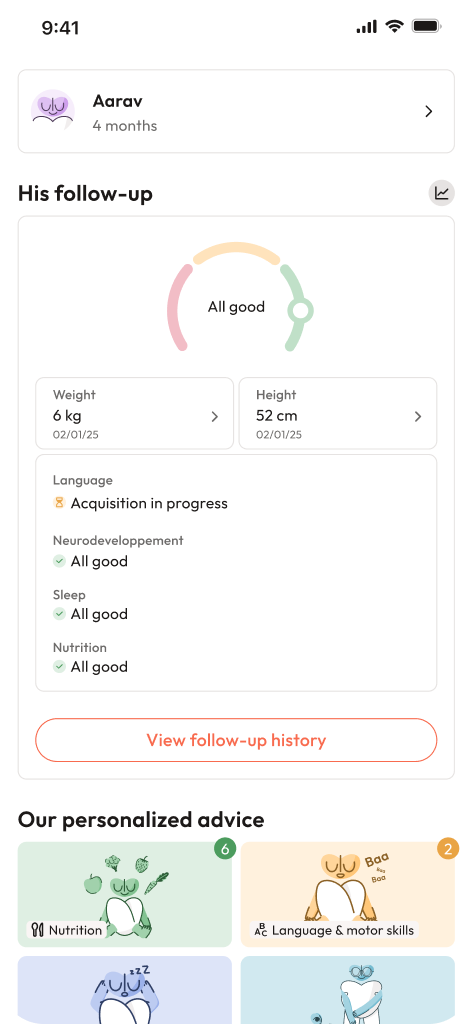
- If reflux, constipation, feeding distress, allergy concerns, or growth worries persist, professionals can support you. You can also download the Heloa app for personalised tips and free child health questionnaires.
Further reading :