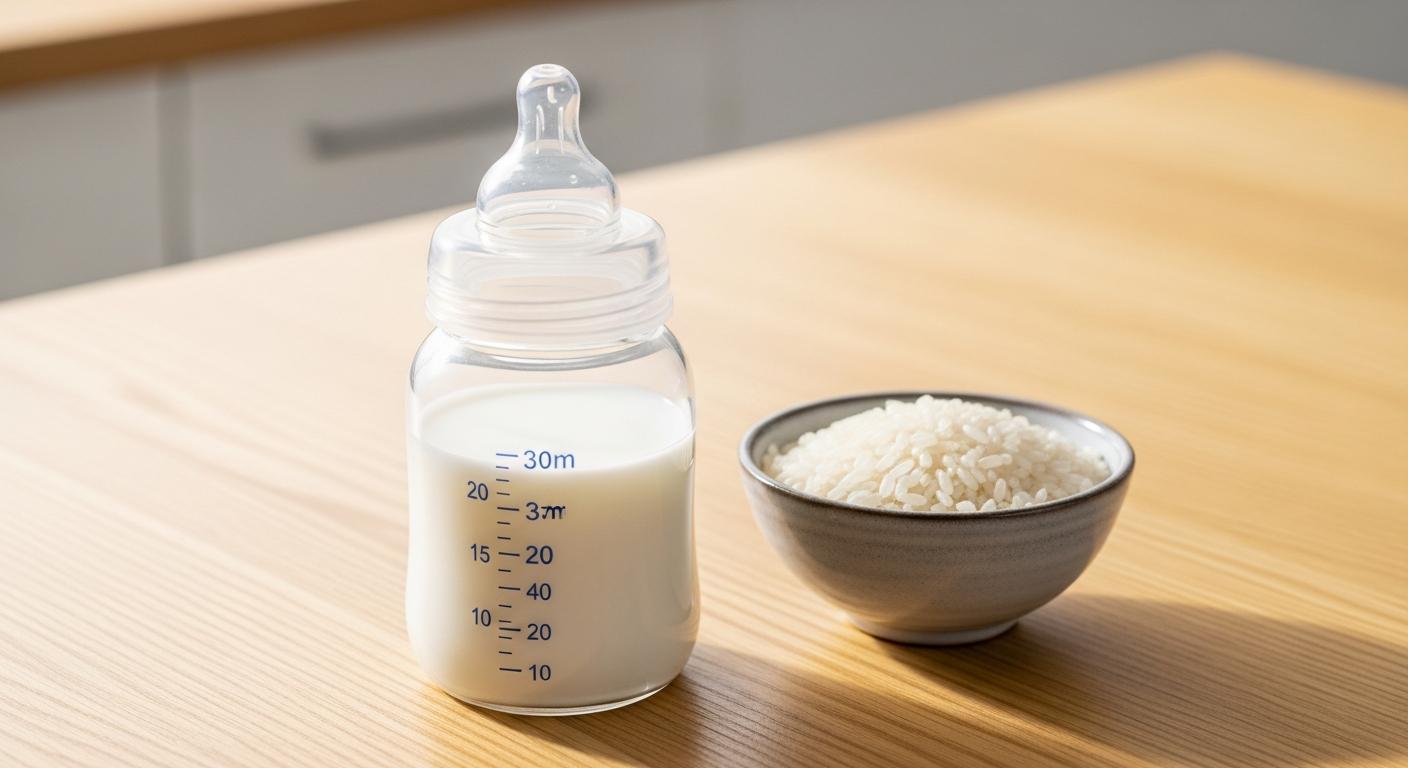
Feeding can feel straightforward – until your baby starts spitting up after every feed, scratching at angry eczema patches, or crying through the bottle. That is often the moment parents Google rice milk for babies. Something gentle. Something “light”. Something that will not trigger tummy trouble.
But one small detail changes the whole meaning: are you holding a commercial rice drink from the supermarket (often in the plant-based beverage section), or a rice-based infant formula meant for babies and regulated as a formula? The names sound similar. The nutrition is not.
Rice milk for babies: what parents mean (rice drink vs infant formula)
In everyday talk, rice milk for babies may point to two very different products:
- Rice drink / rice beverage: a plant drink made from rice and water, sometimes fortified.
- Rice-based infant formula: a formula that meets infant nutrition standards and is fortified by design.
A quick label check helps. If it says “drink” or “beverage”, it is not equivalent to breast milk, infant formula, or cow’s milk.

Why rice drink tastes naturally sweet
Rice drink is typically rice (milled rice or rice flour) blended with water and filtered. Many brands add enzymes that break rice starch into smaller sugars. That is why it can taste sweet even without “added sugar”.
Rice drink: typical nutrition limits
Most rice drinks are:
- Very low in protein (often under 0.5 g/100 mL)
- Low in fat (so fewer essential fatty acids for brain and eye development)
- Low in iron and zinc (and plant compounds like phytates can reduce absorption)
- Higher in carbohydrates, sometimes with more sugars due to starch breakdown
A common thought is: “If my baby drinks enough quantity, it should be fine, no?” The issue is that babies can drink plenty and still miss protein, iron, calcium, vitamin D, and overall energy density.
Rice-based infant formula: what makes it different
Rice-based infant formula follows strict rules for calories, protein quality, vitamins, minerals, and essential fats.
Its main feature is hydrolysed rice protein (protein broken into smaller fragments), which may be useful in selected situations under paediatric guidance – especially when cow’s milk proteins are not tolerated.
And importantly, it is fortified (iron, calcium, vitamin D, essential fatty acids). Plain rice cannot meet an infant’s needs.
When can babies drink rice milk?
Early growth is rapid – brain wiring, bone mineralisation, immune development. The margin for error is small. That is why a plant drink should not become a baby’s main milk.
Under 12 months: why rice drink is not suitable
Before 12 months, a commercial rice drink is not suitable as a main drink and should not replace breast milk or infant formula.
Reasons:
- Too little protein and fat for fast growth
- Nutrient density too low (iron and vitamin D are frequent gaps)
- Fortification varies widely across brands
- Extra concern: inorganic arsenic exposure from rice-based products
If a baby needs a non-dairy option, the safer route is a clinician-chosen infant formula (extensively hydrolysed, amino-acid formula, or sometimes rice-based infant formula depending on the plan).
After 12 months: where rice drink can fit
After 12 months, rice drink can fit occasionally in a varied toddler diet – more like an extra beverage with meals, or used in cooking, rather than the default drink through the day.
If you choose it, prefer:
- Unsweetened, unflavoured
- Fortified with calcium and vitamin D
- Vitamin B12 fortification if the family diet is vegan
Even when fortified, rice drink remains low in protein and fat.
1 to 3 years: how a “good idea” can backfire
Toddlers eat more solids, yes, but milk (or an age-appropriate equivalent) still contributes calcium, fat, and protein.
Rice drink is easy to overuse – especially if a child likes the taste. Over time, it may displace more nourishing options and quietly lower overall diet quality.
Rice milk for babies: safety concerns (arsenic, sugars, digestion)
Rice can absorb arsenic from soil and groundwater. The main concern in foods is inorganic arsenic.
Babies and toddlers are more sensitive because they consume more per kilogram of body weight and their organs are developing.
Practical steps:
- Avoid using rice drink as the daily main beverage for young children
- Rotate grains during weaning (do not let rice dominate every day)
- If a rice option is needed in infancy, a regulated rice-based infant formula may be safer than a rice drink when medically appropriate
Added sugars, syrups, flavoured cartons
Even with “no added sugar”, rice drink may taste sweet due to starch breakdown. Still, check for:
- Added sugar
- Syrups (including rice syrup)
- Flavours like vanilla/chocolate (often higher sugar)
Frequent sweet drinks can encourage a stronger preference for sweetness and increase tooth decay risk, especially with all-day sipping.
Constipation and stool changes
Rice is low in fibre, so rice-heavy patterns can be binding for some children. Thickened anti-reflux formulas can also firm stools.
Speak to a clinician if you see:
- Painful constipation or fissures
- Repeated vomiting
- Persistent diarrhoea
- Signs of dehydration (fewer wet nappies, dry mouth)
Rice milk for babies: nutrition essentials parents should watch
Protein supports growth, immune function, enzymes, and tissues. Rice drink is naturally low in protein.
If a toddler has rice drink sometimes, protein needs must come from meals:
- Egg, fish, chicken/meat (as per family preference)
- Dahi, paneer, cheese (if dairy tolerated)
- Dal, chana, rajma
- Tofu
- Nut/seed butters in safe, age-appropriate textures
Fat and essential fatty acids
Young children need fat for energy and neurodevelopment. Rice drink is usually low in fat.
Add healthy fats via foods:
- Avocado
- Groundnut, mustard, or rice bran oil in cooking (as suited)
- Full-fat dahi (if tolerated)
- Nut/seed butters
- Oily fish where culturally appropriate
Iron, calcium, vitamin D
These are the nutrients most at risk when rice milk for babies is interpreted as “swap formula for rice drink”.
- Iron supports brain development and prevents anaemia.
- Calcium + vitamin D support bones and teeth.
Infant formulas are designed to supply these reliably, rice drinks are not.
Why rice drink cannot replace breast milk or infant formula
Infants need a tightly balanced package of calories, high-quality protein, fats, and micronutrients in predictable amounts.
Rice drink cannot provide that balance consistently. Homemade rice milk is even riskier: nutrition varies with recipe and straining, and it is not reliably fortified.
If rice drink replaces breast milk or formula in the first year, possible outcomes include:
- Low calorie intake
- Protein and fat intake too low
- Iron and vitamin D shortfalls
Over time, growth may slow and weight gain may be affected.
Rice-based infant formula: when clinicians may consider it
Parents searching rice milk for babies are often trying to avoid cow’s milk proteins. A paediatrician may discuss rice-based infant formula in selected situations.
Cow’s milk protein allergy (CMPA)
CMPA is an immune reaction to proteins in cow’s milk.
Typical approach:
- First option often: extensively hydrolysed formula (eHF)
- If symptoms persist or strict avoidance is needed: rice-based infant formula may be considered
- Severe cases: amino-acid formula
Choice depends on symptoms (skin, gut, respiratory) and growth.
Lactose intolerance is different
Lactose intolerance is reduced lactase enzyme activity, often temporary in babies – sometimes after a stomach infection.
Important: “lactose-free” does not automatically mean “allergy-safe”. CMPA is about protein, not lactose.
Reflux and thickened formulas
Reflux is common and often settles with time. Thickened formulas may be considered if reflux affects feeding or growth.
If a thickened option is used, monitor stools – constipation can worsen.
Choosing and using rice-based infant formula (practical points)
- Age stage (0-6 months, 6-12 months, 1-3 years)
- Hydrolysed rice protein
- Iron, calcium, vitamin D
- Thickened or not (and constipation risk)
If it is a rice drink carton from the plant-beverage aisle, it is not infant formula.
Preparation: hygiene and exact mixing
- Wash hands, keep bottles and nipples clean
- Use level scoops and the exact water quantity
- Use safe drinking water as per product instructions
Do not concentrate formula to keep baby “fuller”. It can disturb the body’s salt-water balance.
Storage and travel
- Avoid microwave heating
- Discard after 2 hours at room temperature
- Refrigerate only if product instructions allow, typically up to 24 hours at ~4°C
- For travel, carry powder separately and mix fresh, keep prepared bottles chilled
Discard any bottle once feeding has started.
Switching formulas
Unless advised otherwise (for example, a strict allergy plan), gradual change often suits: 25/75, then 50/50, then 75/25, then 100% over a few days.
Track stools, reflux, comfort, and appetite.
Rice drink after 12 months: how to choose and serve
- Unsweetened and unflavoured
- Fortified with calcium and vitamin D
- Avoid sweetened flavours
Serving style
Offer in an open cup or straw cup. Give it with meals, not for continuous sipping. Offer water between meals.
Homemade rice milk: is it a good idea?
For infants, no. For toddlers, it is unpredictable in calories and nutrients, not reliably fortified, and it spoils quickly.
If used in cooking, keep portions small and pair with nutrient-dense foods.
When to seek medical advice quickly
Seek medical advice if you notice:
- Poor weight gain, tiring during feeds
- Worsening eczema or hives
- Wheeze or breathing discomfort
Seek urgent care for swelling of face/lips/tongue, breathing difficulty, or collapse.
Key takeaways
- Rice milk for babies may mean a commercial rice drink (not suitable as a baby’s main drink) or a rice-based infant formula (regulated and fortified).
- Before 12 months, rice drink should not replace breast milk or infant formula.
- Rice-based infant formula may be used under paediatric guidance in selected cases (CMPA, significant reflux, specific clinical needs).
- Because of inorganic arsenic, avoid making rice drink the everyday main beverage for young children and rotate grains during weaning.
To remember
Parents deserve clear options when feeding gets stressful. Your paediatrician, dietitian, and lactation support can help tailor a safe plan.
For personalised tips and free child health questionnaires, you can also download the Heloa app.

Further reading :