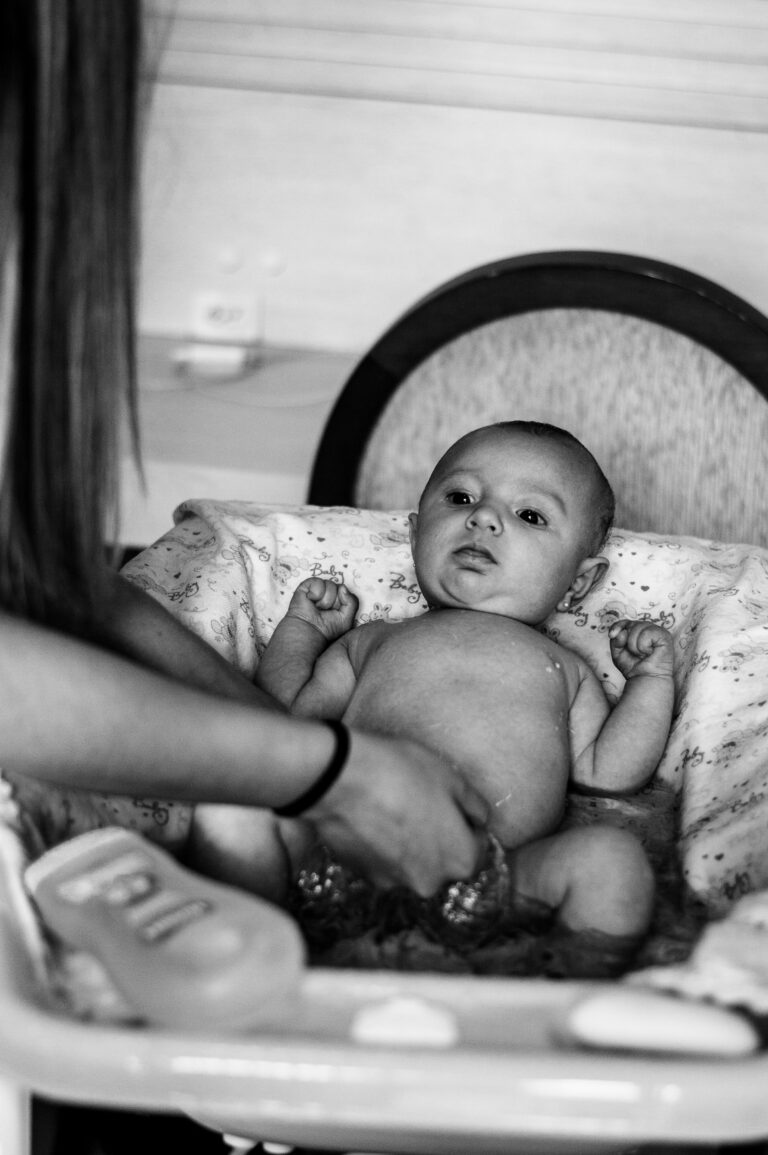
Baby naps can feel puzzling in the early months: one day your baby dozes off anywhere, the next day the nap ends at 32 minutes and you start thinking something is off. Usually, it is simply sleep development in action. Short sleep cycles, the circadian rhythm settling into day and night, digestion, the need for closeness, and the sleep setup all play a role. With a few steady anchors (sleep needs by age, wake windows, tired cues, a simple routine, and safe sleep), baby naps become easier to manage.
Baby naps and night sleep: how they fit together
Naps are not “extra” sleep. They sit inside your baby’s 24-hour sleep requirement. Early on, sleep is spread across the full day because feeding needs and immature sleep organisation drive frequent sleep bouts.
Two forces guide sleep:
- Circadian rhythm (body clock, shaped largely by light)
- Sleep pressure (the need for sleep that builds during awake time)
Night sleep leans more on the body clock, baby naps lean more on sleep pressure. When naps are timed well, many babies settle faster at bedtime. When the last nap runs too late, bedtime can shift later and night sleep may get lighter.

Why baby naps matter for mood, feeds, and growth
Daytime sleep supports emotional regulation, growth hormone release, and better stamina for feeding. Missed baby naps often show up as late-day fussiness, “wired” behaviour, and feeds that feel frantic.
From a child-health viewpoint, naps help:
- steadier mood
- calmer feeds (less fatigue-driven “snacking”)
- memory and learning as sleep architecture matures
- recovery and tissue repair
Short or inconsistent baby naps are often normal, or a sign that timing needs a small tweak.
The science behind baby naps: cycles, clock, pressure
If you understand only three words for naps, make it these: cycle, clock, pressure. Most daytime sleep trouble sits somewhere in that triangle.
Short sleep cycles: why 30 to 45 minute naps happen
Before about 3 months, sleep cycles are often 40 to 60 minutes, with lots of active sleep (movement, small sounds). A baby nap that ends after one cycle is frequently just that: a completed cycle.
As the first year moves along, cycles often lengthen towards 70 to 90 minutes, and many babies link cycles more easily. This is when baby naps may consolidate.
Day/night rhythm: what changes after 2 to 4 months
The circadian system is immature at birth. Daylight during wake time and dimmer evenings act like time signals. Around 2 months, melatonin secretion becomes more noticeable for many babies, and day/night patterns often feel clearer by 3 to 4 months.
Sleep pressure and wake windows: tiny shifts, big impact
If a wake window is too long, overtiredness can make settling harder. Too short, and sleep pressure may be low, leading to quick wakes. For many families, adjusting timing by 10 to 15 minutes is more effective than adding extra soothing.
Baby naps by age: practical expectations
These ranges are flexible. Temperament, illness, travel, and childcare can change baby naps for a while.
Newborn baby naps (0 to 3 months)
Focus on safe sleep and enough total sleep rather than a strict schedule.
- Wake windows often 45 to 90 minutes (sometimes shorter early on)
- Often 4 to 6 baby naps a day (sometimes more)
- Many naps 20 to 60 minutes, with occasional 2 to 3 hour stretches
Helpful basics:
- feed by hunger cues
- start settling at early tired cues (soft stare, yawns)
- avoid pushing past crying
Stop swaddling once rolling attempts begin.
Baby naps at 3 to 4 months
Many babies move towards 3 to 4 baby naps. Short naps are common (often 30 to 45 minutes) because babies wake at cycle endings and may not yet resettle.
Keep cues steady, protect total sleep, and avoid stretching wake windows aggressively.
Baby naps at 4 to 6 months
Often a 3-nap rhythm:
- morning
- early afternoon
- short late-afternoon nap (often 20 to 45 minutes)
If bedtime keeps sliding later, capping the last nap by 15 to 45 minutes (age-dependent) can protect bedtime sleep pressure.
Baby naps at 6 to 9 months
Many babies settle into 2 to 3 baby naps with about 2.5 to 3.5 hours of daytime sleep. Two “anchor” naps (morning and early afternoon) commonly stabilise the day.
If nap two is short, an earlier bedtime often works better than squeezing in a very late third nap.
Baby naps at 9 to 12 months
Two naps are common. One can be short, that can still be normal. Before dropping a nap, look for a pattern lasting 1 to 2 weeks, not just a few tough days.
Baby naps at 12 to 18 months
Many children move from two naps to one midday nap. Signs include the second nap pushing bedtime too late or becoming consistently difficult. During the transition, an earlier bedtime is a useful tool.
Toddler baby naps (18+ months)
Most toddlers keep one midday nap (often 1 to 2 hours). If bedtime becomes difficult, first check if the nap is too late or too long. If naps start fading, quiet time can still protect mood.
Wake windows and tired cues for baby naps
Wake windows are not a strict timetable, they are a starting point. Pair them with your baby’s cues and you get timing that feels far more natural.
Wake windows by age (use as a starting point)
- 0 to 3 months: 45 to 90 minutes
- 3 to 4 months: 1.5 to 2 hours
- 4 to 6 months: 1.75 to 2.5 hours
- 7 to 10 months: 2.5 to 3.5 hours
- 11 to 14 months: 3 to 4 hours
- 14 to 24 months: 4 to 6 hours
Many babies handle a longer window in the morning and a shorter one later in the day.
Early cues vs late cues
Early cues (best timing help): yawning, softer gaze, rubbing eyes, less engagement.
Late cues: escalating crying, stiff body, arching, frantic movements. This often means overtiredness, which can shorten baby naps.
After short naps, long naps, early mornings
- After a short nap (20 to 40 minutes), the next wake window is often shorter.
- After a long nap (90+ minutes), your baby may manage a fuller window.
If mornings are very early, keep a consistent morning start and get daylight exposure during wake time. If the day becomes too long, earlier bedtime often helps more than a late nap.
Baby nap length and total daytime sleep
Parents often ask: “How much daytime sleep is enough?” There is a range, and it shifts with age.
Typical daytime totals (rough):
- 0 to 3 months: often 4 to 8 hours spread across many naps
- 4 to 6 months: often around 3 to 4 hours
- 6 to 12 months: often around 2 to 3.5 hours
- toddlers: often around 1 to 2 hours
If nights become unsettled, check the last nap and the total day sleep first.
Overtired vs undertired: reading the pattern
Overtired: harder settling, short baby naps with crankiness, late-day meltdowns.
Undertired: long time to fall asleep, playful in the crib, short naps but a happy wake-up.
A small adjustment (10 to 15 minutes) for 4 to 7 days gives the clearest answer.
Nap routine and sleep environment: simple, steady, safe
A quick nap routine (2 to 5 minutes)
- diaper change
- dim the room
- a repeated phrase
- steady background sound
Repetition matters more than doing it perfectly.
Light, sound, temperature
Morning daylight supports the body clock. For baby naps, dim light often helps after 3 to 4 months. A consistent background sound can reduce sudden startles.
Keep the room comfortably cool, 18 to 20°C is a commonly used range. Overheating can disrupt sleep. A wearable sleep sack is safer than loose blankets.
Safe sleep for every nap (including in India’s busy homes)
For every nap:
- back to sleep
- firm, flat surface (crib, bassinet, play yard)
- empty sleep space (no pillows, quilts, soft toys)
In many Indian homes, babies may nap in the living room while elders chat, or while a pressure cooker whistles in the kitchen. If that is your reality, aim for what you can control: a darker corner, steady fan noise or white noise, and fewer sudden disturbances.
On-the-go baby naps happen. In a stroller, keep the face uncovered and check the airway. Car seats are for travel, if your baby falls asleep and you reach home, transfer to a flat sleep surface when practical. In babywearing, keep the chin off the chest and the nose clear.
Feeding, digestion, and baby naps
In the first months, feeding and sleep are closely linked. Sucking is soothing, digestion uses energy, and wake windows are short.
If transfers are difficult (baby sleeps at the breast or bottle but wakes on placing down), try a small bridge:
- feed
- hold upright for 5 to 10 minutes while awake (helps comfort and burping)
- then place down on the back
If reflux seems painful (arching, screaming with feeds, feeding refusal, poor weight gain), speak to your paediatrician. Avoid wedges or inclined products for sleep, the safe position remains on the back on a firm, flat surface.
Common baby naps challenges: quick fixes that often work
When baby naps go off track, it is tempting to change everything. Try one lever, give it a few days, then reassess.
Short naps and micro-naps
Try one change at a time for 4 to 7 days:
- shift timing by 10 to 15 minutes earlier or later
- reduce stimulation before the nap
- keep the room dim and cues consistent
If your baby wakes at 40 to 50 minutes, a brief pause and calm reassurance can sometimes help them link into the next cycle.
Nap refusal or protests
Often it is timing (too early or too late), overstimulation, congestion, teething pain, reflux discomfort, or a routine change. Keep the routine short and calm. Even a quiet rest in a dim room can be restorative.
When naps affect nights
If bedtime is getting later or nights fragment, look at the last nap first: cap it, shift it earlier, or use an earlier bedtime during transitions.
Sample baby naps schedules you can adapt
These are examples, not targets. Use your baby’s wake time as the base.
Example: 3 baby naps day (often 4 to 7 months)
- Wake 7:00
- Nap 1 9:00 to 10:15
- Nap 2 12:30 to 2:00
- Nap 3 4:15 to 5:00
- Bedtime 7:15 to 8:00
Example: 2 baby naps day (often 7 to 12 months)
- Wake 7:00
- Nap 1 9:30 to 11:00
- Nap 2 2:00 to 3:30
- Bedtime 7:00 to 7:30
Example: 1 baby nap day (often 12 to 18+ months)
- Wake 7:00
- Nap 1:00 to 2:30
- Bedtime 7:00 to 7:30
If daycare sets nap timings, keep your home anchors steady: a consistent morning start, a calming evening routine, and bedtime that does not drift too late.
Tracking baby naps and when to seek medical advice
Track for 7 to 14 days:
- wake time
- nap start and end
- time to fall asleep
- wake windows
- bedtime and night waking
- feeds near naps
- mood on waking
Seek medical advice if you notice breathing pauses, persistent laboured breathing, bluish or grey colour, unusual sleepiness, poor feeding, dehydration signs, fever (especially in young infants), or concerns about growth.
Key takeaways
- Baby naps are irregular at first, patterns usually improve after 3 to 4 months.
- Wake windows guide timing, tired cues fine-tune.
- Short naps around 4 to 6 months are often normal sleep-cycle development.
- A short routine, steady environment, and safe sleep practices support better baby naps.
- Protect bedtime by managing the last nap and using earlier bedtime during transitions.
- For personalised support and free child health questionnaires, you can download the Heloa app.

Further reading: