
Hearing that seal-like cough in the middle of the night can make any parent sit up straight. Is it just a cold? Is your child’s throat “closing”? And why does it sound so loud when they breathe in? Croup is common in young children, especially in cooler months, and most episodes settle well with the right support. Still, croup deserves attention: when swelling sits just below the vocal cords, the airway can narrow quickly, and symptoms often intensify after bedtime.
What croup is and what happens in the airway
Croup is usually a viral infection that causes swelling in the upper airway—mainly the larynx (voice box) and the upper trachea (windpipe). In small children, this region is already narrow. So even mild inflammation can create noisy breathing and the famous barking cough.
Clinicians may call croup acute laryngotracheitis (or laryngotracheobronchitis if inflammation extends further down). The key area is the subglottis (just below the vocal cords). When it swells, airflow becomes turbulent, producing inspiratory stridor—a high-pitched sound heard when the child breathes in.
You might be wondering: why does your child look okay between coughs, then suddenly sound frightening? Because the swelling can behave like a “valve”: calm breathing may be manageable, while crying, agitation, or lying flat can make the narrowing more noticeable.

Quick signs parents usually notice
Many parents identify croup by this trio:
- Barking cough (often compared to a seal)
- Hoarse or raspy voice
- Noisy breathing on inhalation (stridor)
A practical point that matters a lot: stridor at rest (when your child is calm, sitting quietly, or asleep) needs prompt medical assessment. Stridor only while crying is often milder.
Who gets croup most, and when
Croup is most common from about 6 months to 3 years. With age, the airway widens, so episodes become less frequent. In India too, families often notice more cases during seasonal viral peaks—monsoon-to-winter transitions, cooler evenings, and dry air in air-conditioned rooms can all irritate an already inflamed airway.
Types and patterns of croup
Viral croup often begins like an ordinary cold: runny nose, congestion, mild throat discomfort, sometimes fever. After about 12–48 hours, the barking cough appears, and nights can become rough.
Typical course:
- Symptoms often peak over 1–2 nights
- Many children improve significantly within 48 hours
- Total duration is commonly 3–7 days
Spasmodic croup (sudden at night)
Spasmodic croup may start abruptly at night, sometimes without fever. A child can seem well during the day and then wake up coughing with noisy breathing.
Possible triggers include:
- Viral infections (same viruses as viral croup)
- Airway irritants (cigarette smoke, incense smoke, strong room fresheners)
- Reflux (GERD)
- An atopic tendency (allergy, eczema)
Atypical or recurrent croup
Croup deserves a closer look when:
- Episodes are frequent (for example, several in a year)
- Symptoms are unusually severe
- It occurs outside the typical age range (under 6 months or older than 5–6 years)
- It does not improve as expected with standard treatment
Recurrent croup can sometimes link to reflux/GERD, allergies, irritant exposure, or structural airway differences like subglottic stenosis (a narrower subglottic area). Your paediatrician may suggest further evaluation if the pattern keeps repeating.
Croup symptoms: what to watch closely
Stridor happens because air is squeezing through a narrowed area. The next step is checking your child’s breathing effort.
Signs of increased work of breathing can include:
- Intercostal retractions (skin pulling in between the ribs)
- Pulling in above the breastbone at the base of the neck
- Nostrils flaring
- Fast breathing
- A child who is very agitated… or unusually drowsy and tired
If your child looks exhausted, less responsive, or their breathing sounds become quieter despite obvious struggle, that is an emergency sign.
Why croup often worsens at night
Night-time worsening is common in croup. Reasons include normal overnight changes in cortisol (our natural anti-inflammatory hormone), fatigue, and drier air. Also, a frightened child cries, crying tightens the upper airway, and stridor gets louder. Your calm presence helps more than it may feel in that moment.
Fever, fatigue, and drinking
Fever can happen in croup, but it may be mild. What often matters more is hydration and energy:
- Drinking less than usual
- Feeding becoming tiring
- Fewer wet diapers/less urine
Young children can dehydrate quickly, especially if they are breathing fast and not drinking well.
Babies vs toddlers vs older kids
- Babies (under 12 months): smaller airways, symptoms can progress faster, feeding issues can become a big concern.
- Toddlers (1–3 years): classic age, barking cough and night worsening are typical.
- Older children: croup is less common, clinicians consider other diagnoses more readily.
What causes croup and how it spreads
Most croup is caused by respiratory viruses—commonly parainfluenza viruses. Other causes include RSV, influenza A/B, adenovirus, rhinovirus, human metapneumovirus, and SARS‑CoV‑2.
When bacteria may be involved
Bacterial causes are uncommon, but “croup-like” symptoms with high fever and a very ill-looking child can suggest bacterial tracheitis. In areas with incomplete immunisation, diphtheria remains a rare but serious possibility.
A key clue for bacterial involvement can be: initial improvement followed by worsening again, with fever returning and overall condition declining.
Everyday factors that can worsen episodes
The upper airway can become more irritable with:
- High virus exposure (crèche/daycare, school-going siblings)
- Smoke exposure (including smoke on clothes)
- Incense/dhoop, strong sprays, paint fumes, solvents
- Very dry air (including prolonged AC)
- Reflux/GERD symptoms, especially when lying down
- Allergic rhinitis/atopy
Is croup contagious?
Yes. The viruses behind croup spread via droplets and hands/surfaces. Many children are most contagious in the first few days, and return-to-school decisions often follow: fever-free for 24 hours (without fever medicines) plus the child being well enough to participate.
Croup or something else?
Sometimes symptoms overlap, and doctors keep an open mind.
- Common cold: cough and runny nose, but typically not a barking cough.
- Bronchiolitis: lower airway disease (often RSV) with wheeze/crackles, fast breathing, feeding difficulty, usually no stridor.
- Asthma: wheeze mainly on breathing out, stridor suggests an upper-airway issue.
More serious possibilities:
- Epiglottitis: high fever, drooling, difficulty swallowing, muffled voice, very unwell child—emergency.
- Bacterial tracheitis: toxic appearance, thick secretions, stridor not improving as expected.
- Foreign body aspiration: sudden onset during eating/play, often without fever—urgent evaluation needed.
How doctors assess croup severity
Clinicians often describe croup as mild, moderate, or severe by looking at stridor, retractions, breathing rate, and the child’s general state.
- Mild: barking cough, stridor only when upset, minimal/no retractions.
- Moderate: stridor at rest, noticeable retractions, child distressed but alert.
- Severe: prominent stridor at rest, marked retractions, very fast breathing, agitation or exhaustion.
Some teams use the Westley croup score (alertness, cyanosis, stridor, air entry, retractions) to guide treatment and monitoring.
Emergency warning signs
Seek emergency care if you notice:
- Blue/grey lips or face (cyanosis)
- Pauses in breathing
- Severe retractions or struggling to speak/cry
- Extreme tiredness, poor responsiveness
- Poor air movement (breathing sounds getting quieter)
- Drooling with difficulty swallowing and high fever
When to seek medical care
Home care may be suitable when croup is mild and your child:
- Breathes comfortably between coughs
- Has no stridor at rest
- Drinks reasonably well and passes urine normally
- Looks alert, with normal skin colour
When to call your doctor the same day
Same-day advice is sensible if:
- Your baby is very young (especially under 3 months)
- Stridor occurs at rest, even if mild
- Breathing effort is increasing (retractions, nasal flaring, fast breathing)
- Fever is high/persistent or your child seems unusually sleepy/irritable
- Drinking drops or wet diapers reduce
- Symptoms are not improving over 3–5 days
When to go to the ER immediately
Go urgently if there is:
- Stridor at rest with significant breathing difficulty
- Blue/grey colour or your child looks very unwell
- Pauses in breathing
- Inability to drink, signs of dehydration
- Rapid worsening
How croup is diagnosed
Croup is mainly a clinical diagnosis. The doctor listens for stridor, checks voice hoarseness and the barking cough, measures breathing rate, and looks for retractions. They also assess hydration and overall appearance.
Tests may include:
- Pulse oximetry to check oxygen saturation
- A neck X-ray only if diagnosis is unclear or symptoms are severe (may show the “steeple sign”)
- Viral testing only in selected situations (severe/atypical illness, immunocompromised child, outbreak tracking)
Recurrent or atypical croup may lead to ENT or paediatric pulmonology review. Flexible laryngoscopy/bronchoscopy can assess structural issues or vocal cord movement.
Medical treatment options
The aim is to reduce airway swelling, ease breathing, support oxygenation and hydration, and keep the child calm.
Steroids
Steroids reduce inflammation and are a mainstay of croup treatment.
- Dexamethasone is commonly given as a single dose (often 0.6 mg/kg, max 10 mg) orally or by injection.
- Prednisolone can be used in some settings.
- Nebulised budesonide is an option if inhaled treatment is preferred or oral medicine is difficult.
Many children start improving within a few hours, and benefit often lasts beyond 24 hours.
Nebulised epinephrine and observation
For moderate to severe croup, nebulised epinephrine can rapidly reduce swelling and improve stridor. Because the effect can wear off, observation for a few hours is standard to ensure symptoms do not return.
Hospital care for severe croup
In hospital, teams may provide oxygen (if needed), monitoring, and repeat treatments. Rarely, heliox (helium-oxygen mixture) or intubation is required if breathing failure is developing.
Antibiotics
Antibiotics do not treat viral croup. They may be used if bacterial tracheitis, pneumonia, diphtheria, or another bacterial complication is suspected.
Home care for mild croup
This is not “just emotional comfort”—it changes the airway dynamics. Crying tightens the upper airway and can amplify stridor. Hold your child upright, speak softly, and keep the room quiet.
Fluids, rest, and safe positioning
Offer frequent sips of water, ORS if advised, soups, or breastfeeds—small and often. Rest supports recovery.
Upright positioning on your lap can ease breathing. For sleep, maintain a safe flat sleep surface, avoid pillows or propping that could lead to unsafe positioning.
For fever or discomfort, paracetamol (acetaminophen) or ibuprofen may be used when appropriate for age and medical history, as per dosing guidance.
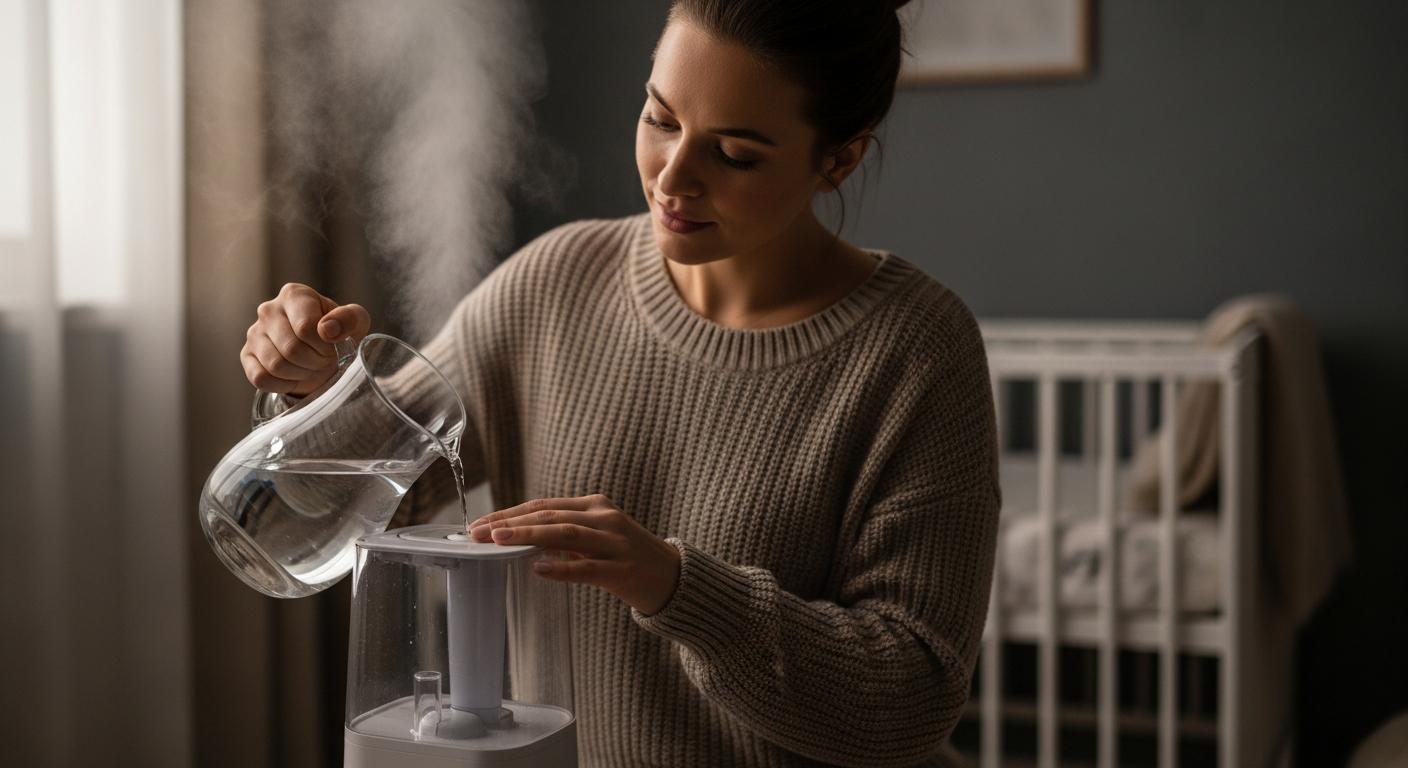
Humidifier and cool air: safe use
Humidified air has mixed evidence, but some children feel better with cool mist.
- Use a cool-mist humidifier
- Clean it daily to reduce mould/bacteria
- Keep it out of reach
Avoid hot steam (burn risk) and “steamy bathroom” methods.
Helpful, simple add-ons (when symptoms are mild)
Some children temporarily improve with a few minutes of cool night air near an open window or on a balcony (keep your child warmly dressed). If stridor is present at rest or breathing looks hard, do not rely on this—seek urgent medical advice.
For children over 1 year, a small amount of honey can soothe throat irritation. Avoid honey under 1 year due to the risk of infant botulism.
If episodes keep recurring, discuss triggers like reflux/GERD, smoke exposure, and allergies with your paediatrician, especially if noisy breathing happens even when your child is otherwise well.
How long croup lasts and returning to routine
Most croup improves within 3–5 days, and many children are much better within a week. Seek medical advice if symptoms worsen, your child cannot drink adequately, or there is no improvement after a few days.
Return to school/daycare is usually reasonable when your child is fever-free for 24 hours (without fever medicine), breathing is comfortable at rest, drinking is adequate, and they can take part in routine activities.
Prevention and reducing future episodes
Because croup is usually viral, prevention mirrors cold/flu prevention:
- Handwashing
- Covering coughs/sneezes
- Cleaning frequently touched surfaces
- Good ventilation at home
Avoid smoke exposure and strong fumes. If reflux or allergies seem to trigger episodes, discuss management options with your clinician.
À retenir
- Croup often starts like a cold, then becomes a barking cough with hoarseness and sometimes stridor, often worse at night.
- Stridor at rest, increasing retractions, blue/grey colour, pauses in breathing, or drooling with swallowing difficulty need urgent medical care.
- Steroids like dexamethasone reduce airway swelling, nebulised epinephrine may be used for moderate to severe croup with observation.
- Calm, upright positioning and good hydration can make nights easier.
- For recurrent or atypical croup, your paediatrician may consider reflux, allergies, irritants, or airway differences.
- Support is available from healthcare professionals, and you can download the Heloa app for personalised guidance and free child health questionnaires.

Further reading: