The first year can feel like a relay race where the baton keeps changing: feeding, sleep, tummy time, vaccinations, teething, and suddenly your baby is trying to pull up on the sofa. If you have been searching baby development month by month, you are likely looking for two things at once: a clear idea of what is “typical”, and a calmer way to read milestones without turning every day into an exam.
Development has a usual order (head control before sitting, babbling before words), but the timing can vary a lot, especially for babies born early, babies with reflux discomfort, or babies with a more observant temperament.
Baby development month by month: reading milestones with a calm mind
Milestones are best treated like road signs. Helpful, yes. Absolute deadlines, no.
- Many skills have broad windows (rolling often appears around 4-7 months).
- Progress is not linear. Babies often move in spurts: a leap, a pause, a few messy days, then a new breakthrough.
- Temperament matters. Some babies practise endlessly, others study the situation and then try.
One point deserves special attention: regression (loss of a skill your baby already had, like suddenly stopping babbling or not using one hand). That calls for a prompt medical check.

The main developmental areas you will see every month
In baby development month by month, skills are usually grouped into:
- Movement and posture (head control, rolling, sitting, crawling, standing)
- Hand skills (reaching, grasping, transferring, pincer grasp)
- Language and communication (cooing, babbling, gestures, first words)
- Learning (attention, cause-and-effect, object permanence)
- Social-emotional (smiles, bonding, stranger/separation anxiety, play)
Vision, hearing, sleep, and feeding sit in the background of everything.
Why babies develop at different speeds
The sequence is usually predictable, but the calendar shifts because of:
- Neurological maturation (brain circuits organising step by step)
- Genetics and body build
- Temperament
- Opportunities to practise (floor time, reaching for toys, talk-rich interaction)
- Health history (reflux pain, frequent infections, iron deficiency)
- Prematurity: many clinicians use corrected age (chronological age minus weeks early), often up to about 2 years
Chronological age vs corrected age (for preterm babies)
If your baby arrived early, corrected age often gives a fairer comparison.
Example: born at 32 weeks (around 8 weeks early). At 4 months chronological age, corrected age is closer to 2 months.
Tracking milestones without over-counting
If you like tracking baby development month by month, keep it light:
- Once a month, note 1-2 examples from each area (e.g., “rolled tummy-to-back”, “transferred toy hand-to-hand”).
- Add context: illness, sleep changes, travel, a new caregiver.
- Bring a short video to your paediatric visit if you want help interpreting what you see.
If tracking increases anxiety, scale back.
What clinicians watch beyond a single milestone
Paediatricians often look for patterns: steady growth, comfortable feeding, good interaction, tone and symmetry, and progressive skill building.
Growth: weight, length, head circumference
Growth is plotted on growth charts. Percentiles are not marks, the curve over time matters.
Discuss early if you notice:
- plateau or drop across major percentile lines
- feeding struggle plus poor weight gain
- head circumference that stops increasing or grows very fast
Sleep: rhythm, naps, night waking
Day-night rhythm (linked partly to melatonin) develops gradually. Night waking can be common throughout the first year.
Watch for:
- age-appropriate awake windows
- ability to settle (with your help early on, expected)
- sleep cues (yawning, looking away, fussiness, “wired” behaviour)
Safe sleep basics: back to sleep, firm flat surface, fitted sheet only, no pillows/blankets/toys, avoid overheating. Room-sharing (without bed-sharing) is commonly advised in early months, depending on local guidance.
Feeding: milk, solids, textures
From 0-12 months, breast milk or infant formula remains the main nutrition. Solids are usually introduced between 4 and 6 months based on readiness:
- steadier head control
- sits with support
- interest in food
- reduced tongue-thrust
Safety and nutrition highlights:
- introduce foods gradually, build variety, and discuss common allergens with your clinician
- avoid honey before 12 months
- vitamin D supplementation is often advised, follow local guidance
Motor development: gross and fine motor (and asymmetry)
Gross motor tends to move from head control → rolling → sitting → moving → pulling up → cruising → walking.
Fine motor refines from reflex grasp → purposeful grasp → transfers → thumb–index pincer grasp.
Discuss with a clinician if you notice:
- persistent asymmetry (one side consistently ignored)
- very low tone (floppy) or very high tone (stiff)
- no progression for weeks, or any regression
Communication: long before first words
Communication begins with gaze, calming to voice, smiles, cooing, and babbling. Gestures (giving, showing, waving, pointing) become important in the second half of the first year.
Sensory development: vision, hearing, touch
Vision goes from preferring high-contrast faces to smoother tracking and later distance recognition. Touch and mouth exploration are major learning routes, especially once the pincer grasp appears and tiny objects become irresistible.
Social-emotional development: regulation and attachment
Early babies “borrow” your nervous system: contact, rocking, skin-to-skin, calm voice. Social smile often appears around 6 weeks.
Between 6 and 12 months, stranger anxiety and separation anxiety may show up. This is attachment development, not “naughtiness”. Predictable goodbyes and calm reunions help.
Baby development month by month: Month 1 to Month 12 milestones
Month 1 (newborn)
Growth: small weight loss in first days is common, many regain birth weight by around 10-14 days.
Gross motor: reflexes dominate (rooting, sucking, Moro startle). Head control is minimal.
Fine motor: hands often fisted, strong palmar grasp reflex.
Cognition: brief alert moments, early tracking of slow, high-contrast objects.
Language: crying is main tool, hearing works at birth.
Social-emotional: bonding through repeated need → comfort → calm cycles.
Sleep: about 14-17 hours in 24 hours, in short stretches.
Tummy time: start from birth when awake and supervised, 1-2 minutes several times a day.
Check-in: poor feeding with low wet nappies, fever, breathing difficulty, extreme sleepiness, unusual floppiness or stiffness.
Month 2
Gross motor: lifts head briefly in tummy time, movements smoother.
Fine motor: hands open more, may hold a light rattle briefly.
Cognition: longer awake windows, early cause-and-effect noticing.
Language: cooing begins.
Social-emotional: social smile often around 6 weeks.
Sleep: some longer night stretches may start.
Check-in: no social smile by 2-3 months, very limited response to sound.
Month 3
Gross motor: stronger head control, pushes up on forearms in tummy time.
Fine motor: hands-to-mouth, reaching and batting with better coordination.
Cognition: studies faces, smoother tracking.
Language: back-and-forth cooing “conversations”.
Check-in: not lifting head in tummy time, rarely vocalising, not tracking faces/objects.
Month 4
Gross motor: rolling attempts often start.
Fine motor: grabs more purposefully, mouths objects.
Cognition: repeats actions, classic cause-and-effect learning.
Language: laughter and squeals may appear.
Sleep: the 4-month sleep change can bring more waking.
Feeding: readiness signs for solids may appear.
Check-in: very poor head control, no reaching, concerns about vision/hearing.
Month 5
Gross motor: rolling improves, sitting with support steadier, brief tripod sitting.
Fine motor: transfers hand-to-hand, raking grasp.
Language: babbling may begin.
Feeding: if solids started, keep textures smooth and prioritise iron-rich foods.
Check-in: no rolling attempts by 5-6 months, little interest in toys or vocal play.
Month 6
Gross motor: many sit with minimal support and roll confidently.
Fine motor: accurate reaching, banging toys, passing hand-to-hand.
Cognition: may search briefly for a dropped object.
Language: babbling with consonants (“ba”, “da”, “ga”).
Feeding: many begin solids, slowly thicken textures as skills grow. Milk remains the main calorie source.
Check-in: cannot roll either way, cannot sit with support, very limited vocalising.
Month 7
Gross motor: sitting steadier, mobility may start via scooting, pivoting, early army crawl.
Fine motor: stronger grasp, bangs objects together.
Cognition: early object permanence.
Language: responsive babbling, some respond to name.
Feeding: thicker textures, soft finger foods if sitting is stable.
Check-in: not sitting with support, no babbling, not responding to sounds.
Month 8
Gross motor: crawling may begin, pulling to stand may start.
Fine motor: pincer grasp emerging, gestures expand.
Social-emotional: separation anxiety often increases.
Feeding: finger foods in safe shapes, cup practice.
Check-in: cannot sit with support, no attempt to move toward objects.
Month 9
Gross motor: efficient crawling, pull-to-stand common, cruising may begin.
Fine motor: pincer grasp improves, and tiny-object choking risk rises.
Language: understands a few words with tone/gesture, babble becomes richer.
Safety: anchor furniture, gate stairs, keep button batteries and magnets away.
Check-in: no mobility attempts, little babbling, not responding to name.
Month 10
Gross motor: cruising more, stands with support.
Fine motor: precise pincer, releases objects into containers.
Cognition: imitation takes off (clapping, waving).
Language: understanding grows fast, pointing becomes a key communication tool.
Check-in: not pulling to stand, no gesture use as 12 months approaches.
Month 11
Gross motor: stands longer, cruising smoother, early steps for some.
Fine motor: “in and out” play, early stacking attempts.
Language: gestures purposeful, babble more speech-like.
Check-in: no gestures, no response to name, minimal babbling.
Month 12
Gross motor: some walk, others cruise confidently without walking yet.
Fine motor: pincer grasp strong, more intentional object use.
Language: first words for many, follows simple requests with gesture.
Feeding: family foods in safe textures, cup skills improve.
Check-in: no gestures, not responding to name, no babbling/communication attempts, or any regression.
Play and daily habits that support development
For baby development month by month, the most effective activities are simple:
- daily floor time
- talk through routines and pause
- easy-to-grasp toys and safe containers
- rotate toys to keep interest steady
A note on screens: before 12 months, screens can reduce back-and-forth interaction.
À retenir
- baby development month by month follows a typical sequence, but timing varies widely.
- Corrected age can make milestones fairer for preterm babies.
- Tummy time and floor play build strength for rolling, sitting, crawling, and walking.
- Solids readiness is skill-based.
- If you notice regression, persistent asymmetry, feeding safety concerns, or low responsiveness, contact a health professional.
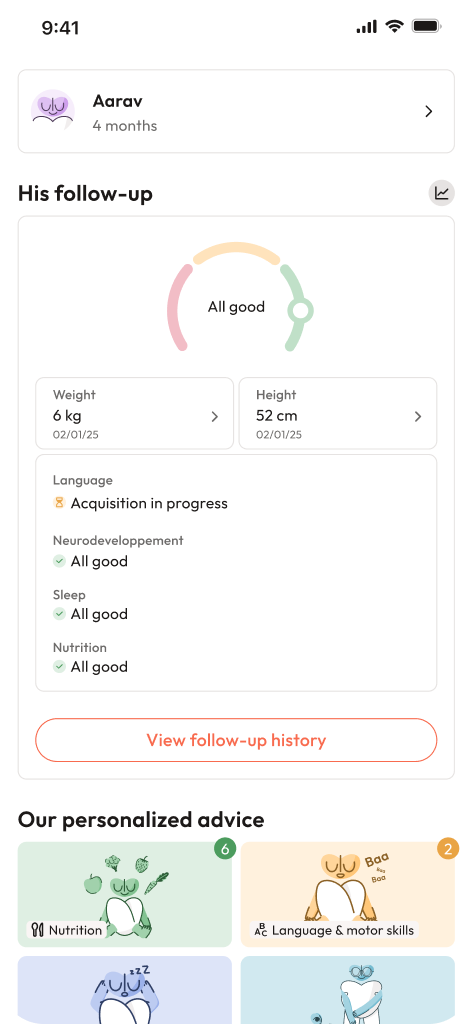
For extra support, download the Heloa app for personalised advice and free child health questionnaires.

Further reading :