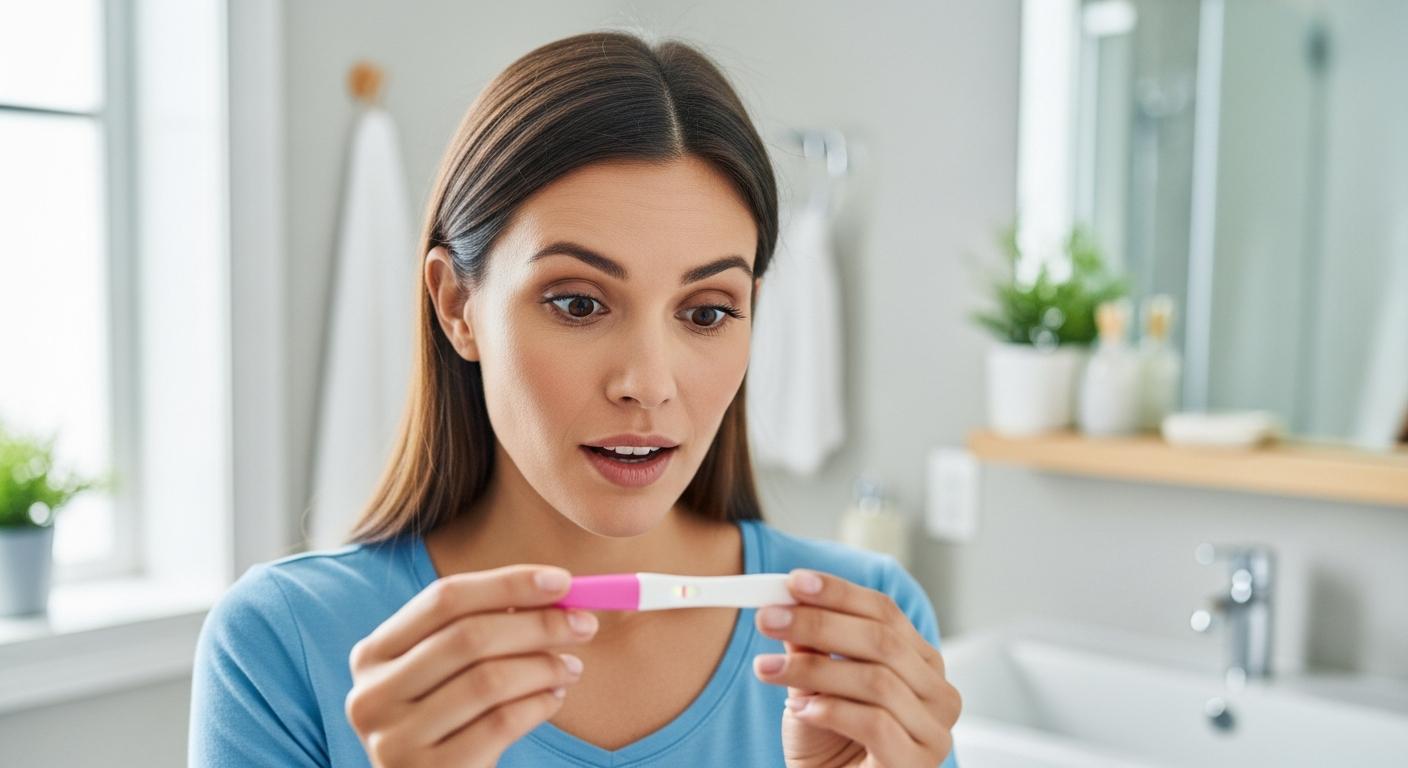
A positive test when you have an IUD can feel unreal: “How is this possible?” Then the practical worries start—pain, bleeding, the baby, your own safety. In India, many parents also worry about privacy, access to an ultrasound, and how fast they can reach a gynaecologist.
Pregnancy with IUD is uncommon, but it always deserves timely evaluation. The goal is not panic. The goal is to confirm the pregnancy, date it, locate it, and locate the device—because the first question is medical and urgent: is the pregnancy inside the uterus or ectopic (outside the uterus, usually in the tube)?
Pregnancy with an IUD: what it means and why evaluation matters
What “pregnancy with IUD” means
Pregnancy with IUD means you have a confirmed pregnancy while an intrauterine device may still be in your body (in the uterus, low in the cervix, embedded, or sometimes already expelled). Even with correct insertion, pregnancy can still occur, though rarely.
Once pregnancy with IUD is suspected, clinicians focus on four steps:


- confirm the pregnancy (urine test and/or blood test)
- estimate gestational age (how many weeks)
- confirm location (uterus vs ectopic)
- locate the IUD (in place, low-lying, embedded, or not seen)
How an IUD prevents pregnancy (and how pregnancy can still happen)
A copper IUD releases copper ions that reduce sperm function and fertilisation and create local uterine changes that make implantation less likely.
A hormonal IUD releases levonorgestrel, which thickens cervical mucus (harder for sperm to pass), thins the uterine lining, and may suppress ovulation in some cycles.
So why does pregnancy with IUD happen?
- the IUD has shifted (malposition)
- partial or complete expulsion (sometimes unnoticed)
- device used beyond its effective duration
- rarely, pregnancy occurs despite correct positioning
Copper vs hormonal IUD: why bleeding patterns change detection
- Copper IUD: periods usually continue, sometimes heavier/more crampy.
- Hormonal IUD (levonorgestrel): periods often become lighter, amenorrhea (no bleeding) may happen.
This matters because with hormonal IUDs, a missed period may not be a clue. In that case, symptoms or a change from your usual pattern may be the first sign of pregnancy with IUD.
How common pregnancy with IUD is
IUDs are highly effective.
- Copper IUD: roughly 0.6–0.8% pregnancy rate in the first year.
- Hormonal IUDs: roughly 0.1–0.4% pregnancy rate in the first year.
With IUDs, typical and perfect use are similar because there is no daily action.
Why early evaluation protects your health
A confirmed pregnancy with IUD needs assessment to:
- rule out ectopic pregnancy
- check if the device is still present and where it sits
- decide if removal is possible and safer than leaving it in
In practice this often means a pelvic exam and ultrasound (usually transvaginal ultrasound early on).
Why pregnancy with an IUD can happen
Malposition: low-lying or tilted IUD
An IUD works best when it sits high in the uterine cavity. A low-lying or tilted device may reduce protection.
Possible clues (not always):
- new pelvic discomfort
- unusual bleeding
- strings suddenly longer/shorter
Partial or complete expulsion (sometimes silent)
Expulsion can happen during a period or postpartum. Some people feel cramps, others notice nothing.
Clues may include:
- strings not felt, or suddenly much longer
- sudden change in bleeding or pain
- feeling plastic at the vaginal opening
Duration of use exceeded
Each device has a recommended duration (often 3–10 years depending on the model). Beyond that, effectiveness can decrease.
Strings not visible: what it can mean
Strings may not be felt because:
- they are curled into the cervix
- the IUD has shifted
- expulsion has already happened
- rarely, uterine perforation at insertion with migration
You cannot tell which without an exam and imaging.
Higher-risk times: postpartum, soon after insertion, uterine anatomy
The risk of malposition or expulsion is higher:
- in the weeks after insertion
- in the postpartum period (uterus still changing)
- with certain uterine cavity shapes
If there is doubt, early testing is simpler than waiting.
Pregnancy with an IUD: quick next steps
Take a home pregnancy test and note key details
The IUD does not affect test accuracy.
If you suspect pregnancy with IUD, note:
- first day of last period (or last bleeding episode)
- IUD type (copper vs hormonal)
- symptoms (bleeding, pain, nausea)
- whether you can feel the strings (do not pull)
When to contact a clinician the same day
Contact your gynaecologist or nearest maternity/ER the same day if:
- the test is positive
- you have missed a period with a copper IUD
- strings are not felt or have clearly changed length
- there is new pelvic pain or abnormal bleeding
What to avoid while waiting
Do not try to remove the IUD yourself. Do not pull strings.
If you have bleeding or pain, avoid inserting anything in the vagina (tampons, douching).
When urgent care is safer
Go to emergency care if you have:
- severe or increasing one-sided pain
- heavy bleeding with weakness or faintness
- dizziness, fainting, or shoulder-tip pain
- fever with pelvic pain or foul discharge
Pregnancy with an IUD: symptoms and early signs
Common early pregnancy symptoms
Symptoms are similar with or without an IUD: nausea, breast tenderness, fatigue, frequent urination. They do not confirm location.
Missed period vs irregular bleeding
With hormonal IUDs, periods may be absent, so watch for change from your baseline: new nausea, breast tenderness, or unexpected spotting.
With copper IUDs, a missed period is more noticeable.
Bleeding: spotting vs concerning bleeding
Spotting can occur with IUDs and in early pregnancy.
Concerning bleeding is:
- heavy or persistent
- associated with faintness, weakness, dizziness
- paired with one-sided pain
- with fever or foul-smelling discharge
Pelvic pain: do not minimise it
Seek prompt care if pain is:
- severe or increasing
- clearly one-sided
- with bleeding, dizziness, vomiting, shoulder pain, or fever
Pregnancy with an IUD and ectopic pregnancy
Why ectopic pregnancy is the key concern
IUDs reduce overall pregnancy risk. But when pregnancy with IUD occurs, the proportion that is ectopic is higher compared with pregnancies without contraception. Absolute risk is still low, but the consequences can be serious.
Ectopic warning signs
Urgent evaluation for:
- one-sided pelvic/lower abdominal pain
- pain with light bleeding
- dizziness or fainting
- shoulder-tip pain
Rupture warning signs
Emergency symptoms:
- sudden severe pain
- fainting/near-fainting
- clammy skin, confusion, rapid pulse
How clinicians check early
- transvaginal ultrasound
- serial β-hCG (repeat blood tests about 48 hours apart)
Confirming pregnancy with IUD: tests and ultrasound
Urine pregnancy test
Detects hCG. IUD does not interfere.
Blood β-hCG
Helps with timing and trends. Early hCG usually rises significantly over 48 hours, though patterns vary.
Transvaginal ultrasound
Checks:
- gestational sac inside uterus
- ectopic signs (adnexal mass, free fluid)
- IUD position relative to pregnancy
Sometimes the first scan cannot locate the pregnancy: pregnancy of unknown location. Follow-up is essential.
Finding the IUD during pregnancy
Strings visible vs not visible
Visible strings often mean the device is still in the uterus (sometimes low).
Not visible strings can mean retraction, expulsion, embedding, or rarely perforation.
Locating the IUD on ultrasound
Ultrasound may describe it as:
- in uterine cavity
- low-lying
- embedded
If not seen, expulsion is possible, perforation is rarer. Further imaging (like pelvic X-ray) may be advised.
Managing pregnancy with an IUD: removal vs leaving it in place
When removal is usually advised
If an intrauterine pregnancy is confirmed and strings are accessible, clinicians often recommend removal in the first trimester because leaving an IUD in place is linked with higher complications.
If strings are visible
Removal is usually done in clinic with sterile technique, brief cramping and light bleeding can occur.
If strings are not visible
Avoid blind removal attempts. Decisions are ultrasound-guided and individualised. Sometimes removal is riskier than leaving the device and monitoring.
Weighing risks
Removal (when feasible) can reduce risks like infection and pregnancy loss linked to an in-situ device. Removal itself can also trigger miscarriage. The plan depends on gestational age, ultrasound findings, and symptoms.
Pregnancy options when you are pregnant with an IUD
If intrauterine and you want to continue
Often: attempt clinician removal if safe, and plan closer follow-up.
If intrauterine and you do not want to continue
Method depends on gestational age and clinical findings, the IUD is managed as part of care.
If ectopic
Management may include:
- medical treatment (often methotrexate) when criteria are met
- surgical treatment (often laparoscopy) if rupture risk or instability
Pregnancy outcomes with an IUD in place (and after removal)
Risks
Pregnancies with an IUD in the uterus have higher risks:
- miscarriage
- infection (including chorioamnionitis)
- premature rupture of membranes
- preterm birth
Early removal can reduce some risk but not eliminate it.
When to seek care during an ongoing pregnancy
Prompt assessment for:
- significant pelvic pain
- heavy bleeding
- fever/chills/foul discharge
- rapid worsening overall
Follow-up after removal
Mild cramping/light bleeding can occur. Follow-up may include ultrasound or clinical monitoring.
If the IUD must remain
Increased vigilance for bleeding, infection symptoms, and fetal well-being.
Preventing another pregnancy with an IUD in the future
What to review
Most pregnancy with IUD events relate to expulsion, malposition, or extended duration. Reviewing the likely cause helps with future planning.
String checks and follow-up
Occasional string checks (if comfortable) can help. Contact a clinician if strings disappear, change length, or you feel the hard plastic.
Fertility after IUD removal
Fertility returns quickly after removal.
Key takeaways
- Pregnancy with IUD is uncommon but needs prompt evaluation.
- The first priority is to locate the pregnancy and rule out ectopic pregnancy.
- Do not attempt self-removal.
- Urgent care is needed for one-sided severe pain, fainting/vertigo, heavy bleeding, shoulder-tip pain, or fever.
- If intrauterine and strings are accessible, early clinician removal is often advised, if not visible, ultrasound-guided decision-making is essential.
- If the IUD cannot be removed, closer monitoring is usually planned.
- For personalised guidance and free child health questionnaires, you can download the Heloa app.
Questions Parents Ask
Can getting pregnant with an IUD cause birth defects?
This worry is very common—especially after an unexpected positive test. Reassuringly, the IUD itself is not known to “cause” birth defects. The bigger concern is where the pregnancy is located (inside the uterus vs ectopic) and whether the device is still in place. An early ultrasound helps clarify this, and your clinician can then discuss the safest plan for you.
Can I have a “normal period” and still be pregnant with an IUD?
Yes, it can happen. With an IUD, bleeding patterns can be confusing: some people have spotting, lighter bleeding, or irregular bleeding that feels like a period. That’s why a pregnancy test is often the simplest way to get clarity if something feels “off” (new nausea, breast tenderness, unusual fatigue, unexpected bleeding, or pelvic discomfort). If the test is positive, you can seek timely evaluation for reassurance and next steps.
What does it mean if I can’t feel my IUD strings and I’m pregnant?
Not feeling the strings can be stressful, and it doesn’t automatically mean something serious. Strings can curl up into the cervix, the IUD may have shifted, or it may have been expelled without you noticing. Rather than trying to check deeper or pull anything, you can book an exam and ultrasound to locate the pregnancy and the device—this is often the most reassuring, clear answer.

Further reading :