Pregnancy changes posture, breathing, even the way the pelvis moves—sometimes subtly, sometimes dramatically. By the third trimester, many parents feel a familiar mix: excitement, fatigue, a back that protests, hips that seem stuck, and the practical question: What can help me cope, without turning my living room into a medical unit? The birthing ball often enters the picture right there: simple, affordable, and surprisingly versatile.
Used well, a birthing ball can support comfort, encourage upright or forward-leaning positions, and add gentle pelvic mobility during late pregnancy, through contractions, and after birth. Safety and fit matter. So does knowing when to pause and ask for medical advice.
Birthing ball basics: what it is (and what it isn’t)
A birthing ball is a large inflatable stability ball used during pregnancy, labor, and postpartum. Its slightly unstable surface invites tiny postural corrections (micro-adjustments), which softly engage deep trunk muscles (transversus abdominis), the hip stabilizers, and the pelvic floor.
Parents often like it because it’s low-tech and adaptable:


- Sitting feels less rigid than on a chair, especially with pelvic pressure
- The pelvis can move with small circles, tilts, and sways
- Forward-leaning positions become easier to maintain during contractions
- Relaxation routines (breathing, jaw release, shoulder softening) feel more natural
A key idea: mobility plus gravity.
Recognizing the exercise ball look-alike
A gym ball may look identical to a birthing ball, but labels and build quality are not decoration. For pregnancy and labor, look for:
- Anti-burst behavior (slow air loss if punctured)
- Clear diameter guidance for sizing
- A stated weight limit with a comfortable margin
- A textured, non-slip surface
If you already own an exercise ball, it can be acceptable if it matches those specs.
Anti-burst: what it really means
Anti-burst means the ball should deflate gradually if punctured, rather than popping explosively. That slower air loss gives time to get off safely—particularly helpful when balance can be altered by pregnancy fatigue or contractions.
Anti-burst is not puncture-proof. Keep it away from pet claws, sharp edges, and heat sources.
Why a birthing ball can feel so good in late pregnancy
The biomechanics: why the back and pelvis complain
Pregnancy shifts the center of mass forward, the lumbar spine often increases its curve (lordosis), and the pelvis may tilt. Meanwhile, hormones (including relaxin) increase ligament laxity—useful for birth preparation, sometimes uncomfortable for joints.
Common results:
- Low-back discomfort
- Pelvic girdle pain (pain around sacroiliac joints and/or pubic symphysis)
- Stiffness after sitting
A birthing ball supports upright alignment while allowing movement.
Comfort strategies: movement and tension patterns
During contractions, staying still can amplify pain for some people. Gentle rocking, forward leaning, and slow circles may reduce muscle guarding around the lower back and hips.
A birthing ball may help by shifting pressure through the pelvic ring and supporting forward-leaning postures that can ease sacral strain. Will it remove pain? Not necessarily. But it often makes coping feel more active and less rigid.
Pelvic mobility: small motions, real effects
Pelvic mobility is mostly small:
- Anterior/posterior pelvic tilt
- Side-to-side sway
- Gentle hip circles
These movements can reduce stiffness and help you explore labor-friendly positions. The goal is ease, not intensity.
Circulation and heavy legs
In pregnancy, venous return can be slower, contributing to swelling and heavy legs. A comfort option: lying on a mat with calves resting on the birthing ball, legs slightly elevated.
If swelling is sudden, one-sided, painful, or linked with headache/visual changes, contact your maternity team.
Relaxation, breathing, and the nervous system
A birthing ball can become a daily anchor for downshifting:
- Sit tall, feet grounded
- Inhale softly through the nose
- Exhale longer than the inhale
- Let the pelvis sway gently
Jaw tension, shoulder elevation, and breath-holding often travel together—and contractions rarely feel easier when the whole body braces.
Deep core and pelvic floor awareness
Ball-based work can encourage coordination rather than force:
- Inhale: pelvic floor naturally lengthens (relaxes)
- Exhale: gentle pelvic floor lift and deep abdominal engagement
It should never feel like bearing down. If you have pelvic heaviness, leakage, or pain, a pelvic health physiotherapist can tailor guidance.
Birthing ball safety: setup, precautions, and when to stop
Practice before labor
Using a birthing ball during contractions is easier if it’s familiar. Practice teaches you what stable feels like, which movements calm you, and how to transition on and off safely.
The basics: stable surface, slow movement
Use the birthing ball on a flat, dry surface with space around you. Think slow and controlled, not bouncing.
Reduce fall risk:
- Feet planted, stance wide
- Avoid rugs that slide
- Keep a bed, wall, or sturdy chair within reach
Feet and grip
Barefoot often provides the best traction. Otherwise, choose non-slip socks or shoes.
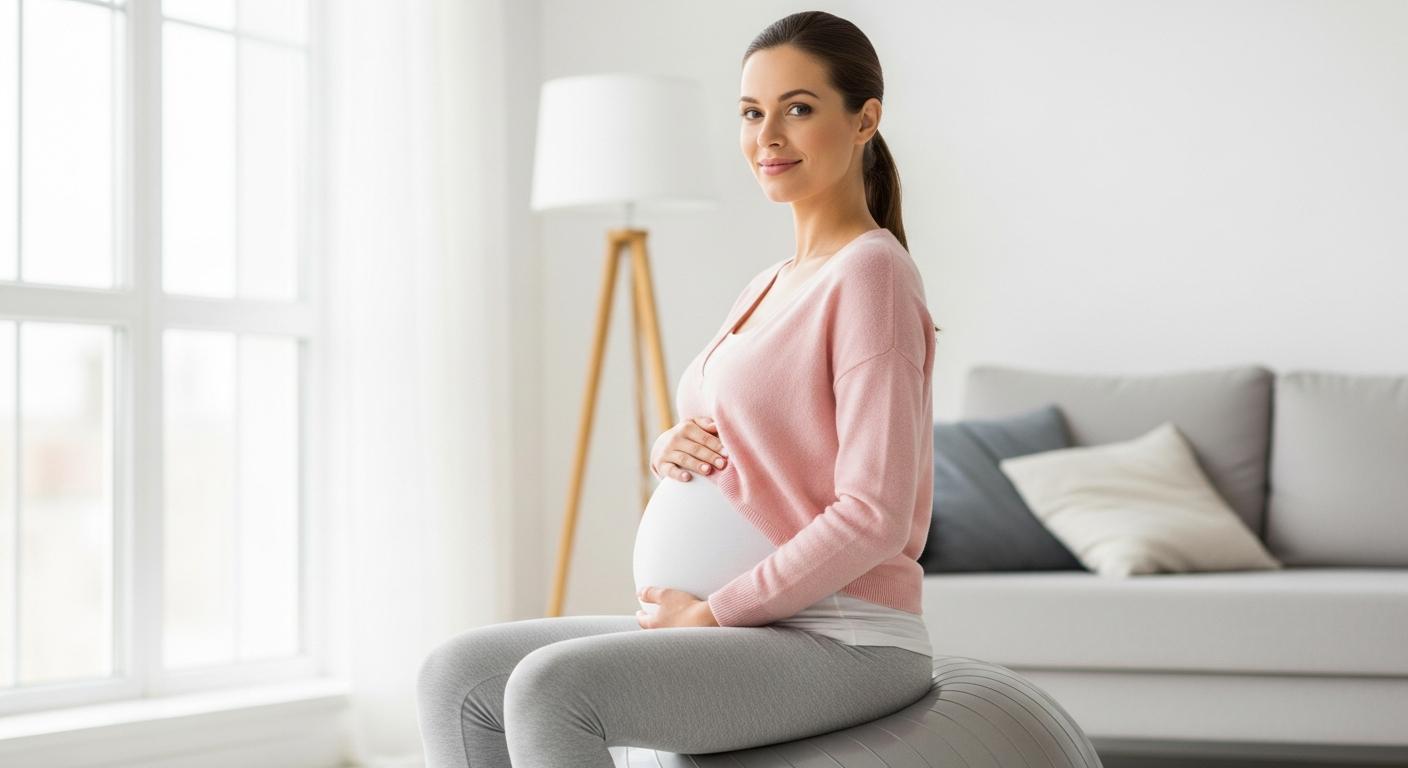
Sitting alignment: hips slightly higher than knees
When seated on the birthing ball, aim for hips slightly higher than knees. If knees rise above hips, the ball may be too small or too soft.
Warning signs: stop and seek medical advice
Pause and get help if you notice dizziness, sudden unsteadiness, significant shortness of breath, sharp worsening pain, heavy bleeding, fever, reduced fetal movement, or concerning fluid leakage.
Situations where you should ask first
Check with your clinician before using a birthing ball if you’ve been advised to limit activity, or if you have placenta previa with bleeding, suspected placental abruption, threatened preterm labor, cervical concerns (cerclage/cervical insufficiency), non-reassuring fetal status, severe hypertension, significant heart/lung disease, major musculoskeletal conditions aggravated by movement, or a multiple pregnancy with specific restrictions.
Choosing the right birthing ball: size, fit, and quality
Sizing by height (starting point)
Common diameters: 55 cm, 65 cm, 75 cm.
A practical guide:
- 1.50–1.60 m: 55 cm
- 1.60–1.75 m: 65 cm
- Over 1.75 m: 75 cm
Fit check: the quick seated test
On the birthing ball:
- Feet flat
- Knees near 90°
- Hips slightly higher than knees
- You feel grounded, not perched
Quality markers
Prioritize:
- Anti-burst construction
- Clear weight capacity
- A textured, non-slip surface
- Strong seams and a reliable valve
Inflation and setup: firm but giving
Inflate gradually. The ball should feel firm, yet allow a small indentation under your thumb.
- Overinflated: can feel hard and less grippy
- Underinflated: can feel wobbly and tiring
Recheck your seated alignment after inflating.
Using a birthing ball during pregnancy: simple routines
When to start and how long
Many parents start using a birthing ball in the second trimester (earlier if pregnancy is uncomplicated and your clinician agrees).
A realistic rhythm:
- A few minutes daily for comfortable sitting and breathing
- 10–20 minutes of gentle movement a few times per week
You should not feel pain or breathlessness.
First movements
Start still, then add:
- Tiny pelvic tilts
- Slow circles (then reverse)
- Side-to-side shifts
Positions that often ease lower-back strain
Two options:
- Semi-standing forward lean: ball in front, hands on top, hips back, spine long
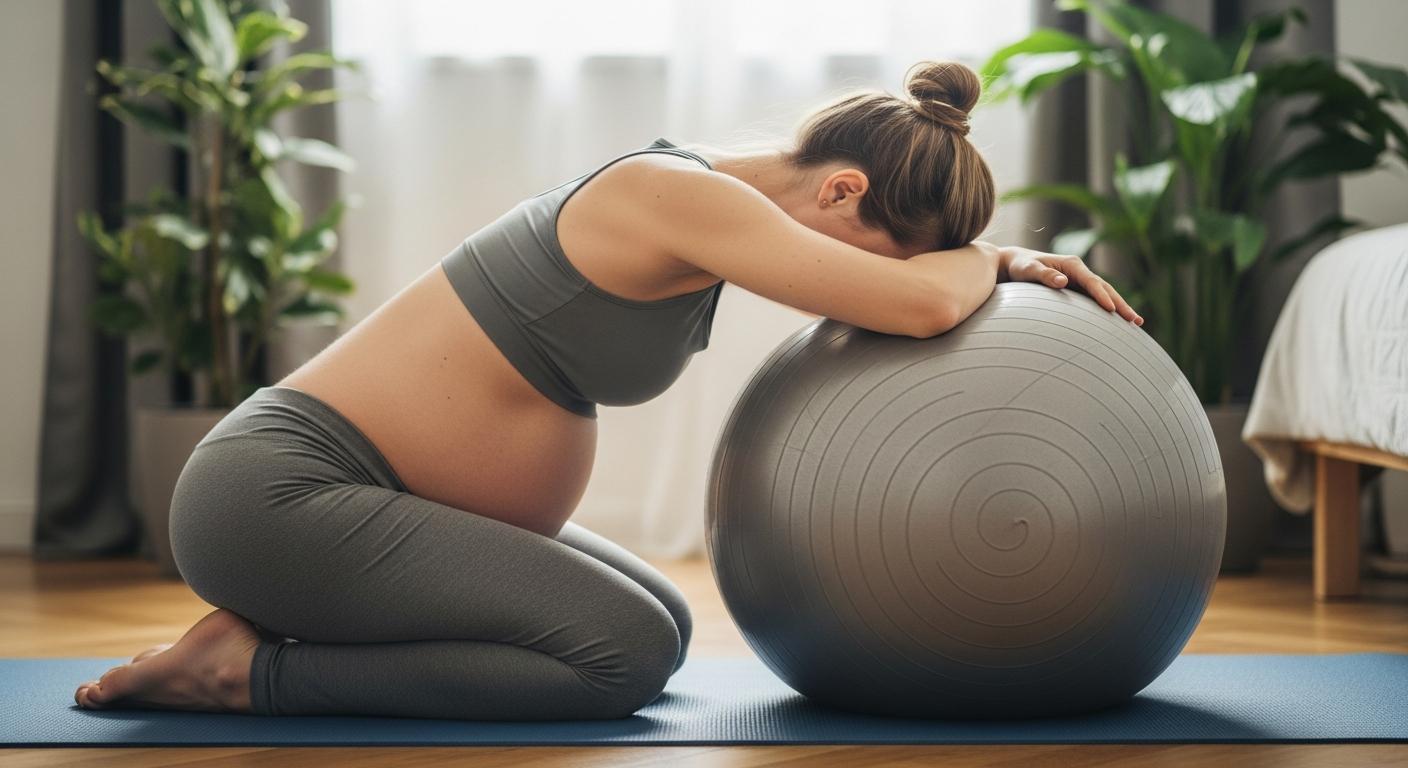
- Kneeling lean: knees cushioned, forearms or chest on the ball, belly free
Movements to avoid
Avoid fast bouncing, intense core drills with feet on the ball, classic crunches, and aggressive twisting.
Birthing ball positions during labor
Sitting during contractions
Sit tall, feet grounded. Move during the contraction if it helps, soften between waves.
Options:
- Side-to-side sway
- Circular hip circles
- Figure-8
Kneeling and leaning
Kneel on a folded towel, ball in front, forearms or chest resting on it. Let the belly hang and unclench the jaw.
Ball on the bed: forward-leaning support
Place the birthing ball on a bed and lean into it while standing or kneeling.
Active rest between contractions
Between contractions, try leaning forward with forearms supported, or kneeling with chest supported on the ball. Switch positions to reduce pressure points.
Partner support with a birthing ball
A partner can stabilize the birthing ball to prevent rolling and help with transitions. When you’re leaning forward, massage and firm sacral counterpressure may be soothing, especially for back discomfort—always guided by your feedback.
Postpartum: using a birthing ball after birth
After a vaginal birth, the birthing ball can often return gradually once early soreness settles and your clinician agrees. After a cesarean birth, return later and more slowly, prioritizing incision healing and comfortable posture.
For feeding, pillows matter: bring baby to breast height so your shoulders and back do not collapse forward.
If you have leakage, heaviness, or pelvic pain, pelvic floor rehabilitation is the reference approach, the ball can complement therapy once you’re cleared.
Avoid bouncing with baby on your lap.
Key takeaways
- The birthing ball can support comfort, mobility, and upright or forward-leaning positions in late pregnancy and during contractions.
- Choose safety features: correct size, anti-burst behavior, good grip, and a stable setup.
- Gentle options include sway, circles, figure-8, and kneeling/leaning, position changes can reduce fatigue.
- Stop and seek medical advice for dizziness, bleeding, severe pain, fever, reduced fetal movement, or concerning fluid leakage.
- Healthcare professionals can support you through pregnancy, birth, and recovery—and you can also download the Heloa app for personalized guidance and free child health questionnaires.
Questions Parents Ask
Can a birthing ball help baby move into a better position?
It can sometimes support positioning by encouraging upright, forward-leaning postures and gentle pelvic movement. Slow circles, sways, or a relaxed kneeling lean may help baby find space to rotate and descend. That said, baby’s position also depends on many factors (pelvic shape, timing, contractions). If you’re worried about a persistent posterior position (“back labor”) or slower progress, it’s completely normal to ask your midwife or OB for targeted position ideas.
Can I use a birthing ball to help induce labor?
A birthing ball isn’t a proven method to “start” labor on its own. What it can do is keep you comfortable, mobile, and more upright—conditions that may support your body once labor is already beginning. If you’re at term and wondering about safe ways to encourage labor, it’s best to discuss options with your maternity team, especially if you have any medical considerations.
What should I wear (or avoid) when using a birthing ball?
Comfort and grip matter most. Many parents feel steadier barefoot or in non-slip socks, with clothing that doesn’t slide (leggings or soft joggers often work well). If the ball feels slippery, a light towel on top can improve comfort and traction—reassuring if you’re tired or feeling a bit unsteady.
Further reading :
- Effectiveness of Birthing Ball Exercises Therapy in Improving Labor … (https://pmc.ncbi.nlm.nih.gov/articles/PMC12056438/#:~:text=It%20also%20helps%20to%20strengthen,labor%20and%20improved%20labor%20outcomes.)