Many parents are drawn to essential oils for babies because they smell comforting and feel “natural.” But these oils are not simple fragrances: they are concentrated plant chemistry. One extra drop, a poorly planned diffusion, or a dab on fragile skin can be enough to trigger irritation and, sometimes, breathing discomfort.
Maybe you are hoping for calmer evenings, easier breathing during a cold, or a soothing massage after bath time. The key is separating what can be done cautiously from what should be skipped, especially in the first months of life.
Essential oils for babies: what parents can know first
When it makes sense to skip essential oils and choose simpler options
Often, the safest move is not adding scent at all because the same goal can be reached with unscented, body-based comfort:
- For sleep: dim light, steady routine, white noise, comfortable room temperature.
- For a “fresh” room: daily ventilation, regular sheet washing, fragrance-free detergent.
- For comfort: cuddling, rocking, skin-to-skin, a warm bath with plain water.
- For a stuffy nose: saline drops and humidified air, following your clinician’s advice.
If your baby is under 3 months (or was born preterm), most pediatric safety advice leans toward avoiding essential oils for babies unless a clinician gives a specific plan.


Quick safety reminders: no ingestion, no undiluted use, keep away from the face
A few rules are non-negotiable:
- No oral use: infants should not ingest essential oils for babies.
- No undiluted application: never apply an oil “neat” to baby skin.
- Keep away from the face: avoid eyes, nose, mouth, ears, and hands (babies rub their faces and mouth their hands).
- Avoid oil baths: essential oils do not mix with water, they can stick to skin in patches and irritate.
- Avoid steam inhalations: hot-water bowls, towels over the head, or a scented tissue under the nose are hard to dose and often irritating.
When to contact a clinician before trying anything new
Ask for medical advice before using essential oils for babies if your baby:
- is under 3 months, was born preterm, or had NICU care
- has wheezing, recurrent bronchiolitis, or breathing sensitivity
- has eczema, frequent rashes, hives, or a strong allergy history
- is currently ill (fever, poor feeding, vomiting/diarrhea, breathing symptoms)
- takes regular medication or has a chronic condition
What essential oils are and why babies need extra caution
Essential oils are volatile, highly concentrated plant extracts obtained from distillation (most often steam) or cold pressing (mainly citrus peels). They are not “fatty oils.” In a few drops, you can have the equivalent of a large amount of plant material.
Each essential oil contains dozens (sometimes hundreds) of active molecules. Some families of compounds are more often described as soothing (for example, certain esters). Others are more likely to irritate the skin or airways (for example, some oxides such as 1,8-cineole). Babies, with their delicate skin barrier and sensitive airways, can react fast.
How babies are exposed: inhalation, skin absorption, accidental transfer
With essential oils for babies, exposure happens mainly through:
- Inhalation: airborne molecules reach the nose and small airways.
- Skin absorption: baby skin is thinner and more permeable, especially under a diaper (warm, occluded).
- Accidental transfer: oils on adult hands, clothing, or bedding end up on baby skin or near the mouth.
Why babies can react faster: skin barrier, metabolism, and sensitive airways
A baby’s protective systems are still maturing:
- Thin, more permeable skin absorbs more and becomes inflamed more easily.
- Immature liver and kidneys may clear some compounds less efficiently.
- Reactive airways can respond to strong scent with cough, watery eyes, noisy breathing, wheeze, or bronchospasm.
Essential oils vs fragrance oils and hydrosols: not the same thing
- Essential oils: concentrated extracts, powerful, more likely to irritate if misused.
- Fragrance oils: often synthetic blends with additives, a poor choice around infants.
- Hydrosols (floral waters): aromatic waters from distillation with far lower concentrations. They may feel like a “lighter” option, but choose pure products (no added perfume) and patch test.
Essential oils for babies by age: what changes as your baby grows
Age matters because skin, lungs, and metabolism mature over time.
Under 3 months: why most families should avoid essential oils
Before 3 months, it is generally best to avoid essential oils for babies (topical use and diffusion). Skin absorption is higher, and airways are easily irritated.
At this age, comfort strategies usually work better: predictable routines, a stable room temperature, gentle touch, and saline for congestion when needed.
After 3 months: what changes and what does not
After 3 months, some oils are considered more tolerable, but the framework stays strict:
- occasional use (not daily by default)
- very low dilution
- small surface area
- one oil at a time
Age is not the only variable. A baby who has wheezed, had repeated bronchiolitis, or has significant eczema may tolerate scented exposure poorly even later.
Non-negotiable safety rules for essential oils for babies
If you choose to use them at all, think: smallest amount, shortest time, simplest approach.
Topical use: never undiluted, and not on fragile areas
Rule number one: never apply essential oils for babies undiluted.
Avoid high-risk zones:
- face and around the eyes
- hands (quick transfer to mouth)
- mucous membranes
- broken, inflamed, or oozing skin
- severely irritated diaper area
A patch test helps: apply a tiny amount of your diluted mix to a small area (inner elbow or lower leg) and watch for up to 24 hours.
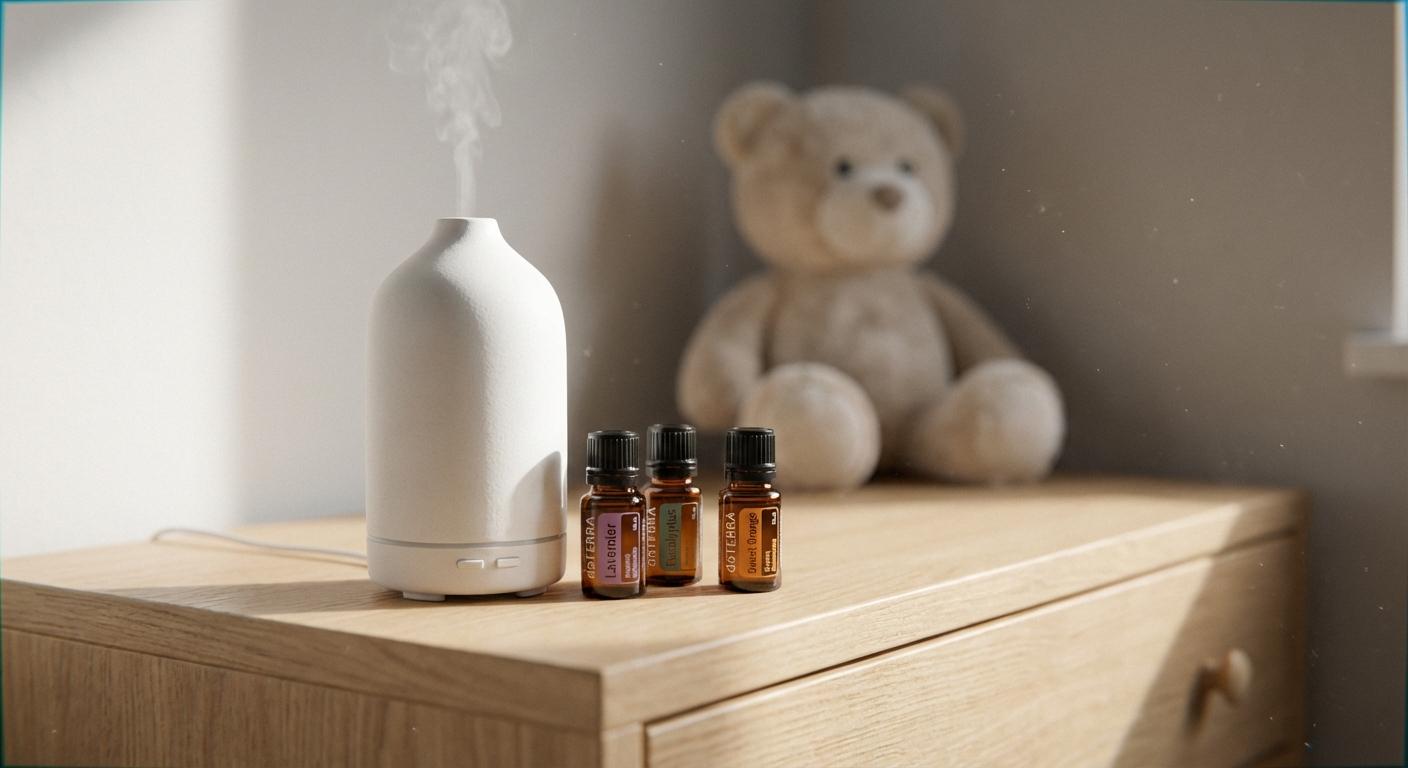
Diffusion basics: brief, ventilated, and ideally when baby is not present
If diffusion is considered after about 3 months:
- keep sessions short (often 5-10 minutes)
- start with 1-2 drops total
- ventilate during and after
- keep the diffuser far from where baby sleeps
- do not diffuse during naps and never near the crib
A cautious routine many families use: diffuse briefly in an empty room, ventilate well, and only bring baby in once the air feels neutral.
If you notice cough, agitation, watery eyes, runnier nose, or noisier breathing: stop immediately.
A short list of oils sometimes considered gentler
Even “gentle” choices can irritate some babies. Start later, start low, keep it simple.
True lavender and Roman chamomile
- True lavender (Lavandula angustifolia) is often described as better tolerated and linked with relaxation.
- Roman chamomile (Chamaemelum nobile) is often mentioned for soothing routines and reactive skin.
“Better tolerated” is not “risk-free.” Irritation and allergy remain possible, so patch testing matters.
Citrus oils: diffusion only, and remember phototoxicity
Mandarin or sweet orange are sometimes viewed as mild for mood. Many families keep citrus oils to diffusion only.
If used on skin, remember phototoxicity can occur with some citrus oils (especially expressed oils): avoid sun exposure on that area for 12-24 hours. For young children, skipping citrus oils on skin is often simplest.
Essential oils to avoid for babies: simple safety anchors
Some oils are more likely to irritate the skin, affect breathing, or raise toxicity concerns.
Cineole-rich oils (including many eucalyptus)
Many eucalyptus oils (including Eucalyptus globulus) are rich in 1,8-cineole and are generally discouraged for infants, especially in diffusion. The concern: airway irritation and bronchospasm.
Peppermint, thyme, rosemary
- Peppermint (menthol/menthone) can be too stimulating and may worsen breathing discomfort.
- Thyme: some chemotypes contain strongly irritating phenols.
- Rosemary: some types contain camphor-like compounds or cineole.
“Hot” oils and phenol-rich oils (oregano, clove, cinnamon)
These are more likely to burn and irritate. Keep them away from baby skin and baby rooms.
Tea tree and premade “breathe/cold” blends
Tea tree is a common irritant for sensitive skin. Premade blends often contain cineole- or menthol-rich oils, so they are often skipped for infants.
Dilution and carrier oils for babies (topical safety)
Topical use should be rare, ultra-dilute, and limited to small areas.
Practical dilution ranges (when topical use is chosen)
A conservative target often used from about 3 to 12 months is 0.25%-0.5%.
Approximate examples:
- 0.25%: about 1 drop in 20 mL carrier oil
- 0.5%: about 1 drop in 10 mL carrier oil
Drop size varies. If you feel unsure, choose the lowest end or skip topical use.
Choosing a carrier oil
Choose an unscented carrier that supports the skin barrier (for example, sunflower/safflower, jojoba, or fractionated coconut oil). If your family has peanut or tree-nut allergy, avoid nut-derived carriers such as sweet almond oil.
Where to apply and where to avoid
- Prefer: legs or back (small amount).
- Avoid: face, near nostrils, hands, diaper area, and any broken/irritated skin.
Common situations: what to do, what to avoid
Essential oils for babies should never replace medical care.
Cold, congestion, blocked nose
First-line comfort measures include saline and comfortably humidified air (as advised by your clinician). Many “respiratory” oils are irritating for babies.
A question parents ask a lot: “Could a tiny bit help my baby breathe?” If your baby is coughing, wheezing, breathing fast, or feeding less, fragrance exposure can make things worse. At that point, the safest step is fresh air, saline, and a medical check if symptoms persist.
Sleep and evening fussiness
Sleep is built mainly through cues: gentle light, consistent timing, and a calm environment. If you add scent, keep it extremely simple: brief diffusion with baby absent, or a very diluted massage.
Skin irritation and eczema
On inflamed skin, essential oils for babies are often too irritating. Avoid them during eczema flares, oozing, crusting, or a very red diaper rash.
Recognizing adverse reactions and what to do
Reactions can appear quickly in infants, and breathing symptoms deserve prompt attention.
Warning signs
- Skin: redness, burning, rash, hives, blisters, swelling
- Breathing: cough, wheeze, noisy breathing, faster breathing, visible effort
- Neurologic: unusual sleepiness, extreme agitation, tremor
If there is a skin reaction
Stop exposure. Remove oily clothing. Wash with mild soap and plenty of running water, then rinse well. Seek medical advice if it spreads, blisters, or seems painful.
If there are breathing symptoms
Stop exposure and move to fresh air. Seek urgent care if breathing is difficult, there is wheeze, bluish lips/face, or pauses in breathing.
Accidental ingestion is an emergency
If ingestion is suspected, contact poison control or emergency services immediately. Keep the bottle for identification. Do not induce vomiting.
Key takeaways
- Essential oils for babies are highly concentrated, under 3 months, avoiding them is usually the safest choice.
- No ingestion, no undiluted skin use, and keep oils away from the face and hands.
- After about 3 months, if used at all: occasional use, very low dilution, small area, one oil at a time.
- Diffusion should be brief, ventilated, and ideally when baby is not in the room, never near the crib and never during sleep.
- Many oils are commonly avoided for infants (peppermint, many eucalyptus oils, thyme, rosemary, phenol-rich “hot” oils).
- If a reaction appears (redness, cough, wheeze, unusual sleepiness), stop exposure and contact a health professional.
- Support exists: your pediatric clinician, pharmacist, and you can also download the Heloa app for personalized tips and free child health questionnaires.
Questions Parents Ask
Can I put essential oils in my baby’s bath?
It’s understandable to want a calming bedtime bath. Still, essential oils don’t blend with water, so they can float in concentrated “pockets” and irritate delicate skin—especially in warm, sensitive areas. If you’d like a soothing routine, many families find a plain warm bath, gentle massage with an unscented carrier oil, and a consistent bedtime rhythm just as comforting. If scent feels important to you, consider asking a pharmacist or clinician about baby-safe, fragrance-free alternatives.
Is lavender essential oil safe for my baby to smell?
Lavender is often described as one of the milder options, but “mild” doesn’t mean risk-free for infants. Some babies can still develop watery eyes, cough, agitation, or skin reactions from scented air. If your baby is older than about 3 months and you’re considering lavender, a cautious approach is brief diffusion in a well-ventilated room while baby is out of the space, then airing the room before bringing them in. If you notice any breathing or skin changes, stopping is usually the best next step—no guilt, just information.
Can essential oils help my baby’s teething?
Teething can be a long stretch, and it’s normal to look for gentle solutions. Essential oils aren’t a reliable or recommended option for teething because they can irritate the gums and may be risky if transferred to the mouth. Many parents get better results with a chilled (not frozen) teething ring, a clean finger gum massage, and clinician-approved pain relief when needed.
Further reading: