Parents often look at a baby walker because a baby wants to be upright—now. It can promise a few calmer minutes, a change of scenery, and that exciting “I can move!” moment. Then doubts arrive just as fast: Is it safe? Does a baby walker really help with walking? Why do so many pediatric professionals sound hesitant?
The reality is a mix of biomechanics (how babies build balance and gait), home hazards (stairs, hot surfaces, water), and product design (wheels, speed, reach). Here is what a baby walker is, what it changes in your home, how it may affect motor development, and which alternatives tend to support safer, more natural practice.
Baby walker basics: what it is (and what it is not)
Baby walker definition: the seated wheeled walker
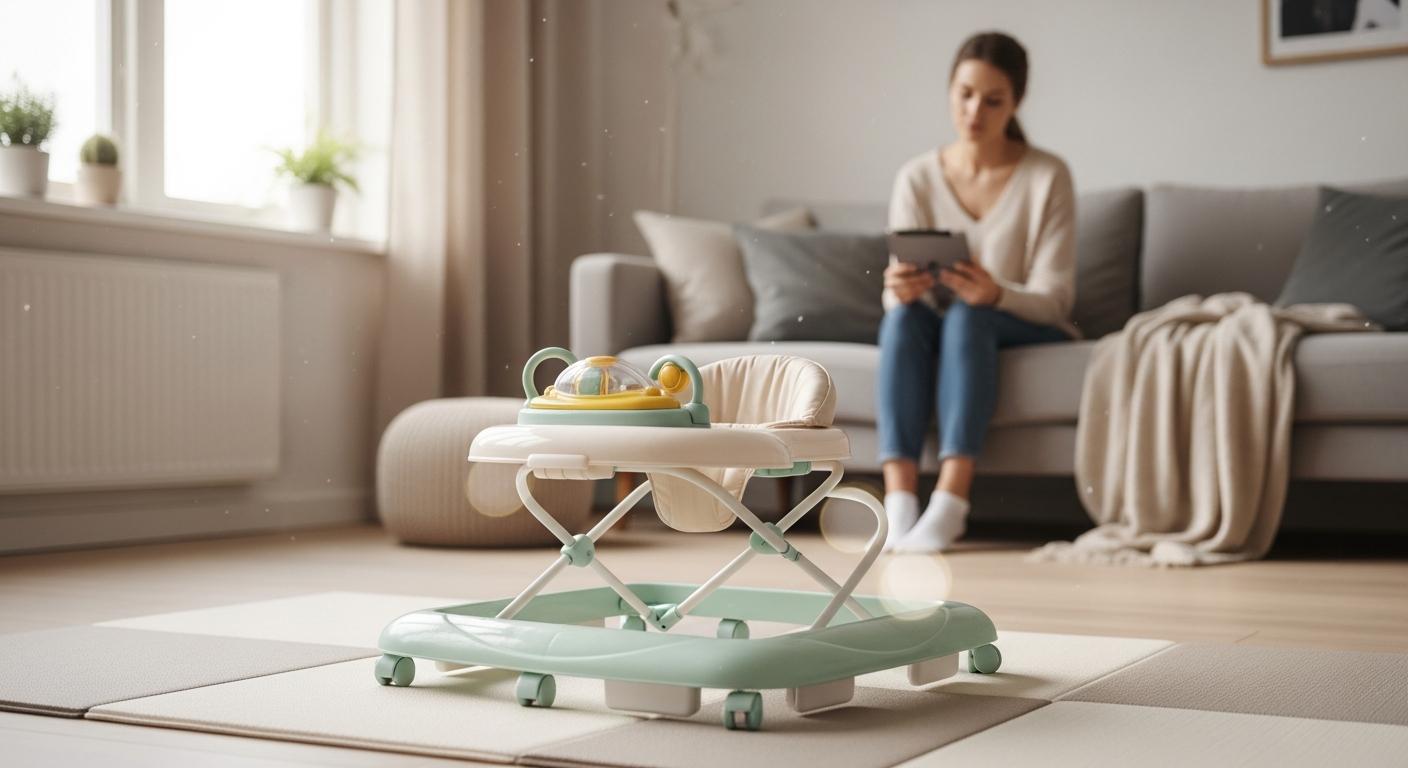
A baby walker usually refers to a seated frame on wheels. Your baby sits in a fabric seat suspended in a wide base and moves by pushing against the floor. Many models add a toy tray with lights and sounds.
Medically, the key issue is simple: a baby walker gives speed and reach before a baby has the balance skills to stop, turn, avoid obstacles, or recover from a loss of balance. It can look like walking, but the movement is assisted.


Baby walker vs push walker (push toy)
A seated baby walker moves while your baby is sitting and pushing the floor.
A push walker is a push-toy your baby stands behind. It asks for weight-bearing, trunk control, and balance reactions. Push toys can still roll quickly, so supervision matters, but the classic stair-fall scenario is far more typical of a seated wheeled baby walker.
Baby walker vs ride-on toy
A ride-on toy is a sit-on vehicle. Your baby pushes with their feet and steers with their body. It does not teach standing balance and often makes more sense once walking is already emerging.
Baby walker vs stationary activity center
A stationary activity center keeps your baby in one spot. They can turn, bounce, and play, but they cannot roll across the room. For families wanting upright play without the “speed + reach” risk, stationary options can be a practical compromise.
Why parents consider a baby walker
The reasons are understandable: your baby wants to be vertical, you want a short hands-free moment, you hope it helps walking happen sooner, or you have heard it “tires them out” for sleep. Yet walking earlier and better sleep are not reliable outcomes.
Why the baby walker debate feels heated
What parents expect vs what walking truly requires
Two common hopes:
- “It will teach my baby to walk.”
- “It will burn energy.”
But walking is built on the floor. Babies typically practice rolling, crawling, sitting transitions, pulling to stand, cruising (side-stepping while holding furniture), and controlled falls with recovery. A baby walker can reduce time spent rehearsing these steps.
Some clinical observations also link heavy walker use to less efficient patterns in certain children (for example, pushing more on the forefoot). Not every baby will show this, but it helps explain professional caution.
What health professionals focus on first: development and safety
When a clinician hears “baby walker,” two priorities appear immediately:
- Motor development: trunk alignment, symmetry, foot loading, transitions.
- Home safety: falls (especially stairs), collisions, access to hazards.
A blunt truth: a baby walker can give a baby adult-level access to an adult-designed environment, at baby speed.
Baby walker pros and cons in real family life
Benefits parents often notice
A baby walker can feel like an easy win: upright exploration, a different viewpoint, short stretches of entertainment. Sometimes that means a calmer parent for a moment, which also matters.
Sensory play: lights, sounds, buttons
Toy trays offer cause-and-effect learning (press, spin, kick, hear a sound). In small doses, with you close, this can be enjoyable.
Common drawbacks
The flip side:
- overstimulation (fussiness, frantic kicking, difficulty settling)
- less floor time (less practice of foundational movements)
- reliance on “container time” to fill the day
Floor play is where coordination and balance are trained, quietly and effectively.
A practical way to weigh convenience and risk
Ask three questions:
- Home layout: stairs, thresholds, rugs, open-plan kitchen, how many hazards are one roll away?
- Baby factors: steady sitting? good trunk control? comfortable foot contact?
- Your routine: occasional and supervised, or daily background equipment?
Risk rises when the baby walker becomes the default.
Baby walker safety: what worries pediatric teams
Main risks: falls, stairs, tip-overs, collisions
The biggest concern is speed. A baby walker can cross a room in seconds.
Typical injury mechanisms include:
- falls down stairs or level changes
- tip-overs from thresholds, rugs, uneven flooring
- collisions causing head/face impacts (table edges, door frames, corners)
Hazards your baby can suddenly reach
A baby walker increases reach and mobility at the same time. That combination changes the hazard map:
- hot drinks on a low table
- oven doors and stove knobs
- dangling cords, tablecloths
- radiators, fireplaces
- bathrooms and water containers
Burns and scalds are a serious concern when a walker enters the kitchen zone.
Why “I’m right here” can still fail
The problem is reaction time. Turning to drain pasta, grabbing a towel, answering a door: seconds matter more when your baby has wheels.
Baby walker and motor development: what it teaches (and misses)
Walking foundations are built on the floor
Independent gait depends on core strength, weight transfer side-to-side, balance reactions, and learning to fall and recover safely. In a baby walker, your baby can move without managing the full chain of transitions.
Posture and foot patterns: leaning and toe-pushing
Depending on fit and model, some babies lean forward, slump at the pelvis, or push mainly on the forefoot (a tiptoe pattern). A mature walking pattern relies on stacked alignment (head-trunk-pelvis) and progressive foot loading.
Strength building: what may be under-trained
Free movement naturally trains hips, trunk rotation, and coordination for crawling and cruising. A baby walker supports part of the body weight and can reduce that work.
Baby walker safety checklist: quick but meaningful
Before every use: wheels, brakes, locks
Do a fast scan:
- wheels roll smoothly (no wobble)
- brakes/speed controls engage fully (if present)
- anti-tip or stair stoppers are intact
- no cracks, sharp edges, loose screws
Fit check: seat support and skin marks
Fit is not comfort-only, it is safety.
- pelvis and trunk supported (not slumped)
- harness snug, not tight
- leg openings not rubbing
After a short trial, look for red marks. Persistent redness means stop and reassess.
Safe space rules
Use only on flat flooring, in a clutter-free, blocked-off area. Keep kitchens and bathrooms off limits. If you cannot create a contained zone, that often answers the question about whether a baby walker fits your home.
Supervision and time limits
What “within reach” means
For a baby walker, supervision means: same room, eyes on your baby, within arm’s reach, ready to stop motion immediately.
Short sessions, then back to the floor
Long sessions do not equal better learning. They more often increase fatigue, overstimulation, and exposure time. Protect daily floor play: tummy time, rolling games, crawling practice, cruising at the sofa.
Signs to pause or stop
Stop if you see agitation, slouching, repeated toe-pushing, redness, or loss of control on your flooring.
Standards, rules, and recalls
Age/weight/height limits
Follow label limits closely. Outgrowing increases instability and worsens fit. Re-check after growth spurts.
Recalls: especially important second-hand
Before buying or using a used baby walker, check official recall databases with the brand and model number. If recalled, stop use and follow the remedy steps.
Baby walker age and readiness: why there’s no perfect number
Readiness signs
Readiness is functional: steady head/neck control, stable trunk control, sitting well with minimal support. If your baby folds forward in sitting, a walker seat can encourage a collapsed posture.
Foot contact goals
Ideally, your baby can place feet comfortably on the floor. Persistent toe-pushing suggests the seat is too high, your baby is not ready for that setup, or sessions are too long.
Why “ideal age” misleads
Even if packaging starts around 6 months, the major risk is fast mobility without full balance control. That can exist at any age when a baby is placed in a wheeled baby walker.
Types and alternatives: choosing what fits your baby and home
Traditional seated baby walker with wheels
This is the classic model, and the one tied to the highest mobility-related risks. It demands the strictest environment control and supervision.
Stationary options
Stationary activity centers provide upright play without travel. For many families, that is the safer trade-off.
Push walkers
A push toy can be useful once your baby is already pulling to stand and shows decent foot control. Look for a wide base, some weight, and adjustable resistance.
Floor time and cruising supports
A firm mat, a safe space, and stable furniture for cruising often do more for motor development than any wheeled device.
If you use a baby walker anyway: minimum conditions
Keep it strict:
- adult within arm’s reach, actively watching
- one closed room, flat floor, no rugs/thresholds
- stair access blocked, no level changes
- kitchen and bathroom off limits
- hazards cleared (cords, hot drinks, small items)
If sessions feel chaotic (constant crashing, getting stuck, repeated rescues), treat it as a mismatch: tool, home, stage.
Key takeaways
- A baby walker can feel convenient, but it carries real injury risk, supervision must be active and within arm’s reach.
- Moving in a baby walker is not the same as learning to walk, walking grows from floor-based transitions, balance reactions, and controlled falls.
- There is no perfect age for a baby walker, home layout, posture, and fast mobility matter more than a number.
- If a baby walker is used, keep sessions very short, stop at the first sign of poor posture or rubbing, and protect daily floor time.
- Your pediatric clinician, a pediatric physical therapist, and child-safety resources can help. You can also download the Heloa app for personalized advice and free child health questionnaires.
Questions Parents Ask
Can a baby walker delay walking or cause toe-walking?
Many parents worry about this, and it’s a fair question. A seated wheeled baby walker doesn’t “teach” the balance, weight-shifting, and controlled falling that lead to independent walking. Some babies also push mainly on their toes in a walker (because of the seat position or fatigue), and repeating that pattern can reinforce toe-pushing for certain children. No need to panic—if you notice lots of tiptoe contact, slouching, or frantic kicking, shorter sessions (or switching to floor play/pull-to-stand practice) is often a simple, supportive next step.
Are baby walkers banned—and what’s the difference with activity centers?
This depends on where you live. In some countries, wheeled baby walkers have been restricted or banned due to injury risk (especially stairs and collisions). Stationary activity centers are usually treated differently because they don’t roll across the room, which reduces “speed + reach” accidents. If you’re unsure, you can check your local consumer safety authority and recall lists for your specific model.
What’s a safer alternative if my baby wants to be upright?
You’re not alone—lots of babies love being vertical. Safer options often include a stationary activity center (short, supervised play), lots of floor time with reachable toys, and cruising along stable furniture. When your baby is already pulling to stand, a weighted push walker with adjustable resistance can be a gentler way to practice balance while staying closer to natural movement.
Further reading :